Author: Claude, Deep Tide TechFlow
Deep Tide Overview: Starting Wednesday, Asia's largest Bitcoin vault company Metaplanet transferred 5,014 Bitcoins (approximately $322 million) within 24 hours, and as soon as the on-chain data was released, speculation that "they are selling" immediately intensified. CEO Simon Gerovich personally extinguished the rumors on Thursday: it was just a transfer between custody addresses, not a single coin was sold. A false alarm, but the reason the market is startled is that giants like Strategy and MARA are indeed selling this year.
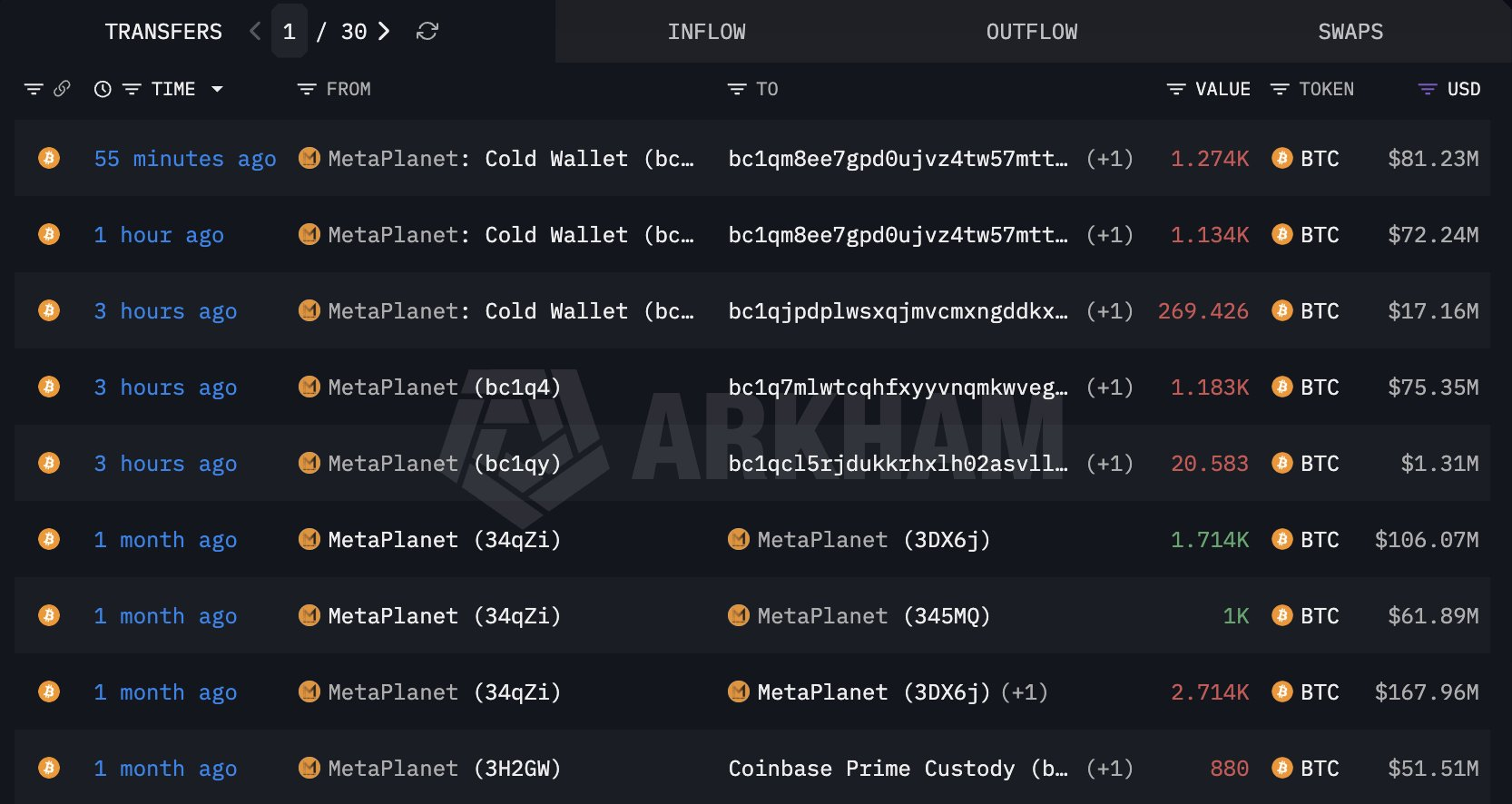
On Wednesday, the on-chain data platform Lookonchain detected that Metaplanet's wallet transferred 3,881 Bitcoins (approximately $247 million) in just three hours, leading The Block to report that the speculation of "Metaplanet is selling coins" quickly amplified. On Thursday, CEO Simon Gerovich directly responded on X: "This is a routine custodial operation. No Bitcoins were sold, our holdings remain at 43,000."
$8 in fees moved $322 million: CEO shares data to prove "not a single coin sold"
According to Cointelegraph, within the 24 hours starting Wednesday, Metaplanet transferred a total of 5,014 Bitcoins worth about $322 million, all directed to the company’s own custodial addresses, with a total network fee of approximately $8. Gerovich also emphasized that all company addresses are public, and the transfer process can be monitored in real-time on-chain.
This detail explains why the "sell theory" does not hold water. If the goal were to liquidate, the typical route would be to transfer coins to an exchange hot wallet, rather than moving them between custodial addresses under one's control. On-chain data shows that 36,000 of the 43,000 Bitcoins remain in the transferring wallet, consistent with the interpretation of "changing custodial arrangements."
Why the market is startled: Strategy and MARA are indeed selling this year
An ordinary internal transfer could cause panic, but the root cause lies not with Metaplanet, but with the overall credit environment of the vault sector. Earlier this week, we reported that Strategy has sold Bitcoins multiple times this year; this largest vault company, which once claimed "never to sell," has shifted to "dynamic vault management," even selling at prices below cost to boost cash flow. Mining company MARA Digital sold a total of 23,093 Bitcoins in the first half of the year, reversing its previous policy of hoarding without selling; Hut8 also transferred 493 Bitcoins from its vault, not yet clarifying whether it was an internal transfer or a precursor to a sale.
In such an atmosphere, large transfers from the world's third-largest publicly traded vault company are directly priced by the market as a "selling precursor," almost instinctively.
"Not sold" does not equal "no issue": the real ledger of Metaplanet
The panic may have been unfounded, but Metaplanet's situation is not easy. The company holds 43,000 Bitcoins with an average cost of approximately $96,000, while the current price of Bitcoin is about $64,000, resulting in an overall unrealized loss of about $1.4 billion, exceeding 30%. The stock price has fallen more than 43% this year, hovering around 221 yen, close to historical lows.
More critically, there is a lack of follow-through. After buying 2,823 Bitcoins in early July, the company has not increased its holdings; after issuing $50 million in bonds to major investor EVO Fund in April, there have been no new financing announcements. Currently, cash reserves are about $280 million, with liabilities around $400 million. At this rate, the goal of holding 100,000 Bitcoins by the end of the year looks nearly impossible: a shortfall of 57,000 Bitcoins, requiring approximately $3.6 billion in new funds at current prices. The engine of the vault model is "financing to buy coins, rising coin prices, then refinancing;" now both wheels are slowing down.
Providing holders with a recognition framework: how to distinguish "moving" from "selling"
This false alarm is actually a practical teaching moment for ordinary holders. The next time you see a "large transfer by an institution," you can judge it in three steps. First, look at the destination: transfers between owned custodial addresses are usually internal management; transfers into exchange addresses are closer to sell signals. Second, look at disclosures: companies like Metaplanet, with all addresses public and a CEO who shares data, have traceable and verifiable operation transparency; those who do not respond or disclose should be regarded with caution. Third, look at subsequent actions: tracking actual holdings snapshots on platforms like Arkham can reveal true sales through changes in holdings.
Returning to the matter at hand, the CEO used on-chain data to extinguish the rumors on the spot, which is a standard emotional management practice for vault companies. However, conversely, the market's hypersensitivity itself is a signal: when "institutional large transfers" are implicitly read as "they are leaving," it shows that the narrative around vaults has shifted from "always buying" to "when to sell." From Strategy's willingness to sell to MARA's reversal of policy, to Trump's media cutting the CRO vault plan, the belief that "public companies buying coins is bullish" from 2025 is retreating layer by layer.
免责声明:本文章仅代表作者个人观点,不代表本平台的立场和观点。本文章仅供信息分享,不构成对任何人的任何投资建议。用户与作者之间的任何争议,与本平台无关。如网页中刊载的文章或图片涉及侵权,请提供相关的权利证明和身份证明发送邮件到support@aicoin.com,本平台相关工作人员将会进行核查。


