Author: ENS Foundation
Compiled by: TechFlow
TechFlow Digest: ENS token holders have formally made the foundation a legal entity through governance proposals, enabling it to represent ENS in regulatory affairs, standards organizations, and top-level domain negotiations. This addresses the long-standing shortcoming of the DAO in handling institutional matters while retaining the ultimate control of token holders over the protocol and personnel of the foundation. This is a critical step for those concerned about the status and governance boundaries of the ENS infrastructure.
ENS token holders have approved the "next era of ENS DAO" proposal, and the executable content related to this has been completed on-chain, thus making the ENS Foundation a fully operational organization with a full-time executive director, staff, and a five-person board. This article will explain the motivations behind this structure, what the foundation can do now, and how it allows token holders to continue controlling the protocol and the foundation itself.
Why ENS Needs an Institutionally-Oriented Foundation
Over the past decade, ENS has grown into a core infrastructure: it has millions of domain names, integrated across wallets, applications, and L2 solutions, with other systems relying on it for resolution. ENS has also dealt with policymakers and entities like ICANN, which are responsible for coordinating the stable and secure operation of internet naming infrastructure. In 2021, the core team at ENS Labs initiated the ENS DAO to safeguard the protocol. Specifically, the DAO placed the core contracts, pricing, and treasury of the protocol under the control of token holders, with these funds used to support public goods, service providers, and community projects within the ecosystem.
On its own, the DAO lacks the legal and operational capacity needed to act in many instances where this infrastructure currently requires representation. It cannot pursue recognition and management rights for the .ens top-level domain within ICANN. It cannot sign agreements necessary for participation in IETF and W3C standards work, cannot hire full-time staff, cannot enforce trademark rights against phishing activities impersonating ENS, cannot respond to legal actions, and cannot represent ENS in regulatory discussions on decentralized naming.
For years, some of this work was left unattended, while others informally fell on ENS Labs. ENS Labs is an engineering organization that has never been authorized to act as the protocol's representative at the institutional level. Naming policies have been shaped in ICANN, standards organizations, and global regulatory discussions. Until now, ENS has not had a formal entity capable of representing it in these instances.
The foundation is that entity. Specifically, it can now:
- Represent ENS at naming standard-setting venues. The foundation can actively participate in ICANN, IETF, W3C, and related forums; pursue recognition and management rights for the .ens top-level domain; and coordinate with SEAL and the DNS infrastructure community.
- Engage in policy work. As a legal entity, the foundation can meet directly with regulators and legislators to discuss issues affecting ENS and decentralized naming.
- Hold and defend the brand. ENS's trademarks, brand assets, and other intellectual property will be centralized in the foundation, enabling it to take action against fraud and impersonation.
- Hire individuals accountable to its mission. The foundation can employ full-time staff to manage operations, grant funds, and donations, overseen by a board whose members are appointed and can be dismissed by token holders.
- Act as the institutional counterpart for the protocol. Courts, registries, standards organizations, and other entities will have a clear entity with which to engage regarding ENS.
This also clarifies the role of ENS Labs. Previously, Labs implicitly undertook some institutional work while also developing protocols and applications, supporting the integration of ENS standards across the crypto ecosystem, and other core tasks. As the foundation begins operations, Labs can focus on product and engineering work, including ENSv2 and the infrastructure supporting the protocol.
Three Institutions, One Protocol
This vote creates a system in which the various parts of ENS reinforce each other. ENS Labs, the ENS Foundation, and the broader community and token holders acting through ENS DAO (including service providers and public goods beneficiaries) all remain aligned on one thing: to protect and expand the ENS protocol in the coming decades.
It is important to clarify that, according to the new proposal, the grant fund funded by the income from .eth domain name registration fees will retain its assets, and related transactions will now undergo a 9-day time lock, during which the ENS Security Committee can cancel any transaction beyond the foundation's scope of responsibilities. The foundation will only spend according to a publicly approved budget and will report its expenditures through annual audited financial statements and quarterly funding updates.
The ENS tokens held by the DAO (representing 54.6% of the total supply of ENS) remain unchanged and continue to be held by the DAO, fully under the control of token holders, with the only approved exception being a one-time transfer of 1 million ENS to the foundation, limited for employee compensation under a public framework.
Moreover, the ENS Foundation and ENS Labs are independent legal and operational entities, each with its own management and board. The foundation does not own Labs. Labs has no governance authority over the foundation, the grant fund, the ENS tokens held by the DAO, or the protocol. Its only presence in the governance of the foundation is through a founder seat among the five board positions, which will recuse itself from decisions involving funding support for ENS Labs.
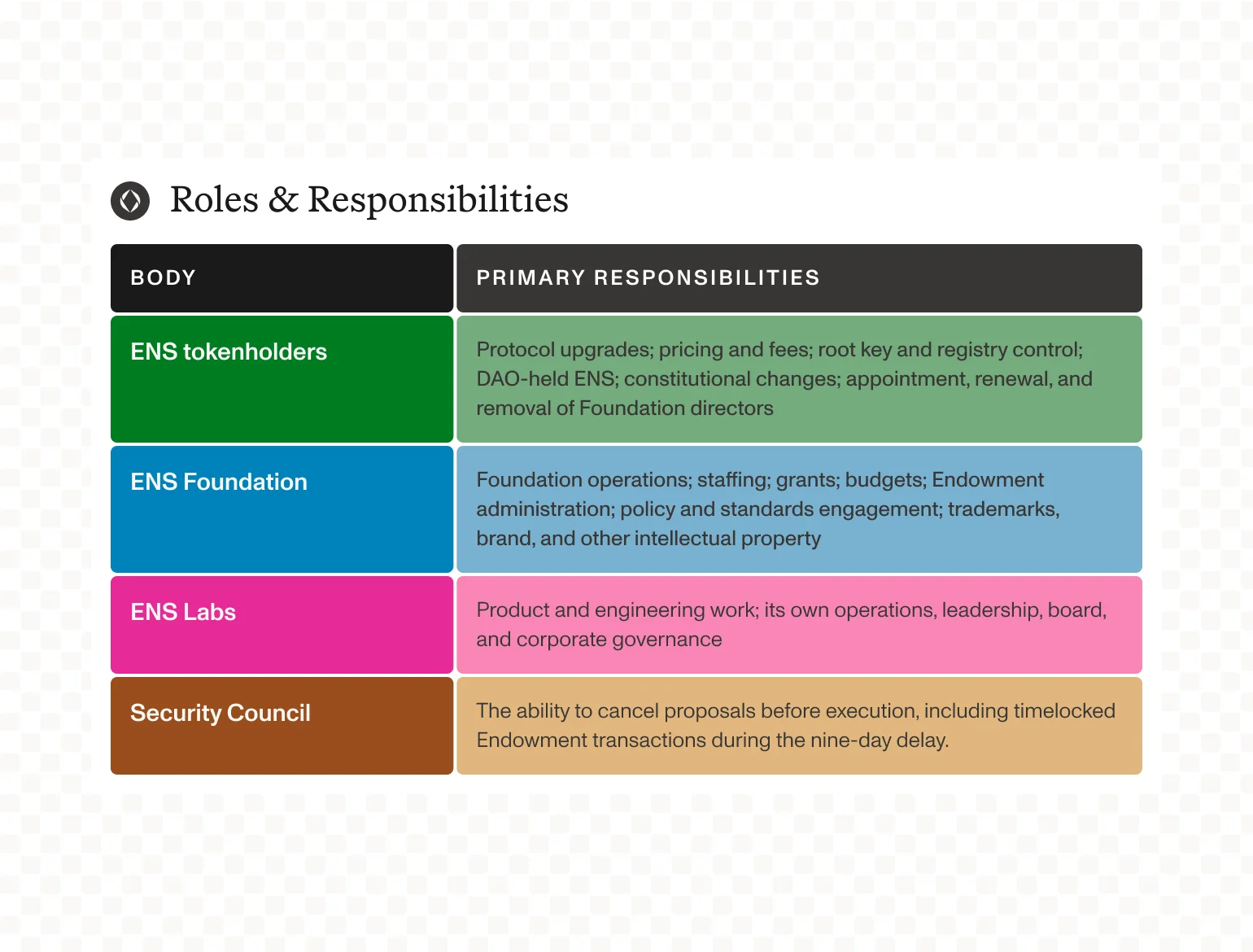
ENS Labs continues to lead the core development of the ENS protocol, while the protocol is governed by token holders. Token holders also oversee the institutions that represent them, including the power to appoint or dismiss board members of the foundation. The foundation handles the off-chain work necessary to support the protocol, with its board responsible for overseeing operations and ensuring that ecosystem contributors, including ENS Labs, receive sustainable financial support. ENS Labs, DAO, and the foundation play different but complementary roles, remaining aligned on the long-term management of ENS. This symbiotic relationship makes ENS stronger while helping the on-chain protocol maintain trusted neutrality.
Foundation Board of Directors
The first five-person board members of the foundation are as follows:
- Alexander Urbelis, Executive Director. His career spans cybersecurity law, DNS threat intelligence, and policy: he has served as General Counsel and Chief Information Security Officer at ENS Labs, Chief Information Security Officer at the NFL, and Chief Compliance Officer at Richemont.
- Nick Johnson, Director. Founder of ENS, CEO of ENS Labs, previously employed at the Ethereum Foundation and Google.
- Kartik Talwar, Independent Director. General Partner at A.Capital Ventures, co-founder of ETHGlobal.
- Brett Sun, Independent Director. Co-founder of Prelude, previously led Aragon's technical efforts, including early ENS integration with AragonID.
- Anthony Leutenegger, Independent Director. CEO of Aragon, significant integrator of ENS, while also serving as a delegate for Lido and Morpho.
Independent directors serve a term of two years and may be reappointed by token holders. Each director brings different experiences necessary for ENS during this first term.
What Happens Next
Existing commitments will continue as agreed: administrators, active funding flows, grants, and current term commitments will be prolonged, and the foundation will collaborate with relevant parties to develop transition plans for grant schemes, SPP3, and current working group structures. As personnel needs are clarified, foundation positions will be publicly posted.
Once the proposal has been executed, the foundation can begin fulfilling its approved operational, financial, policy, and institutional responsibilities. ENS Labs will continue to operate under its own management and governance, building ENSv2 and products and infrastructure supporting the ENS protocol, while token holders retain control over protocol decisions and oversight of foundation directors.
ENS aims to demonstrate that key internet infrastructure can achieve trusted neutrality and public governance, and that it can outlast any single company. A complete governance record can be viewed in executable proposals, on-chain votes, and executed transactions.
免责声明:本文章仅代表作者个人观点,不代表本平台的立场和观点。本文章仅供信息分享,不构成对任何人的任何投资建议。用户与作者之间的任何争议,与本平台无关。如网页中刊载的文章或图片涉及侵权,请提供相关的权利证明和身份证明发送邮件到support@aicoin.com,本平台相关工作人员将会进行核查。


