Author: Deep Tide TechFlow
Entrepreneurship is a one-way street.
This statement resonates deeply with Shawn Yan, founder and CEO of Cregis.
As a serial entrepreneur who has been at it for over a decade, Shawn has experienced the success of his first startup as well as the pain of business transformation. He lived through the frenzy of 2017 when the market saw funding without white papers, and he has repeatedly turned down the temptation to "quickly make a hundred million."
Over the past ten years, the industry has gone through dramatic reshuffling from chaos to compliance, and Shawn's entrepreneurial journey has evolved from SaaS and FinTech to an enterprise digital asset service platform.
The times are changing, the forms of products are changing, but Shawn's judgment has always remained the same:
The creation of long-term value is more important than chasing every trend.
Now, as the captain of the enterprise-level digital asset infrastructure platform Cregis, Shawn is standing at a delicate crossroads:
On one hand, institutional adoption of Crypto, especially stablecoins, is on the rise; on the other hand, there are many practitioners who have lost confidence in Crypto and chosen to leave.
When managing client funds on a scale of billions of dollars, as the era of regulatory arbitrage ends and compliance becomes the ticket to entry, as the AI era raises higher demands for "understanding customer needs" and "service efficiency," how does Cregis, a "shield" composed of Crypto and Aegis, reclaim the essence of value creation in the business world and continue to accumulate the trust of over 4,000 enterprises?
We had a serious chat with Shawn Yan about this series of questions.
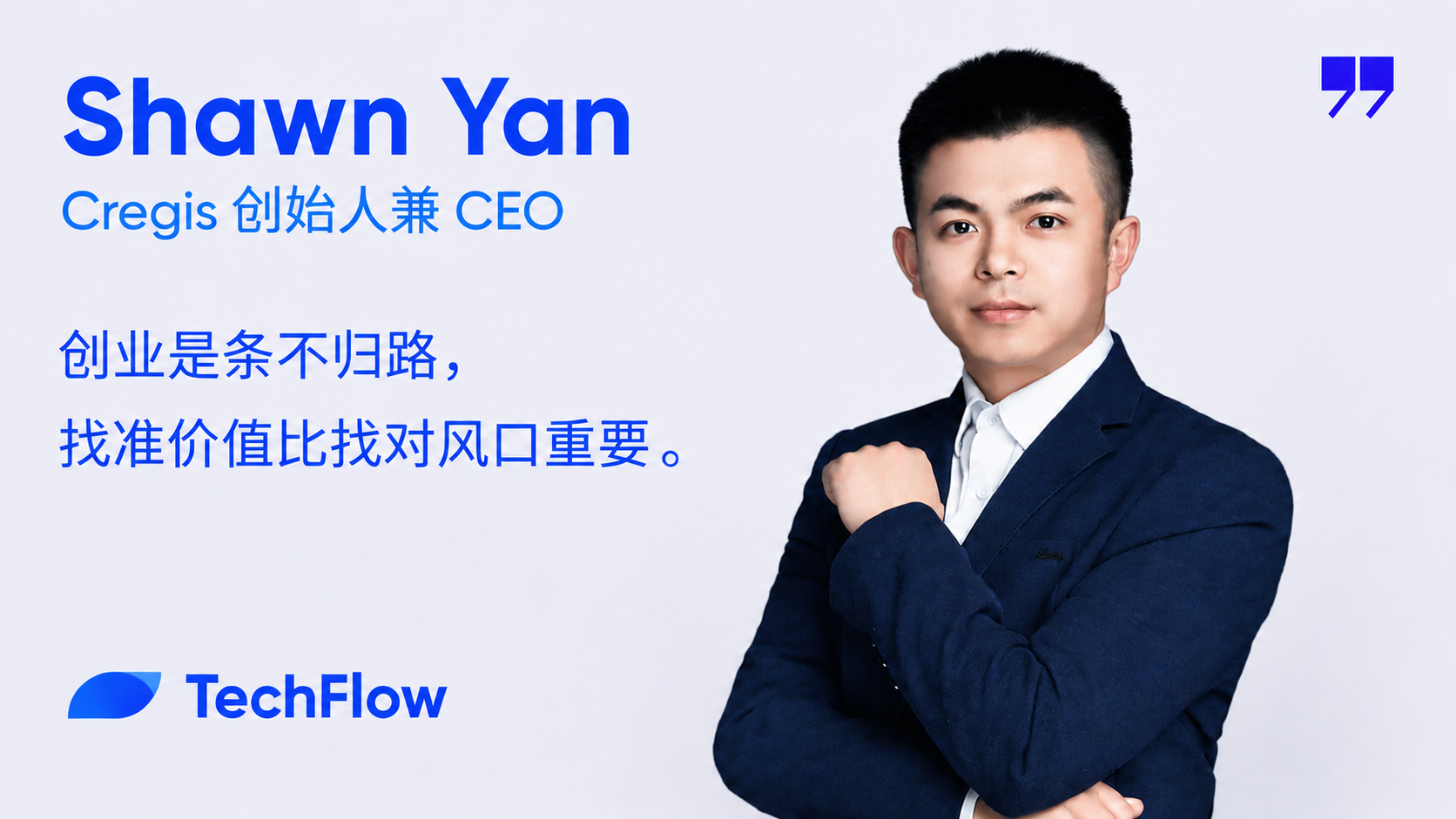
Many things can only be understood by serious entrepreneurs
Deep Tide TechFlow: Thank you for your time. Please introduce yourself briefly.
Shawn:
Hello everyone, I am Shawn, a serial entrepreneur.
I graduated from university in 2012 and started my first venture in 2013. Early on, I mainly provided SaaS services for WeChat merchants, then shifted to FinTech, and now focus on enterprise digital asset infrastructure. I've been at this for over a decade.
When I first started entrepreneurship, I heard a saying: Entrepreneurship is a one-way street. Later, I found this saying quite reasonable.
Once you truly invest in entrepreneurship, the things you engage with and the way you think about problems will change. You are no longer just dealing with a product idea, but with a team, customers, and the long-term responsibility for the industry's development. The whole process is interconnected; you need to continuously learn, adjust, and make choices, making it hard to stop.
Deep Tide TechFlow: You started your first business in 2013, providing SaaS tools related to WeChat public accounts. So, did you succeed in your first venture?
Shawn:
It can only be said that it was not a failure. The product was created, and we gained a number of customers, achieving profitability in the first year.
But we quickly discovered that the competition in this lane was intense, as the technical barriers were low and it was easy to replicate, so profitability significantly declined in the second year.
At that time, we judged that if we continued to stay in service-based SaaS, it would be difficult to establish a long-term competitive moat, so we began to attempt a transformation towards financial SaaS.
However, the transformation was much harder than anticipated. It required continuous investment, and at that time, we were not well-prepared in terms of strategy, team, or talent reserves. For me personally, that was a significant setback early in my entrepreneurial journey.
Looking back now, that setback was just a minor issue. After experiencing more, we gradually realized that change itself is the only constant, and what entrepreneurs truly need to learn is not to pursue stability, but to adapt to change and achieve a spiral rise amidst fluctuations.
Deep Tide TechFlow: It seems you analyze this industry more from a financial or technological development perspective rather than a "speculative mindset." Assume there are two paths: one is to earn quick money through ICOs to make a hundred million in a short time, the other is to persist for ten years and earn a hundred million in infrastructure. This kind of temptation is actually very hard to overcome; why were you able to persist back then?
Shawn:
I personally don't trade cryptocurrencies much. Compared to short-term price fluctuations, I believe much more in long-termism.
During the ICO boom of 2017, the entire industry fell into a very FOMO-driven sentiment. Many people came to us for collaboration, and given our technical accumulation at the time, we could have participated and potentially gained high returns in a short period.
But in the end, we chose a different path.
Looking back, what we have been doing over the years revolves around a single direction: from the early trading systems, enterprise wallets, and fund operation systems, to now a relatively holistic financial infrastructure aimed at enterprises connecting a broader commercial scene, at its core is addressing the fundamental issues that exist in the developmental process of the industry.
At that time, since the industry was still very small, it was hard to form scale doing technical services. From others' perspective, we might have seemed a bit foolish, as the speed of making money wasn't that fast.
But in reality, we possessed sufficient profitability capable of supporting us through bull and bear markets. Our business was not built on market sentiment or single asset cycles, but rather accompanied by real demand growth in the industry.
To be frank, we were not very willing to earn money without value:
On one hand, the company was doing quite well, and we didn't have to earn quick money; on the other hand, if something does not hold value, we couldn't convince ourselves, and it would be even harder to insist on long-term commitment.
Deep Tide TechFlow: I have noticed a very interesting phenomenon: nowadays many VCs prefer to invest in already wealthy individuals, so those who are not short on cash may pay more attention to long-term value.
Shawn:
This is indeed the case, especially as we work on enterprise-level wallets, where the responsibility is quite significant.
It feels like you are guarding a "mountain of gold," and the biggest challenge is not technology, but how to resist temptation, maintain boundaries, and not touch the clients' money. This essentially tests a person's foundational humanity and long-term values.
If a person is under significant financial pressure for a long time or is used to pursuing returns through high risk and high leverage, the likelihood of making different choices when faced with temptation will also be higher.
In the past, we encountered a client who paid attention to the management team’s attitude towards risk and assets when choosing a wallet partner. Because to him, a team that consistently focuses on short-term gains and high-risk opportunities may not be suitable for the responsibility of long-term asset management.
For us, it is essential to follow the inner choices consistently. Looking back on taking the long-termist path, it was both coincidental and inevitable to find our psychological comfort zone, technical comfort zone, and market comfort zone, and the best state is when the three can match.
Bitcoin is an inevitable product of economic globalization
Deep Tide TechFlow: You entered the crypto industry because of Bitcoin; what opportunity made you aware of Bitcoin at that time?
Shawn:
I first encountered Bitcoin during university.
I studied computer science, and the teacher mentioned Bitcoin and mining in class. I have a natural curiosity for new technologies and enjoyed exploring the operational principles behind them, so I reviewed a lot of information afterwards and even ran mining programs on my own computer. At that time, some websites were even giving away free Bitcoins.
Back then, I thought it was quite an interesting thing, but I viewed Bitcoin more as a new technology and did not realize its deeper financial value.
However, entrepreneurship surrounding Bitcoin in its early days was not easy. The entire ecosystem was very small back then, and the infrastructure and application scenarios were not mature, resulting in a relatively limited commercial space to explore.
2017 was a very important explosion point. With the continuous maturation of public chains, smart contracts, and other infrastructures, the entire industry began to transition from a single asset narrative to more diversified application scenarios, creating opportunities for entrepreneurship.
Later, we shifted from SaaS to FinTech during this process. We gradually encountered the needs of more enterprise clients and financial institutions.
Compared to ordinary users, entrepreneurs tend to observe technological changes more from the perspective of commercial application and infrastructure.
When FinTech clients started hoping we could support capabilities related to digital assets, we realized that this was not just a new functional requirement but a direction of a new type of financial infrastructure that was forming. We began to systematically dive deeper into Crypto and gradually arrived at where Cregis is today.
Deep Tide TechFlow: Looking back at Bitcoin in the past two years, would you consider it a financial revolution?
Shawn:
If we extend the timeline, the medium of exchange for humans has always been evolving.
From the earliest shells and precious metals to today’s fiat currency systems, and now to digital assets, they are essentially all looking for a more efficient and suitable way to exchange value for the development of society at that time.
As the global economy becomes increasingly connected, we naturally need a value transmission tool that can cross regions and different financial systems, and circulate more efficiently.
Thus, I believe that Bitcoin is not an accidental phenomenon but an inevitability that arises at a certain stage of economic globalization. Even without Bitcoin, something with similar characteristics would eventually appear. Of course, whether a particular form becomes mainstream in the future still requires long-term market validation.
Deep Tide TechFlow: From a settlement perspective, among Bitcoin, on-chain gold, and stablecoins, which do you think will be more mainstream in the future?
Shawn:
I think these three actually represent different directions.
On-chain gold has been discussed for many years, but its circulation efficacy has been limited. The reason is that gold, by nature, is still a physical asset, and its trading and circulation logic continues to follow traditional systems. There have been many attempts to put physical assets like tea leaves and collectibles on-chain, but many have not resulted in real applications, primarily because they are not native on-chain assets, and mere digitization does not generate new liquidity.
Stablecoins, on the other hand, are currently assets that better align with the native logic of being on-chain. Besides pegging to the value of the dollar, nearly all of their circulation occurs on-chain without complex intermediaries, making the entire payment and settlement experience very smooth, so we see stablecoins developing relatively well now.
As for Bitcoin, due to price volatility and transaction efficiency factors, it is currently difficult to become a daily payment tool. In comparison, it resembles more of a value anchor or a global value carrier and spiritual support.
Cregis = WAAS + Rails + Custody
Deep Tide TechFlow: If you were to describe Cregis in one sentence, how would you introduce it?
Shawn:
Cregis today is positioned as a comprehensive digital asset service platform for enterprise clients.
It currently consists of three main parts:
- The first is WAAS (Wallet as a Service) enterprise wallet service: helping organizations quickly integrate and deploy cryptocurrency wallet functions without building the underlying wallet infrastructure from scratch, suitable for exchanges, banks/financial service providers, OTC, and other businesses needing to embed digital asset wallet functionalities in their products.
- The second is fund flow orchestration and payment infrastructure service Rails: focusing on orchestrating fund inflow, routing, settlement, and outflow, achieving efficient fund lifecycle management, suitable for enterprises that require highly efficient fund scheduling and compliant payment infrastructures, such as cross-border payments, stablecoin settlements, Forex brokerage treasury management, e-commerce/merchant collections, etc.
- The third is enterprise asset custodial service Custody: aimed at meeting institutional asset custody and compliance needs, providing stronger control, auditing, and regulatory support, suitable for banks, asset management institutions, exchanges, hedge funds, sovereign wealth funds, and other regulated entities.
We believe that digital assets will become a very significant asset class in the future. Familiar assets like Bitcoin, Ethereum, stablecoins, as well as more digitized assets in the future, even NFTs, are all part of digital assets.
As the scale of digital assets continues to expand, how enterprises transact, manage, and store these assets will become an increasingly crucial issue. Therefore, we hope to provide a digital asset financial OS for enterprises to enable them to use assets more simply and safely.
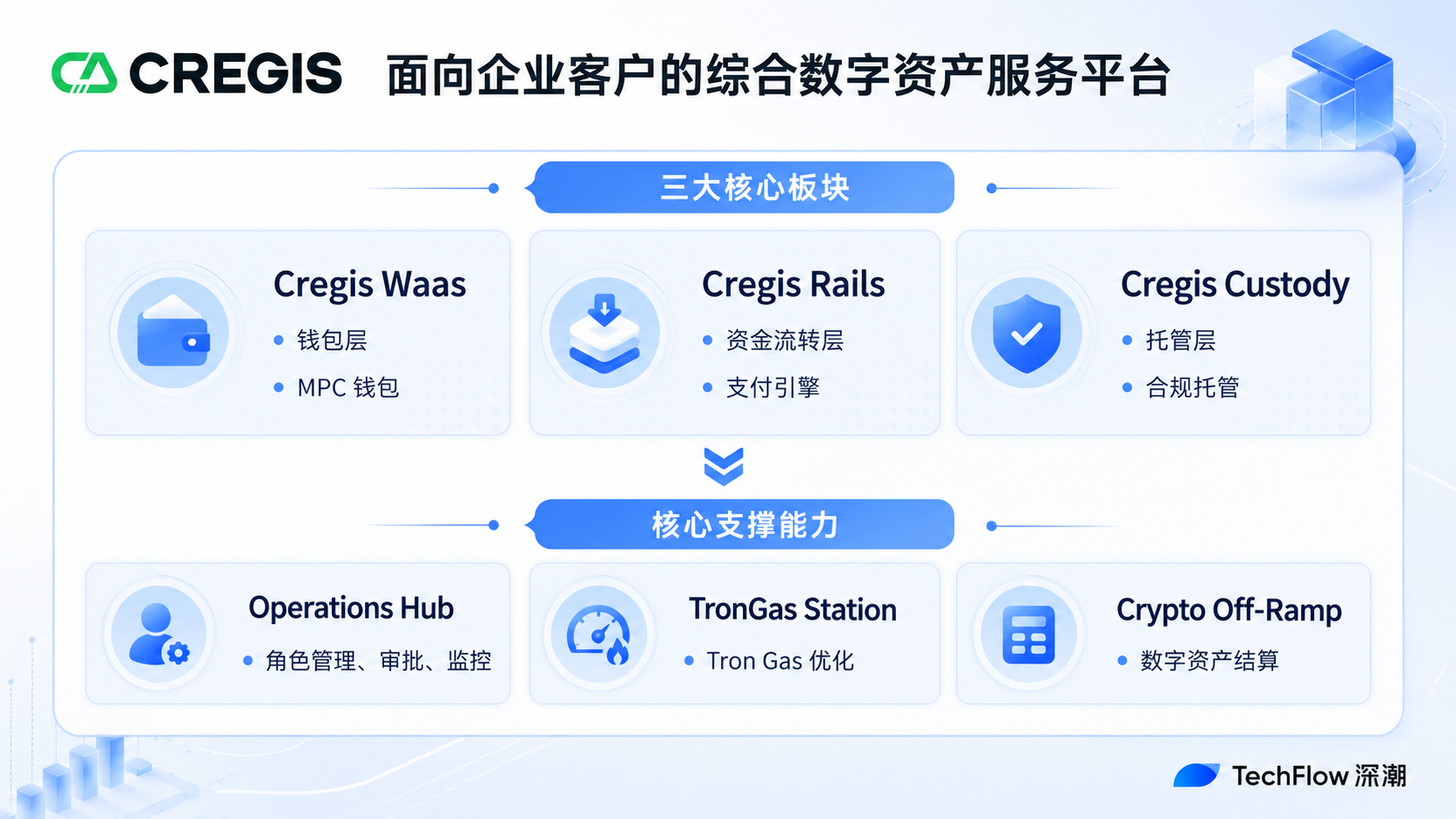
Deep Tide TechFlow: WAAS, Rails, and Custody can be understood as three different layers. Which direction do you think has the most growth potential?
Shawn:
For us, WAAS remains the core because it essentially is the foundational capability, while also representing a larger business domain; even Custody and Rails could potentially integrate into this broader WAAS framework.
As a foundational capability, the MPC secure architecture is WAAS's core technical advantage; by splitting the private key into multiple shards for distributed storage, it eliminates single points of failure. Cregis itself cannot access the complete private key, achieving true self-custody.
Secondly, WAAS provides standardized APIs and multi-language SDKs, making it highly developer-friendly and its suite of digital asset business functionalities includes role-based access control, multi-sign approval workflows, smart risk control, real-time monitoring and alerting, team collaboration, and so forth, catering to different needs in various scenarios.
Increasingly, our clients come from traditional finance, and many of them do not fully understand Crypto. From the standpoint of client needs, what they genuinely care about is not the underlying technical modules but whether it can ultimately resolve their business problems.
And WAAS offers them a very advantageous choice: enterprises do not need to incur development costs or learning time. They can quickly achieve multi-chain asset operations while retaining complete control over their assets.
This is what we aim to do: encapsulate underlying complex capabilities allowing clients to complete their business using a simpler method.
Deep Tide TechFlow: Rails is positioned as a fund flow orchestration and payment infrastructure service. How will it achieve efficient fund lifecycle management? Why are payment institutions important partners of Cregis Rails?
Shawn:
Many people instinctively think of payments when mentioning Rails, but the problems Rails aims to address are much larger than just payments.
Cregis Rails provides a set of fund flow orchestration capabilities connecting enterprise collections, fund management, wallet circulation, and subsequent settlements, allowing for more automated fund lifecycles, thereby minimizing manual operations and enhancing operational efficiency.
Payments are a very important application scenario and an extension of real demands from clients:
Initially, we mainly provided wallet services to help enterprises manage digital assets. However, in practical operations, many clients still need to connect to third-party payment gateways to receive payments, which can cause disruptions in the fund flow and lead to a loss of control over funds, creating substantial security hazards.
As more and more clients raised related demands, we decided to delve deeply into the payments scenario: enterprises should not worry about the complex intermediary pathways. They only need to focus on whether the money has been received, whether the funds are safe, and whether business operations are running normally, streamlining the process to enable more traditional businesses to genuinely enter the digital asset space. This is also one of the reasons why many payment institutions are essential partners of Cregis Rails.
Deep Tide TechFlow: Are there any specific cases that sufficiently demonstrate how Rails has helped clients complete this entire fund orchestration?
Shawn:
Global e-commerce is a quite typical scenario.
For e-commerce businesses targeting the global market, they care not about which assets users use for payment but about whether payment is smooth and what funds they ultimately receive.
However, in the Crypto scenario, this is complicated. Users may pay with stablecoins from different chains, as well as BTC, ETH, and other assets, while enterprises face issues like multi-chain wallet management, Gas fees, fund aggregation, and settlements.
Through Cregis Rails, merchants only need to customize the final type of funds they wish to receive. Once users complete the payment, the underlying wallet selection, chain transitions, fund aggregation, and subsequent processing can all be completed automatically by the system. Enterprises do not need to deal with complex infrastructures, they only need to care about how much money they received, what the costs are, and whether business operations are running smoothly.
Forex brokers face similar scenarios as well. Involving multiple accounts, channels, and partners, traditional methods often rely on manual coordination.
Through Cregis Rails, brokers can automatically complete fund routing, allocation, and settlements based on business rules, making fund circulation more transparent and traceable, while reducing operational costs.
Essentially, Cregis Rails is not replacing existing systems of enterprises, but serving as the underlying infrastructure for payment scenarios, connecting previously fragmented fund processes, allowing digital assets to integrate more naturally into daily business operations.
Deep Tide TechFlow: Compared to other platforms, what do you consider as Cregis's core advantages?
Shawn:
I actually do not like to use "competitors" to define other platforms in the industry. Different enterprises are at various stages of development, business models, and regulatory environments, making it hard to have a one-size-fits-all solution for every client.
We focus more on what kind of infrastructure is most suitable for each client's business at its current developmental stage.
In the current Asia-Pacific market, our greatest advantage is the self-custody model. Self-custody is naturally suitable for payment infrastructure.
The biggest demand in payment scenarios is not for long-term asset custody, but for high-frequency, bulk fund payment capabilities, alongside lower costs, more flexible fund orchestration, and a risk control system closely aligned with business processes. Self-custody wallets are very user-friendly for them, and many of our payment clients strongly agree with this point.
Additionally, Cregis's core moat also includes:
First, solid product research and development capabilities with ongoing investment; second, nine years of industry experience and over 4,000 customers’ trust; third, operational service capacity across multiple jurisdictions; fourth, compliance capabilities.
These four capabilities may have different priorities but are all indispensable; together they form the foundation for Cregis’s long-term development.
Deep Tide TechFlow: You mentioned compliance capabilities. We understand that Cregis has already obtained relevant licenses in Hong Kong, and the Dubai license is about to be approved. What are the future plans in terms of licensing? Do you think licenses are a moat or just a ticket to entry?
Shawn:
First of all, our current core business is self-custody WAAS, leaning towards being a technology service provider, and from the current policies, it does not necessarily require financial licenses.
We choose to proactively布局,因为我们认为未来客户需求一定会变化。
On one hand, enterprises in the future may not only require self-custody but also may need comprehensive services like platform custody; we hope to be well-prepared in advance to offer clients more choices.
On the other hand, licenses are also an important part of market trust; when clients see compliance qualifications, it is easier for them to establish trust.
The era of regulatory arbitrage will certainly pass, and future industry regulations will only become more comprehensive, so we need to start preparing early. In addition to Hong Kong and Dubai, we are also focusing on markets in North America, Latin America, and others, evaluating whether to apply for licenses according to business needs.
However, I believe licenses themselves are not a moat; they are more like a ticket to entry. Because currently, there is no license that applies universally worldwide, and no license can automatically earn global client trust.
Deep Tide TechFlow: Now many traditional companies are still in the hesitation phase of "whether to embrace Web3," while Web3 practitioners themselves are starting to shift away from Crypto to AI or other industries. If you were to send a message to these two groups in one sentence each, what would you want to say?
Shawn:
For those still hesitating whether to embrace Web3, I feel that most of the time, it fundamentally comes from a bias against new things.
Many people ask: Why should we use Web3?
But I prefer to turn the question around: Why not?
This reflects two completely different mindsets.
When you conduct a cost assessment and find that you do not have to pay much while also likely improving efficiency and reducing costs, then why not try?
Crypto has developed to this point, and I believe it relies not just on the beliefs of a few but on the technological efficiency improvements and genuine demands.
As for those planning to leave Crypto, I think if you need to leave, then go ahead.
But the premise is to evaluate seriously: do you have long-term confidence in this industry? What is the underlying logic you believe in? Are you truly creating value in what you are doing?
If your value creation is not here, then go to a place that suits you better.
In any field, early on, there will be boom benefits that allow rapid growth through traffic, but ultimately, it all needs to return to truly creating value.
Of course, some people specialize in making money off trends, and that's also a business model; there's nothing inherently right or wrong about it, but the challenge of this model is how to ensure you can continuously stand among the trends.
Deep Tide TechFlow: What will be the focus of Cregis’s work going forward?
Shawn:
In the coming years, our most important goal is still to continue solidifying Cregis.
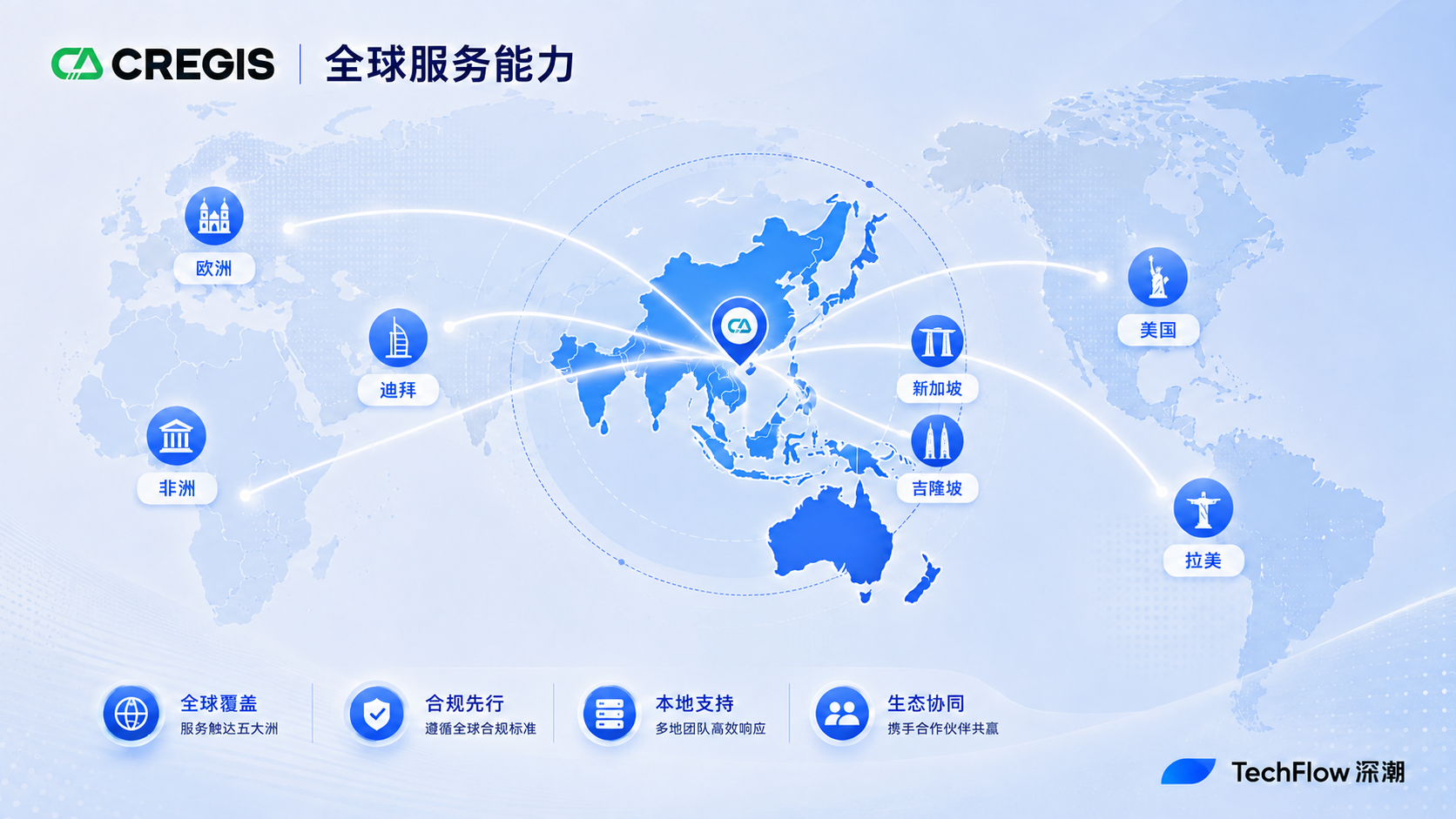
Cregis is headquartered in Hong Kong and started in the Asia-Pacific market, where we also validated our product and business models. Now, our business has expanded into markets such as the Middle East, Europe, Latin America, Africa, and the United States, with offices in Kuala Lumpur, Singapore, Dubai, and São Paulo, gradually building localized teams and service capacities, achieving good results.
Take the Middle East market, for example. After two years of development, Cregis has over 200 long-term paying clients in the Middle East. Over the past year, we have also continued to push expansion into key markets like Latin America, Africa, Europe, and the United States. For us, globalization is not merely about replicating products; it is about understanding local enterprise needs in different markets and establishing long-term service capabilities.
At the same time, there are many excellent peers in this industry, and I see this as a good thing. Just like in the AI field, different companies’ explorations drive the maturity of technology, products, and services, ultimately benefiting users and the entire industry ecosystem. I hope the digital asset infrastructure industry can also form such a positive development.
Deep Tide TechFlow: Finally, back to the meaning of the company's name Cregis, Crypto (encrypted) + Aegis (shield) = Cregis.
Standing at a point nearly ten years since the company's establishment, do you feel that the shield is protecting something different today compared to the first day of entrepreneurship? What more do you hope it can protect in the future?
Shawn:
Over these years, we have added many products and capabilities, also expanding more application scenarios, but our original intention has always been to help clients manage digital assets in a safer and more efficient manner, so they are willing to entrust us with their trust.
In this industry, when clients are willing to entrust their assets to you, that alone represents a tremendous trust. We also maintain a sense of reverence, hoping to do every single thing well and live up to clients' expectations.
Now Cregis serves thousands of enterprise clients and more users behind them. As we continue to scale, we are safeguarding not just the asset safety of individual clients, but also the foundation of trust in the digital asset infrastructure ecosystem.
Because for infrastructure companies, once the underlying capabilities encounter issues, the effects extend beyond a single client and can impact the entire industry's confidence in digital asset applications.
As for building this trust, I believe it revolves around the following two points:
First, products must truly solve customer problems; that is fundamental.
Second, time. Trust is not built through marketing, but accumulated gradually through long-term practice. In our industry, being able to withstand the test of time is itself the greatest threshold.
免责声明:本文章仅代表作者个人观点,不代表本平台的立场和观点。本文章仅供信息分享,不构成对任何人的任何投资建议。用户与作者之间的任何争议,与本平台无关。如网页中刊载的文章或图片涉及侵权,请提供相关的权利证明和身份证明发送邮件到support@aicoin.com,本平台相关工作人员将会进行核查。


