From 25% to 51% Premium: How HIP-3 Makes SKHX/SKHY the Best Tool for Cross-Border Equity Price Spread Trading.
Written by: Eren, Four Pillars
Translated by: AididiaoJP, Foresight News
After the ADR was listed on the Nasdaq, the price gap between the ADR (SKHY) and the underlying shares (SKHX) sharply widened. During this period, TradeXYZ, the builder of HIP-3 on Hyperliquid, opened perpetual futures markets for both. The funding rates in these two markets clearly demonstrate what stock perpetual futures actually provide, what the market is still lacking, how they interact with the underlying spot market, and where the strongest demand is attracted.
Note: ADR (American Depositary Receipt) is a certificate issued by a U.S. bank representing shares of a foreign company, facilitating U.S. investors to trade on U.S. stock markets such as Nasdaq in dollars. ADR (SKHY) is the ADR code for SK hynix, listed on Nasdaq, where each SKHY represents 1/10 of a share of the underlying shares (SKHX); the underlying shares (SKHX) are the original stocks or related products traded in South Korea. After its listing, due to strong demand from U.S. stocks, liquidity differences, and arbitrage difficulties, the price gap between SKHY and the underlying shares significantly widened.
1. SK hynix ADR Premium and Blocked Arbitrage
On July 9, SK hynix sold 177.9 million American Depositary Receipts (ADRs) at a price of $149 each, raising $26.5 billion. This was the largest ADR issuance by a foreign company in history, surpassing Alibaba's record of $21.8 billion in 2014. The subscription book was oversubscribed more than seven times, with the Nasdaq opening price on July 10 at $170.
Subsequently, the price gap between ADR (SKHY) and the original shares (SKHX) drastically widened. The premium timeline is as follows:
- July 13: The ADR premium expanded from about 3% relative to the issuance price to 25.6%, while the original shares plummeted by 15.4%. The KOSPI index also fell over 8% during trading, triggering a circuit breaker, but the ADR only dropped by 9.3%.
- July 14: The ADR soared by 27%, closing at $193.92, with its premium relative to the original shares skyrocketing to 51%.
- July 15: The previously surging ADR declined by 9%, closing at $176.46, while the original shares rebounded by 8.8%. The ADR premium relative to the original shares narrowed from 51% to 30.7%.
The cause of the premium was the closure of the arbitrage channel. In an efficient market, institutions would buy the cheaper original shares, convert them into ADRs, and then sell the ADRs to increase supply and eliminate the price difference.
However, this channel has not yet opened. This ADR was not created by depositing existing shares but by issuing 17.79 million new shares to the depositary bank (Citigroup), with these original shares planned to be additionally listed on the Korea Exchange on July 29. The Korean securities depositary institution stated that applications for the mutual conversion of original shares and ADRs would only be possible after that date.
Furthermore, the issued ADRs account for less than 3% of SK hynix's total shares. U.S. institutional demand encountered a supply that could not expand, causing the price difference to widen.
2. HIP-3 Funding Rates Reveal the Current Stage of Stock Perpetual Futures
During the same period, TradeXYZ opened perpetual futures markets for both sides on Hyperliquid. The SKHX tracking the original shares had been running for some time, while the SKHY tracking the ADR went live as a pre-IPO contract the day before listing and switched to a standard contract at the start of Nasdaq trading.
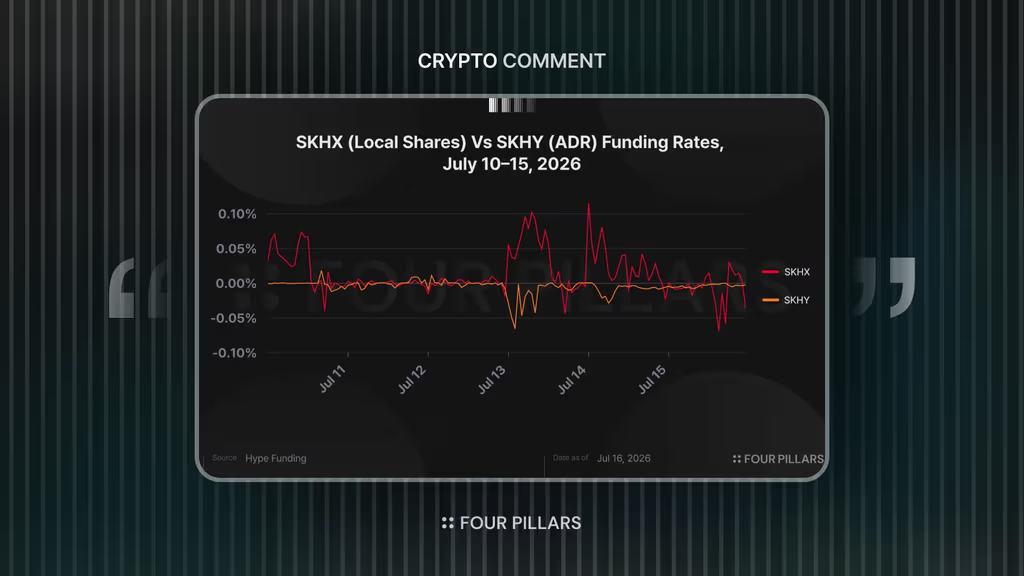
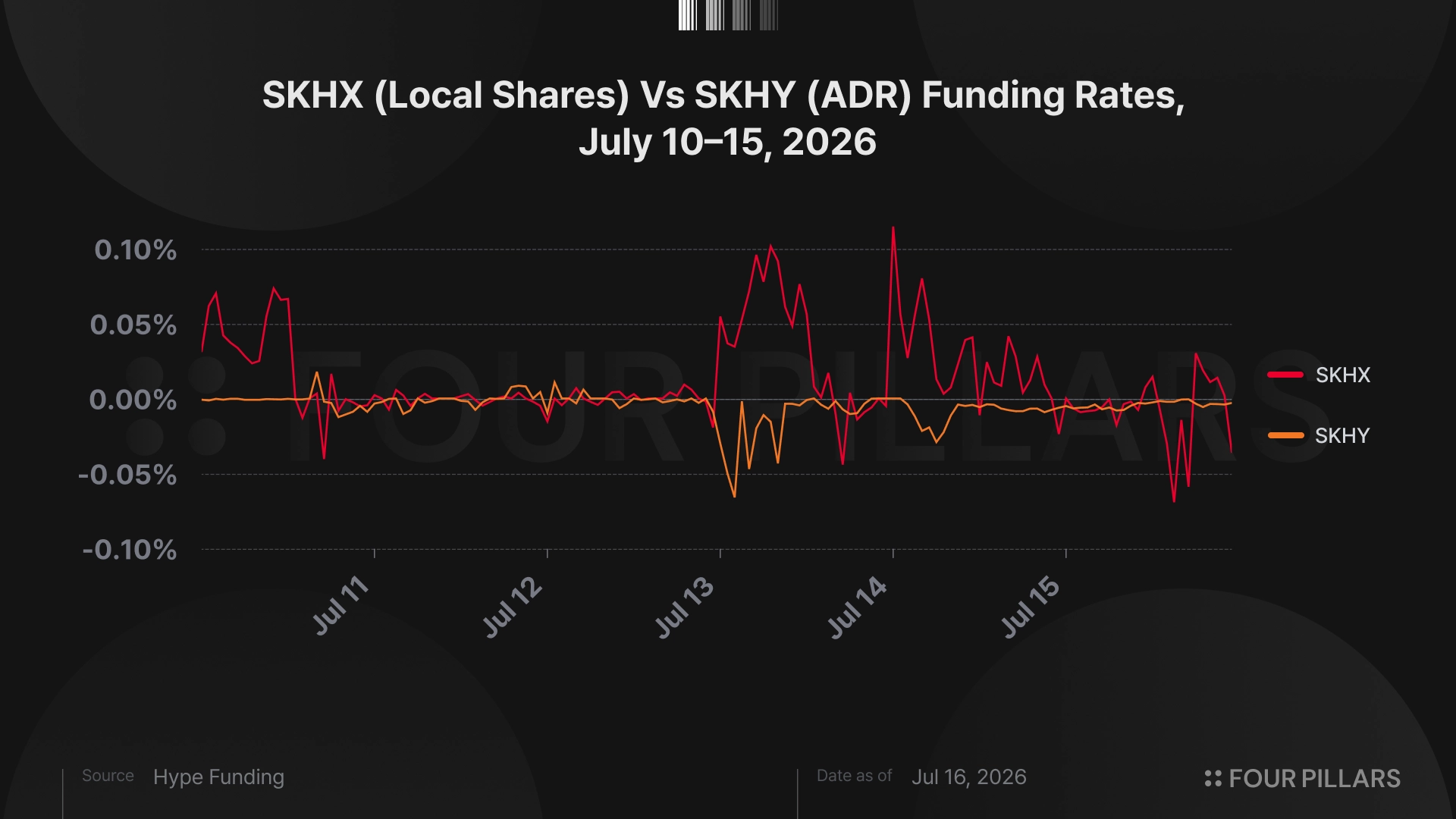
As the gap between the original shares and ADRs expanded, the funding rates in the two markets showed divergent movements in opposite directions. On the 13th, as the original shares plummeted, the SKHX funding rate jumped to +0.10% per hour, while SKHY fell to -0.065%.
A positive funding rate means longs pay shorts, while a negative rate indicates the opposite. This implies that longs flocked to the original share side, while shorts rushed to the ADR side. This combination points to a single position - a bet on the narrowing of the premium executed on Hyperliquid.
This event validated several hypotheses about stock perpetual futures through a single case. It directly demonstrates what stock perpetual futures actually provide, what the current market lacks, how they relate to the underlying market, and which markets offer them the strongest demand:
- Ability to express bypassing spot market frictions: Betting on a narrowing premium requires buying original shares and shorting ADRs. In the spot market, this requires conditions such as Korean won funds, foreign investor accounts, settlement infrastructure, and borrowing ADRs. However, in perpetual futures, it only requires using USDC as collateral and trading both contracts on a single platform.
- Missing tool to separate funding rates: The current bilateral betting position structure is not ideal. Even if the premium persists, the hourly accumulation of funding rates leads to the dilution of collateral. In spot arbitrage, once original shares are converted into ADRs, the price difference can be immediately locked in as realized profit, but perpetual futures lack this forced convergence mechanism. SKHX converges to the original share index, and SKHY converges to the ADR index, but neither can narrow the gap between the two indexes. While perpetual futures reflect the price difference of the underlying market, they do not resolve it. Even if the direction is correct, a late convergence can let accumulated holding costs erode returns. Ultimately, it is a structure that simultaneously bears the viewpoint that "the premium will narrow" and holding costs.
- Need separate market trading of funding rates themselves to separate the two. For example, Pendle's Boros tokenizes funding rates into YU (Yield Unit) and splits them into fixed and floating parts. Positions like SKHX longs that pay funding rates can purchase YUs on Boros to receive floating funding rates to offset costs. This achieves the conversion of variable costs into fixed costs through hedging. The costs themselves do not disappear, but future spending can be locked in at entry, thus managing position sizes. However, the markets currently supported by Boros are limited to mainstream assets like BTC and ETH, while HIP-3 stock perpetual futures have not yet been included. Therefore, trading this price difference currently means bearing the volatility of funding costs.
- Function of perpetual futures as leading indicators: TradeXYZ's SKHY pre-IPO market pointed to $164 three hours before Nasdaq opening, $169.80 one hour before, and $169.92 one minute before, while the actual opening price was $170. The SKHX market also trades at night and on weekends during KRX's closed hours, with Korean traders using its price as a leading indicator for the next day's opening. Perpetual futures are no longer limited to being derivatives that track the underlying assets but proactively establish prices during the periods when the original market is closed.
- Market value inversely proportional to the accessibility of the underlying asset: This is binding two futures contracts from the same company, yet the funding rate of SKHY has generally remained near zero outside of periods like the 13th when the price difference sharply expanded. The reason is that physical ADRs exist on Nasdaq, and U.S. options began trading on the 14th, allowing arbitrageurs to capture the basis. On the other hand, SKHX lacks hedging tools, with funding rates becoming the only mechanism for market clearing, leading it to become the largest single contract, accounting for 33% of total HIP-3 trading volume and 50% of stock perpetual futures trading volume. Listing perpetual futures for highly liquid U.S. large-cap stocks is equivalent to building once again on something that already exists. The more access is blocked, the higher the value of the perpetual futures contract.
A future point of interest is July 29. When the original shares are additionally listed on the Korea Exchange, and applications for the mutual conversion of original shares and ADRs open, the blocked arbitrage channel will partially open.
However, even if the channel opens, asymmetry still exists. Redeeming ADRs for original shares has no restrictions, but converting original shares to ADRs can only occur within the issuance limit, which is necessary to compress the premium.
For this reason, whether the premium will narrow dramatically remains uncertain, but even so, Hyperliquid remains the only place to trade this price difference.
免责声明:本文章仅代表作者个人观点,不代表本平台的立场和观点。本文章仅供信息分享,不构成对任何人的任何投资建议。用户与作者之间的任何争议,与本平台无关。如网页中刊载的文章或图片涉及侵权,请提供相关的权利证明和身份证明发送邮件到support@aicoin.com,本平台相关工作人员将会进行核查。


