
Author: Flora, CryptoPulse Labs
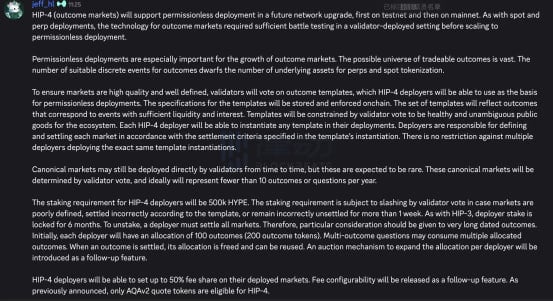
On July 20, Hyperliquid announced the latest proposal for HIP-4 (Outcome Markets), planning to support permissionless deployment of outcome markets in future network upgrades, first launching on the test network and then promoting it to the mainnet.
According to the proposal, validators will decide on available outcome market templates through voting, and deployers can create specific markets based on these templates, and are responsible for completing market definitions and final settlements. At the same time, deployers need to stake 500,000 HYPE and can receive up to 50% of the fee share in the future.
This means Hyperliquid is gradually transforming outcome markets from being an officially led product into an open ecosystem co-created by the community. For a platform originating from perpetual contract trading, HIP-4 not only adds a new trading category but may also be an important step in its transformation from a trading platform to an on-chain financial infrastructure.
1. From Official Launch to Permissionless, Outcome Markets Open New Growth Space
In the past few years, Hyperliquid's core competitiveness has mainly come from perpetual contracts. With high trading performance, an on-chain order book model, and a self-developed Layer 1, Hyperliquid has gradually become an important platform for the on-chain derivatives market.
However, the trading objects of spot and perpetual contracts are mainly existing crypto assets, and while the market is vast, it still has certain boundaries. Outcome markets are different; they do not trade on a specific asset itself but on the outcomes of future events.
For example, whether a country will cut interest rates, whether a policy will be implemented, whether a company will complete financing, whether an ETF will be approved, or even the final result of a sports competition can all become trading objects in outcome markets.
As long as the event can be clearly defined and ultimately verified, it can potentially form a new on-chain market.
This means outcome markets have a potential trading scenario far exceeding traditional spots and perpetual contracts. The number of events in the real world that can be defined and verified has almost no clear upper limit. If all markets rely on the official team to create them one by one, it will clearly not meet future demands.
Therefore, the core change of HIP-4 is to open the market creation rights.
In the future, developers, research institutions, community organizations, and even individual teams that meet the protocol requirements can deploy outcome markets based on standard templates. The platform will no longer need to decide on all trading objects officially but will provide the underlying infrastructure and rule framework, allowing the community to continuously create new markets.
This has certain similarities with how Uniswap allows users to create trading pools themselves. In the past, platform growth mainly relied on the official launch of new products. In the future, Hyperliquid can achieve ecological expansion driven collaboratively by developers and the community through open deployment.
If spot and perpetual contracts solve the asset trading problem, then outcome markets attempt to solve the future event pricing problem. Therefore, Hyperliquid’s competitive boundaries may gradually extend from crypto asset trading to real-world information, events, and expectations.
2. Templates, Staking, and Governance: HIP-4 Attempts to Solve the Trust Issue of Outcome Markets
Outcome markets have tremendous imaginative space, but they also face some more complex issues than ordinary trading markets.
For instance, how to define outcomes—if a match is postponed, does it count as finished? If a policy is issued but then canceled, how is the final outcome determined? If a company announces financing but the funds have not yet arrived, does that count as completed financing?
If the market definitions are unclear, disputes are likely to arise during final settlements.
Therefore, HIP-4 does not simply take the approach of "anyone can create a market at will" but designs a set of rule frameworks.
First is the template mechanism. In the future, Hyperliquid validators will vote to decide which outcome market templates can be used. The templates will specify the market definition methods, settlement conditions, and execution logic, all stored on-chain. Deployers can create specific markets based on the templates but must comply with the template regulations.
For example, different standardized templates may be formed around sports events, macroeconomic data, political events, or crypto asset prices. Templateization lowers the bar for market creation and reduces settlement disputes caused by inconsistent rules.
Secondly, there is a requirement to stake 500,000 HYPE. If the deployer's market definitions are unclear, or if proper settlements are not made according to the template, or if correct settlements are not completed within a week after the market result, validators can vote to forfeit the staked amount.
This establishes an economic guarantee mechanism. Deployers gain the freedom to create markets but must also take responsibility for market quality and final settlements. If someone intentionally creates ambiguous markets or abandons settlements after market closure, they could suffer significant financial losses.
In addition, the staking period for deployers is six months, and they must complete all market settlements before the stake can be released. This provision further prevents creators from "exiting after creating a market."
Regarding the number of markets, the initial phase of HIP-4 stipulates that each deployer can create up to 100 outcomes, corresponding to 200 Outcome Tokens. In the future, the protocol also plans to expand deployment capacity through an auction mechanism.
Overall, HIP-4 establishes a "permissionless creation but must bear responsibility" model. The community can innovate freely, but market rules are constrained by templates; deployers can gain profits but must stake; validators participate in governance through voting.
The core of this design is to seek a balance between openness and market quality. If outcome markets are too closed, they cannot form sufficiently rich trading scenarios.
If completely open, it is easy to produce low-quality markets and settlement disputes. HIP-4 aims to resolve this contradiction through templates, staking, and governance mechanisms.
3. Up to 50% Fee Sharing, Market Creation May Become a New Business Model
Another important design of HIP-4 is that, in the future, deployers will be allowed to receive up to 50% of the fee share. This mechanism suggests that market creation itself could become a sustainable business model.
In the past, transaction fees in trading protocols typically mainly belonged to the protocol or liquidity providers, but HIP-4 incorporates market creators into the revenue system.

In the future, sports media could create event prediction markets, financial institutions could build markets around interest rates, inflation, and economic data, research institutions could create specialized markets for industry events, and Web3 communities could build dedicated markets around project upgrades, token launches, and more.
These deployers can not only design markets but also attract users through content dissemination and community operations, thereby earning income from transaction fees.
As a result, a new on-chain role may emerge in the future, that is, market operators.
They do not need to develop the underlying blockchain or establish a complete trading platform but can focus on market creation and user operations in a specific vertical area relying on Hyperliquid’s infrastructure.
This model has certain similarities with the creator economy of content platforms. The platform provides infrastructure; creators are responsible for producing content and attracting users; in the HIP-4 system, the platform provides market infrastructure, deployers are responsible for creating markets, operating communities, and earning revenue through fee sharing.
Meanwhile, Hyperliquid will still retain official standard markets. According to the current proposal, the official markets are expected to be limited to within 10 per year. In the future, an ecological structure may form, "officially established standards and community-driven innovation": the official team is responsible for building basic templates and governance systems, while the community is responsible for discovering more segmented needs.
Of course, HIP-4 is still just a preliminary proposal. Permissionless deployment will first be validated on the testnet, and related rules may be adjusted based on community feedback. The real challenge lies in how Hyperliquid can avoid the flooding of low-quality markets, reduce settlement disputes, and prevent markets from being maliciously manipulated.
If the templates, staking, governance, and fee sharing can form an effective closed loop, HIP-4 could potentially push outcome markets into a new development stage.
From a broader perspective, Hyperliquid is changing the growth logic of on-chain trading platforms. In the future, competition may not only be about trading speed and fees, but also about how many types of markets the platform can support, how many developers it can attract, and whether it can establish effective community incentive mechanisms.
Conclusion
If HIP-4 is successfully implemented, Hyperliquid's positioning may further shift from a high-performance derivatives trading platform to an open financial market infrastructure.
Spot and perpetual contracts are just the foundation, while outcome markets will transform numerous events in the real world into on-chain markets that can be traded, priced, and settled. What Hyperliquid truly aims to open up may not just be a new trading category but a financial ecosystem continuously created by the community.
免责声明:本文章仅代表作者个人观点,不代表本平台的立场和观点。本文章仅供信息分享,不构成对任何人的任何投资建议。用户与作者之间的任何争议,与本平台无关。如网页中刊载的文章或图片涉及侵权,请提供相关的权利证明和身份证明发送邮件到support@aicoin.com,本平台相关工作人员将会进行核查。


