Author: Claude, ShenChao TechFlow
ShenChao Introduction: On July 8, Blockstream co-founder Adam Back’s Bitcoin treasury company BSTR announced in partnership with SPAC company Cantor Equity Partners I (NASDAQ code CEPO) that they would not complete the merger as per the original agreement by July 2025. The private placement (PIPE) tied to the deal is no longer required to be completed, and the scheduled shareholder meeting on July 10 has been indefinitely postponed. This deal was originally set to go public with 30,021 bitcoins and up to $1.5 billion in fiat currency PIPE. Bitcoin is currently around $64,000, nearly halved from the historical high of $126,000 last October. Whether this financing machine can restart after the price premium supporting the "coin-storing company" model disappears depends on the next SEC filing.
Adam Back, the inventor of Hashcash, holds 30,000 bitcoins and is unable to secure funding in the capital market.
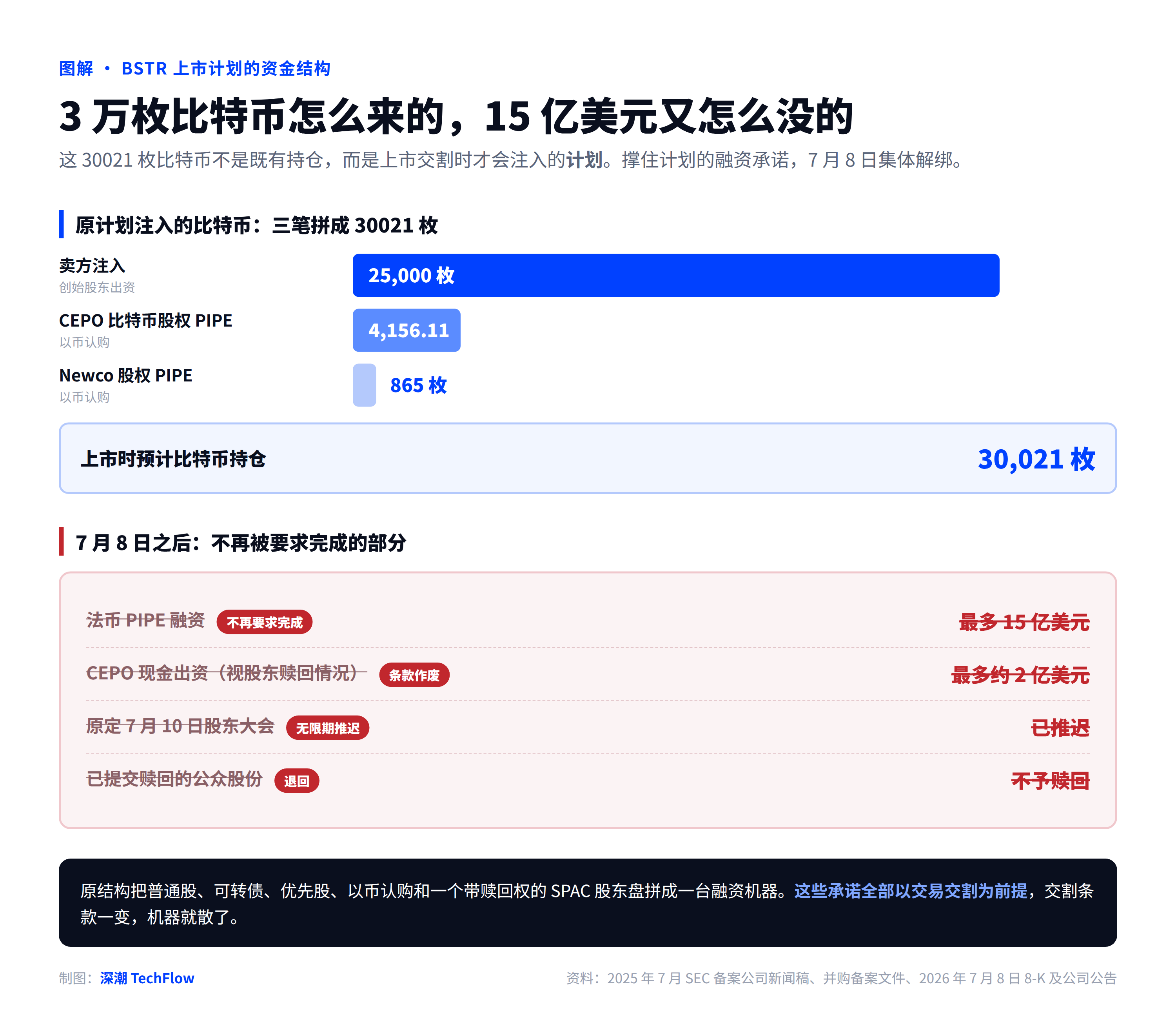
On July 8, Cantor Equity Partners I submitted an 8-K filing to the SEC, disclosing that it is discussing a revised transaction structure and terms with BSTR Holdings, citing "to better reflect current market conditions." The key sentence in the document is: the parties will not complete the transaction under the original merger agreement signed on July 16, 2025, and the private placement tied to the deal is also no longer required to be completed.
The company announcement released the same day added two points: the scheduled shareholder meeting on July 10 has been indefinitely postponed; the public shares that have submitted redemption requests will be returned and not redeemed.
Bitcoin did not crash; what crashed was the financing structure for buying Bitcoin.
How big was the original deal: 30,000 bitcoins
The selling point of BSTR has always been its scale.
According to a company press release submitted to the SEC in July 2025, BSTR expected to go public with a balance sheet containing 30,021 bitcoins, as well as up to $1.5 billion in fiat currency PIPE funding, 5,021 bitcoins in physical PIPE, 25,000 bitcoins from founding shareholders, and up to about $200 million in cash from Cantor Equity Partners I (depending on shareholder redemption situations).
The number 30,021 is not a whole block; the detailed merger documents split it into three portions: 25,000 bitcoins injected by the seller, 4,156.11 bitcoins from CEPO equity PIPE, and 865 bitcoins from Newco equity PIPE. In addition, there are cash equity, convertible bonds, preferred shares, and subscription commitments denominated in bitcoins, all contingent upon the successful closing of the transaction.
These commitments are the real load-bearing walls. They transformed a pile of bitcoins into a financing machine aimed at the public market: common stock, convertible bonds, preferred shares, bitcoin subscriptions, along with a SPAC shareholder base with redemption rights, combined into five sources of funding.
Adam Back himself serves as the CEO of BSTR, and the narrative of the transaction revolves around "Bitcoin per share" rather than purely passive coin-holding.
After the announcement on July 8 stated that the private placement does not need to be completed, the question became whether the new terms can bring those funds back.
The engine is the price premium, not Bitcoin
The logic of operation for the "coin-storing company" model is actually two separate matters from whether Bitcoin goes up or down.
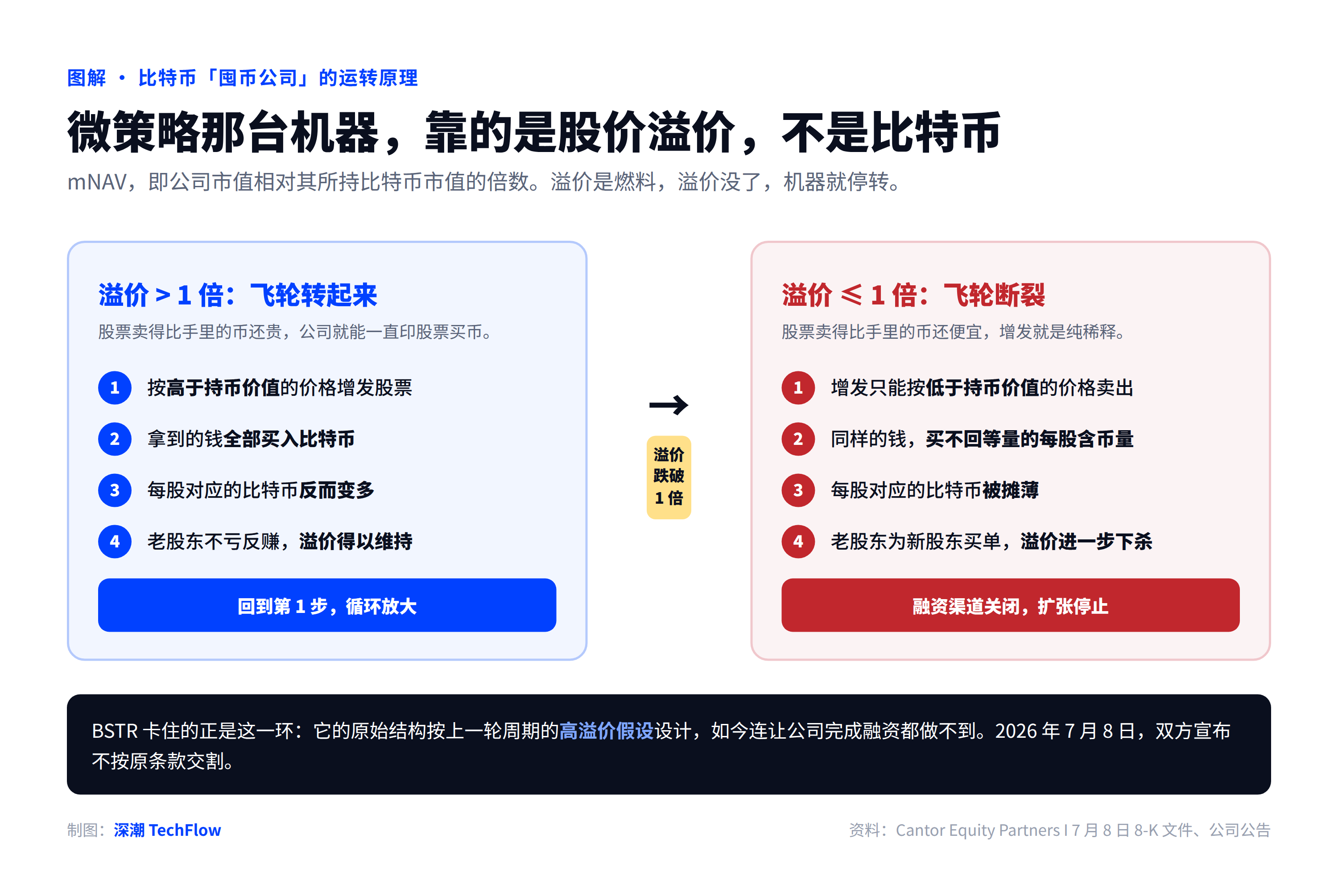
The key indicator is called mNAV, which means the company's market capitalization relative to the value of the bitcoins it holds. If a company has a market cap that is 2 times the value of its holdings in bitcoin, the mNAV is 2. This premium is the fuel for the whole machine: the company issues new shares at prices above net asset value, takes the money to buy more bitcoins, which paradoxically increases the Bitcoin per share content, resulting in shareholders not losing but gaining, and then repeating the cycle. MicroStrategy (now known as Strategy) achieved this cycle.
Once the premium converges to 1 times or even falls below 1 times, this cycle breaks. Issuing new shares to buy bitcoins no longer thickens the Bitcoin per share content but instead dilutes existing shareholders. The machine stops operating.
BSTR's problem lies precisely here. The original structure was designed based on the assumptions of the previous cycle's premium, and now no one is willing to pay for that set of assumptions. Thus, this time it's not about "can the stock maintain its premium post-listing," but rather the premium assumptions can’t even allow the company to complete the financing.
The entire sector is under pressure
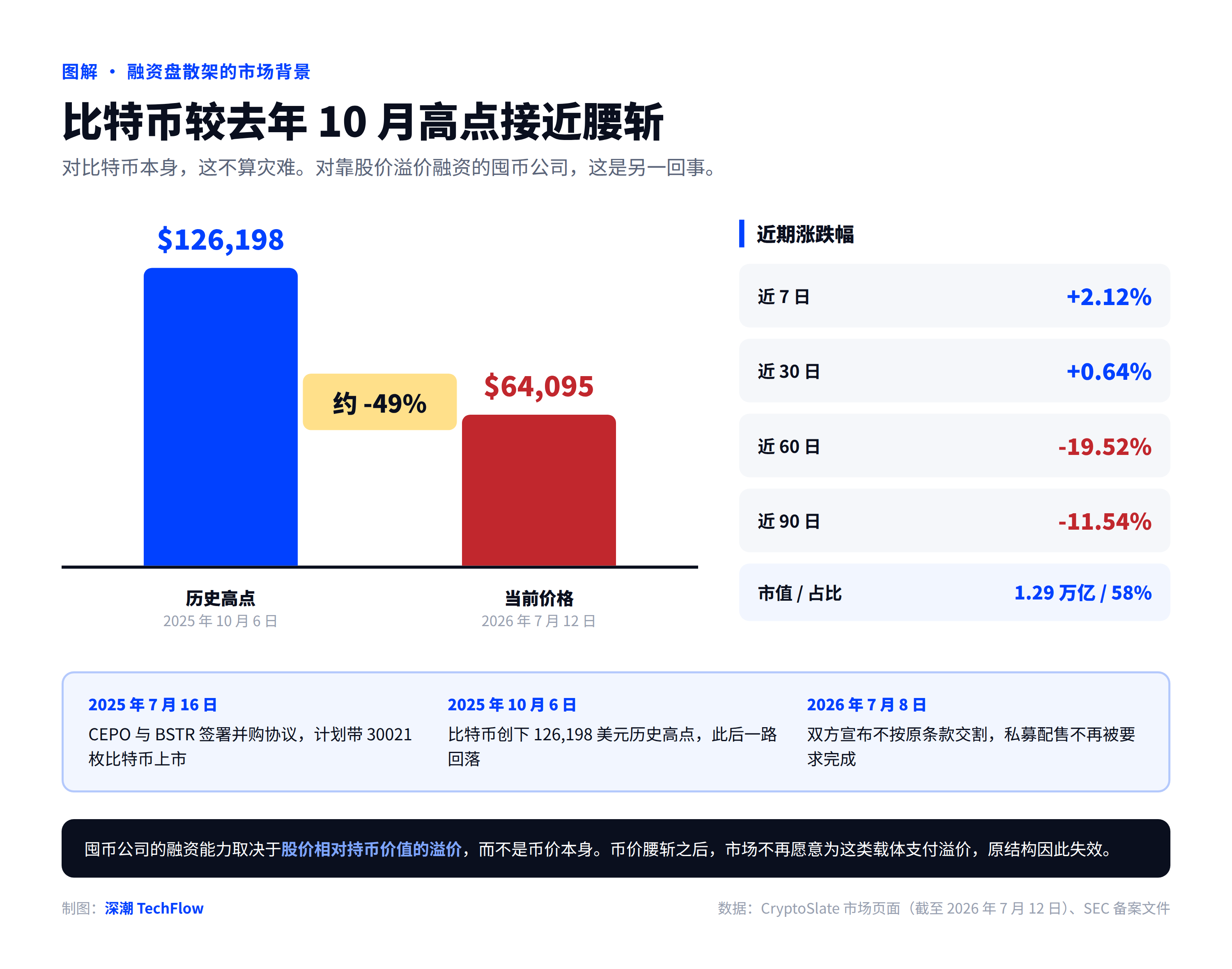
On July 12, Bitcoin was quoted at approximately $64,000, with a market capitalization of about $1.27 trillion, making up about 58% of the crypto market. This price is approximately 49% lower than the historical high of $126,200 set on October 6 of last year and has dropped about 19.5% in nearly 60 days.
For Bitcoin itself, this isn’t a disaster. For coin-storing companies relying on premium financing, it’s a different story.
Other news from the same week can serve as a reference. American Bitcoin, in which Eric Trump is involved, was forced to implement a 1-for-15 reverse stock split to maintain Nasdaq's minimum price requirements, holding about 8,000 bitcoins. Strategy's preferred shares fell below par value in June for a time. Metaplanet’s stock price has already dropped below its holding value of bitcoins. At the beginning of July, another American coin-storing company cleared all its Bitcoin holdings under debt and Nasdaq compliance pressure.
Meanwhile, capital is moving elsewhere. AI computing company CoreWeave has just completed a $20 billion financing round.
The next SEC document is the real verdict
Cantor and BSTR are still negotiating, and the original terms have been voided.
If the two parties reach a new agreement, there will be new SEC documents to amend or supplement the registration statement and proxy materials. That document will answer three questions: how much of the 30,021 bitcoins' scale remains, how much of the original PIPE commitments remain, and what price do investors now require to invest.
According to market data cited by TFTC, CEPO's stock price is currently around $10.5, close to its trust value. This position itself is a signal: the market is not giving this transaction any premium.
The risks listed in the July 8 document are almost the checklist for the upcoming negotiations: public shareholder redemptions, public float percentage, liquidity, exchange listing, Bitcoin price volatility, competition, regulatory uncertainty, and the difficulty of expanding Bitcoin accumulation and treasury operations.
For readers holding coin-storing stocks, the implications of this matter fall into two categories:
If the new terms maintain the scale of 30,000 bitcoins, retain substantial investor commitments, and do not massively pass costs onto new shareholders, it means this model can be revalued and survive in a low-premium environment.
If the new terms reduce the holding scale, raise the cost of capital, weaken investor protection, or rely more on dilution to raise funds, it means the next batch of coin-storing companies can no longer benefit from the premium dividends left by the previous cycle. Those buying such stocks are essentially paying for someone else's restructuring.
BSTR is now a public stress test for the entire sector. The test results will be written in the next SEC document.
免责声明:本文章仅代表作者个人观点,不代表本平台的立场和观点。本文章仅供信息分享,不构成对任何人的任何投资建议。用户与作者之间的任何争议,与本平台无关。如网页中刊载的文章或图片涉及侵权,请提供相关的权利证明和身份证明发送邮件到support@aicoin.com,本平台相关工作人员将会进行核查。


