Author: Zhou Ailin, Tencent Technology
Editor: Liu Peng
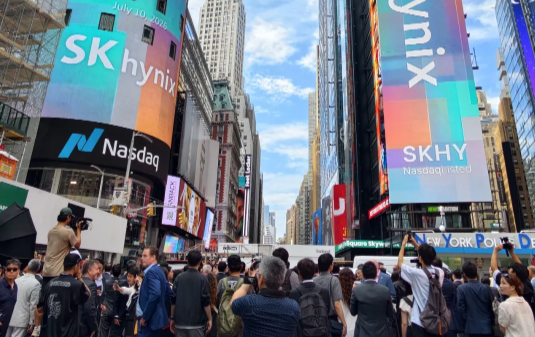
New York in July is extraordinary, crowds surge in Times Square. In front of the Nasdaq Market Center, the blue logo of South Korea's SK Hynix intermingles and flashes with the green light strips of Nasdaq on a giant LED screen, shining blindingly under the morning sun in Manhattan.
On the morning of July 10, local time in the United States, the "King of HBM," Hynix, officially landed on Nasdaq. Hynix is one of the world's largest memory semiconductor companies. The company focuses on the design, manufacture, and sale of advanced memory semiconductors, including DRAM (Dynamic Random Access Memory), NAND flash, and High Bandwidth Memory (HBM) for artificial intelligence (AI). HBM is currently the most scarce hardware component in the AI ecosystem.
This US stock issuance was oversubscribed by seven times, raising $26.5 billion, making it the second largest stock issuance globally, following last month's listing of SpaceX. The financial report for the second quarter of this year shows that Hynix's net profit for the quarter reached an astonishing 40.35 trillion Korean won (approximately $27.3 billion), a year-on-year increase of 398% and a quarter-on-quarter increase of 165%. To put this in perspective, Nvidia's net profit in the first quarter was only about $19 billion. A company selling the world's most expensive GPUs has a single-quarter net profit that is less than that of Hynix.
A Hynix employee on site told Tencent Finance, "I specifically took leave to fly to New York to attend this listing ceremony." He joked that many young people in South Korea have indeed invested in leverage ETFs related to memory, and there is a sense of FOMO (fear of missing out on rising markets) among everyone.
However, after experiencing continuous price hikes in the memory industry and a significant rise in company stock prices, the memory sector has recently entered a consolidation phase. Is Hynix's landing on the US stock market a signal of a peak, or the beginning of an expansion? What does this mean for Changxin Technology, which is about to land on the A-share market?
Asif Suria, founder of San Francisco asset management firm Inside Arbitrage, told Tencent Finance, "Hynix's landing on Nasdaq is clearly an attempt to benefit from the current favorable industry cycle. From the demand side, memory chips are still in short supply, and we have already seen the impact of this tension in supply and demand; for example, Apple has raised prices for some of its products. However, stock prices usually lead fundamentals, hence the current pullback in the memory sector is healthy. I believe that at least until the end of this year, the core logic of this bull market has not changed. But compared to the volatile and leverage-complex Korean stocks, I prefer to gain memory exposure through holding Micron Technology."
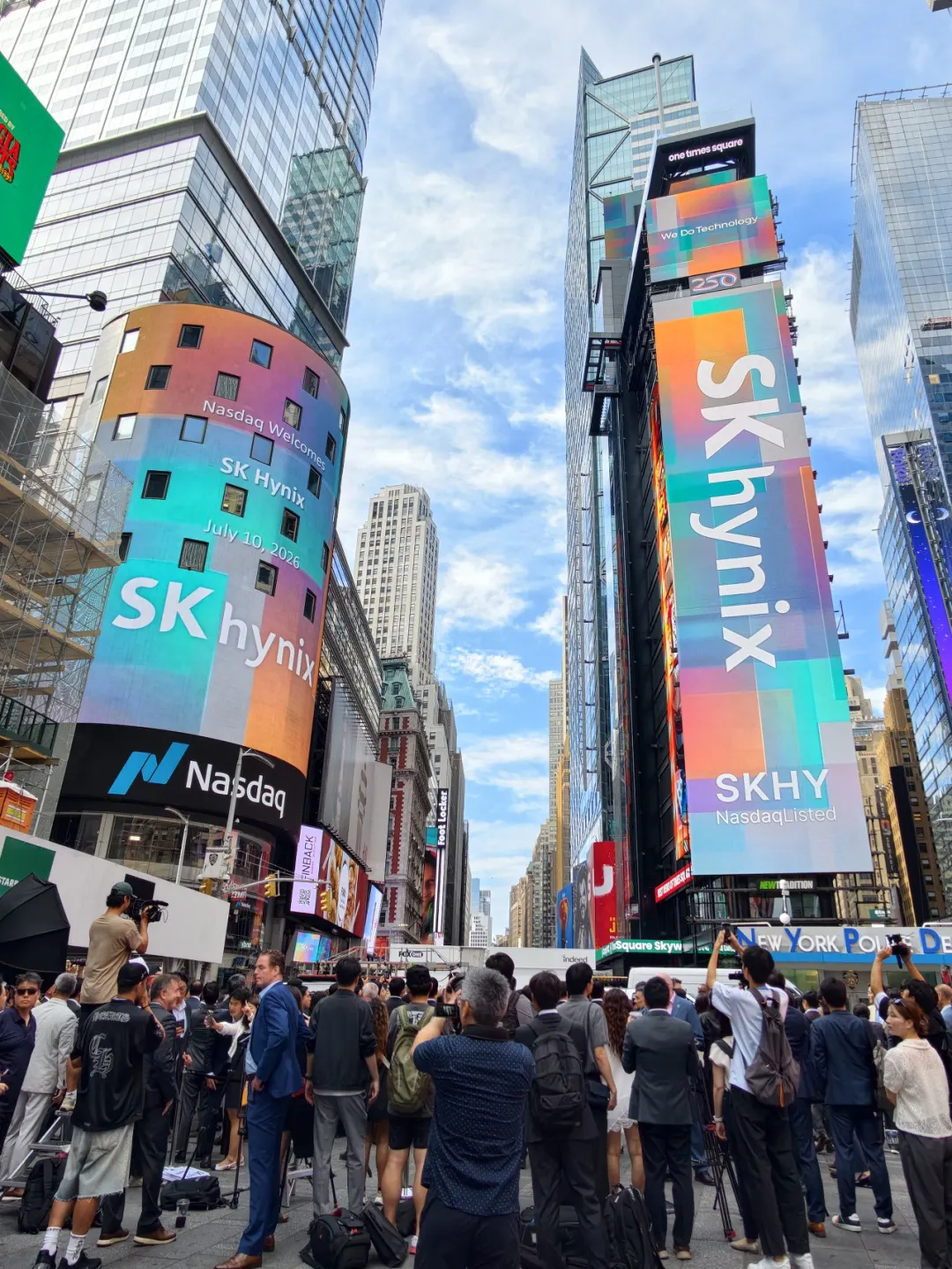
Scene outside Times Square during Hynix's listing at Nasdaq. Photo: Zhou Ailin
01 HBM Dominance in the AI Era
Under this AI supercycle, Hynix's kingly status has been highlighted.
The explosive growth of large AI models and high-performance computing (HPC) has led to a surge in demand for high bandwidth, high capacity memory. According to Gartner data, from 2025 to 2027, the overall memory semiconductor market is expected to expand at a compound annual growth rate (CAGR) of 86.0%, reaching nearly $748 billion by 2027. The growth of HBM is particularly rapid.
Meanwhile, the average selling prices of the company's DRAM and NAND products are also expected to rise significantly. The industry is transitioning from consumer demand-driven to enterprise and data center demand-driven, which brings continued growth opportunities for high-end memory products (such as HBM and enterprise SSDs).
Let's take a look at Hynix's industry position and the industry competition landscape:
Industry Position:
- In the field of HBM: Global leader. According to IDC data, in the first quarter of 2026, Hynix's revenue share in the HBM market reached 56.4%, ranking first in the world.
- In the field of DRAM: Global second. Market share of 29.1% in the first quarter of 2026.
- In the field of NAND: Global second. Market share of 18.5% in the first quarter of 2026.
Competition Landscape:
- DRAM market: Highly concentrated, primarily dominated by Samsung Electronics, Hynix, and Micron Technology.
- NAND market: Major competitors include Samsung Electronics, Kioxia, Hynix, and Western Digital.
- Barriers: The industry has extremely high technological and capital barriers, making it difficult for new entrants to pose a threat in the short term.
The reason Hynix can maintain high profits is that HBM technology barriers are high. Hynix is a pioneer in HBM technology, first mass-producing HBM3E in 2024 and successfully developing the next generation HBM4 in 2025. Its mastery of TSV (Through-Silicon Via) packaging technology and MR-MUF (Mass Reflow Molding Underfill) process is its core moat. HBM is critical because it alleviates the "memory wall" problem encountered when the computational power of high-performance GPUs far exceeds the speed of traditional memory.
From the perspective of process technology, Hynix also maintains an absolute advantage. For instance, in the DRAM field, the company has a 1c generation (sixth generation 10nm level) process technology; in the NAND field, it is transitioning from 238 layers to 321 layers of high-density flash memory products, continuously improving storage density and energy efficiency. As AI server architectures continue to evolve, the role of CPUs in the system is becoming increasingly important, which means the demand for server DRAM also increases with each node.
The business model is particularly crucial for an excellent company. "Dual-driven" is the key phrase. The company secures stable cash flow by mass-producing standard memory chips (such as DDR5, SSD) on one hand; on the other hand, it achieves excess profits through customized, high value-added AI-specific memory (such as HBM, CMM).
Moreover, due to its strong cash-generating ability. Benefiting from the industry upturn cycle driven by rising memory prices, the company has ample cash flow, enabling it to support massive capital expenditures (Capex). In the context of the extreme shortage of HBM, the company’s determination for capacity expansion has also been demonstrated, which is one of the main purposes of Hynix's fundraising in the United States. The company is constructing a massive semiconductor cluster in Yongin, South Korea, and advanced packaging facilities in Cheongju and Indiana, USA, ensuring capacity supply for the next 5-10 years.
02 The Cyclical Struggle
The memory industry has always been a highly cyclical industry. Now the million-dollar question is — when will the cycle return, and when will stock prices react in advance? Recently, the South Korean memory sector has continued to pull back, pushing this question to the forefront.
In AI servers, the value of memory accounts for as much as 40%, due to the continuous expansion of the number of tokens processed by AI, the demand for DRAM capacity has nearly quadrupled, and prices have soared as supply cannot meet demand. Meanwhile, cloud vendors and memory manufacturers have successively signed long-term supply agreements (LTA), actively smoothing out the previous cyclic volatility. In at least the past two years, the traditional "memory cycle" has almost disappeared.
"But that doesn't mean the cycle will never return." Stuart Rumble, Chief Investment Strategist for Asia Pacific at Fidelity International, previously told Tencent Finance that historically, every wave of technology infrastructure ultimately experiences a phase of excessive investment, and the memory sector will be no exception. Major memory companies are expanding production, but the new capacity is expected to hit the market concentratedly only by 2028 to 2029. The capital market typically trades fundamental changes 12 to 18 months in advance — this means that the capacity pressure becoming a market theme may only happen in 2027.
Even if strong earnings actually lead to a contraction in Hynix's valuation (i.e., becoming cheaper), Asif Suria told Tencent Finance, "The contraction of valuation multiples could actually be a bearish signal, because for cyclical stocks, it often appears that valuations look cheapest when the industry cycle peaks and earnings are at their best."
03 The Three Core Controversies Currently in the Memory Sector
In light of the recent pullback in the memory sector, Morgan Stanley has pointed out three core controversies in the market:
Controversy 1: Did Meta's Sale of Computing Power Mean the Collapse of the AI Bubble?
A rumor circulated in the market last week: one of the world’s largest AI computing power buyers intends to sell surplus computing resources. The interpretation from bears is obvious — if ultra-large-scale cloud vendors have surplus computing power, has the entire AI development become oversupplied?
Morgan Stanley's judgment is: the real answer will wait for the second quarter financial reports.
Selling computing power does not equal surplus; it is more likely a business behavior of cloud vendors optimizing their capital return rates. The true judgment criterion is whether ultra-large-scale cloud vendors maintain or increase capital expenditures in their second-quarter financial reports — if they increase, memory stocks will have an excellent buying window; if they decrease, the narrative of oversupply will continue to fester.
At the same time, a new variable appears in token economics: many companies previously encouraged employees to consume as many tokens as possible, but this has led to IT budgets being overspent; companies are now starting to cut back on token usage and turn to cheaper alternative models — companies are building an "orchestration layer": simple queries are handled by open-source models, while complex queries are reserved for flagship models. This means that while the AI supply chain performed adequately in the second quarter, uncertainty in guidance for the second half is rising.
Controversy 2: Why Didn't Long-Term Supply Agreements (LTA) Propel Valuation Reassessment?
The signing of LTAs by memory stocks should have been a significant positive, but the stock price reaction has been muted. Morgan Stanley provided a direct answer:
The market is rational — it remembers that in the past, LTAs were renegotiated or ultimately forced customers to accept unwanted inventories (similar to semiconductor companies during the COVID pandemic). The market's indifference towards LTAs is fundamentally a reasonable doubt regarding whether the "structural" AI demand can truly continue to exist. Morgan Stanley believes that while the current memory LTAs indeed have structural characteristics (as long as AI demand remains strong), the biggest uncertainty faced by bulls is whether profit expectations can continue to exceed expectations.
Controversy 3: Is the Cycle at its Peak or Has it Been Extended?
Morgan Stanley clearly distinguishes between two concepts: "rate of change peaking" ≠ "cycle ending."
The issue is that the year-on-year price increase has narrowed significantly from over 100% in the first quarter to single digits to low double digits in the third quarter — this is an intuitive manifestation of "rate of change peaking."
Now, institutions still maintain a long-term bullish stance on the memory industry, citing expected profit growth of 35-40% by 2027 and the large-scale popularization wave of AI agents. However, they provide three clear signals for the short term:
- Stock prices will continue to be under pressure before the earnings season; market reactions will depend on how ultra-large-scale cloud vendors interpret AI capital expenditures
- Sector preference: DRAM > traditional memory >> NAND, least favorable toward memory module manufacturers
- On the position level: The historically high long positions are difficult to maintain under the current volatility environment, and it has been observed that investors are starting to diversify positions and layout lagging opportunities (such as MLCC, semiconductor equipment, etc.)
04 Changxin's IPO "Dream Linkage"
One is landing on Nasdaq in New York, and the other is aiming for the Shanghai Star Market; the "dream linkage" of the two giants, Hynix and Changxin Technology, has attracted attention.
Changxin Technology will start its IPO subscription on July 16, with its market value expected to exceed 2 trillion yuan. A person involved in the semiconductor investment banking business at a top Chinese brokerage told Tencent Finance that Changxin's profit logic is to reap the "HBM squeezing dividend" — Samsung, Hynix, and Micron will lock more than 90% of their production capacity in the highly profitable HBM sector, resulting in a structural supply vacuum in traditional DRAM. The direct result is a cliff-like contraction in effective supply of general DRAMs such as DDR4, DDR5, and LPDDR5 — Changxin, as the only large-scale manufacturer focusing on general DRAM globally, makes money not due to technological leadership, but because competitors "step back" to earn profits. This is a typical historic window of "others compete in high-end, I profit in low-end premiums."
Samsung and Hynix have announced a gradual exit from DDR4 production, with some models seeing price increases of nearly 50% within a month in 2025, leading to an annual cumulative increase approaching 800%. TrendForce predicts that in 2026, ordinary DRAM profits are expected to surpass HBM3e — this is the first time such a reversal has occurred in history.
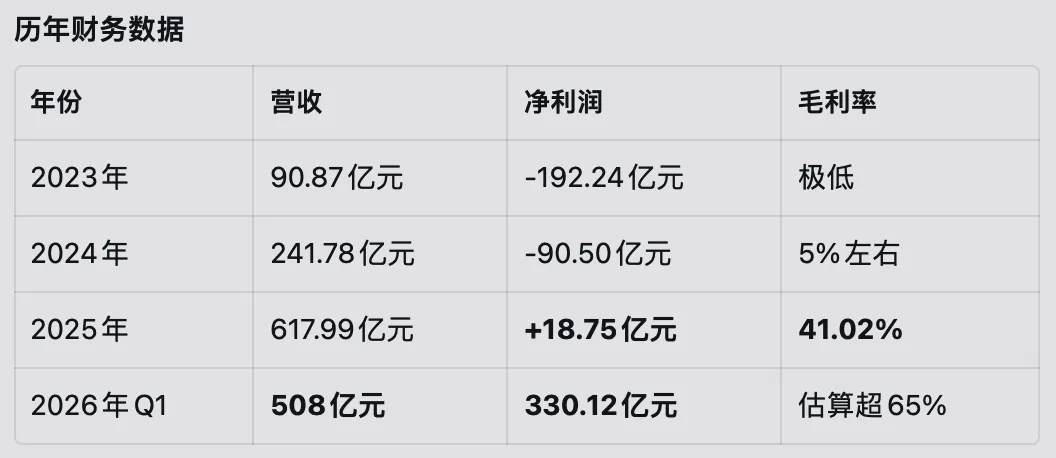
The image shows Changxin's financial data
Wang Ying, a China stock strategist at Morgan Stanley, told Tencent Finance that regarding the market's concern about liquidity squeeze, the listing of quality giants will actively promote retail participation, attracting more off-exchange funds into the market with robust fundamentals and a larger circulation. Additionally, since the beginning of the year, state funds have sold over $150 billion worth of A-share positions, and this portion of capital is fully capable of entering the market to stabilize fluctuations when short-term IPO subscriptions cause liquidity volatility.
Strong performance is the current backbone of Changxin. Although it does not yet hold a voice in HBM, Changxin's financial report remains explosive, with a gross margin jump of 36 percentage points year-on-year expected in 2025; the prospectus directly states that the reason is "the continuous increase in sales prices of DRAM products since the second half of 2025":
- Net profit in Q1 2026 is 5.7 times that of the entire year of 2025
- Revenue compound annual growth rate of 160.78% from 2022 to 2025
- The company originally anticipated profitability in 2026-2027, but this has actually been achieved over a year ahead of schedule
- Guidance for the first half of the year: revenue of 110-120 billion yuan, a year-on-year increase of more than 6 times
In the short term (now-2027), Changxin undoubtedly can benefit from the "windfall money" as the HBM squeezing effect continues; in the medium term (2027-2030), the company will profit from domestic substitution; China is the largest DRAM consumption market worldwide, but Changxin's current global market share is only 7.67%, and its penetration rate in China is far from saturation; in the long term (after 2030), the company needs to earn profits in high-end storage. The prospectus clearly outlines the technology roadmap: first pursuing general DRAM, then targeting HBM. Among the 29.5 billion yuan raised, 13 billion is allocated for DRAM technological upgrades, and 9 billion for pioneering technology R&D — this is to build capacity and technology reserves for future entry into HBM. Of course, whether this path can be successfully traversed remains challenged by three formidable barriers: the sanction wall, yield wall, and packaging wall.
免责声明:本文章仅代表作者个人观点,不代表本平台的立场和观点。本文章仅供信息分享,不构成对任何人的任何投资建议。用户与作者之间的任何争议,与本平台无关。如网页中刊载的文章或图片涉及侵权,请提供相关的权利证明和身份证明发送邮件到support@aicoin.com,本平台相关工作人员将会进行核查。


