Author: David, Deep Tide TechFlow
In the past few weeks, if you have been keeping an eye on your chip stocks, you might be wondering one thing: Has AI already peaked?
In just over half a month, the semiconductor sector has evaporated over a trillion dollars in market value, memory stocks have collectively fallen into a bear market, and even Samsung, which reported record profits, saw its stock price drop...
Bearish analysts have pulled out charts from the 2000 internet bubble, while bullish ones say this is just a correction after a rapid rise. Amid all the debates, everyone is still focused on the same companies: giants like Nvidia, Intel, and Micron selling chips.
The debate might just be a small slice of a significant industry trend change; the larger picture has hardly been put on the table for discussion. Have you considered that the chips themselves are undergoing a transformation?
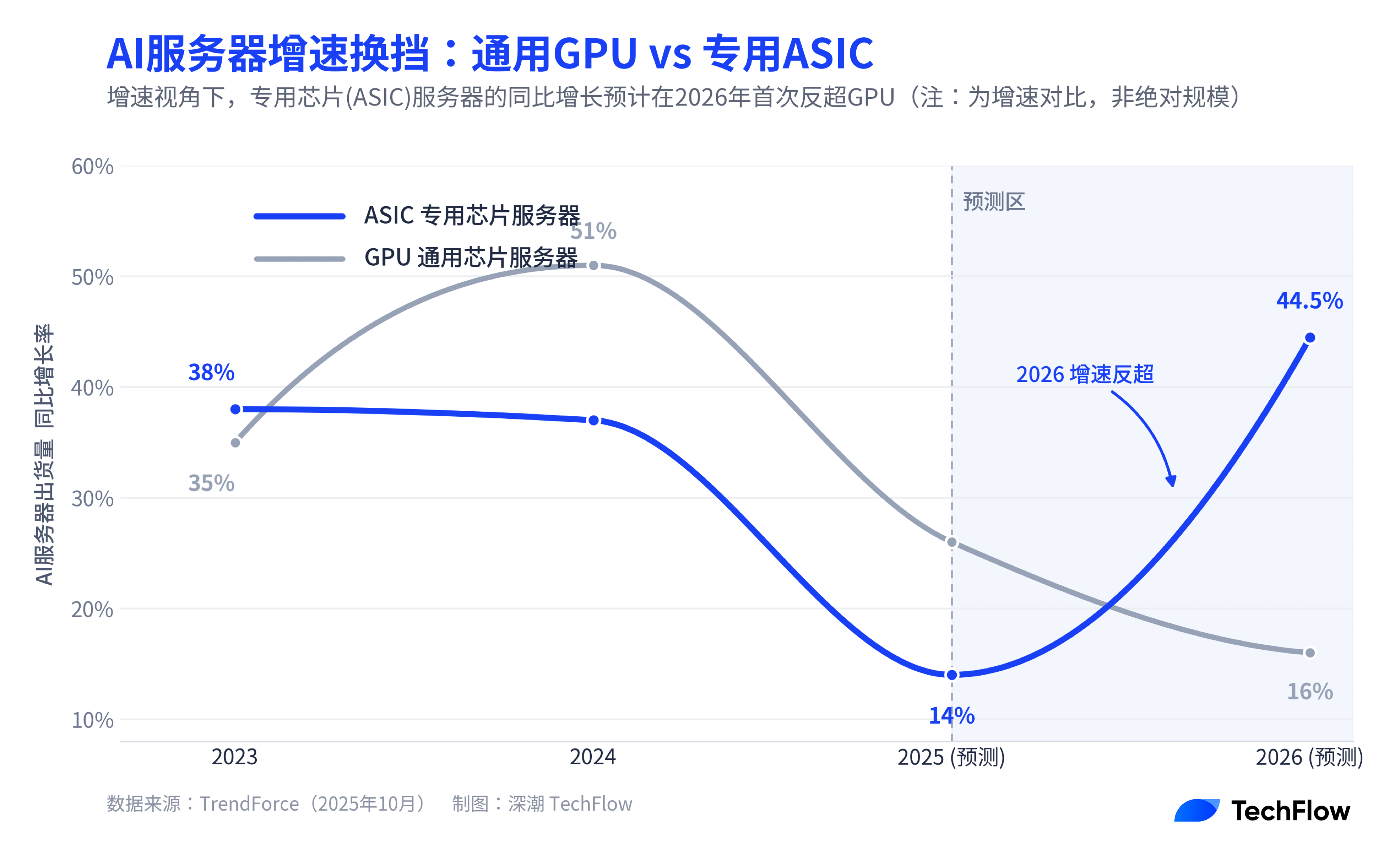
In recent years, the chips used for AI have been general-purpose. Nvidia's GPUs can handle anything—drawing, training, inference, you name it. But the cost of being versatile is that they don’t reach extremes in any one area.
Now, almost all major tech companies are quietly building something new: specialized chips that do one thing but do it to perfection.
OpenAI is building, Google's TPU and Amazon's Trainium are doing the same, and Broadcom’s stock surged this year due to its work on chips for Google. This could be a dark horse that most people haven’t noticed yet.
The era of general-purpose chips is being pried open by specialized chips.
On this dark horse line, a company you might not have even heard of is making strides more aggressively than anyone else, even boldly claiming to replace Nvidia.
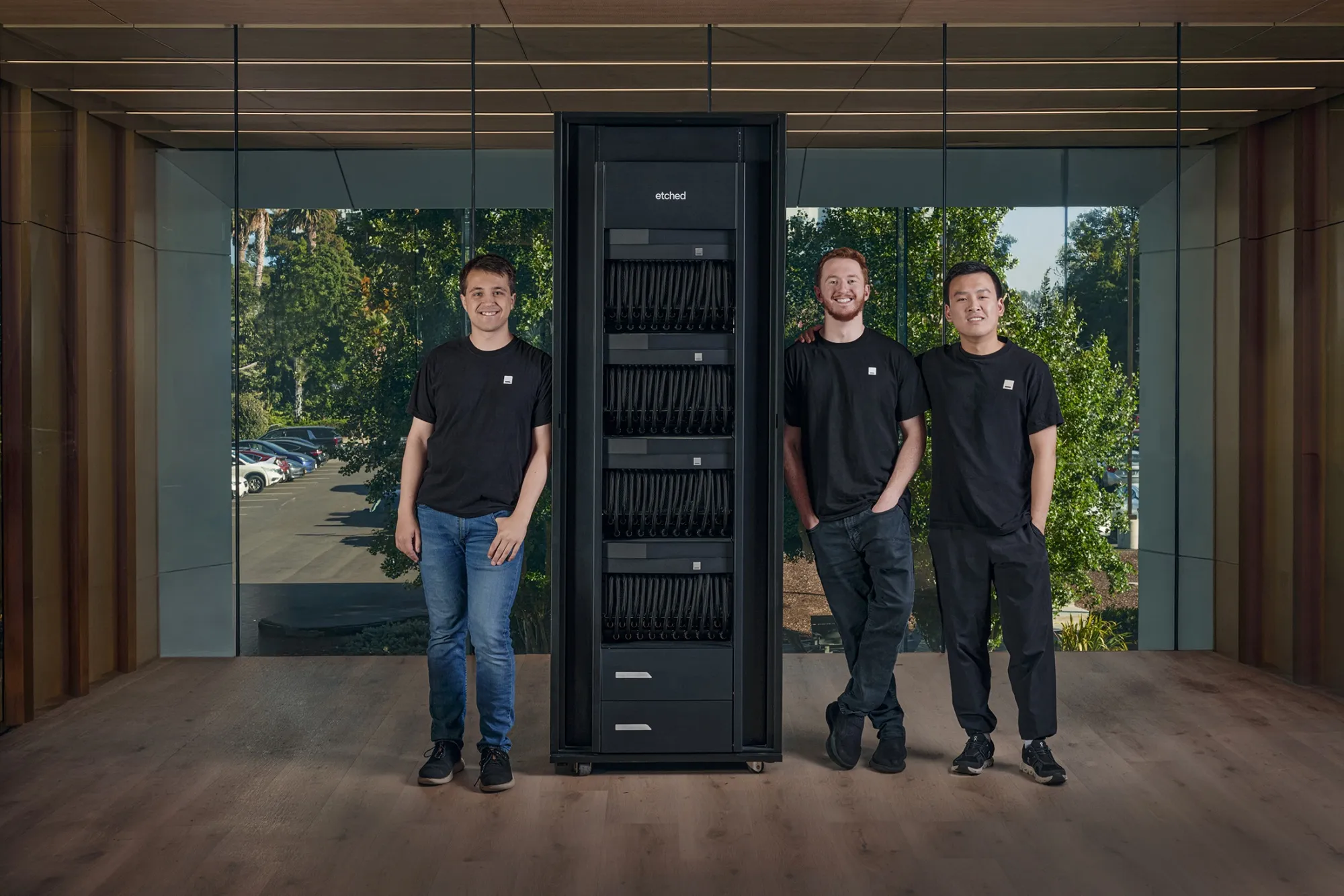
It’s called Etched and was founded by three young dropouts from Harvard, all around 25 years old this year. The company has been established for four years and hasn’t sold a single product to date.
But it has attracted investment from notable figures and institutions:
Silicon Valley venture capital legend Peter Thiel, top quant firm Jane Street, venture capital funds associated with TSMC... This company, which has yet to deliver a single chip, has currently raised about $800 million and is valued at $5 billion.
Even more unusually, according to reports, it already holds over $1 billion in orders for chips that haven’t even been made yet.
The three founders believe that the biggest cost in AI has already shifted from "training models" to "getting models to answer questions," which is inference.
Every time you ask ChatGPT or Claude a question, behind the scenes is an instance of inference, happening billions of times a day—it’s the most expensive and most frequent part of AI.
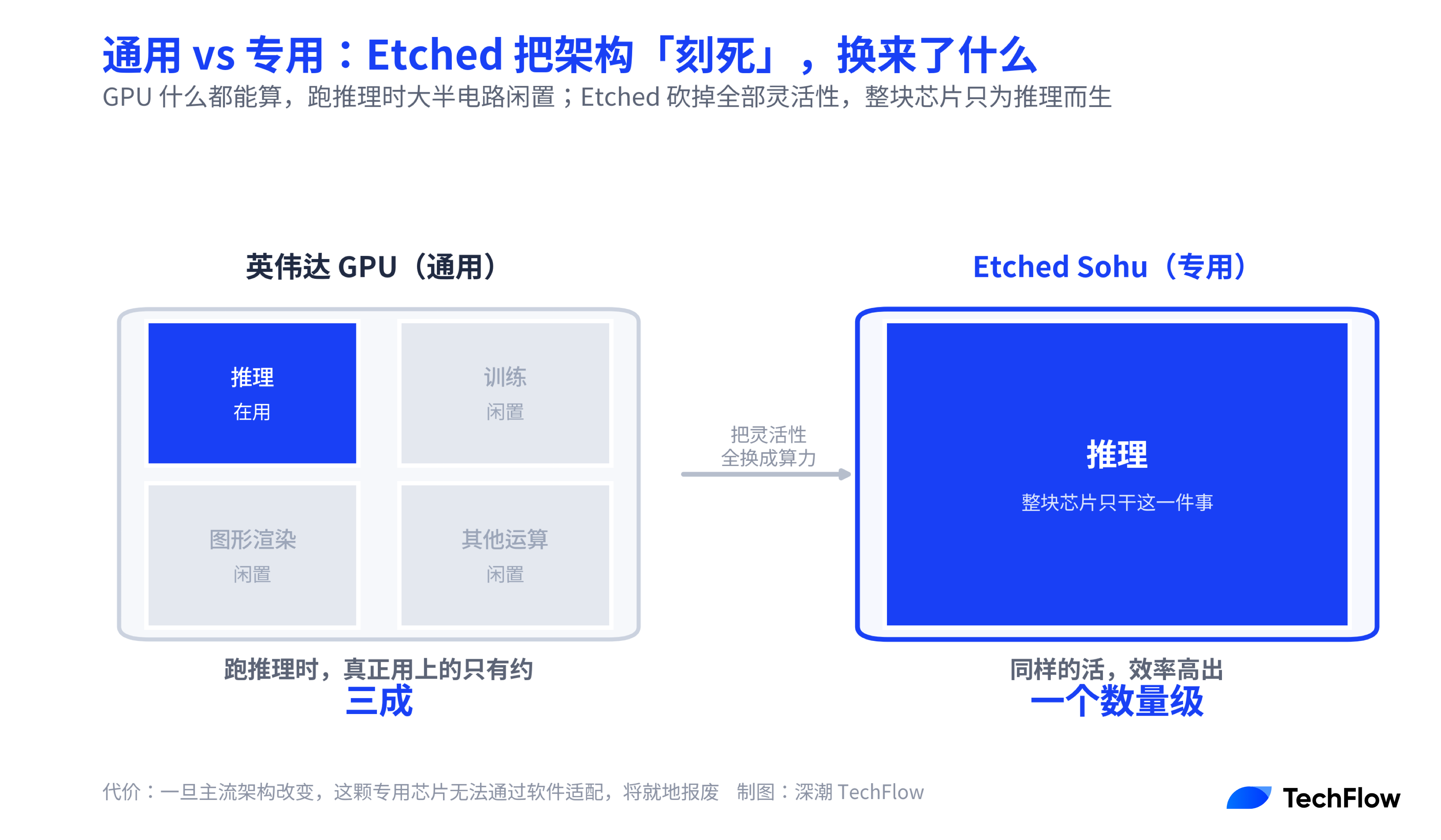
Nvidia's GPUs can do everything, but they are not specifically designed for inference. What Etched aims to produce is a chip that runs only inference, incorporating the entire architecture of ChatGPT directly etched into the silicon.
According to its published data, eight Etched chips can handle the same workload as over 100 Nvidia H100 chips. This figure hasn’t been verified by third parties, but it's precisely this bold claim that gives the three young founders the courage to challenge Nvidia.
The most costly task does not require an all-purpose chip.
No Turning Back Gamble
From a product perspective, this truly is a gamble with no turning back. The key lies in the phrase "etched in stone."
Other companies making specialized chips usually leave themselves a backdoor, allowing their chips to adapt to new model structures through software; but Etched hasn’t done so. It has directly burned the underlying architecture shared by large models like ChatGPT (known in the industry as Transformer), into the silicon as physical circuits.
Every inch saved that could have been left for flexibility has been allocated to computing power, resulting in exponential speed. The price of this power is that if AI adopts a new architecture one day that is no longer Transformer, this chip becomes a piece of useless silicon, irreparable.
The founders are well aware of this point.
During the Series A funding round in 2024, the company's CEO Gavin Uberti mentioned in a public interview that they are placing the biggest bet in the AI sector; if this architecture fails, the company will perish.
However, if they survive, Etched would become the largest company in history.
When he said this, he was 23 years old, and the company had just $120 million in its account. Two years later, the company now has $800 million in funding and holds $1 billion in orders, yet that chip still hasn’t shipped.
A young man in his twenties bets his company’s fate on two fateful words: zero or the largest ever, leaving no room for retreat, which is somewhat fantastical.
But the investors putting money into him are seasoned veterans; why do they also dare to join in on the gamble?
When Inference Becomes the Profit Center
AI training is Nvidia's moat, but inference is not.
Training takes a model from zero to being functional, burning a huge amount of computing power once every few months; while inference occurs daily, answering questions for hundreds of millions of users repeatedly, burning money each time.
The way these two tasks spend money is entirely different. According to multiple foreign media reports, inference has surpassed training to become the largest ongoing cost for AI companies, as well as the biggest bottleneck.
There are reports that Anthropic could turn profitable this quarter purely from inference margins. The focus of money is quietly shifting from training to inference.
Almost all inference today runs on Nvidia's GPUs, but GPUs are not designed for this task, meaning a lot of circuits are idle during inference.
Gavin Uberti of Etched mentioned in an interview that when GPU clusters run inference, the actual computing power utilization rate is often only 20-30%, with over half of the capacity wasted.
In other words, if you spend $50,000 to $150,000 on a Nvidia machine for inference, only 30% of that power is actually utilized, while the remaining 70% might just be generating heat and consuming electricity.
Nvidia’s moat has been built on training and its CUDA software ecosystem, with high and thick walls that short-term competitors struggle to overcome. But inference is different; it's a more singular and repetitive task, not requiring an all-purpose chip, and here Nvidia doesn’t have the same barrier.
You could say Nvidia is the highest-valued chip company globally, but the most profitable and fastest-growing part of its business is exactly where it isn’t fully skilled and adaptable.
The investors betting on Etched are gambling on this shift in focus.
Among them, the least likely to be chip investors is longevity enthusiast Bryan Johnson, a tech billionaire who measures over a hundred metrics daily in hopes of reversing aging.
According to him, a few years ago the two founders of Etched dropped out and found him, claiming they could create faster AI chips to accelerate longevity research—the faster the chip outputs tokens, the faster they can find drugs and unlock diseases.
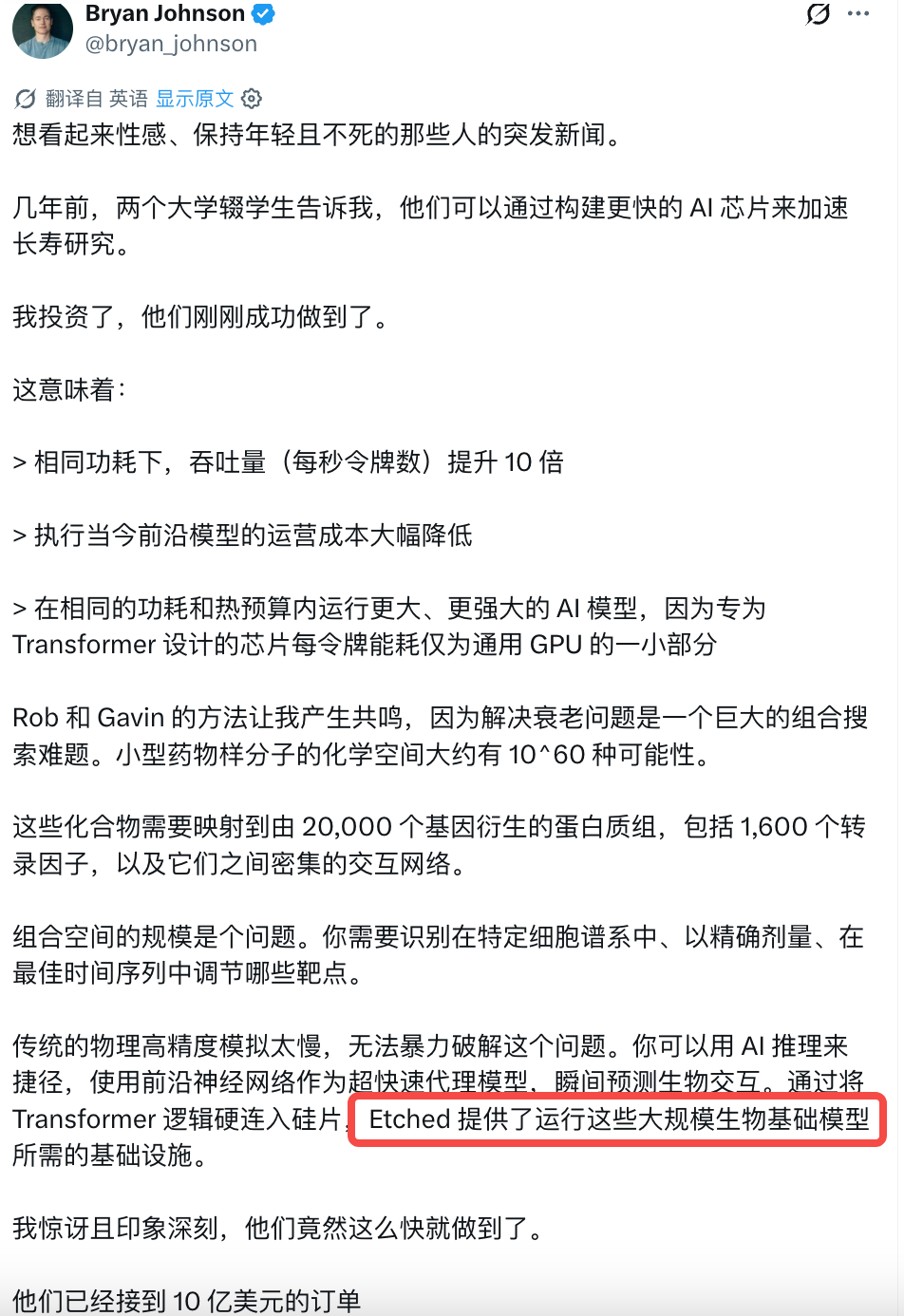
Whoever makes inference quicker and cheaper can redefine pricing for all industries relying on AI.
You might wonder why Nvidia doesn’t develop its own inference-specific chip. In reality, it certainly could. But why would a giant like Nvidia risk everything to pivot entirely to specialized GPUs?
Thus, this is the budding form of a story about marginal disruption.
This Summer, the Bet is Revealed
The chip Etched has gambled on for four years is set to be delivered this summer.
For a company that has been established for four years and hasn’t sold a single product, this is a moment of fulfillment. When the chip is installed in clients' data centers, it will be tested to see if it lives up to its claim of being designed specifically for inference.
But just before revealing the cards, the table itself has quietly changed a bit.
What Etched has etched into the silicon is the image of AI it believed in three years ago. However, during the years it has been working hard on chips, some AIs have changed their gameplay. In the past, a model was an entire block, calling upon everything for any question; the strongest recent open-source models have changed their structure, breaking into many small pieces and only temporarily selecting a few blocks to do the work. DeepSeek and Qwen, among the cutting-edge Chinese open-source models, all follow this new approach.
Changing the software might take a few weeks, but producing a chip from design to mass production takes two years. Etching the architecture in stone, to some extent, is just short-selling the speed of change.
This flavor feels familiar to anyone who has experienced the last cryptocurrency cycle. Ethereum once relied on hardware mining, with a batch of machines dedicated only to mining Ethereum, leaving general-purpose graphics cards far behind. This is exactly the story Etched told its investors: Specialization crushes generalization.
On the night of September 2022, Ethereum completely changed its mining rules from hardware-based to token-holding, rendering all the mining machines built globally, along with countless graphics cards, effectively worthless—tens of billions of dollars in hardware became worthless overnight.
The mining machines gambled on unchanged algorithms, while Etched bets on an unchanged architecture; and the three founders also understand this hurdle.
Their approach is to race against time.
Uberti repeatedly mentioned a term in interviews: "too late." He believes Etched is at least 18 months ahead of giants like Nvidia and Google in specialized inference chips; by the time big companies catch on and produce similar products, Etched will have already iterated to its second generation and locked in its customers.
In other words, he is not just betting that the current mainstream AI inference architecture, Transformer, won’t die, but he is also betting that they are fast enough to deliver the goods this summer and capture the market before the architecture changes beyond their reach.
This is a race about speed, and there’s more than one company betting on this race.
Investment is Betting on Technology to Flourish
Looking back, the story of Etched is not only about Etched.
It has pushed a matter that everyone is involved in yet rarely speaks openly to the extreme. If you hold stocks of Nvidia, Broadcom, Cambricon, Cerebras, etc., you are never just buying a company's performance; you are making a judgment, betting that a certain technical route can last long enough, long enough for the money poured around it to be recouped.
Etched simply placed this bet in the most no-turning-back position. It has forever etched the architecture into silicon, where it is either win or lose—clear cut; whereas most bets are soft, slow, and hard to even be aware of.
Buying into a "specialization" story is, in a sense, betting against the speed of change.
The slower the change, the steadier your winnings; once change speeds up, the more permanent your etching, the harder the fall.
This summer, Etched’s chip will naturally provide its share of answers. But this also serves as a noteworthy barometer and signpost, testing every position in your account that quietly bets on "it won’t change."
It's time to turn over the cards in your hand and take a good look for yourself.
免责声明:本文章仅代表作者个人观点,不代表本平台的立场和观点。本文章仅供信息分享,不构成对任何人的任何投资建议。用户与作者之间的任何争议,与本平台无关。如网页中刊载的文章或图片涉及侵权,请提供相关的权利证明和身份证明发送邮件到support@aicoin.com,本平台相关工作人员将会进行核查。


