
Original Author: Shao Jia Dian
From the end of June to early July, Binance notified users in some EU countries such as France, Italy, Poland, and Spain that it would limit or cease certain cryptocurrency services and suspend new user registrations due to failing to obtain CASP authorization before the end of the EU MiCA transition period. Binance emphasized that users' assets remain accessible and did not indicate a permanent exit from Europe; however, after July 1, 2026, unauthorized platforms cannot continue to provide comprehensive services to EU customers as they did in the past. (Related reading: MiCA Era New Landscape for European Crypto: Why is Germany on the Main Stage?)
This news is striking because the protagonist is not a small exchange or a nascent project but Binance. Over the past few years, Binance has experienced regulatory adjustments in multiple markets globally: some locations withdrew applications, some ceased services, and some changed entities to reapply. When it comes to MiCA, the market originally expected that leading platforms would be more capable of completing compliance transitions ahead of smaller projects, but the outcome was not so smooth.
The timeline for the EU MiCA is also crucial. July 1, 2026, marks an important deadline for the MiCA transition arrangements. ESMA (European Securities and Markets Authority) had previously made it clear that after the transition period ends, unauthorized cryptocurrency service providers are not allowed to solicit new customers, should not continue to market related services, and can only make very limited arrangements for customer exits and winding down operations. In simple terms, Europe will no longer accept a "do business first, get licensed later" ambiguous state.
For Web3 project teams, this news is not just about Binance's troubles. It indicates that the European market has moved from a phase of "gray area exploration" to a phase of "licensed access." The previous approach of companies being based overseas, teams scattered in Asia, websites accessible globally, users accessing on their own, and a few lines in the terms stating "not serving restricted areas" is becoming increasingly difficult to sustain in Europe.
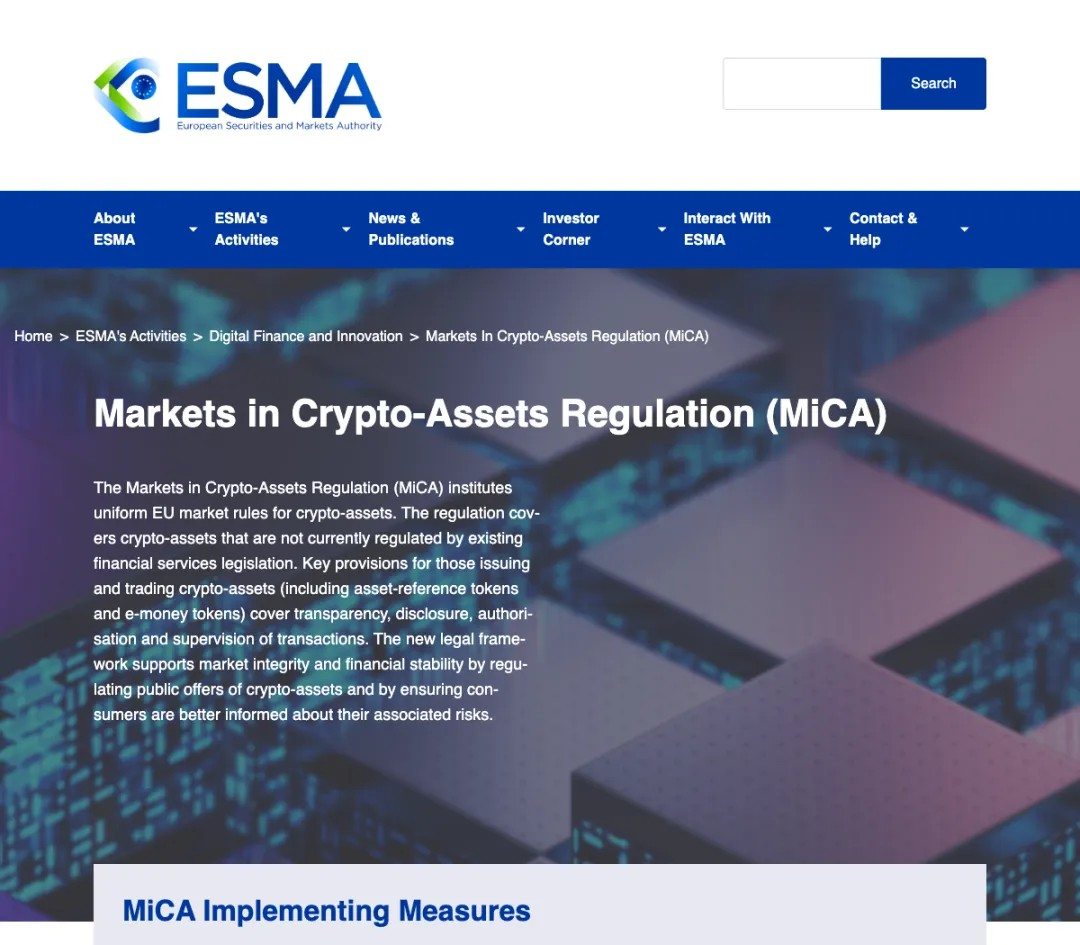
Image Source: ESMA Official Website MiCA Special Page
What Web3 projects really need to ask is not "How to get MiCA," but "Is the European market worth the heavy compliance costs?"
What makes MiCA difficult? It's not about submitting materials, but transforming the company into a financial institution.
Many project teams, upon hearing about MiCA, first respond by asking about costs and timelines: How much in Lithuania? How long in Malta? Can we submit materials first to secure a spot? This line of questioning is too superficial.
CASP authorization under MiCA is not about an empty shell entity, but rather about a continuously operating cryptocurrency service institution. Services such as trading, custody, exchange, order execution, order routing, and cryptocurrency transfer will require the project teams to disclose shareholders, actual controllers, executives, business models, risk control systems, customer asset arrangements, AML/KYC, complaint handling, information security, outsourcing, business continuity, and market abuse control to regulators.
The operating costs are the easiest to underestimate. Minimum capital is just the tip of the iceberg. The real expenses come from local board members, local compliance personnel, legal consultants, auditing, system transformation, compliance systems, regulatory communication, and subsequent maintenance. Many Web3 teams have previously relied on speed, community, and product iteration to succeed, with very lean organizational structures. However, MiCA requires a different approach: identifying responsible parties first, establishing customer protection mechanisms, and drafting clear contingency plans before discussing market expansion.
The pressure from MiCA is not just about "high licensing costs." It will alter the internal structures of companies. Project teams will need to start operating like quasi-financial institutions rather than as internet product teams trying to patch things together on the run.
This is also the real shock that the Binance incident has brought to the market. If even leading platforms may be forced to adjust their European operations at the MiCA juncture, smaller projects should certainly not view the EU license as simply a packaged outsourcing service.
Europe has always been this way, and MiCA has merely pulled Web3 into the old script.
Some project teams may feel that Europe is particularly harsh on the crypto industry. In fact, Europe is stringent on many industries.
Data compliance has GDPR, where severe violations can incur fines up to €20 million or 4% of global annual turnover; platform governance has DSA, with large platform violations incurring fines up to 6% of global annual turnover. Consumer protection, investor protection, payment compliance, financial marketing, anti-money laundering, and sanction compliance have always maintained high standards in the EU. Its regulatory logic is very consistent: if you want to enter the European market, you can, but you cannot just take European users and revenue while refusing to accept the European responsibility system.
The Web3 industry previously had a familiar narrative: protocols are decentralized, code is neutral, users bear the risks themselves, and platforms are just technology service providers. These statements resonate within the community but are not effective before EU regulators. Regulators look at what you are doing: Are there custody assets, are there match trades, are there assistances in exchanges, are there marketing efforts toward European users, are European user data being processed, and is there revenue coming from the European market?
Europe has not suddenly become unfriendly. Europe has merely placed Web3 into the regulatory framework it is already good at. The rules are detailed, the thresholds are raised, responsibilities are enforced, and the costs of violations are increased. This approach has been applied in data, finance, and the platform economy, and it is now the turn of crypto assets.
For project teams, complaining about the difficulties in Europe is not particularly meaningful. More pragmatically, the question is: Is this market worth the cost of compliance?
The soul question: Is it really necessary for your project to stay in Europe?
Europe certainly has its appeal. Users have strong purchasing power, institutional resources are mature, financial infrastructure is complete, and regulatory endorsements have value. A project that can compliantly enter Europe will see long-term branding and financing benefits.
However, this benefit does not belong to all projects.
Many Web3 projects claim to be global businesses, but upon close examination of their revenue structures, Europe is not necessarily a core market. Some European users are simply airdrop users, “easy gain” users, or community users, contributing little to stable revenue. Some traffic comes from organic visits, and once KYC is strengthened, high-risk products are limited, and local community operations are stopped, retention drops immediately. Other projects mention Europe in their business plan just to make the financing narrative more compelling, without truly relying on Europe for their business.
If European revenue does not cover the costs of lawyers, compliance officers, local directors, auditing, system transformations, and ongoing maintenance within a year, then pushing harder for MiCA is difficult to justify as a rational choice. If the business model is still not proven, challenging one of the markets with the highest global regulatory costs seems less like an internationalization effort and more like placing the hardest hurdle at the earliest stage.
For early to mid-stage projects, exiting Europe is not necessarily shameful. Licensing is not a trophy, and more markets do not equate to better.
Ceasing proactive marketing, limiting European users, adjusting user terms, closing local communities, and halting the provision of certain functions can sometimes be closer to the commercial reality than applying for a license. With limited compliance resources, limited team energy, and finite finances, project teams must decide which markets are worth pursuing and which ones should be put on hold.
If Europe is not cost-effective, where can projects go?
It cannot be simply answered with “go to Dubai,” “go to Hong Kong,” or “go to Singapore.” As long as the project involves trading, custody, exchange, payment, fiat inflow and outflow, yield products, it is hard to find a place completely free from regulation. The distinctions between different jurisdictions are not simply about “having regulation” versus “not having regulation,” but rather about the intensity of regulation, market value, banking channels, licensing costs, business adaptability, and subsequent fundraising reputation.
When project teams choose jurisdictions, it is best not to ask where is the loosest first, but rather to consider the operations, users, funding channels, and the ability to land a team.
If the project is still in the validation phase, the United States is usually not suitable as a low-cost testing ground. FinCEN MSB registration can resolve some anti-money laundering identity issues, but trading, custody, payment, derivatives, stablecoins, securities attributes, state MTL, and sanctions compliance may continue to pile up. The UK is similar; the FCA's cryptoasset regime is still being established, making it suitable for teams that need UK/US financial market endorsement and are willing to invest in long-term compliance; if the aim is only to find a lightly regulated location outside Europe, the UK may not necessarily be much easier than the EU.

Image Source: FinCEN Official Website MSB Registration Page
Hong Kong and Singapore represent two different routes for compliant financial businesses in Asia. Hong Kong's value lies in its regulatory credibility, institutional clients, Asian financial resources, and the ability to connect narratives involving RWA, stablecoins, brokerages, asset management, etc., but the VATP threshold is high, and retail business boundaries are not infinitely broad. Singapore is more suitable for payment, institutional business, stablecoins, fintech, and regional headquarters arrangements; the MAS has remained cautious of DPT services and especially does not encourage treating high-risk retail speculation as a main focus. If the project is inherently institutional, payment-oriented, or fintech-oriented, these two places are worth serious consideration; if it is just looking for a cheap license, it may lead to disappointment.
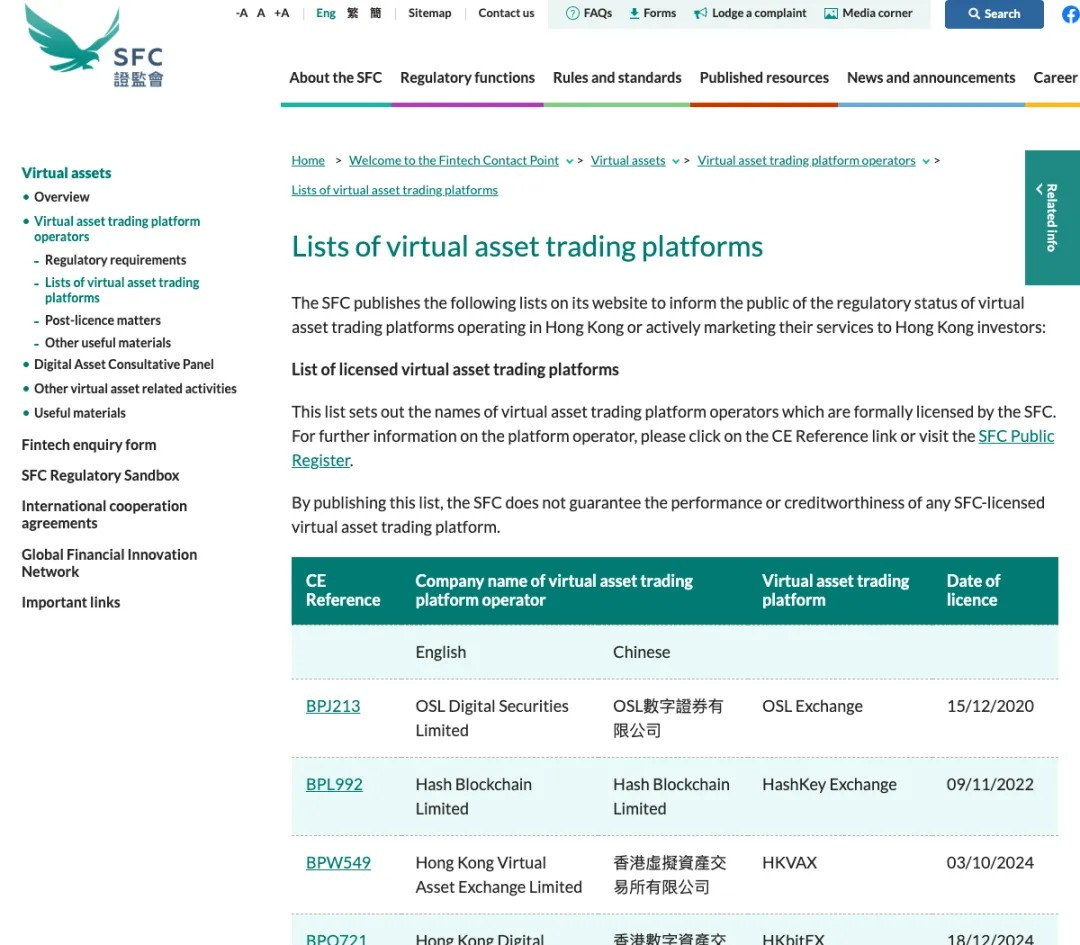
Image Source: Hong Kong SFC Official Website's List of Virtual Asset Trading Platforms Page
Japan and South Korea have user quality and market depth but come with very high localization costs. Exchange admission, banking relationships, language, regulatory communication, user habits—each aspect requires real investment. These markets do not resemble locations where “getting a license allows us to serve global users,” but rather resemble localized siege battles for mature projects. Without a local team, channels, and long-term budget, merely looking at the license itself is of little significance.
The UAE, especially Dubai VARA and Abu Dhabi ADGM, has been a frequent topic of discussion among Web3 teams in recent years. Its business environment, international talent, tax and living conveniences indeed attract many teams. It can also radiate to markets in the Middle East, Africa, and South Asia. However, Dubai is not synonymous with “loose regulation.” Businesses involving trading, brokerage, custody, payment, asset management, lending, etc. all have licensing frameworks. It is more suitable for projects willing to establish real headquarters, business development, operations, compliance, and some teams there, rather than just wanting to obtain a signboard and keep operating remotely.
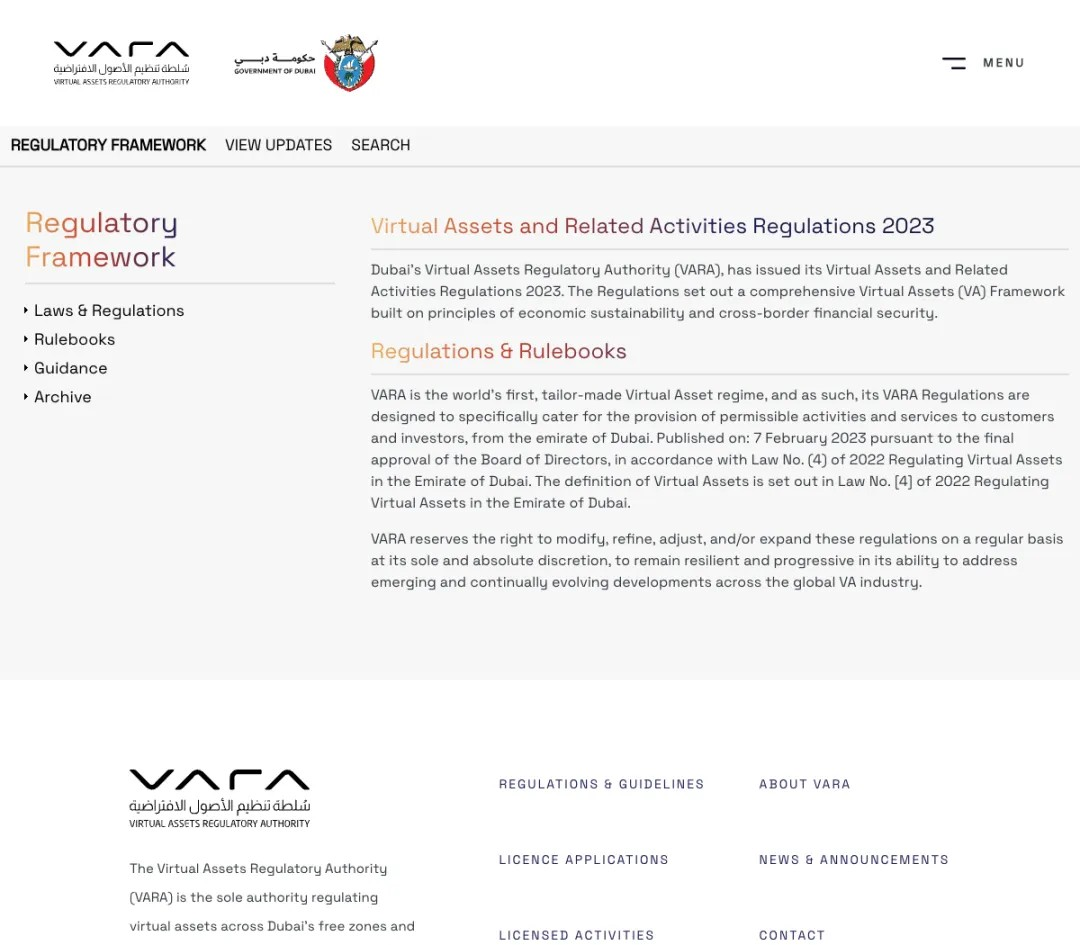
Image Source: Dubai VARA Rulebook Page
Switzerland and Liechtenstein are more suited for RWA, tokenization, foundation governance, institutional clients, and high-net-worth resources. Their advantages lie in regulatory reputation and long-term branding, not in low costs and fast tempos. The Cayman Islands and BVI are more often used for holding, funds, foundations, token-issuing entities, governance structures, and SPVs. They still serve as useful structural tools but should not be packaged as service licenses for trading, custody, and payment business for global users.
Bermuda, the Bahamas, Seychelles, El Salvador, etc., can be evaluated as offshore VASPs or emerging digital asset regulatory markets. They have space in terms of costs, speeds, flexibility, and regional narratives, but also have respective shortcomings. Banking channels, regulatory reputations, target customer acceptance, and subsequent financing impacts all need to be considered together. Offshore licenses can prevent projects from being completely exposed, but they do not prove that projects can freely service retail users in Europe and America.
Do you want users or do you want banks? Do you want a financing narrative or low-cost operation? Do you want to serve retail or focus on institutional clients? Unless these questions are clear, any licensing advice will become distorted.
Some projects should not seek licenses first but should clarify their business boundaries.
Another type of project urgently needs to organize its business boundaries rather than just obtaining licenses.
Non-custodial wallet frontend, open-source protocols, node services, data analysis, B2B technology tools, foundation governance, token treasury management, and directly providing trading, custody, and payment services represent completely different regulatory pressures. The issue is that many teams mix these elements together. The frontend claims to be a technology service, while the backend is channeling trades; terms state no services in restricted areas, but local KOLs are launching promotions; the company is registered overseas, yet the actual operations team, customer service, and decision-making are based in Asia; the project states it does not custody assets, but key processes influence asset flow.
Regulators do not only look at how projects introduce themselves. They look at where the users come from, how assets move, who controls key processes, who receives payments, who does marketing, and who handles problems when they arise. If the business facts are not clear, the licensing scheme will also not be clear.
For these types of projects, the first step is not to ask "which country is cheaper," but to dismantle functions. Each aspect—custody, trading, exchange, payment, inflow and outflow, yields, token issuance, marketing, community operations, data processing—needs to be placed under which entity, who is responsible, which users are targeted, where income is recognized, and where risks land. Only after breaking it down can one determine which businesses need to contract, which aspects can be outsourced to licensed partners, which markets need to exit, and which licenses are worth applying for.
Conclusion: Compliance is not about collecting licenses, but about choosing the battlefield.
Binance missing out on MiCA does not mean that all Web3 projects should rush into Europe for licensing. It reminds project teams that the window for rough global operations is closing.
In the past, Web3 projects liked to portray themselves as global initiatives. Websites targeted the world, communities reached out worldwide, users accessed on their own, and regulatory issues could be dealt with later. After MiCA, Europe is still open, but the entry ticket is expensive, the security inspection is strict, and ongoing checks are required after entering. This market is suited for projects that already have revenue, governance capabilities, local teams, and are willing to accept long-term regulation, rather than for every team to trial and error.
For more projects, thinking clearly about how much European users are worth, which businesses should be contracted, which aspects can be outsourced to licensed partners, and which jurisdictions are more suitable for the current stage is more important than blindly applying for MiCA.
If even Binance has to recalculate its European strategy, other projects certainly don't need to hold onto the obsession of a "global market." The next stage of Web3 compliance capability will not be measured by how many licenses a project has collected, but rather by its ability to make market trade-offs.
免责声明:本文章仅代表作者个人观点,不代表本平台的立场和观点。本文章仅供信息分享,不构成对任何人的任何投资建议。用户与作者之间的任何争议,与本平台无关。如网页中刊载的文章或图片涉及侵权,请提供相关的权利证明和身份证明发送邮件到support@aicoin.com,本平台相关工作人员将会进行核查。


