Source: "Silicon Valley Girl"
Compiled by: Felix, PANews
Steve Jurvetson is one of the few investors who bet on Tesla and SpaceX in the early stages, at a time when private space exploration was virtually ignored. Over the past 29 years, he has witnessed and invested in a range of disruptive companies created by Musk, from electric vehicles to commercial space travel, and now in artificial intelligence and the energy revolution.
In an interview on "Silicon Valley Girl", Steve Jurvetson shared three key principles of success he has concluded from his long observation of Musk and looked forward to potential drastic changes in AI, robotics, energy, biotechnology, and other fields over the next three years. He believes that the core of the next technological revolution is not just about creating new internet applications, but equipping the economic sector with a "nervous system" powered by AI.
PANews has compiled the highlights of the interview.
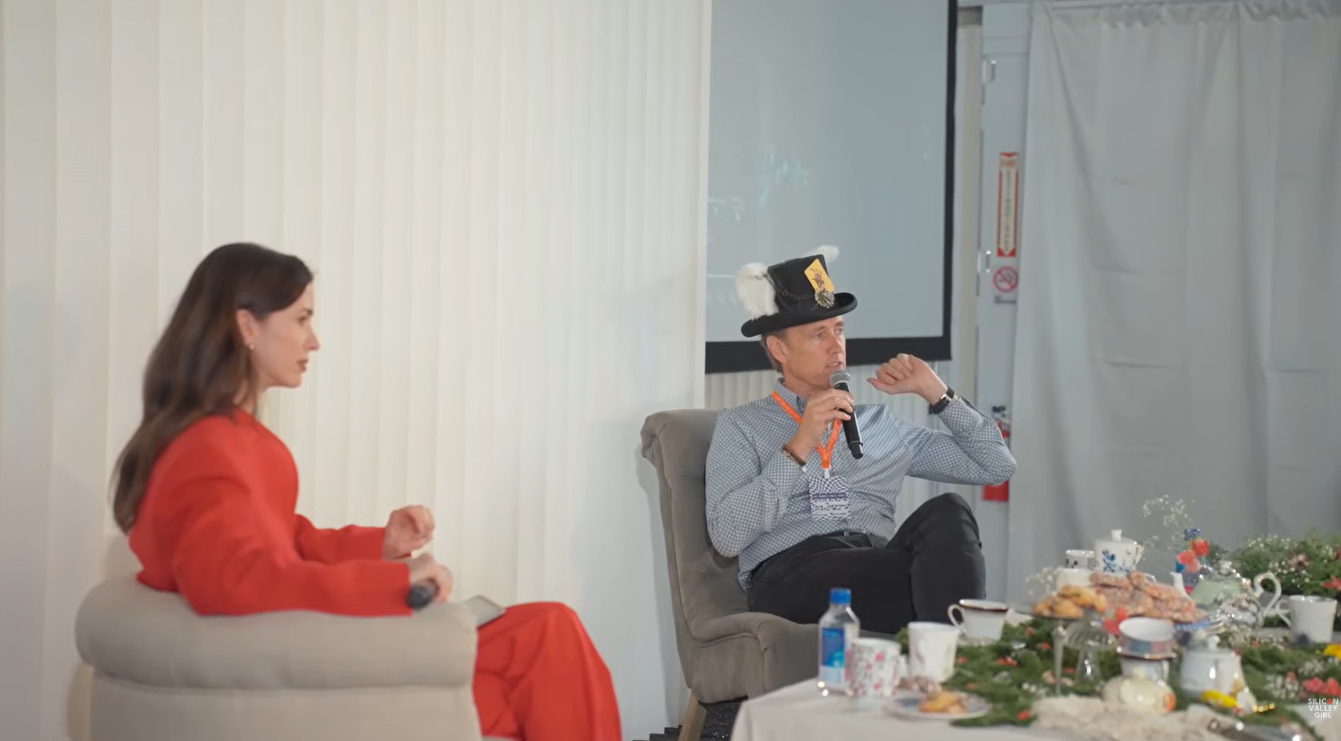
Host: You got involved in SpaceX's IPO very early on. What did you see then that most investors did not?
Steve: At that time, almost no investors were considering the space sector; it wasn't even listed in any investment website categories. So, to phrase it slightly differently: why should we invest in a field that fundamentally isn't considered venture capital? The automotive industry of Tesla is like that, as is fusion energy, with very few investments at the time. The short answer is that Musk is an incredible entrepreneur with whom we've previously collaborated. I've known him for about 29 years and invested in all his companies, even his cousin's company; you could say I'm all in.
Secondly, there's the uniqueness of the opportunity. At the time, we only had a vague understanding, but it's become clearer now: applying a software-centric, systems engineering approach to an industry that has remained unchanged for decades can unleash incredible value and opportunities. When we invested, it was still a long-term bet, but in retrospect, almost every industry is transforming into an information-driven business.
Host: Clearly, you are very good at predicting the future. I really want to understand how you think about the future. You have a chart showing 130 years of computing development, which essentially shows exponential growth. What does this mean for us? Given what is happening in computing, what will the next three years look like?
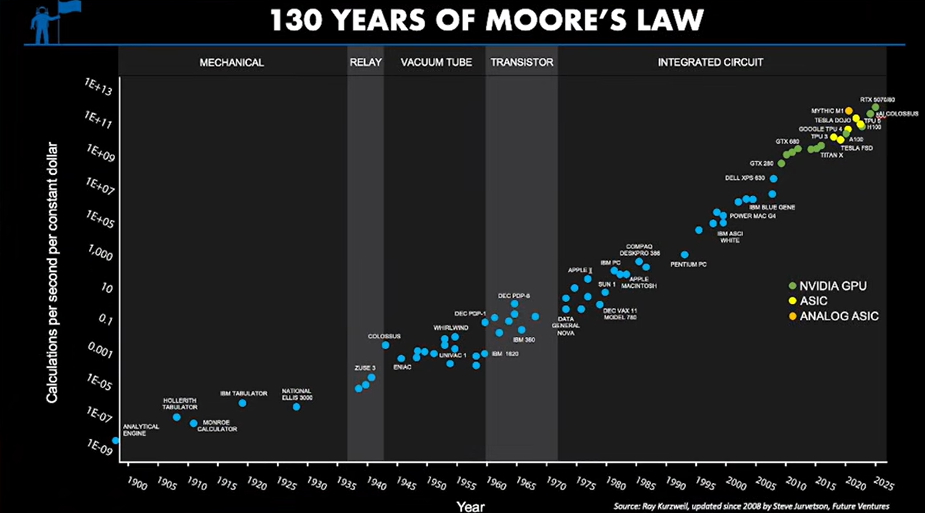
Steve: This chart shows the compounding growth of human computing power over 130 years, spanning five different technological bases. In the next three years, this exponential growth will not hit a "brick wall" as some traditional giants claim and suddenly stop. On the contrary, simulation chips and custom AI silicon will continue to uphold Moore's Law. This explosion of computing power will reshape those massive industries that are the least digitalized, particularly energy, agriculture, and construction, followed closely by healthcare.
Host: Are these the industries you believe will see the biggest changes? What is causing the changes? Is it more advanced LLMs (large language models), or do you think there is something else? I know people are creating world models and delving into robotics. What will be the biggest technological driving force for the most change in the next three years?
Steve: That's a great question, but it's difficult to give a definitive answer. I have a hunch that it will be some kind of architectural variant. It might encompass the models we know today. You can almost think of it as a mixture of expert models (MoE) incorporating other architectures, or the diffusion models we heard about earlier today that will eventually convert into Transformers. This is a different way of thinking about Transformers, a large-scale parallel form of the diffusion model. Additionally, a new generation of neural labs focusing on reinforcement learning may lead to breakthroughs. This will be a reinforcement learning algorithm with continuous learning capabilities, evolving itself from the massive data on the internet.
Host: Will we see some version of superintelligence that self-learns and sets its own goals in the next three years?
Steve: I know that Jack Clark, co-founder of Anthropic, has given a prediction saying there is a 30% chance it could happen next year. I don't have as strong opinions as they do, but they do believe they are on the right path. There is currently a huge debate about the "recursive self-improvement" that's been discussed these past few weeks. I talked to Jack about this a month or two ago. Will this lead to a leap that we cannot presently foresee? They admit they are uncertain if it will happen or what will precipitate this shift. But as of now, AI's self-improvement and general direction are still largely human-directed in terms of core goal setting. To answer your question primarily: I don’t know. It's hard to predict precisely what will happen in the next three years, but I do think it is possible.
Host: Currently, in all robot demonstrations, the technology outpaces actual deployment. We are still adapting and adjusting. How big is the gap between the technology being realized and its use?
Steve: It depends on whether you are in the "atomic world" (the physical world) or the "bit world" (the virtual world). Things involving the physical world take time. For example, fully autonomous driving cars are definitely the future, but because the average physical replacement cycle for cars is around 11 to 12 years, the replacement process can seem slow. The mass production of physical robots also takes time.
However, in some purely digital areas, AI will sweep through like wildfire, such as in creative arts and film production. Additionally, there are white-collar jobs that account for about 1% of the US GDP (like call centers), where these changes will happen instantly. Even in emotional connection and customer service interactions, AI often performs better and more empathetically than humans.
Host: You've worked with Musk for a long time. Are there three key principles that everyone should learn from him?
Steve: The first is radical focus. He incredibly efficiently rejects all distractions that are not important. For example, many years ago, I wanted to introduce him to Craig Venter to discuss how to genetically engineer Mars, and he simply said: "Nothing on Mars matters until Starship gets off the ground. I have to make that successful first."
The second is extreme focus on the cycle times of innovation, striving to see how quickly experiments can be run and iterated. For example, all of Tesla's vehicles (whether customers bought FSD or not) are collecting data, and the data collected for the AI training set every four days exceeds the total collected by Waymo historically.
The third is the absorption and recognition of top talent. He doesn't rely on degrees or specific backgrounds, but rather probes deeply into the details of engineering crises and problem-solving to see if the other party truly grasped the core technology. At the same time, he is adept at painting an incredibly grand vision (such as making survival sustainable, allowing non-multi-planetary humans), thereby attracting the smartest talents globally.
Host: I've talked to many entrepreneurs, particularly since things develop so rapidly now and new highlights emerge weekly. How do you stay true to your mission when 99% of people in the world tell you it's too early for everything, like when talking about space and saying there are many problems to solve on Earth?
Steve: That's an interesting question. I've been a VC for 30 years, and I try to only collaborate with those who have a genuine, messianic sense of mission in their minds, rather than those who are looking for arbitrage opportunities. By the way, one of the methods I use to screen this in meetings is to ask, assuming I’m very excited about a company, "What will your company look like in 50 years?" I typically get two of the most common reactions. The first is a silly smile, like "What a ridiculous question, I'm here to look for arbitrage opportunities, by then I’ll be on my third startup, how could I possibly know what my startup will be like in 50 years?" They just dismiss this question with a grin. We would directly eliminate that. The best reaction is when the person feels relieved, like "Now I can finally tell you what I've wanted to say all day; this is what drives me." This is something far ahead of what they might want to invest in today. So I think the answer is to try and find investors, partners, and of course employees who are willing to journey with you through that long path, who have a seemingly viable route to get there.
Thus, I believe there exists a tension in the best startups that can hardly be simultaneously satisfied. They have a bold, 50 to 500-year vision: what this company will do for the economy or the world, while also stating, "In the next three years, we will iterate with real customers, learn from that, and be able to outline a path from where we are now to that future." This is a linkage; sometimes it links the past to the present, such as what I need to build now to get there and moving along that path, rather than going into a research lab, coming out 20 years later, and saying I've solved all the world's problems.
Host: What are you betting on now? What should we be paying attention to?
Steve: We hold the view that AI and information technology will radically transform every economic sector, meaning equipping everything with a nervous system. We have seen this in the automotive and aerospace sectors, and are now just furthering this thinking. We are looking for other things in the energy sector. We are investing in various forms of nuclear fusion and subcritical nuclear fission that do not trigger NRC (Nuclear Regulatory Commission) regulations. Essentially, we are avoiding the NRC, trying to solve the energy problem, and by the way, this is also the third major bottleneck for AI, not just needing talented individuals and significant computational power, but also energy.
There are many problems you can imagine that will be solved in 500 years, and we are trying to figure it out. Entrepreneurs will show us how to achieve these goals. For instance, achieving permanently free healthcare through mobile phones, where all the diagnostic information you may need for personal health should be provided as a global free service.
In the realm of food, we will no longer slaughter animals for meat. Such products are developing, and you can somewhat taste the future; it is so close. Whether it’s cellular agriculture, mycelium, or other technologies, mycelium is one of the fastest-growing options, but we will eat delicious, healthy, meat-like foods that do not involve animal slaughter. In construction, it is increasing its share of GDP, yet labor productivity has stagnated for 30 years. This is a very hard industry to change, although we have tried and failed several times. But we are still looking.
So, the best answer I can give to your question is that I don't know what the answer is, but I know the categories we want to look for. Recently, we have been investing in epigenetic editing, covering everything from crop health, pesticides, and herbicides to human health. This is essentially the "software" of biology, rather than "firmware" targeting our genome. We are also investing in materials, critical minerals, and metals. From deep-sea mining to copper refining, because there’s incredible demand. These materials are like the "pack animals" for all these chips; you need them to manufacture things.
Overall, we have probably invested 40% in life sciences and 60% in IT. In life sciences, we are looking for those strange things at the edge. For example, acquiring organs for transplantation; growing brainless human bodies so that you can use their organs; in fact, there is a company in the audience doing the same thing; male contraceptives; vastly improving in vitro fertilization (IVF) technology; these are all projects that traditional pharmaceutical venture capital often overlooks.
Host: We have many entrepreneurs with crazy ideas. Can you give them a 30-day plan to execute that idea? What is the best thing they can do?
Steve: I would try to find a co-founder who agrees with your idea, no matter who that person is. The reason I say this is that many startups are rarely founded alone. The vast majority of successful startups have a "golden pair," like Jobs and Wozniak, Page and Brin. Part of the reason for finding someone to collaborate with is something I've discovered as an investor. With my co-founder Mariana, having someone with whom to exchange ideas has made me a better investor, rather than just an individual angel investor. Similarly, for a startup, a co-founder can provide diversity of background, forming a rapid feedback loop of ideas and establishing the future culture of the company.
Host: Among all the startups you have encountered, where did the best co-founders meet? Was it at university or elsewhere?
Steve: I'm not sure; I haven't thought deeply about this. When they come to us, they often have already completed that step. However, they do have a lot of people from different disciplines within the same university. Many breakthrough innovations often arise at the intersections of different disciplines in universities.
Host: Last question, when machines are able to do everything better than humans, what is the meaning of human life?
Steve: All humans have an inherent desire for symbolic immortality, that is, to believe that their contributions to the world can transcend life’s brevity. The mission of humanity in the future will be to understand the universe and contribute to the cumulative knowledge repository that is passed down through generations of humanity.
In the future affluent world, machines will replace humans in all laborious tasks, allowing humans to become philosophers, artists, or pursue whatever they wish to do. Although the transition process (such as experiencing unemployment rates as high as 30%-50%) will be fraught with turmoil and challenges, we will ultimately rediscover meaning in our exploration of the universe.
Related reading: Macro Master Raoul Pal in conversation with Wall Street strategist: Computing power, energy, and the Agent economy
免责声明:本文章仅代表作者个人观点,不代表本平台的立场和观点。本文章仅供信息分享,不构成对任何人的任何投资建议。用户与作者之间的任何争议,与本平台无关。如网页中刊载的文章或图片涉及侵权,请提供相关的权利证明和身份证明发送邮件到support@aicoin.com,本平台相关工作人员将会进行核查。


