Author: Shower Thoughts
Compiler: Deep Tide TechFlow
Deep Tide Introduction: Silicon Valley is shifting from a meritocracy to a relationship-based system. Founders with Stanford backgrounds easily secure funding, VCs throw $50 million at "central casting" teams early on, while truly capable outsiders struggle to raise money. This approach is effective in the short term, but ultimately will lose to the underestimated outliers—those who follow trends await slaughter.
Peter Thiel loves to ask various forms of a question: "In a certain environment, what can you not say?" In the evangelical South, it's dangerous to be gay or liberal. On college campuses, it's dangerous to be conservative.
In Silicon Valley, the unchallengeable dogma is the talent elite system.
Silicon Valley has always prided itself on its elite system. Outsiders without connections can emerge and build generational companies, thus reaping rewards. The industry has always been proud of its distance from Washington, D.C.—the place notorious for getting things done only through lobbying and insider connections.
Today, Silicon Valley's outcomes depend on who you know and how willing they are to elevate you.
This is no different from how any old-money industry operates. In the elite finance circles of the East Coast, you must attend the right elite schools. In British political circles, you need the right family name.
How did Silicon Valley shift from an elite system to a king-making game?
Consensus Groupthink
It is no secret that Silicon Valley's mindset has become extremely consensus-driven in recent years. This primarily stems from 1) AI distorting growth expectations 2) LP capital concentration 3) the professionalization of the venture capital industry.
First, AI has completely distorted expectations for revenue growth. For the first time in history, we see startups going from $0 to $100 million ARR in one or two years. Compared to the SaaS era, sustained annual triple growth was enough to lead your company to an IPO. Even more exaggerated is the scale of growth seen in companies like Anthropic—from $9 billion ARR in December 2025 to $47 billion ARR in May 2026 (adding in the annual revenues of Palantir, Snowflake, and CoreWeave along the way), which is unprecedented.
Famous VCs now say never to invest in unpolished gems. Either wait to see the inflection point and then try to enter into the hottest companies, or attempt to pattern-match against previously successful cases and support a new company early on. The former is the correct strategy for growth investments; the latter is a mistake. Later, we will discuss why this is and how it affects founders.
Second, LP capital has concentrated in the hands of a few mature multi-stage franchise funds. In the first half of last year, 12 VCs took home 50% of all LP funds. This is mainly a response to the over-allocation of venture capital asset classes in 2021-2022 and a flight from "quality" brand names that institutional allocators do not have to defend in IC meetings where they risk their careers. Family office LPs, in particular, are very keen on getting into the hot companies in Silicon Valley, regardless of how high the valuation is. If VC funds must buy small stakes in hot companies at a high price to acquire LP capital, then so be it.
Third, the culture of the VC industry has shifted from a boutique craftsmanship to a mature career path. More than a decade ago, venture capital was a craft. Like medieval guilds, VCs followed an apprenticeship model, with seasoned GPs training young junior VCs on how to judge the qualities of founders and seize market timing.
As time has passed, the VC industry has professionalized into another standard career path. It used to be 2 years in investment banking → 2 years in business school → private equity; now it's 2 years at a large company → 2 years at a high-growth startup → venture capital. Once a standard career path is established, it attracts excellent trend-following sheep NPCs rather than intensely independent thinkers who drive the industry to make contrarian investments.
Given that IPO timelines are longer than ever, extending the feedback cycle, entering hot companies (which are not necessarily the best companies!) is a better strategy for promotions within VC firms. Mid-tier VCs prefer to obtain markups safely and easily from consensus bets rather than take risks on potential fund returners. The turnover rate at large VC firms is also higher than ever, so in a few years, they may no longer be at that firm and miss out on the returns from the deals they invested in.
Consensus Money Attracts Consensus Founders
People might think that the typical startup founder is an extreme nonconformist rebel, paving their way in the world without a care for what the establishment thinks. These founders often polarize their peers; those who do not heed their bosses' directions are at risk of being fired from structured corporate jobs. But that is less the case now.
Startups are becoming a more standard career option, no different from large companies or consulting. One contributing factor is that the unemployment rate for recent college graduates seeking entry-level white-collar jobs is very high, as these jobs are dwindling due to AI. Rather than suffer through the job search, they would rather apply to a startup accelerator, treating it like an internship—burning through $500,000 to have fun and figure out adult life.
The Stanford Review once wrote that YC is for cowards. As YC has increased from 2 batches to 4 (around 800 startups per year!), along with an explosive growth in the number of other accelerator programs, it’s not surprising that the typical startup founder has become more homogeneous and less of an unconventional outlier.
Accelerators put pressure on startups to be comprehensible to VCs before demo day, so startups wandering through the maze of ideas trying to find product-market fit naturally tend to build in the most obvious crowded categories that have proven effective. Currently, 81% of YC's batch is working on AI for XYZ. Crypto startups are creating stablecoin banks for XYZ regions or prediction markets in XYZ niches. Consensus VCs fund these consensus ideas because they feel safe and familiar, easily pattern-matching to what has already worked. But the reality is that the best companies define new categories and get started years before those categories even become apparent or named.
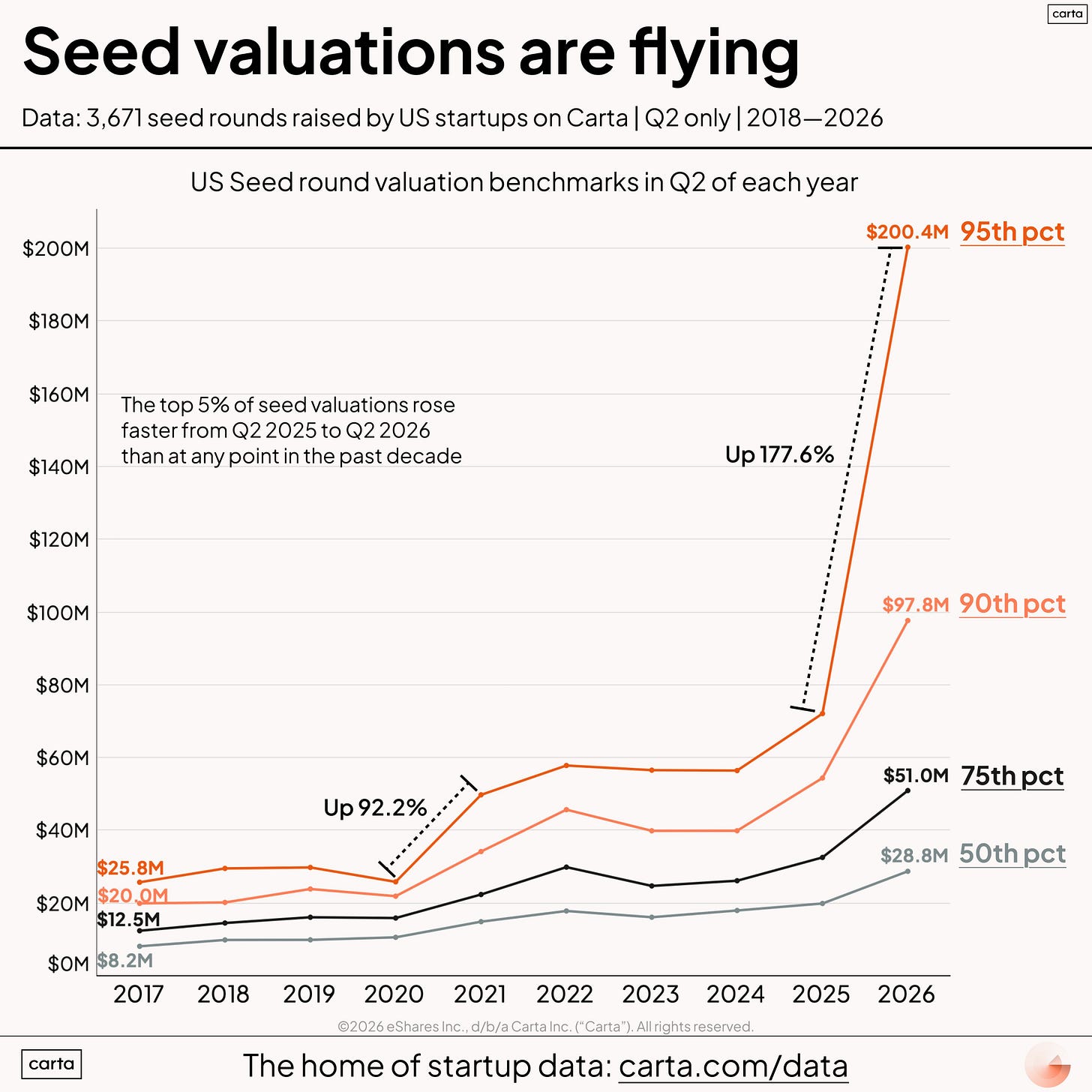
For founders who do not go through accelerators, having a good background is more important than ever. Anyone who has attended Stanford can raise money. Anyone who has spun out from OpenAI can raise money. The size of the check and the valuation is a function of how good the educational background is and how broad the founder's network is in VC circles.
Moreover, large multi-stage funds are providing a group of central casting figures (those with the best educational backgrounds) with war chests of $10 million to $50 million to create a king in a category before their companies have traction, making it difficult for others who are not central casting to win in these markets.
So it's no longer "Can you build a great company?". It's now "Can you fit the mold that large VC firms want to fund?”
A soulless internal clique—those with backgrounds and connections are favored—this stands in stark contrast to the meritocratic ideal where any skilled, hard-working entrepreneur could win. The elite system has historically given Silicon Valley its aura and is the only place in America where the American Dream still exists and works. Today, Silicon Valley is becoming more like Wall Street or K Street.
Founders outside the networks now feel they must play "this game" to become one of the central casting characters. This means mingling with VC associates at happy hours and dinners, acting slightly aloof to create FOMO and fundraising momentum. Usually, founders networking with VCs is a waste of time; they should focus on building the company and talking to customers. Now, this has become part of the game—a skill founders must cultivate.
Downstream Effects of King-Making
To be fair, king-making is effective to some extent. Raising a large amount of capital gives you a massive war chest to acquire customers at a loss (i.e., acquiring users unprofitably until your competitors go bankrupt or pivot). It scares away other teams from entering your market competition.
However, king-making also creates moral hazards for bad behavior. Companies become ~creative~ in reporting revenues, with founders selling secondary shares very early on.
King-making puts pressure on companies to showcase revenue growth at all costs to be comprehensible to VCs. This leads some companies to completely misreport revenue (securities fraud), or creatively manipulate methodologies. One example is taking a one-off contract and annualizing it as ARR. These contracts are usually just pilot pricing with exit clauses, so they ironically are neither "annual," nor "recurring," nor even "revenue." Another example is rebranding ARR from "annual recurring revenue" to "annual run rate" and calculating ARR as last week's revenue × 52 or even yesterday’s revenue × 365. This is not outright securities fraud, but it doesn't look good for anyone conducting due diligence.
VCs trying to king-make rounds often allow founders to sell secondary shares to win deals. Clearly, giving founders secondary share allocations of 10% in hot company rounds is now common practice. The downstream effects of founders’ secondary shares attract fraudsters. Those who can play the "game" described above well create VC FOMO in Series A and leverage it to sell millions of dollars in founders' secondary shares (often more than the company's lifetime revenue), and then slowly rug.
Mean Reversion
The pendulum has swung too far towards consensus; I bet there will be a mean reversion toward contrarian thinking.
History repeatedly shows that the hottest themes in any given year are not the categories of the most valuable companies founded that year. I have no reason to believe this time will be different.
I would rather support the outsiders with chips on their shoulders at all times than the insiders prematurely crowned by VCs. I believe there is a huge blind spot outside the Silicon Valley groupthink bubble—great founders who lack backgrounds, are outside the distribution, and are incomprehensible to most VCs.
I optimistically believe that the elite system will ultimately prevail, and those chasing momentum through king-making games will be left licking their wounds.
Those who follow trends await slaughter.
免责声明:本文章仅代表作者个人观点,不代表本平台的立场和观点。本文章仅供信息分享,不构成对任何人的任何投资建议。用户与作者之间的任何争议,与本平台无关。如网页中刊载的文章或图片涉及侵权,请提供相关的权利证明和身份证明发送邮件到support@aicoin.com,本平台相关工作人员将会进行核查。


