Author: Miles Deutscher, Cryptocurrency Analyst
Transcription: Felix, PANews
The robotics sector may become one of the most "asymmetric return" investment opportunities in the next decade. Software AI has already reached its shining moment, with companies like $PLTR seeing their stock prices soar by over 500% in the past few years. If you can make the right investments in the physical AI space, you could witness similar asymmetric upward potential over the next decade.
This article will cover the following topics:
- Investment Logic in Robotics
- How to Identify Investment Opportunities
- How to Conduct Research and Use Assistive Tools
Investment Logic
You may have recently seen this chart on social media.
Venture capital investment in robotics has just set a quarterly record high (around $16 billion and continuing to grow).
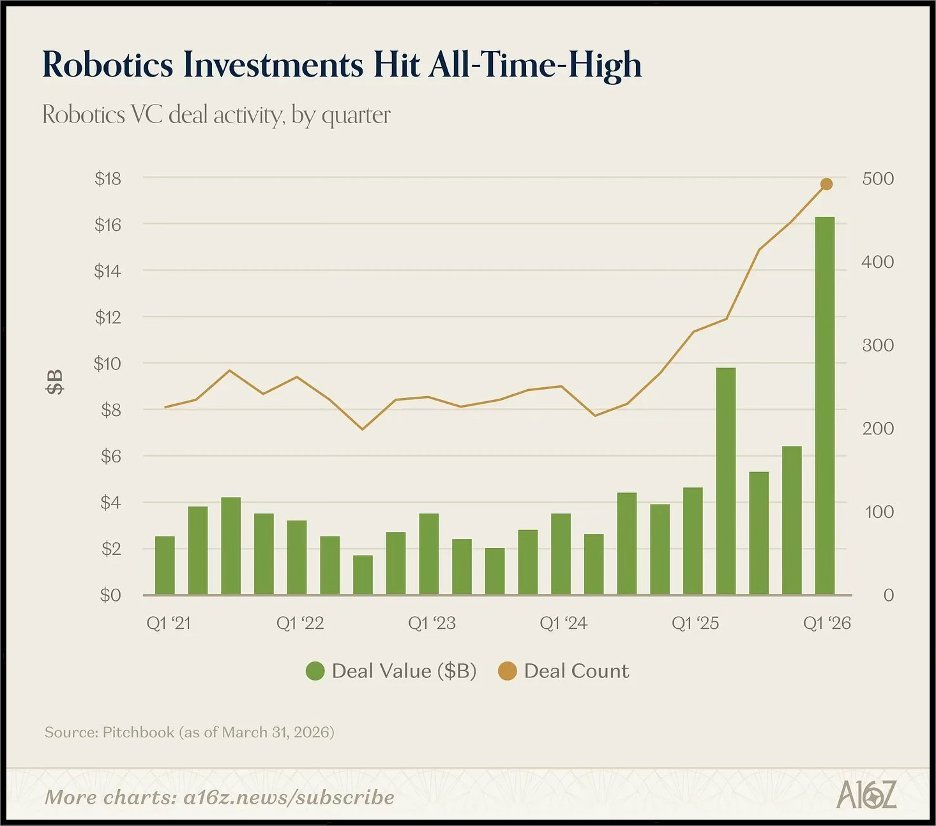
Investment in the robotics field is approximately twice as high in quantity and about 4.5 times higher in value compared to the period from 2021 to 2025.
(Related Reading: a16z's Interpretation of the New AI Cycle: Robotics Becomes the New Leading Actor in Technology, AI Companies Become "Lighter")
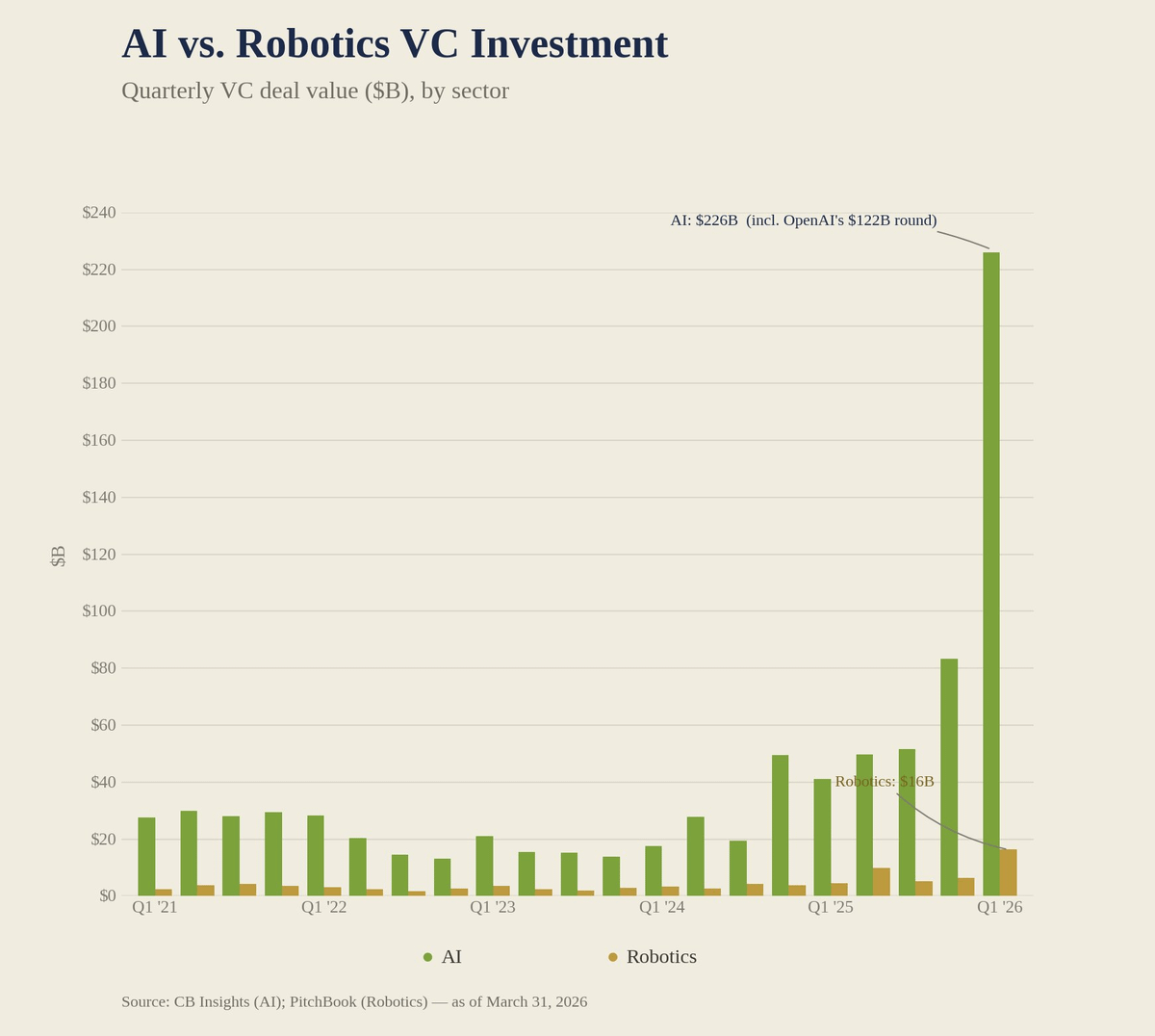
Once you understand the reasons behind this, you will see why this liquidity won't slow down in the short term. In comparison, current VC investment in the robotics field is only 1/14 of the inflow into the AI space. Ultimately, this massive gap represents the asymmetric opportunity currently faced by investors.
So, what drives VC interest?
To understand the investment logic in the robotics sector, you cannot simply view this industry as "manufacturing robots."
This industry actually plays a "bridge" role in linking AI advancements to the real world.
For the past decade, AI advancements have been largely confined within screens.
That is to say, models are becoming smarter, but they are clearly unable to pick anything up, move anywhere, or interact with the physical world.
This significant void is the core of the entire robotics investment logic, which is currently entering the starting point of an exponential growth curve in the industry:
The Limitations of Robotics Technology are Beginning to Be Broken
In the past five years, pessimism regarding robotics technology has primarily focused on two points:
- AI is not powerful enough
- Hardware costs are too high and difficult to mass-produce
These two limiting factors are starting to be overcome.
In terms of capability: Robotics technology is currently at a critical turning point for achieving practical applications.
Three years ago, the robotics field looked completely different.
- In 2022, Google's RT-1 introduced robot learning, which was trained on 130,000 demonstration data for over 700 specific tasks.
- In 2023, RT-2 launched the first visual-language-action (VLA) model.
- By 2025, this progress will have translated into large-scale production deployments from companies like Tesla and Figure AI.
In just three years, the field has evolved from single-task demonstration learning to factory-scale deployment.
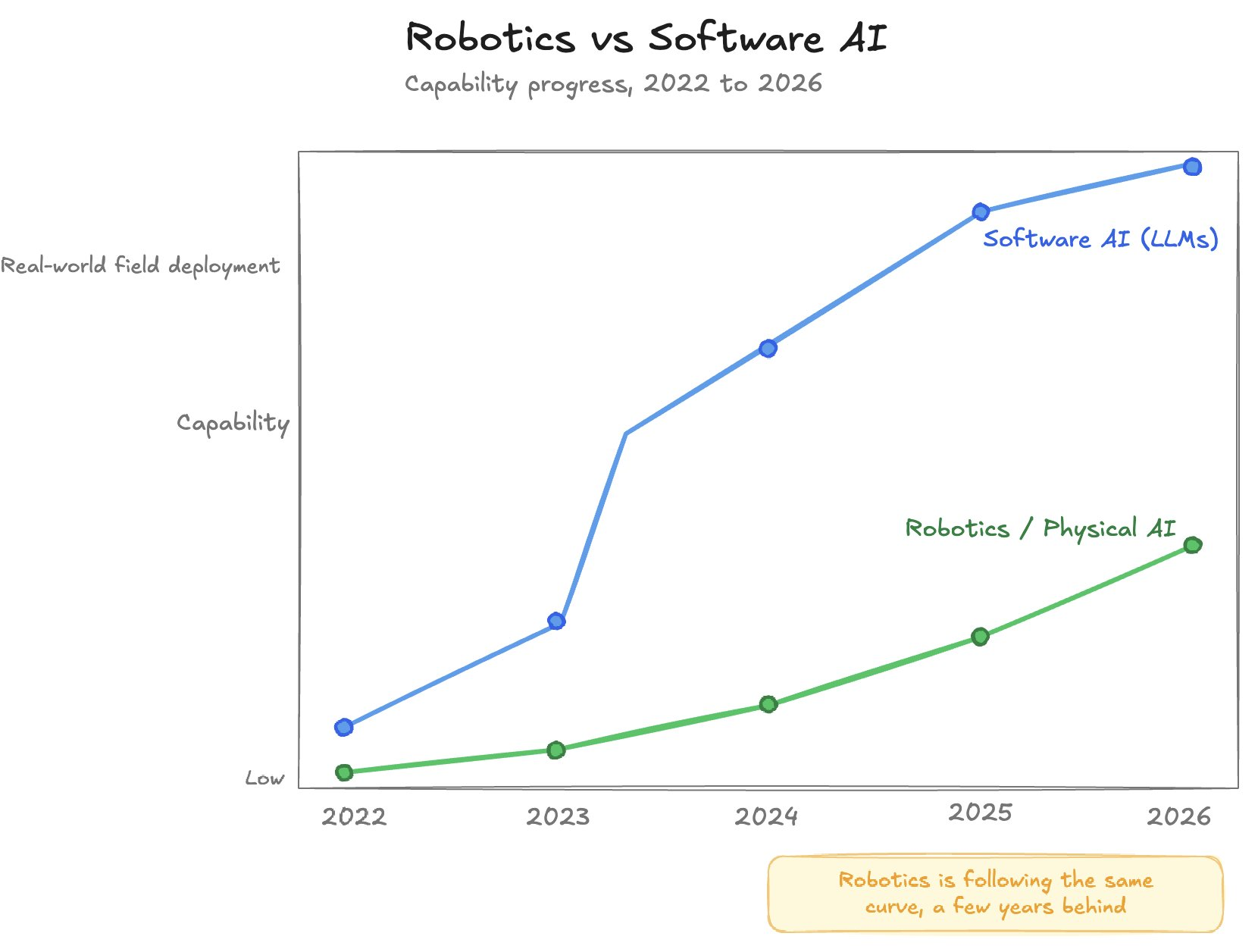
When compared to the development timeline of large language models (LLMs), robotics technology is merely a few years behind.
Robotics Technology and Low-Level Human-Computer Interaction (Practical Applications)
For a fair comparison, the current capabilities of robotics technology can roughly be equated to the level of GPT-2.
GPT-2 is powerful but lacks practical application experience.
This gap is rapidly closing, as demonstrated by a recent live broadcast by Figure.
Their F.03 humanoid robot completed package sorting work for over 160 hours (fully autonomously).
Proof of this advance in robotics technology did not exist just a year ago.
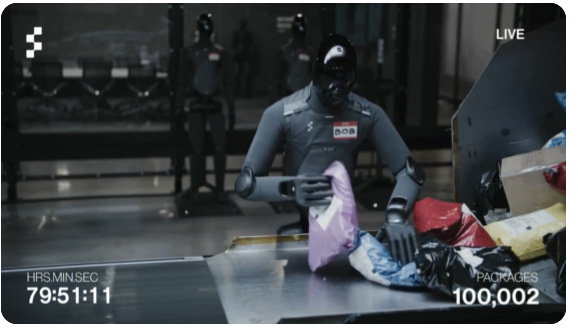
In the past year, there have been numerous practical leaps in robotic capabilities, and in short, actual on-site deployment is finally starting to surface.
In terms of cost: The cost of humanoid robots has been rapidly decreasing.
Total cost of robot manufacturing:
- 2020: Development platform cost over $1 million
- 2022/2023: Single unit cost $150,000 to $500,000
- 2026: Single unit cost $30,000 to $150,000 (depending on functionality)
It is anticipated that future cost curves will continue to decline. By 2030, the average price is expected to drop by about 70%, reaching a new industry average of only $37,000.
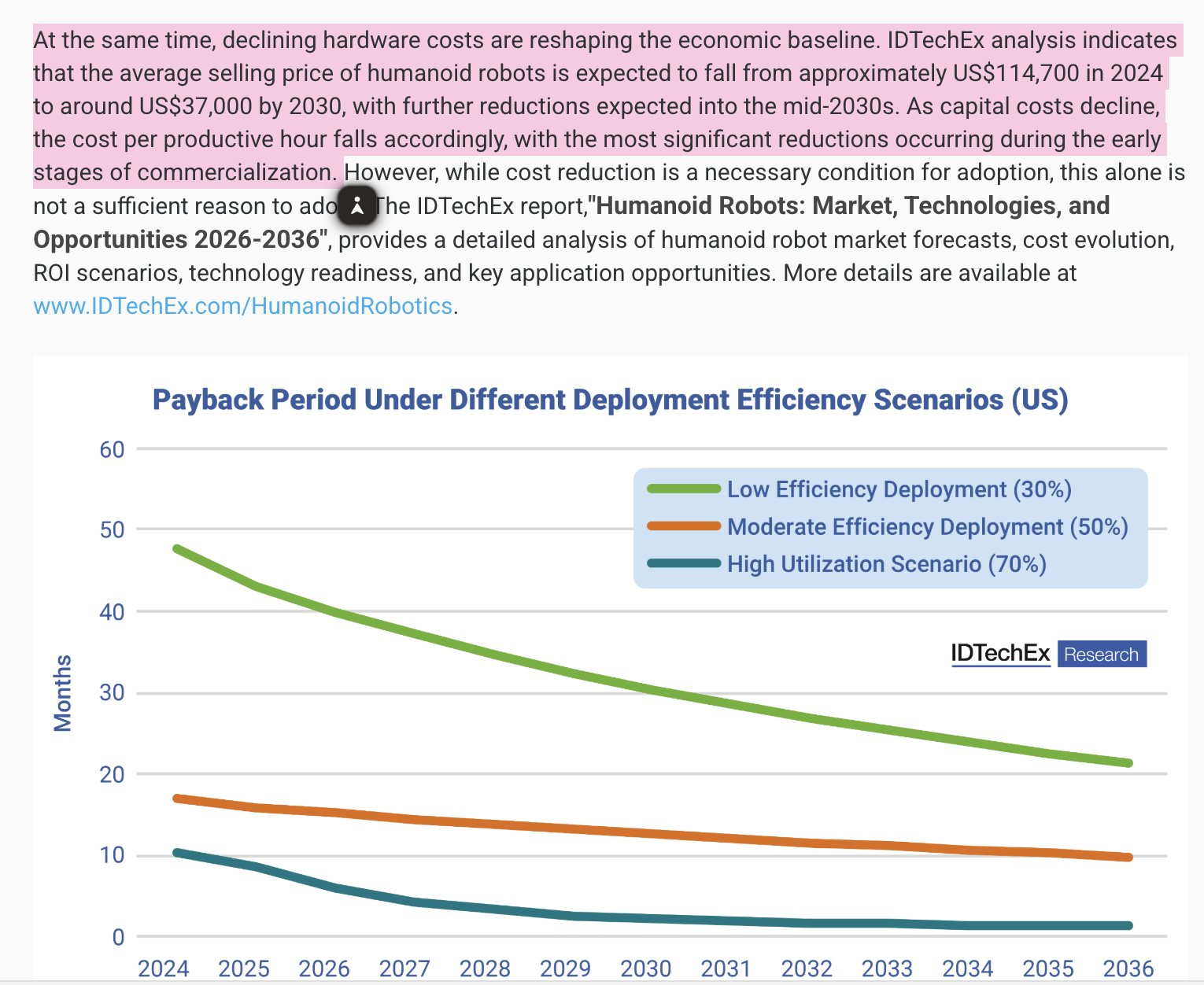
IDTechEX Humanoid Robot Manufacturing Prices
Real Case
Weave Robotics just launched the viral Issac 1 robot, priced at only $8,000. This is an unprecedentedly low price.
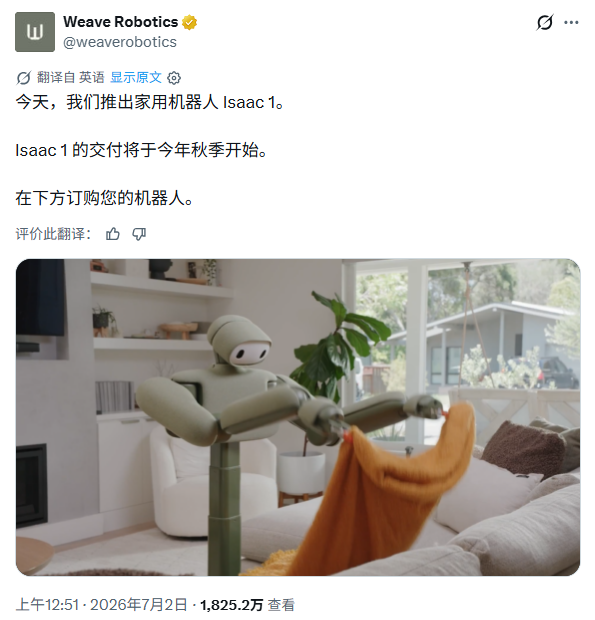
This follows the cost curve of solar panels and electric vehicle batteries transitioning from niche markets to mainstream markets in less than a decade.
A perfect storm for robotics technology is brewing.
Robotics / AI capabilities are rapidly improving, while costs are decreasing.
These are some of the fundamental reasons why VCs are showing strong interest in robotics technology. If you are a savvy investor, you should seize this ride while funding is still abundant.
How to Get Involved
The following content represents the author's views only and is not financial advice. In the final section, some resources will be provided to help you conduct due diligence/research.
When building a robotics investment portfolio, there are five levels worth understanding. As you go deeper into levels, the corresponding risk tolerance will also increase.
The author allocates 5-10% of the portfolio to these levels to construct a long-term, high-conviction robotics investment portfolio, but you can build your portfolio according to your preferences.
Level One: ETFs
If you want to invest in the robotics field but do not want to pick individual stocks, ETFs are an ideal choice. They can diversify investments across the entire ecosystem, allowing the whole industry to operate rather than betting on individual companies.
(Related Reading: How Can Ordinary People Get Involved in the Robotics Sector? Bet on the Entire Industry Chain with ETFs)
The following three robotics ETFs are worth your attention:
$BOTZ: Global X Robotics & Artificial Intelligence ETF
$BOTZ is the fund most retail investors first think of when they hear "robotics ETF." It tracks 68 companies spanning industrial robotics, automation, non-industrial robotics, and autonomous vehicles. $BOTZ has returned about 30% over the past year and has gained about 10% year-to-date.
However, the downside is the high investment concentration: a few automation giants from Japan and Switzerland contribute to most of the returns, making it more like a growth fund focused on a specific area rather than a broadly themed fund.
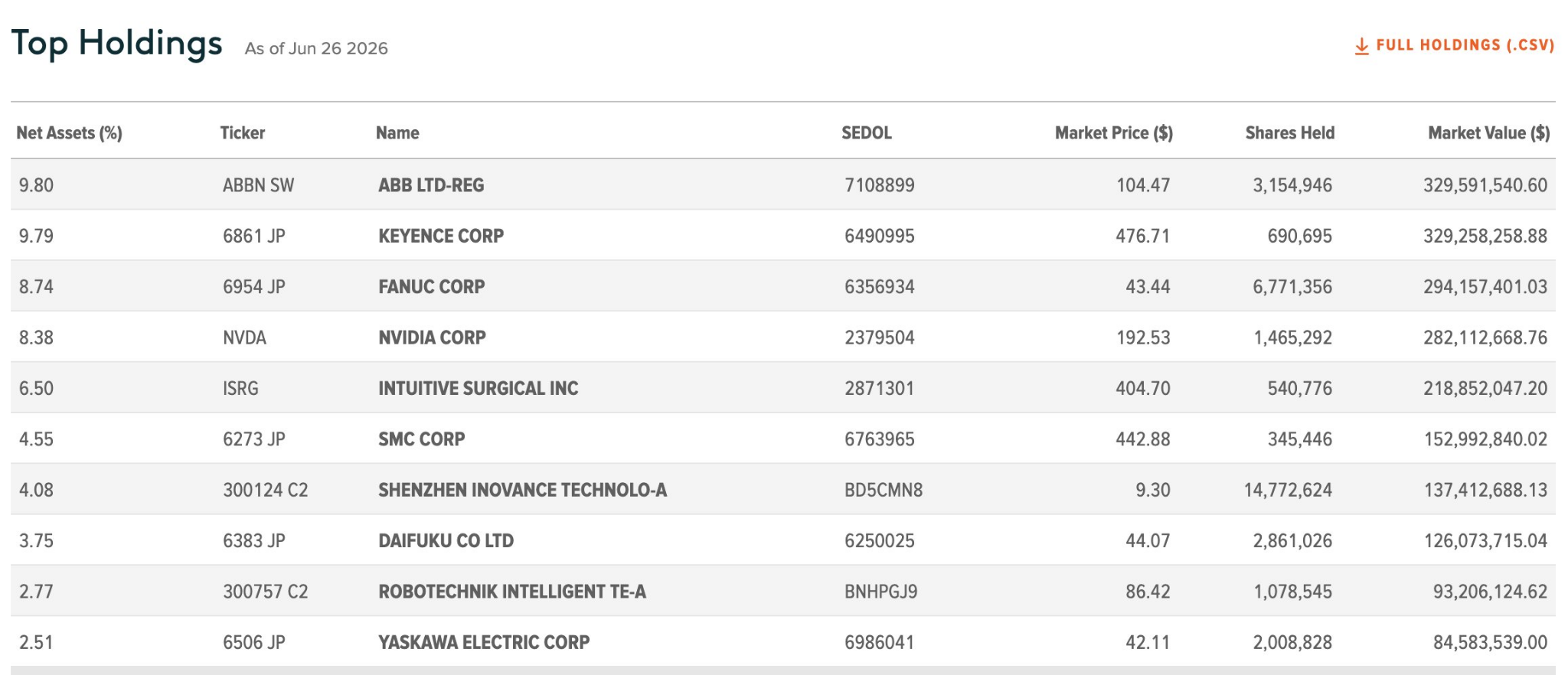
$BOTZ Major Holdings
2. $ROBO: ROBO Global Robotics and Automation Index ETF
ROBO holds 91 companies and has an expense ratio of 0.95%, making it the most expensive on this list. The high fee is because it tracks a highly specialized index dedicated to investing in the robotics sector.
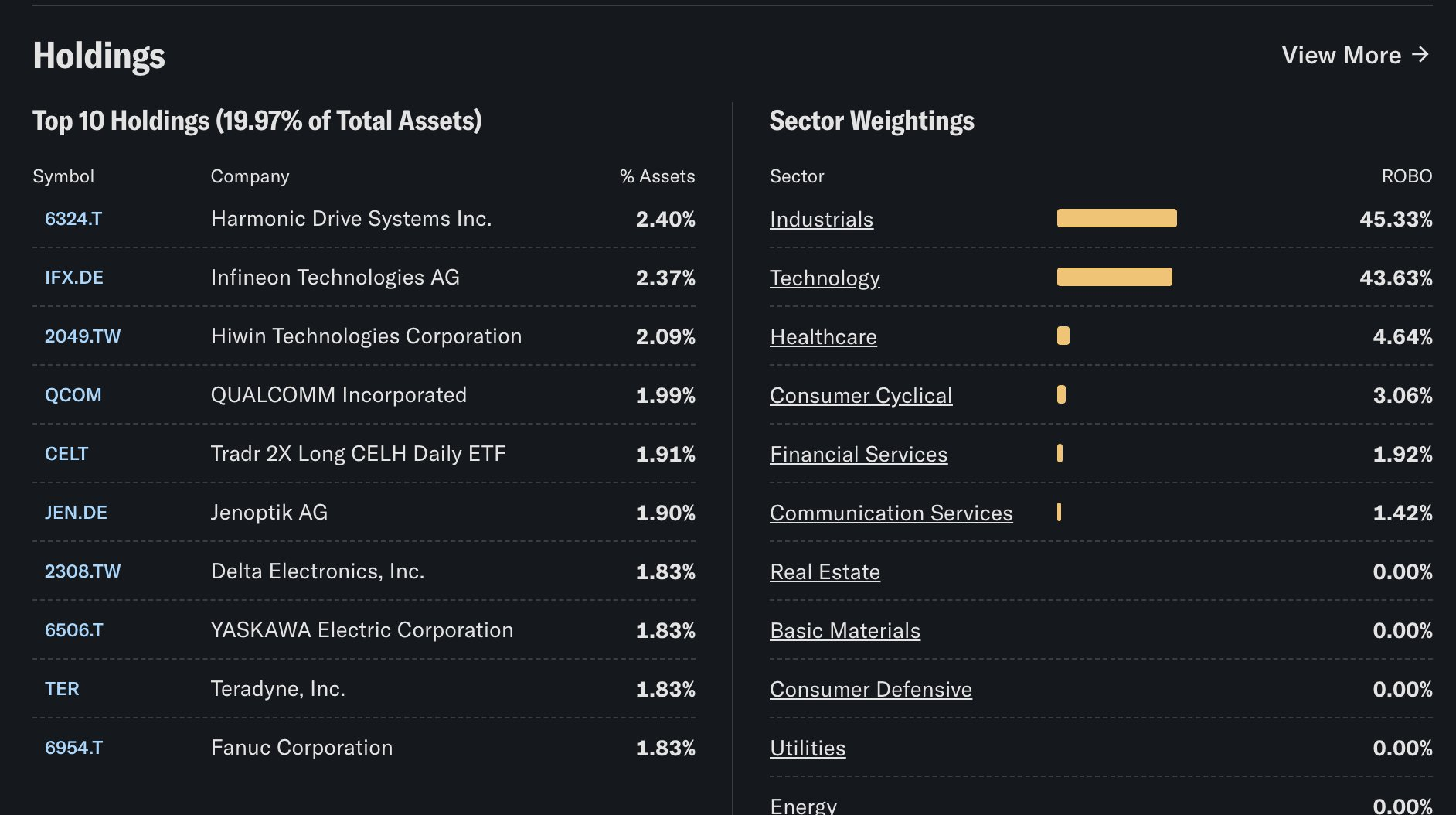
$ROBO Holdings
3. $ARKQ: ARK Autonomous Technology & Robotics ETF
This fund has a significant holding of Tesla stock, and it is only worth holding if you agree with Cathie Wood's unique vision for the future of autonomous technology. Additionally, the fund also has significant investments in the defense sector, with Kratos Defense and AeroVironment as its main holdings.
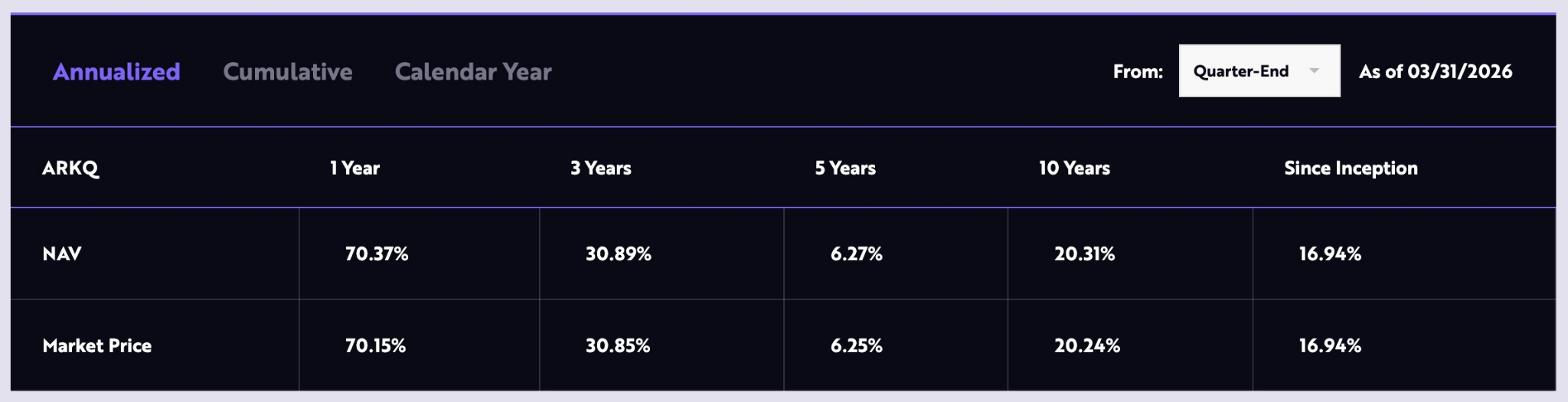
$ARKQ Performance
Level Two: Large-Cap Stocks
At this level, you will directly invest in specific companies that are already generating real revenue from robotics.
Some companies worth adding to your watchlist include:
1. $TSLA - Tesla
Tesla is the most confident and highest-risk company in the robotics field. Musk has explicitly stated that about 80% of Tesla's future value will come from the Optimus system.
Wedbush analyst Dan Ives has described Tesla as "the best physical AI company in the world" and predicts that Tesla's market cap could reach $2 trillion by the end of 2026, mainly due to its growth in fully autonomous driving (FSD) and robotics.
2. $AMZN - Amazon
Amazon is the most undervalued robotics company among large tech stocks.
Since 2012, Amazon has deployed over a million robots and operates a complete ecosystem. Amazon's success in the robotics space will enhance its overall productivity and revenue margins.
Of course, there are many other large-cap stocks worth watching, but these two are ones everyone should focus on.
Level Three: "Sell the Shovel" (Hardware and Component Suppliers)
During the gold rush, those who got rich were not the miners, but those providing the mining equipment. The same logic applies to the robotics industry. In the next decade, those companies selling/producing the necessary resources for robotic companies' success will become the real affluent.
There are many noteworthy "sell the shovel" sectors, here’s a core list:
- Computation
- Visual Perception
- Actuation
- Simulation
- Semiconductors
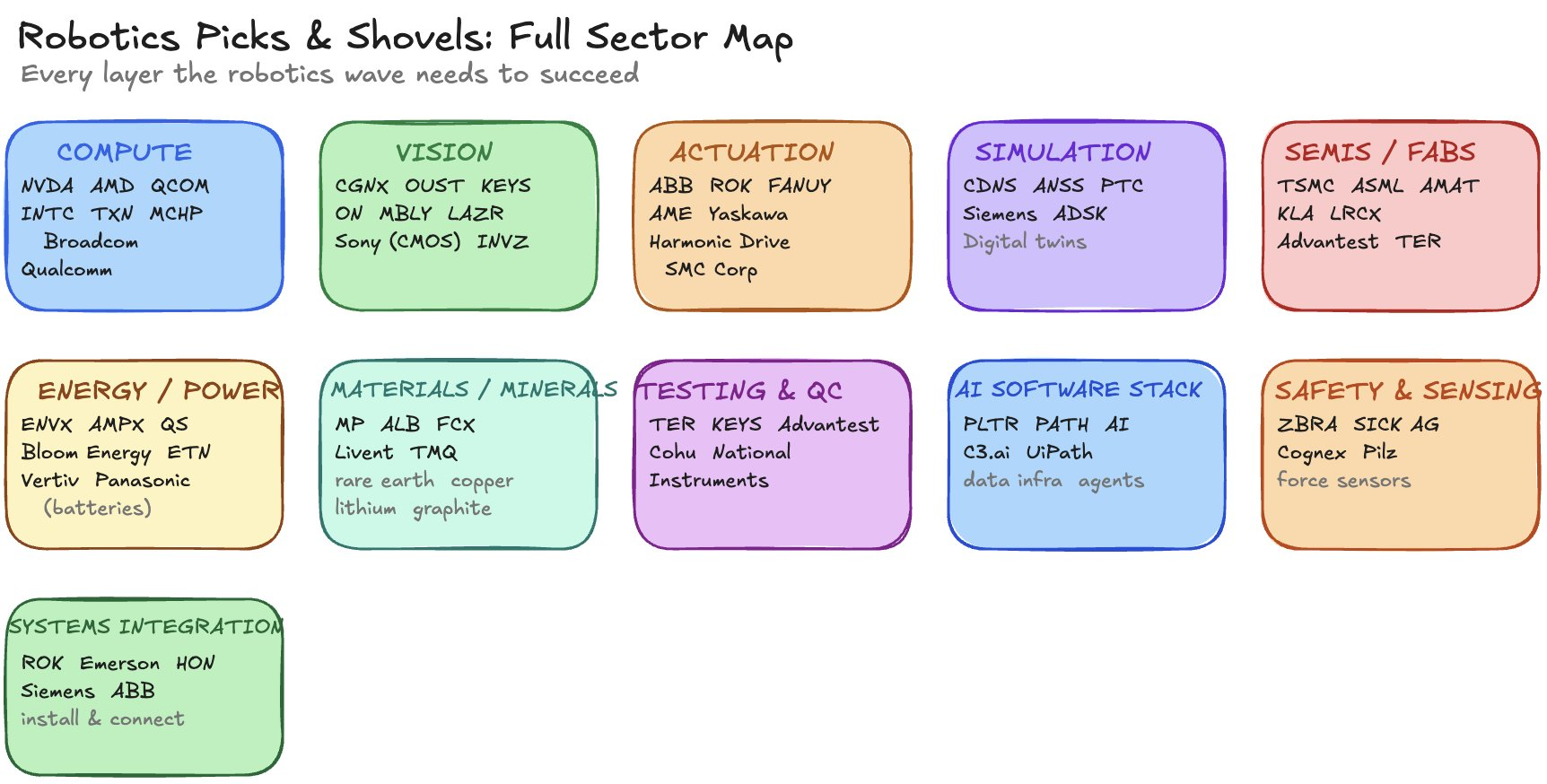
Level Four: Pure Robotics Concepts Stocks
The investment logic at this level is more concentrated. The entire business model of these companies relies on robotics technology. For example:
1. $OUST - Ouster
Ouster is a leader in robotic perception.
Any robot that navigates in the real world needs "eyes," and LiDAR is increasingly becoming the "eyes" of this layer.
2. $SYM - Symbotic
Symbotic is a company betting on the wave of warehouse automation (not directly betting on humanoid robots).
Its investment logic is that distribution centers of major global retailers and grocery chains still primarily rely on human operations. Labor costs are high, unstable, and increasingly difficult to recruit. Symbotic is focused on building fully automated warehouse systems to replace human roles.
They already have major clients like Walmart and are working on a large-scale deployment roadmap.
Level Five: High-Risk Betas
Finally, the fifth level is where you can consider making high-risk investments. For example: cryptocurrency robot projects, early startup investments (if applicable), etc.
A stock code worth researching is $BOT - RoboStrategy. It may be one of the most attention-grabbing companies right now because it allows you to access some private robot companies. This level harbors some of the most asymmetric investment opportunities as it is currently under the radar.
How to Conduct Research and Use Assistive Tools
Understanding the theory of robotics technology is one thing, but thoroughly researching specific companies and building a portfolio is another matter. Here are some tools that can be very helpful for financial research in robotics technology:
Claude Mega Prompt
This is the simplest entry tool.
If you send this prompt to Claude, it will analyze your entire portfolio and help you reverse-calculate which areas of robotics technology may be suitable for investment.
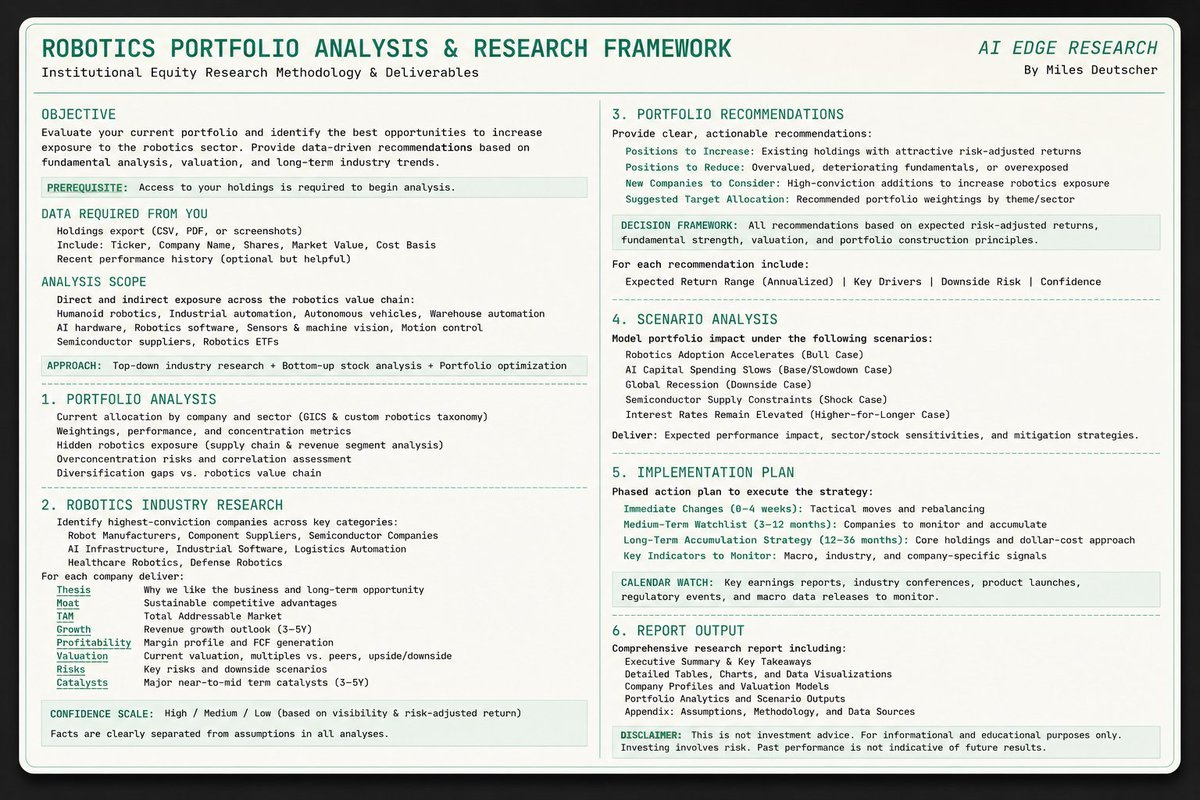
2. Financial Datasets MCP: Personal Finance Terminal
Simply connect the Financial Datasets MCP server directly to your terminal, and you can turn Claude Code into your personal finance assistant in 60 seconds.
Here’s how to set it up:
Step 1: Add MCP Server
Open Claude Code and paste:
claude mcp add --transport http financial-datasets https://mcp.financialdatasets.ai/
Step 2: Verify
Type /mcp in Claude Code and complete the OAuth flow in your browser.
Step 3: Start Prompting
After connecting, you can pull live financial data directly into your terminal:
What's a good entry price on $OUST based on current fundamentals?
Show me Tesla's revenue for the last 4 quarters and flag any trend changes.
3. Perplexity Finance
Perplexity Finance is one of the favorite AI financial research tools.
You can easily find revenue data, seek out emerging robotics companies, create custom watchlists, and more.
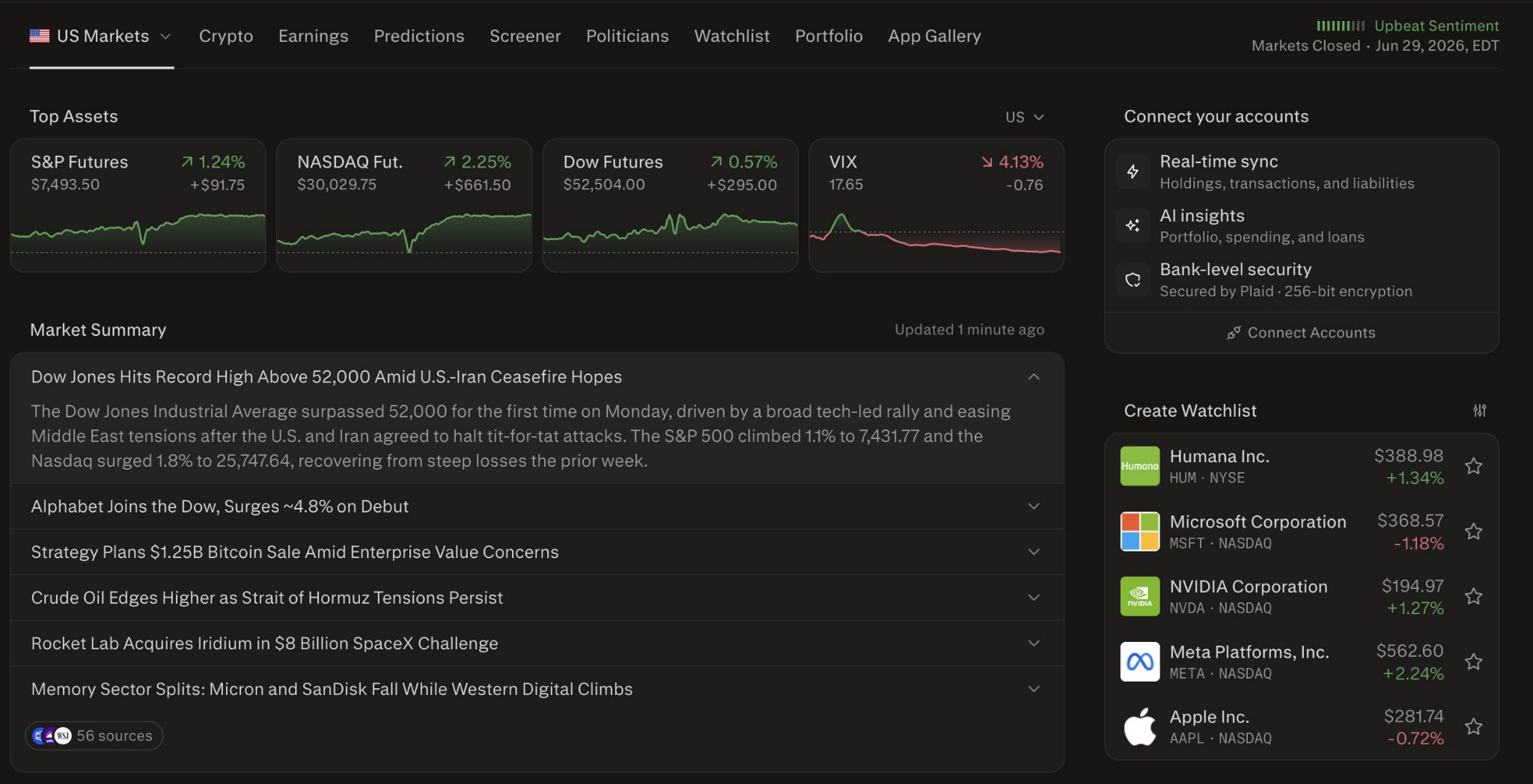
Perplexity Finance
4. EdgeNetwork's RobotScan
This website helps you research top robotics companies (Web2/Web3), sort by hardware, and provide information on the latest news, etc.
If you are new to investing in the robotics field, this is a good starting point:
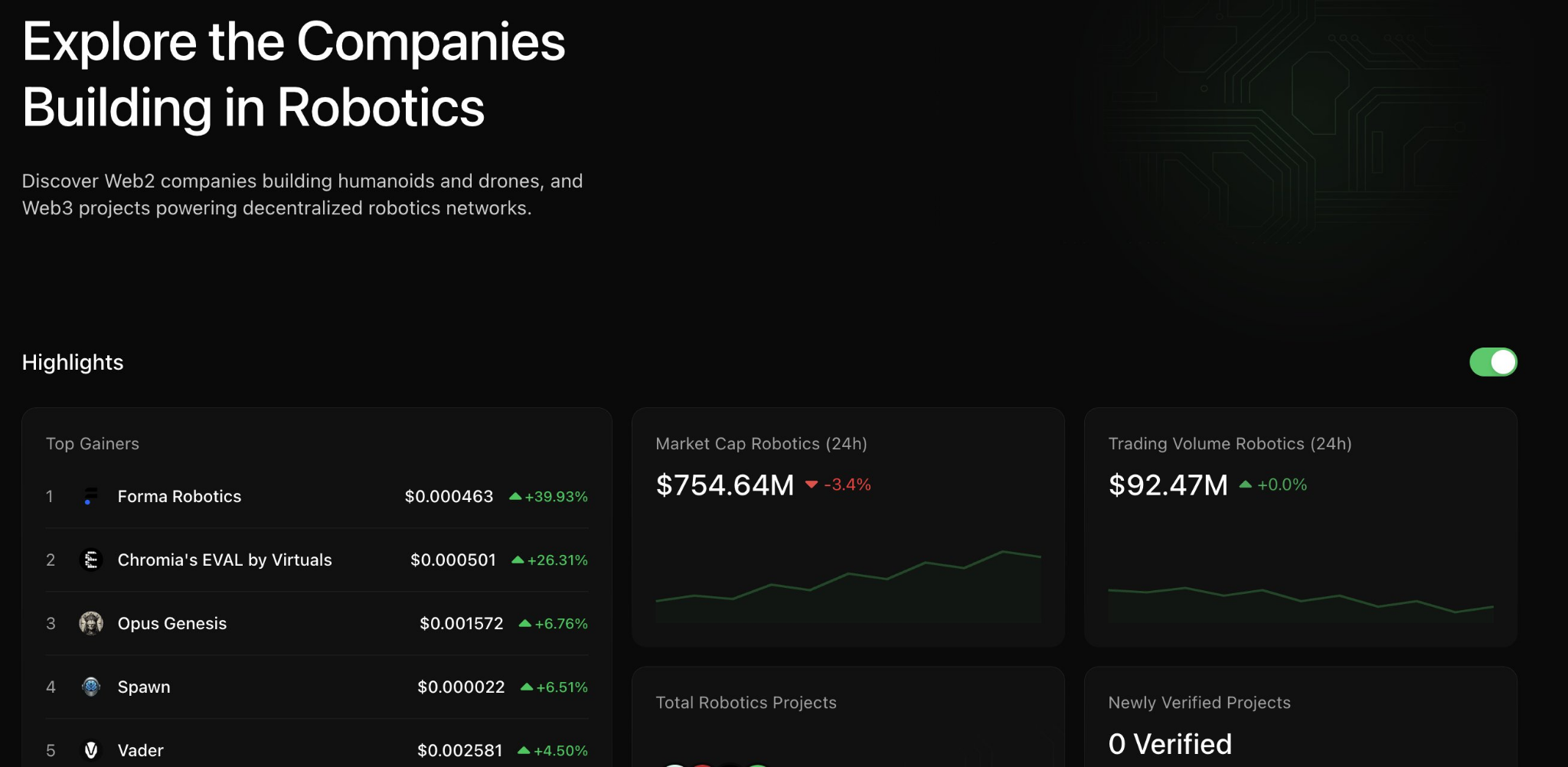
https://www.robotscan.io/
Related Reading: The Second Half of AI: Complete Overview of the Humanoid Robot Industry Chain in the US Stock Market
免责声明:本文章仅代表作者个人观点,不代表本平台的立场和观点。本文章仅供信息分享,不构成对任何人的任何投资建议。用户与作者之间的任何争议,与本平台无关。如网页中刊载的文章或图片涉及侵权,请提供相关的权利证明和身份证明发送邮件到support@aicoin.com,本平台相关工作人员将会进行核查。


