The Vanguard Group, which previously refused to list a Bitcoin spot ETF in 2024, is now actively exploring crypto-related asset management business.
Written by: Gino Matos
Translated by: Luffy, Foresight News
On July 6, Vanguard Group announced a job opening for the head of its digital asset personal wealth business, with locations covering Dallas, Scottsdale, Charlotte, and Malvern. The job listing requires the new head to lead the formulation of the overall strategy for digital assets, build medium and long-term development plans, and oversee the full implementation of the company's wealth business segment.
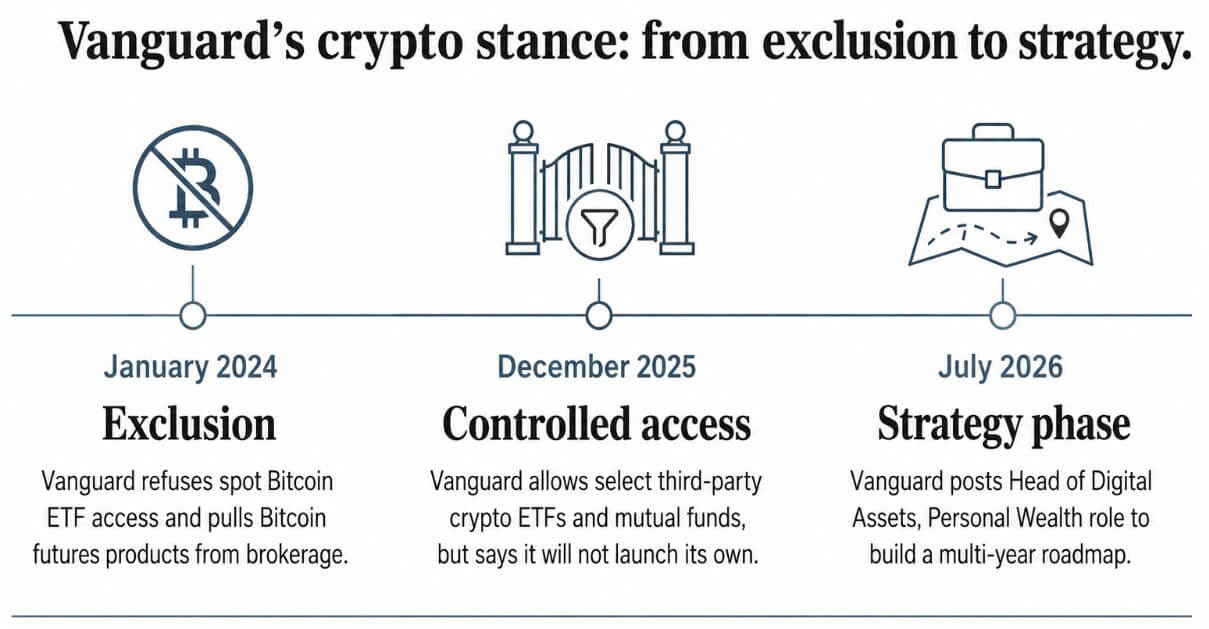
Two years ago, this asset management giant had an entirely opposite attitude towards crypto assets. After the U.S. SEC approved Bitcoin futures ETFs in January 2024, Vanguard not only refused to list a Bitcoin spot ETF but also delisted all Bitcoin futures products on its platform.
This shift has occurred at the second-largest asset management company in the world. By December 2025, Vanguard is anticipated to manage approximately $12 trillion in assets, serving over 50 million investors. For an institution of such scale, a recruitment announcement mentioning custody, settlement, asset tokenization, and stablecoins carries weight far beyond what a native crypto brokerage could compare.
Interestingly, while market expectations for crypto assets are becoming cautious, Vanguard is going against the trend and formally building an internal dedicated digital asset team. This month, Citigroup lowered its price expectations for crypto assets, reducing the 12-month Bitcoin target price from $112,000 to $82,000, Ethereum's target price from $3,175 to $2,240, while also adjusting the annual fund inflow expectation for U.S. Bitcoin spot ETFs from $10 billion to $0.
Vanguard Group's changing attitude towards cryptocurrencies
Core Job Responsibilities
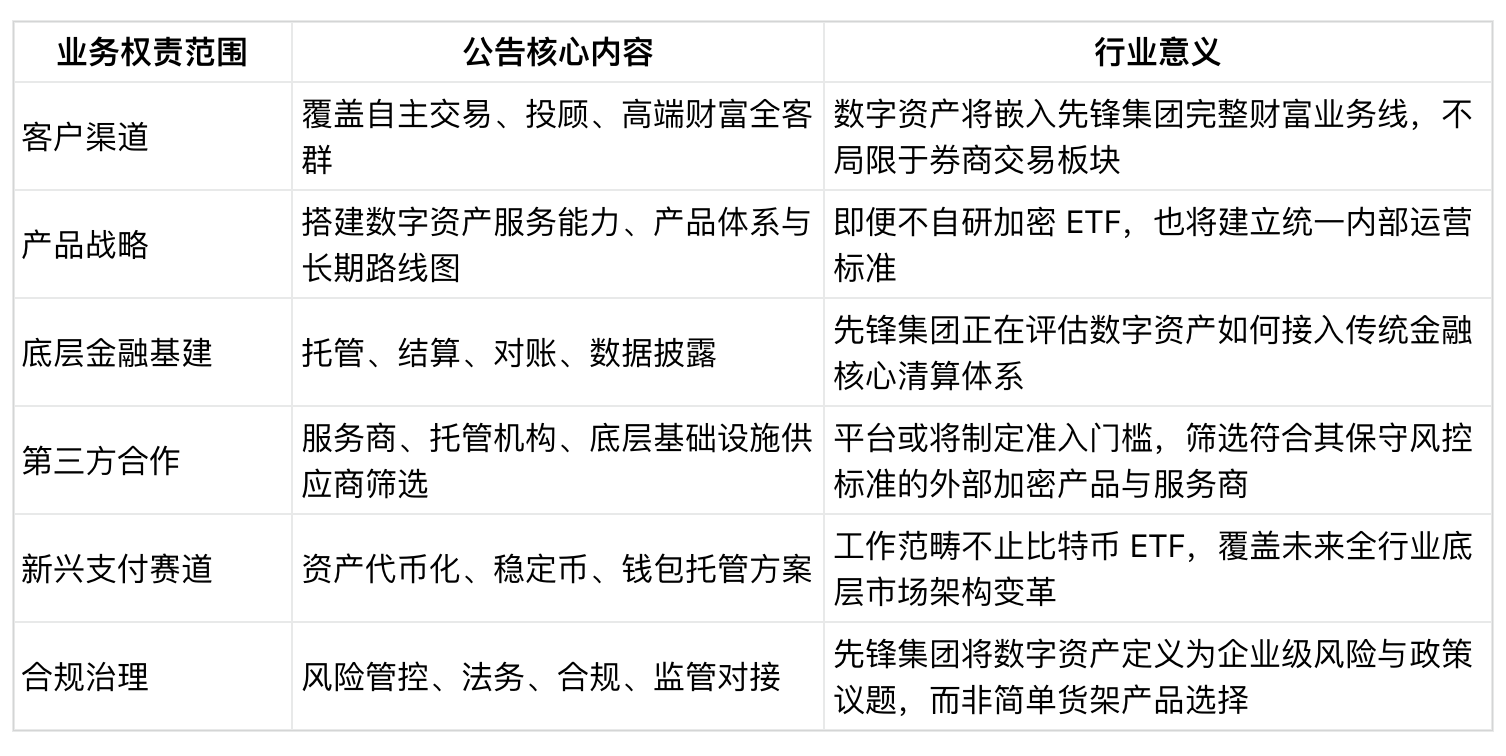
Vanguard Group's announcement requires executives to comprehensively assess the service capabilities supporting digital assets for self-directed trading clients, advisory service clients, and high-net-worth clients; design a complete operational system for asset access, custody, settlement, reconciliation, information disclosure, and third-party service provider integration.
The position requires continuous tracking of five core tracks: asset tokenization, stablecoins, wallet and custody architecture, and blockchain underlying infrastructure, while synchronously liaising with corresponding regulatory bodies, custodial service providers, and technology suppliers.
The boundaries of this job responsibility have exceeded the simple question of "whether to list a Bitcoin ETF." Vanguard has made it clear that its stance on developing proprietary crypto products has not changed, and the company has no plans to issue its own cryptocurrency ETF or mutual fund, while also reminding that trading of crypto ETFs and crypto funds carries high risks and is not suitable for all investors.
These two positions do not conflict: on the one hand, not autonomously issuing crypto products; on the other hand, establishing executive positions to oversee how digital assets can be integrated into a financial system that originally served only stocks and bonds via custody, settlement, and compliance.
Vanguard Group's core business model is to provide low-cost, long-term investment products for retirement savers. Before a global regulatory framework is established, it seeks to build standards for token asset custody and settlement; once the plan is finalized, this $12 trillion asset manager will find it challenging to adjust, with very high costs for trial and error.
Looking back at the change in position, in 2024, Vanguard completely blocked the Bitcoin spot ETF; in December 2025, the platform opened up certain third-party crypto ETFs and fund trading but reiterated that it would not develop similar products; the July 2026 recruitment is the third step, establishing a dedicated internal department to consider how digital assets can adapt to the platform’s infrastructure, rather than merely considering whether to list wealth management products.
Building Industry Underlying Infrastructure
BlackRock chose ETFs as a breakthrough, with its iShares Bitcoin Trust IBIT reaching a net asset size of $46.5 billion as of July 6, with a product management fee of 0.25% and a 30-day median buy-sell spread of only 0.03%. IBIT has cumulatively seen inflows surpassing $60.2 billion; according to Farside Investors data, funds like Grayscale’s GBTC have continued to see outflows, and as of July 7, the overall cumulative net inflow for U.S. listed Bitcoin spot ETFs is approximately $51.4 billion.
BlackRock's market logic is very simple: use a familiar ETF packaging format for investors to standardize Bitcoin trading.
Citi’s June 2026 report entitled "2030 Asset Tokenization" presents a benchmark scenario: the current $17 billion tokenized asset market is expected to expand to $5.5 trillion by 2030, with a range between $2.7 trillion and $8.2 trillion; among them, compliant stablecoins are expected to reach a scale of $1.9 trillion by 2030. The report defines tokenized cash as the underlying core of the monetary settlement system, which is also a key track mentioned in Vanguard's job announcement.
Vanguard's current strategy is fundamentally about solving a key question: how this $12 trillion asset manager can connect its wealth platform to the ETF products that BlackRock has already scaled and the token asset infrastructure that Citi predicts will reach trillions by 2030.
Impact Scope of the Roadmap
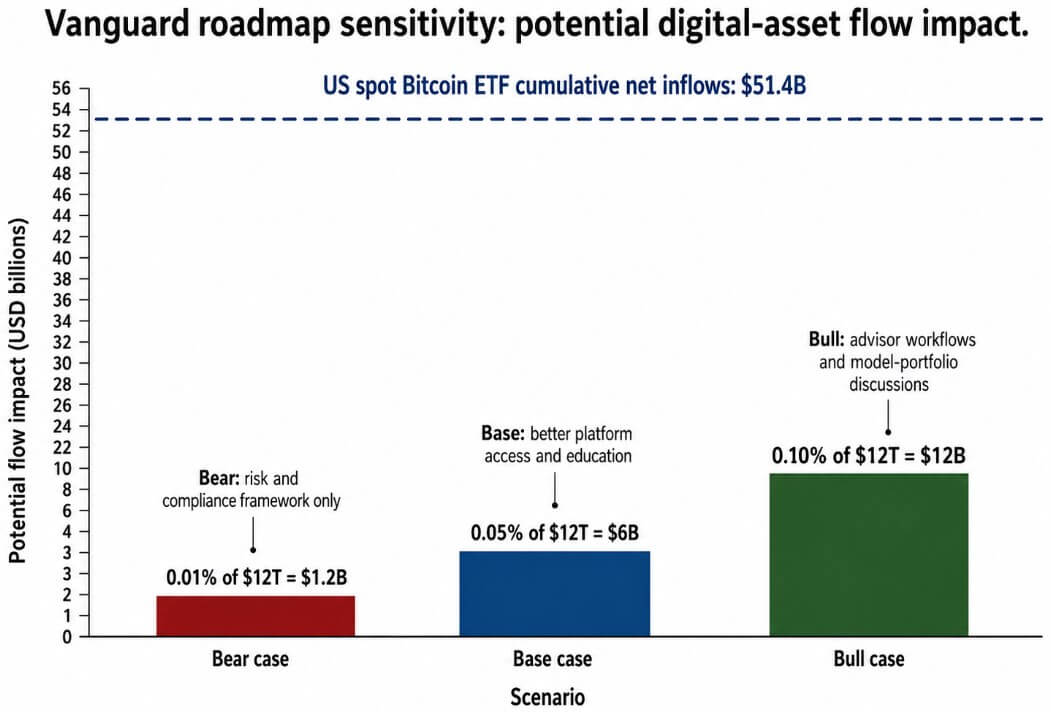
The size of Vanguard's $12 trillion in managed assets determines that its digital asset roadmap will have a substantial market impact. Using this size as a basis, combined with the overall cumulative $51.4 billion net inflow for U.S. Bitcoin spot ETFs as a reference, we can calculate the ranges of fund inflows:
- Pessimistic scenario: If the roadmap only establishes a risk compliance framework and passively opens up third-party product access, with the platform's distribution channels remaining cautious, only 0.01% of its funds allocated to digital assets corresponds to an incremental fund of about $1.2 billion, which is enough to drive the platform to improve its full set of mechanisms such as information disclosure, transaction authority control, and risk control restrictions.
- Benchmark scenario: Medium-scale capital entry, corresponding to an incremental $6 billion.
- Optimistic scenario: Vanguard would integrate digital asset trading into the advisors' workflows and model portfolio discussions, but still need to rely on third-party products to achieve this. This segment of trading would represent 0.1% of its asset size, approximately $12 billion, equivalent to about 23% of all accumulated net inflows into U.S. spot Bitcoin ETFs.
Regulation Not Yet Established, Industry Has Many Gaps
The Bank for International Settlements published a viewpoint in June 2026, stating that stablecoins are expected to enable high-speed programmable payments, but existing products have significant flaws in currency unity, full redemption, cross-chain interoperability, and anti-financial crime risk resistance.
The International Organization of Securities Commissions (IOSCO) also separately warned that asset tokenization presents issues of ownership ambiguity, making it difficult for investors to distinguish whether they hold the underlying real assets or merely tokens representing debts; at the same time, the efficiency of the token market varies greatly across different tracks, with huge discrepancies.
Vanguard requires the new executives to continually track global regulatory frameworks, the technological capabilities of third-party service providers, and the contradictions and shortcomings among various custody solutions. This giant, which targets robust long-term investment, chooses to build an internal supporting system in this uncertain stage where global regulatory rules have not yet been established.
Vanguard is deciding one thing: whether digital assets can connect to existing full-chain infrastructure for custody, settlement, and advisory, which currently serves 50 million investors’ retirement accounts and index funds. Once the custody and settlement standards established by Vanguard are emulated by other conservative wealth platforms, an institution that resolutely refused to list Bitcoin ETFs in 2024 will become the creator of the operating rules for token assets in the Wall Street wealth management industry.
This recruitment announcement focuses on the financial underlying infrastructure, and the impact of infrastructure standards will exist long beyond single crypto asset bull and bear cycles.
免责声明:本文章仅代表作者个人观点,不代表本平台的立场和观点。本文章仅供信息分享,不构成对任何人的任何投资建议。用户与作者之间的任何争议,与本平台无关。如网页中刊载的文章或图片涉及侵权,请提供相关的权利证明和身份证明发送邮件到support@aicoin.com,本平台相关工作人员将会进行核查。


