Written by: Rita
Trends Guide
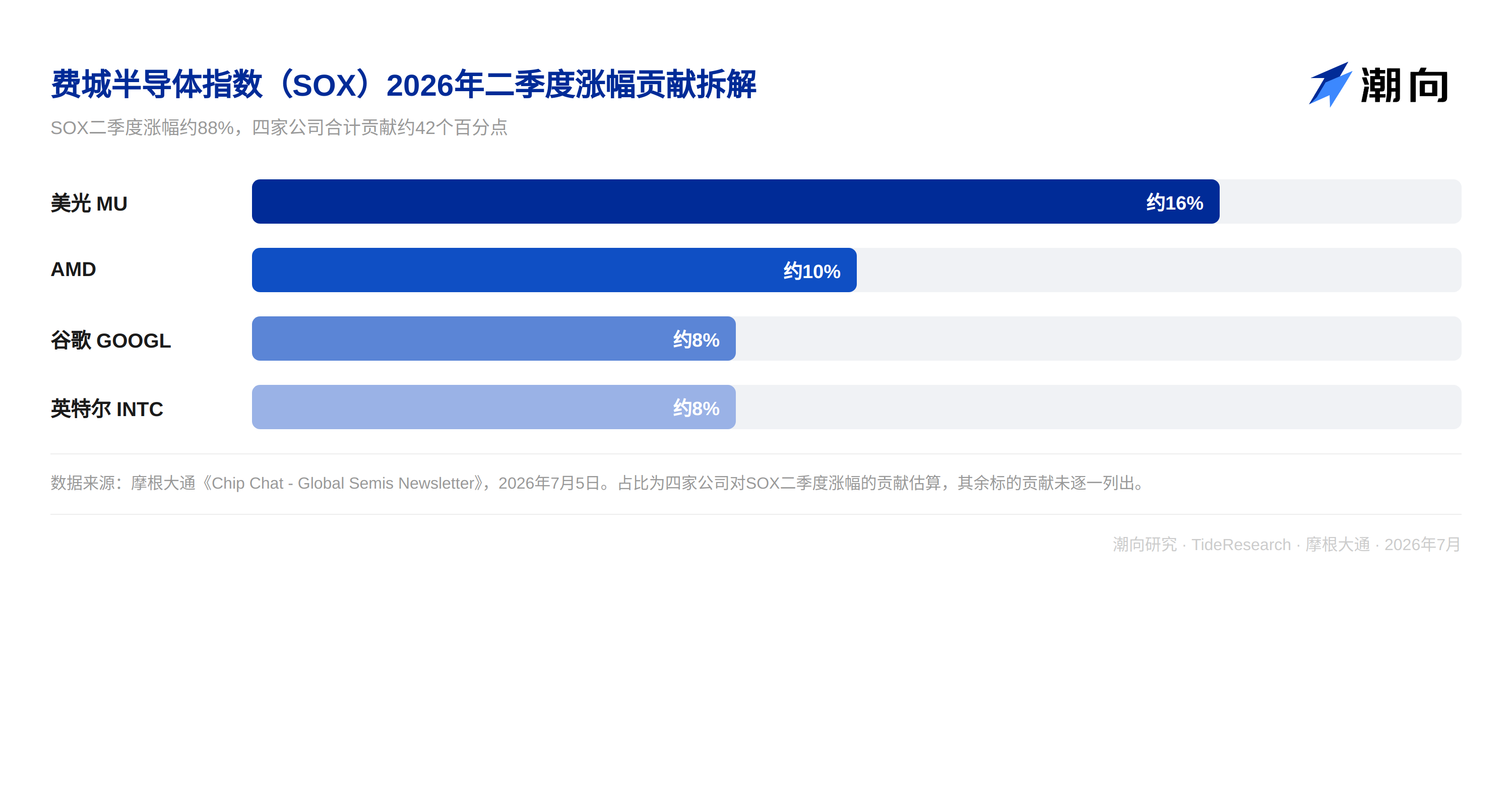
The second quarter has just concluded, and the Philadelphia Semiconductor Index (SOX) has risen nearly 88%, marking the strongest performance in a single season since the index was established. Micron, AMD, Google, and Intel collectively contributed about 16%, 10%, 8%, and 8% of the upward momentum, accounting for almost half of the gain in this round. JPMorgan global market strategist Nikolaos Panigirtzoglou provided a less favorable judgment in the latest Chip Chat global semiconductor weekly report, suggesting that the almost constant outperformance of semiconductors compared to large-scale cloud vendors, which has continued since last September, may not hold in the long term unless profit realization and AI monetization truly catch up, or if capital expenditure growth from cloud vendors indeed slows down.
The more noteworthy aspect in the report is the positions rather than the prices. The crowded long positions in hardware and semiconductors outperformed crowded short positions by nearly 40 percentage points at one point in June, the strongest performance in at least four years, with hedge funds achieving an overall return of 4.2% in June, totaling 11.1% year-to-date. However, entering July, the momentum factor positions have dropped about 17% from the peak on June 22, showing signs of deleveraging, with North America experiencing net selling for three consecutive days, causing the overall U.S. equity positioning to fall from the 60th percentile at the end of May to around the 40th percentile at the end of June.
What are Institutions Worried About After an 88% Rise in One Quarter
The options market shows similar divergences. Throughout the second quarter, the simultaneous rise in individual stocks and options was rare, making it one of the most profitable trades of the season, as investors bought volatility in the storage and memory sectors while selling volatility in large-scale cloud vendors. JPMorgan believes the market has priced in quite a bit of AI optimism in long-term options, making these options appear somewhat expensive, which poses a natural risk in this round of semiconductor trading.
Typically focused on macro issues and rarely touching on individual stock positions, the derivatives trading desk has this time provided specific recommendations: buying two-month puts and selling six-month calls, directly targeting memory, storage, optical communication, and semiconductor equipment, the sectors that have seen the largest gains previously. When such teams start handling specific targets, it itself signals something.
The Divergence Hidden in Details: ASML and Specific Numbers on Storage
Discrepancies at the individual stock level are clearer than macro narratives. For ASML, the buy-side model is already forecasting 60 to 65 euros in earnings per share for 2028; JPMorgan analyst Sandeep Deshpande's numbers are 54.4 euros for 2027 and 64.4 euros for 2028, with the core issue shifting from whether to hold ASML to what the stock can rely on to continue rising. The answer points to whether the demand for EUV equipment from 2027 to 2028 can be validated; the market is currently modeling around 90 to 100 units in 2027 and about 110 units in 2028, and any statement below this number could cause expectations to fluctuate.
Capital expenditure forecasts for storage and foundry have also been revised upwards. JPMorgan raised its forecast for storage capital expenditures from 300 billion dollars to 450 billion dollars for FY26 to FY28, with Tokyo Electron listed as the top pick because its market share in DRAM etching equipment is expanding, and pricing in yen gives it more room for price increases compared to U.S. peers. For TSMC, the market expects a 10% price increase for N3 in 2027, with second-quarter gross margin guidance revised to a high range of 67.5%, but buyers are generally betting on a higher figure of 68% to 69%. The storage sector is also experiencing differentiation, with Kioxia's ten-day implied volatility rising above 150, Samsung approaching 130, while hard drive stocks like Western Digital have become the preferred long choices for institutions, and SanDisk has been one of the worst performers this month, dropping over 23%.
Similar pricing divergences can also be seen in the European listings. Besides ASML, Infineon is given a buy-side range for earnings per share of 3.6 to 4.75 euros for 2028, while STMicroelectronics' target price has been raised to 71.5 euros, corresponding to 2028 earnings per share of 3.68 to 4.48 euros under three scenarios. Nokia continues to be viewed positively by JPMorgan after retreating about 20% from its peak, as the market underestimates the visibility of its AI networking business. When looking at these numbers together, the divergence between buyers and sellers for ASML is most direct, with sellers providing a range of 54.4 to 64.4 euros, while buyers have included 60 to 65 euros in their models; both STMicroelectronics and Infineon's ratings are considered stable, but buyers' expectations for Infineon's 2028 earnings per share are also more optimistic than the company's own guidance, indicating that the market has given these European names more trust in realization ahead of the company's own guidance.
Tide Perspective
The signal that is easiest to overlook in this weekly report is that the derivatives trading desk, usually focused on macro, has rarely provided specific short volatility recommendations targeting storage, optical communication, and semiconductor equipment. When such teams begin to assess individual stock directions, it usually means that market divergences regarding short-term trends have become significant enough to require hedging with options, as simple position adjustments are no longer sufficient. Another contradiction is also worth unpacking: buy-side modeling for ASML and STMicroelectronics’ earnings per share for 2028 is generally higher than that of sell-side, betting on confirmation of capital expenditures and capacity utilization. If the capital expenditure guidance of foundry or storage customers falls short of expectations, there may be substantial pullback potential for these optimistically priced forecasts. JPMorgan's own strategists also admit that the continuous outperformance of semiconductors relative to large-scale cloud vendors has seemed somewhat untenable since September of last year, unless the speed of profit realization truly accelerates. For investors, the real focus in the next two months is the capital expenditure guidance and the pace of price realization in the earnings season, which is the true switch for position reversal.
Disclaimer
This article is a compilation and interpretation of third-party brokerage research reports by Tide Research. The ratings, target prices, profit forecasts, and related judgments cited in this article are opinions of the brokerage analysts and represent the stance of their institutions only, not the views of Tide Research, nor do they constitute any investment advice.
The market has risks, and decisions need to be made independently. This article should not be used as the basis for buying or selling any securities.
免责声明:本文章仅代表作者个人观点,不代表本平台的立场和观点。本文章仅供信息分享,不构成对任何人的任何投资建议。用户与作者之间的任何争议,与本平台无关。如网页中刊载的文章或图片涉及侵权,请提供相关的权利证明和身份证明发送邮件到support@aicoin.com,本平台相关工作人员将会进行核查。


