Written by: Rita
Trend Guide
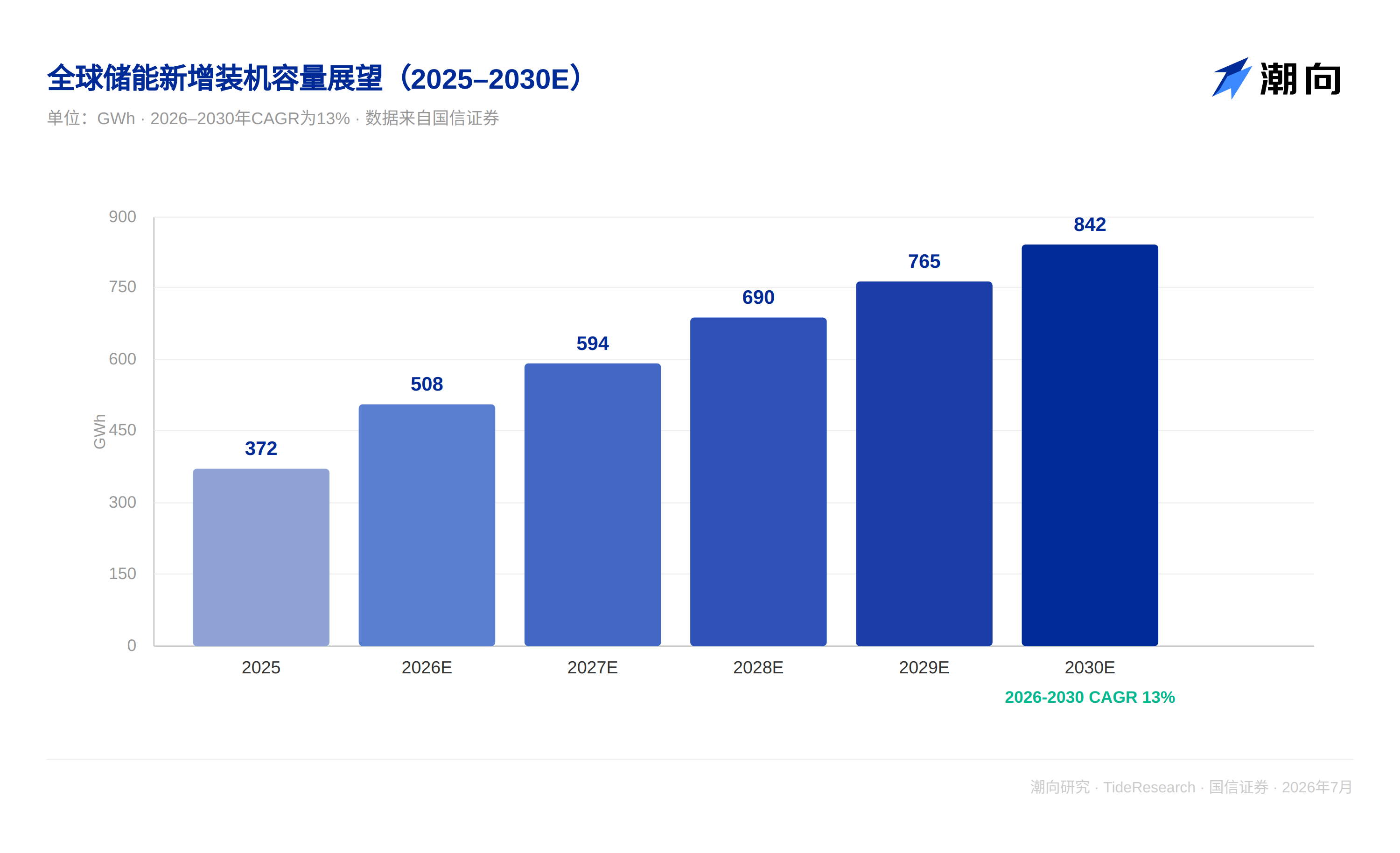
The global energy storage market is bidding farewell to the phase driven by a single policy. According to the latest research report from Guosen Securities, from 2026 to 2030, the global newly installed energy storage capacity will grow from 508GWh to 842GWh, with a compound annual growth rate of 13%, corresponding to an output value increase from 533.9 billion yuan to 839.5 billion yuan. The three major markets of China, the United States, and Europe are expanding synchronously, while emerging markets such as the Middle East, Southeast Asia, and Australia are accelerating their follow-up due to power shortages. Energy storage has upgraded from a supporting facility for new energy to an independent track of electricity infrastructure.
Domestic: Shifting from Subsidy Dependence to Market Pricing
In China, the newly installed energy storage capacity in 2025 is expected to be 66GW, and 189GWh, with a year-on-year increase of 73%. Among them, front-of-meter storage will add 179GWh, accounting for 95%, while commercial and industrial storage will add 10.5GWh, accounting for 5%, and achieve a year-on-year growth of 40%. The report points out that the key to this round of growth is the "Document No. 136" which promotes energy storage from being a supporting attribute of new energy to an independent entity in the electricity market, while "Document No. 114" establishes a capacity pricing mechanism from an institutional level. In terms of revenue structure, domestic front-of-meter energy storage has now established a diversified profit model that combines “capacity guarantee, spot flexibility, and incremental auxiliary services.” Capacity compensation policies have been gradually implemented in various locations, projects that have already established capacity pricing mechanisms have internal rates of return generally reaching 7% to 9%, a return level that was difficult to see in the previous era of mandatory storage allocation. The reform of the pricing mechanism has also opened up space for commercial and industrial storage, with the peak pricing mechanism fully implemented and deepening in the spot market. The price differential between peak and off-peak times in regions with concentrated commercial and industrial loads continues to widen. However, the report also predicts a compound annual growth rate of only 8% for China's installed capacity from 2026 to 2030, far lower than the growth rate of 73% in 2025, indicating that the growth center is naturally falling back under a high base.
United States: AIDC Pushes the Electric Grid to Speed Up, Energy Storage Becomes a Necessity
In the United States, energy storage installations are primarily front-of-meter, with new energy storage expected to add 57GWh in 2025, a year-on-year increase of 29%, of which front-of-meter storage will account for 51GWh, reaching 90%. On June 18, the U.S. Federal Energy Regulatory Commission issued a directive requiring the six major grid operators to open a "fast track" for large electricity users such as data centers to connect to the grid, clearly stating that the costs associated with grid connection will be borne by the electricity users themselves, which forces load sides to configure flexible adjustment resources locally. This means that for data centers to connect to the grid more quickly, energy storage is almost the only practical option, as it can achieve millisecond-level adjustments, directly addressing extreme fluctuations in computing loads while meeting multiple requirements for power supply reliability and grid demand response. Additionally, the “Inflation Reduction Act” extends the energy storage investment tax credit to 2036, with projects that start before the end of 2033 enjoying a 100% credit rate, which decreases to 75% and 50% in 2034 and 2035, respectively, with a slower phase-out than the 2027 phase-out for wind and solar. The policy certainty for U.S. front-of-meter energy storage is clearly stronger than that of other markets.
Europe: Tripartite Agreement Writes the 2030 Goals into Policy Documents
The structure of the European energy storage market is more balanced, with about 27GWh of new installations expected in 2025, a year-on-year increase of 24%. Among them, front-of-meter storage accounts for 16.3GWh, 60%, home storage accounts for 9.8GWh, 36%, and commercial and industrial storage accounts for 3.6GWh, 13%, with year-on-year growth rates for commercial and industrial storage reaching 62% and 83%, respectively. On June 26, the European Union signed the "EU Energy Storage Tripartite Agreement," uniting member countries, industry companies, and financial institutions to support the 2030 target of 200GW of energy storage installations, clarifying that the EU intends to add 30 to 35GW of storage from 2026 to 2028, and that the proportion of storage meeting peak electricity demand will double from 5% to 10%. 22 member countries have simultaneously issued national commitments for energy storage deployment. Commercial and industrial storage is the submarket with the steepest slope in this agreement, with new installations expected to jump from 9GWh in 2026 to 24GWh in 2028, and the proportion of commercial and industrial storage in renewable energy installations increasing from 5% to 20%.
Emerging Markets: The Electricity Gap is the Most Primitive Driving Force
In May this year, Australia introduced a 2.3 billion Australian dollar home storage subsidy program, with eligible families able to receive up to 4,000 Australian dollars in installation subsidies. At the same time, net metering policies in various states are gradually phasing out, and the grid-connected electricity prices for solar photovoltaics are continuously declining, collectively raising the penetration rate of home storage. In the Middle East, Saudi Arabia's "Vision 2030" plans for renewable energy installations to reach 120GW, and the UAE plans for renewable energy to account for 44%. The high proportion of desert photovoltaic grid connections is generating mandatory storage demands, while the construction of data centers in the Middle East is accelerating. Energy storage has dual value as a backup power source and a means for peak and valley arbitrage. In Southeast Asia, countries like Vietnam and Thailand have implemented mandatory storage policies for new energy projects, and the weak grid infrastructure further amplifies the alternative value of energy storage. The common point in these markets is that energy storage is a necessary patch for maintaining grid stability.
Looking at the three major markets together provides a clearer perspective. In terms of newly installed capacity in 2025, China's 189GWh far exceeds the United States' 57GWh and Europe's 27GWh, but the growth rhythm over the next five years is reversing: China is forecasted to have a CAGR of only 8% from 2026 to 2030, while the U.S. is expected to reach 21% according to North American standards and Europe at 10%. Global commercial and industrial energy storage will run ahead of all submarkets with a CAGR of 22%.
Trend Perspective
The CAGR provided in the report is quietly cooling down. China's figure has dropped from 73% in 2025 to 8% from 2026 to 2030, and the global total growth rate is also only 13%. This somewhat misaligns with the term "high prosperity," indicating that the industry is transitioning from explosive expansion to normalized growth. The 22% compound growth rate for commercial and industrial energy storage is nearly double that of front-of-meter storage at 13%, and it clearly surpasses home storage at 9%. This suggests that in the coming years, the companies that truly generate excess returns may not be the traditional large energy storage leaders but those more adept at distributed systems and channel penetration. The nine listed targets span the entire chain of large storage, home storage, and commercial and industrial storage, covering a wide range, but for ordinary investors, distinguishing which sub-market's beta one is investing in may be more important than simply remembering the "outperform the market" rating itself. Additionally, the report categorizes the Middle East, Southeast Asia, and Australia as emerging market increments, but the differences in policy implementation strength and grid construction speed among these regions are significant. Whether mandatory storage policies can be implemented on schedule is the real variable that will determine if these increments can be realized.

Disclaimer
This article is a compilation and interpretation of third-party brokerage research reports by Trend Research. The ratings, target prices, profit forecasts, and related judgments quoted in the text represent the views of the respective brokerage analysts and only reflect the stance of their organizations, not the views of Trend Research, and do not constitute any investment advice.
The market carries risks, and decisions should be made independently. This article should not be used as the basis for buying or selling any securities.
免责声明:本文章仅代表作者个人观点,不代表本平台的立场和观点。本文章仅供信息分享,不构成对任何人的任何投资建议。用户与作者之间的任何争议,与本平台无关。如网页中刊载的文章或图片涉及侵权,请提供相关的权利证明和身份证明发送邮件到support@aicoin.com,本平台相关工作人员将会进行核查。


