
Author: Heart of Computing Power
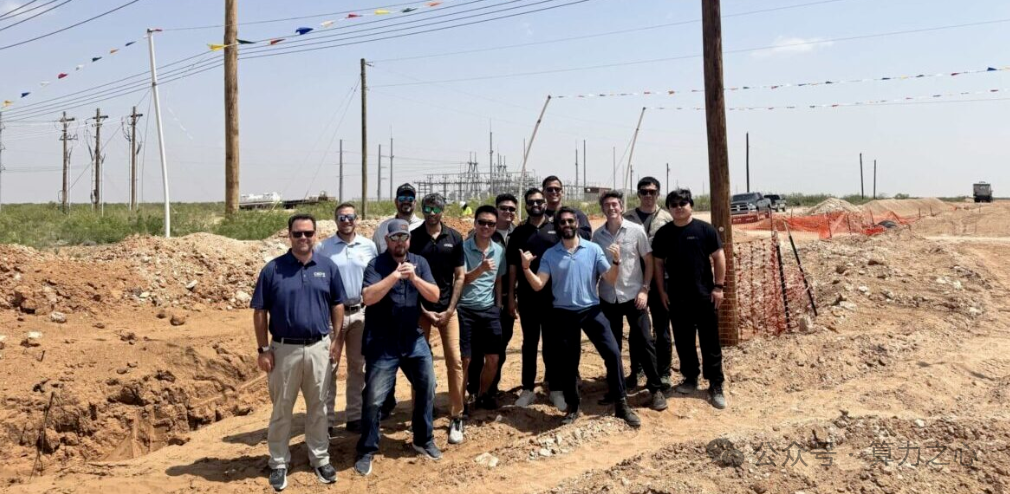
In December 2025, Spencer Marr cut a red ribbon in Ector County, Texas.
Behind the red ribbon was a Bitcoin mining facility called Genesis.
Less than half a year after going live, in June 2026, his company Sangha announced it was considering selling, partnering, or bringing on a strategic partner.
It wasn't that it couldn't continue, but rather that it was too valuable.
Because what was eyeing this mining facility was AI.
1. The mining facility just went live, and it's already looking for buyers
The Genesis mining facility is not large, at 19.9MW.
It does not have a separate power plant; instead, it is connected to a 180MW solar farm owned by the South Korean Hanwha Group.
They use "behind-the-meter supply," meaning the electricity generated by the solar panels does not go through the public grid but is directly delivered to the mining site via a dedicated line.
This saves on grid fees and avoids grid congestion, achieving two goals at once.
In addition, French energy giant TotalEnergies provides retail power services to help them supplement their power from the grid when sunlight is insufficient.
Sangha has named this model "tripartite win."
IPP (Independent Power Producers) earn extra, investors get low-priced Bitcoin, and the grid becomes more stable thanks to flexible loads.
The project timeline is also clear, breaking ground in May 2025 and going live in December.
To facilitate this, Sangha created an SPV (Special Purpose Vehicle) so that investors do not have to trade cryptocurrencies themselves but can invest directly in the mining machines and share in the Bitcoin output.
However, just six months after going live, in June 2026, Sangha announced it was considering selling, partnering, or bringing on a strategic partner.
The operation is managed by investment bank Marathon Capital, with the transaction code-named Project Genesis, proceeding in two phases with a target for completion in the fourth quarter.
Sangha co-founder Spencer Marr has not been shy about it, stating "we are casting a wide net," speaking with "various institutions," and he acknowledged that the company is "monitoring market changes like everyone else."
But why would a newly energized, profit-making mining facility want to change hands after only six months?
2. It's not the mining machines that are valuable, but the power line
Indeed, Genesis is not for sale because it is losing money.
Marr states that despite the hash price (how much each unit of computing power earns) trending downwards, their facility is still profitable.
The reason is simple: they have a low electricity price.
From December 2025 to the first quarter of 2026, their all-inclusive electricity price is around $32/MWh.
In contrast, industrial electricity in North America averages $60-80/MWh; Genesis's price is less than half of that.
Interestingly, while Marr expresses optimism about Bitcoin and hash price, he is also considering selling or partnering with the facility.
It sounds contradictory, but it isn’t.
Being optimistic about Bitcoin does not mean being optimistic about "continuing to mine indefinitely."
As AI companies scramble for significant power, a facility that is already energized, has a grid connection agreement, and low-cost power contracts is seen by them as a ready-made treasure, with "how many GPUs can it accommodate" defining Genesis's value.
Not to mention that for AI companies, the most significant cost is not the construction fee but time; power connections and land approvals can take several years.
And Sangha is indeed working in this direction.
They revised the grid connection agreement, increasing the site's power from 20MW to 110.4MW, aiming to complete this by May 2028.
At 110.4MW, Sangha will either raise funds to expand into an AI data center or sell the "power assets" to a wealthier buyer at a higher valuation.
Sangha is currently also considering that selling the power assets at a high valuation might be more profitable than expanding itself.
When Sangha promotes Genesis externally, it no longer talks solely about Bitcoin mining; AI computing, high-performance computing (HPC), and hybrid strategies are all included in the presentations.
And this story is not unique to Sangha.
3. The entire mining sector is leaning towards AI
Looking at publicly listed mining companies, the shift is more evident.
Companies like Core Scientific, TeraWulf, and Hut 8 have either already received substantial orders from AI/HPC or are in the process of transitioning.
The total value of AI/HPC-related contracts has exceeded $70 billion, and the revenue share from AI within publicly listed mining companies may rise from 30% to 70%.
However, Sangha is somewhat different.
It is not a listed company, has no stock price pressures, and does not need to report to Wall Street each quarter.
It operates on a project basis, with each SPV being an asset package; once Genesis is sold, the team can immediately move on to the next project.
This lightness makes it a target that buyers find easier to acquire.
For buyers, acquiring Genesis means directly obtaining a compliant, powered site with a power contract that is also expandable and ready for AI.
There’s no need to wait three years for approvals, to negotiate with the grid, or to build a substation from scratch.
To be fair, Genesis's operational model has genuinely proven successful.
Solar energy paired with mining, with electricity prices driven down to $32, and the model validated with no issues; continuing expansion will require more investment, but AI buyers are willing to pay a premium.
Selling represents a calculable profit.
However, at this point, the "tripartite win" story shared with investors—power producers earning more, investors getting low-priced coins, and a more stable grid—might have boiled down to one statement: whoever bids higher takes it.
Spencer Marr once stated that what Sangha is doing is "building a new model for Bitcoin capital flow."
Now, this "new model" may need to transform into "selling power assets to AI and then sharing the profits."
But when good power and good land start shifting towards AI, where will be the next frontier for Bitcoin miners?
免责声明:本文章仅代表作者个人观点,不代表本平台的立场和观点。本文章仅供信息分享,不构成对任何人的任何投资建议。用户与作者之间的任何争议,与本平台无关。如网页中刊载的文章或图片涉及侵权,请提供相关的权利证明和身份证明发送邮件到support@aicoin.com,本平台相关工作人员将会进行核查。


