The World Cup is a great scene to observe changes in wallets.
The discussions that fans have daily about whether teams qualify, changes in championship odds, etc., become priced trading actions in prediction markets like Polymarket. Therefore, the World Cup prediction events integrated into mainstream Web3 wallets can be considered a lightweight entry point and starting point for users to engage in on-chain interactions when viewed over a longer timeframe (see further reading "World Cup Carnival, Prediction Markets on the Table: How Polymarkets Is Breaking Through to the Masses?").
At the same time, another earlier but more imaginative change is worth noting, which is that when AI Agents start to enter wallet scenarios, the way users interact with the on-chain world may also change.
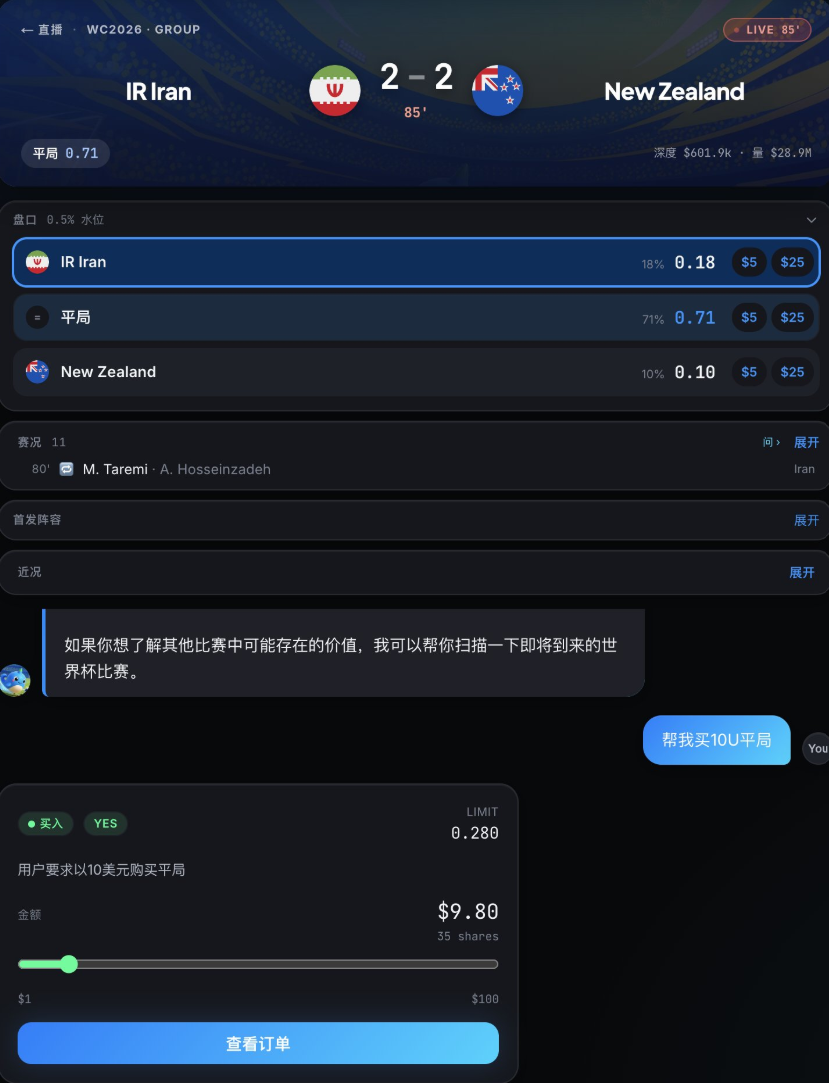
For instance, imToken has begun to experiment with incorporating AI Agents into practical use scenarios during this World Cup exploration, such as the agents launched on the web and in Discord, which can help users naturally complete betting transactions around specific prediction needs, allowing users to no longer just operate within the wallet app but to easily participate in prediction markets in scenarios like Discord and the web, seamlessly guided back on-chain by the Agent.
This is not unlike the early form of the Agentic Wallet—future Web3 wallets may not be limited to wallet applications, but will definitely take on a more ubiquitous "AI wallet form."
1. The World Cup Experiment: When Agents Start to Understand "Intent"
It’s still the age-old question: over the past decade, the core issue wallets solved has been clear: where assets are stored, who controls the private keys, and who signs transactions.
For example, when users open imToken, it’s mainly to check balances, conduct transfers/interactions, and manage multi-chain assets. Because of this, wallets at this stage resemble an asset entry and a signature entry; users only need to know what they plan to do, then complete the final step through the wallet, and that’s enough.
However, the change in the Agentic era is that users may not know from the beginning what they want to click.
For instance, in the World Cup scenario, an ordinary user may not initially think, "I want to open Polymarket, find a market, determine the odds, and complete the transaction." Instead, they are more likely to say, "What highlights are there in tonight's match?" "I think Portugal will qualify, are there any related markets?" "Are these odds already too low?" "If I just want to participate with a small amount, what’s the process?"
These questions may have previously been scattered across WeChat groups, social platforms, or search engines, with each user needing to piece together the information and execute step by step. But after the Agent intervenes, the mode of interaction has significantly changed: users only need to express a general intent, and the Agent will actively help them break down the path, while the wallet then converts the path into a series of on-chain actions.
So this is definitely not simply adding a chat box to the wallet.
The real change is that the wallet starts to transform from a "function menu" into an "intent interpreter." Previous wallets mainly involved users deciding whether to transfer, swap, stake, or connect to DApps. Future wallets may take it a step further, with users only needing to tell it what they want to accomplish using natural language.
This is also why events like the World Cup are very suitable as entry points for the Agentic Wallet. Because it inherently provides context, users naturally have the desire to express themselves, and they inherently need to make judgments. Agents do not need to manage complex asset portfolios for users from the get-go, especially involving complex asset management, where the risks are higher. They can first help users find interaction paths in a specific scenario and then hand back the final control to the wallets and users.
The imToken agents mentioned earlier that allow on-chain interactions via web and Discord are a typical example. They bring wallet capabilities into a lighter entry point, enabling users to not necessarily open the app first, nor enter a traditional DApp browser, but to find interaction paths through the Agent in an event page or a World Cup scenario.
This means the boundaries of wallets are beginning to expand.
The previous wallet entry was relatively clear; users would open the app, enter the asset page, click a function, and then connect to DApps. In contrast, future wallet entries may be scattered in more places, such as on web pages, Discord, Telegram, AI chat boxes, event pages, developer tools, and even lightweight wallet interfaces generated by individual users.
From this perspective, it’s also why we feel the World Cup prediction is not the main point; the main point is that it positions the wallet more naturally at the forefront of "user intent" for the first time.
2. From Agent Pay, AI Is Entering the Payment Layer
If we only look at the crypto internal perspective, Agentic Wallet could be easily understood as a narrative concept, where AI helps users watch the market, find opportunities, and make transactions, resembling an extension of the previous AI Agent hype.
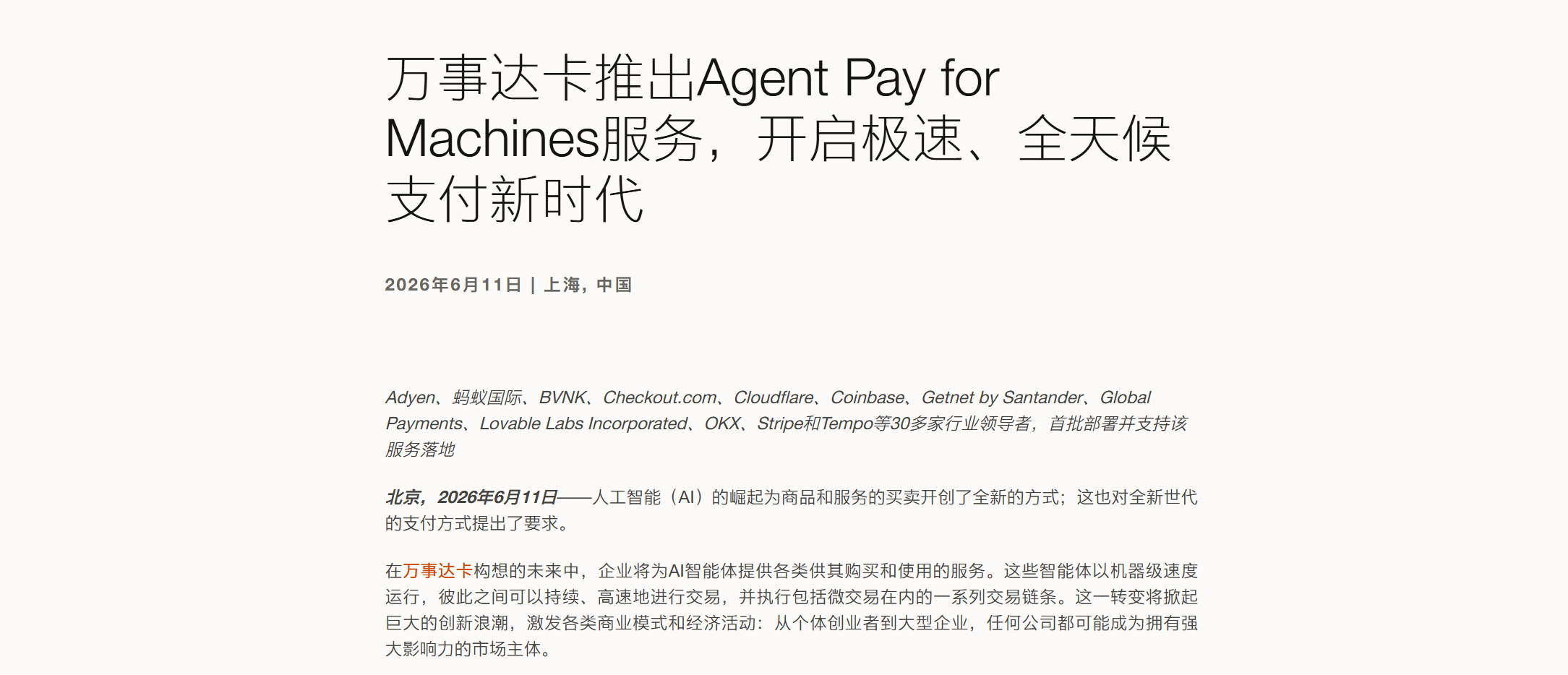
However, the introduction of Mastercard’s Agent Pay for Machines on June 10 has made this issue suddenly extend beyond Web3.
Mastercard's definition of Agent Pay is clear: it aims to allow trustworthy AI Agents to participate in payments with user authorization, including how agents are identified, authorized, verified in the payment network, and how merchants, issuers, and users are made aware that this transaction was completed with the assistance of an Agent.
This is actually highly similar to the problems Web3 wallets face.
When AI is only helping you write copy, the cost of errors is usually manageable, but once AI begins to participate in asset interactions, the issue changes: does it have permission? Is the user intent it understands accurate? Is the service it invokes reliable? Does the transaction it initiates exceed its boundaries? If the outcome does not match user expectations, who will bear the responsibility?
Mastercard’s answer is to redesign the identity, tokens, authorization, risk control, and dispute handling for "trustworthy agents" within the payment network.
This signal is important. If the concept of Agentic within the Web3 circle still carries a hint of geeky imagination, then traditional financial giants beginning to design payment infrastructure for Agentic Commerce indicates that this matter has entered a more realistic business context.
Looking more closely, domestic payment giants are also moving in this direction. WeChat Pay is testing AI payment functionalities in conjunction with Tencent’s AI product WorkBuddy, for example by launching an "AI Exclusive Card" in the WeChat wallet. From the disclosed information, the core of this type of product is not to allow AI to spend freely but to set boundaries for agent payments through recharge limits, payment authorization scopes, and verification confirmations.
This aligns with the logic of Mastercard’s Agent Pay, which is AI can participate in payments, but it must be identified, authorized, restricted, and audited.
Additionally, Web3 wallets are facing the on-chain version of the same issue. The difference is that traditional payment systems emphasize networks, merchants, issuers, and compliance responsibilities more; on-chain wallets emphasize private keys, signatures, authorizations, contract calls, and user self-custody.
Because of this, the Agentic Wallet cannot simply replicate traditional payment paths. After all, in traditional payment systems, users can rely on banks, card organizations, merchants, dispute resolutions, and risk control systems, but in the on-chain world, once a transaction is on-chain, there is often no "undo" button.
The higher the efficiency brought by AI Agents, the more important the last line of security boundaries that wallets bear becomes. Therefore, future wallets should not just enable Agents to "do things," but also ensure that Agents "can only act within the range permitted by the user."
That is also why Web3 may be more suitable for discussing Agentic Wallets.
3. In the Agentic Era, How Does the Wallet Redefine On-Chain Interaction?
When many people discuss AI Agents, they tend to subconsciously lean towards an extreme vision: in the future, AI automatically helps me trade, automatically helps me invest, automatically helps me find airdrops, automatically helps me arbitrage.
This direction is certainly attractive, but for wallets, the real challenge is not "automation," but "sense of boundaries."
Because wallets are not ordinary applications. In ordinary applications, if AI recommends the wrong song, writes a wrong paragraph, or clicks on the wrong page, it is at most an experience issue; but in a wallet, if AI misunderstands a command, invokes the wrong contract, or grants too much authorization, it could lead to real asset risks (see further reading "Signing Is More Than Just Signing: When AI Agents Sign for You, Who Still Holds Control?").
Therefore, the fundamental question of the Agentic Wallet is not "how many things can AI help users do," but "how do users know what AI is doing."
This is also why imToken has emphasized control over the past few years. From self-custody wallets to multi-chain asset management, to today’s AI co-creation and Agent exploration, the true consistent storyline is not that the functionality is increasing, but that users must always be able to understand, confirm, and control their digital world.
In the Agentic era, this storyline will become even more specific.
Wallets need to help users understand who this Agent is, what abilities it can invoke, how long the authorization lasts, whether it can operate across DApps, when it requires my re-confirmation, and whether I can pause or revoke it with one click... These questions may sound a bit cumbersome, but they are the foundation for whether the Agentic Wallet can truly exist.
AI Agents' power comes precisely from their ability to simplify complex processes. When a user says something, the Agent can deconstruct it into several execution paths. This is good for the experience but poses challenges for security. The longer the paths and the more steps involved, the more wallets need to bring the key nodes back into the user’s view.
Future good wallet interactions may not be about showing more technical details to users, but translating complex transactions into understandable language:
- You are authorizing a certain Agent to invoke a contract within the next 24 hours;
- This operation can use a maximum of how many USDC;
- It can only access World Cup-related prediction markets and cannot touch your other assets;
- Each transaction exceeding a certain amount must be re-confirmed;
- The authorization will automatically expire after a certain period;
- You can pause this Agent at any time in the wallet;
This sounds like a far-off future, but it has already begun in some small scenarios. The World Cup prediction activity is an event entry point, and the web-based Agent and Discord Agent that imToken is experimenting with are community entry points.
The more it is at times like this, the less wallets can retreat into the background.
免责声明:本文章仅代表作者个人观点,不代表本平台的立场和观点。本文章仅供信息分享,不构成对任何人的任何投资建议。用户与作者之间的任何争议,与本平台无关。如网页中刊载的文章或图片涉及侵权,请提供相关的权利证明和身份证明发送邮件到support@aicoin.com,本平台相关工作人员将会进行核查。