This adjustment affects global assets: Bitcoin falls to about $64,000, the lowest since February this year; gold rises about 1% due to buying at lower prices.
Written by: Zhang Yaqi
Source: Wall Street Journal
Broadcom's disappointing earnings outlook triggers a rapid cooling of global AI trading, with South Korea's Composite Stock Price Index (KOSPI) leading declines in the Asia-Pacific market on Thursday, abruptly bringing to the forefront the bubble risk accumulated due to the highly concentrated chip stocks and a sharp expansion of leveraged funding this year.
Nasdaq 100 futures fell 0.5% after Broadcom plummeted 14% in after-hours trading, with its latest earnings outlook significantly lower than investor expectations, signaling that the transition to AI clients is progressing slower than the market anticipates. UBS Group's AI Winners Basket Index subsequently dropped 1.4% on Wednesday, ending a four-day winning streak. Asia's decline extended the weak pattern seen on Wall Street on Wednesday—the S&P 500's nine consecutive gains abruptly stopped, with hawkish signals from Fed officials and the renewed tension between the U.S. and Iran further suppressing risk appetite.
According to an article from Wall Street Journal, South Korean Finance Minister Koo Yun-cheol, along with the central bank governor Shin Hyun-song, Financial Services Commission Chairman Lee Eog-weon, and Financial Supervisory Service Commissioner Lee Chan-jin held a joint meeting, promising to take "immediate measures" to respond to severe fluctuations in the foreign exchange market if necessary. Meanwhile, officials warned about the balance of stock financing loans reaching a nearly 20-year high, highlighting authorities' strong concern for market stability.
This adjustment affects global assets: Bitcoin falls to about $64,000, the lowest since February this year; gold rises about 1% due to buying at lower prices; Brent crude oil ends its three-day rising streak with news of a ceasefire agreement between Israel and Lebanon, falling about 1% to around $97 per barrel; European stocks show mixed gains and losses as investors cautiously await Friday's U.S. non-farm payroll data.
European stocks opened mixed, with the Euro Stoxx 50 index up 0.13%, the UK FTSE 100 index down 0.12%, the French CAC 40 index up 0.10%, and the German DAX index up 0.20%.
- The Nikkei 225 index closed down 1.4%, at 67,470.69 points. The Tokyo Stock Exchange index closed down 1.1%, at 3,951.85 points. The Seoul Composite Index closed down 1.8%, at 8,639.41 points.
- The U.S. Dollar Spot Index changed little.
- The yen rose 0.1% to 159.86 per dollar.
- The yield on U.S. 10-year Treasury bonds fell by two basis points to 4.48%.
- The yield on Japanese 10-year bonds rose three basis points to 2.670%.
- WTI crude oil fell 0.8% to $95.27 per barrel.
- Spot gold rose 1% to $4,479.64 per ounce.
- Bitcoin fell 0.9% to $64,312.09.
Broadcom's warning triggers AI nerves, Asia Pacific markets decline
Nasdaq 100 futures fell 0.5%, after Broadcom's 14% plunge in after-hours trading due to its latest earnings outlook not meeting investor expectations. Broadcom also signaled that its transition to AI clients is progressing slower than expected, despite the correct direction, facing excessively high market expectations. UBS Group's AI Winners Basket Index fell 1.4% on Wednesday, ending a four-day winning streak.
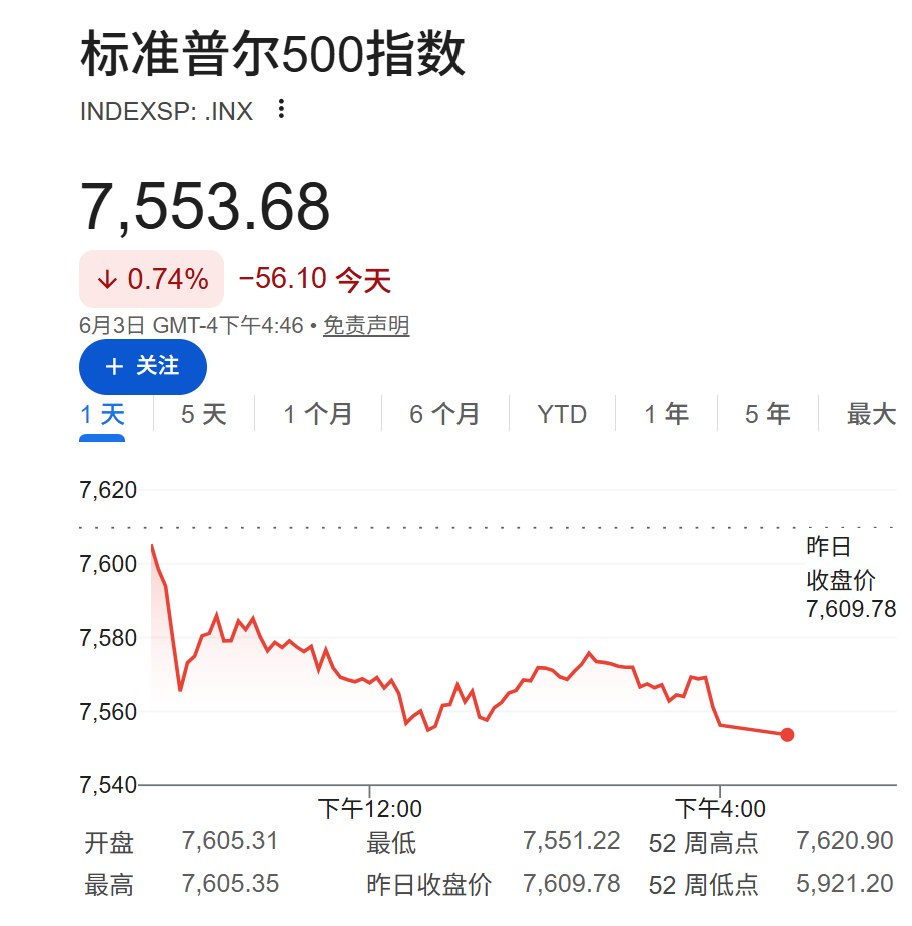
Asia's decline followed the weak pattern on Wall Street on Wednesday—the S&P 500's nine consecutive gains abruptly stopped, and the renewed U.S.-Iran conflict weighed on market risk sentiment. European stock markets also faced downward pressure, with Bitcoin falling to about $64,000, the lowest level since February. News of a ceasefire agreement between Israel and Lebanon provided some localized relief, with Brent crude oil ending its three-day rising streak, falling about 1% to around $97 per barrel; gold rose 0.6% to about $4,460 per ounce due to buying at lower prices.
Global X Management investment strategist Billy Leung stated, "Chip stocks had already risen significantly before the earnings reports, and investors holding large floating profits do not need many reasons to take profits."
South Korean authorities hold emergency meeting, intervention signal clear
KOSPI opened sharply lower on Thursday, becoming one of the major indices with the largest decline in the Asia-Pacific region. Although the KOSPI has still accumulated over a 100% increase year-to-date and has risen over 200% since June 2025, ranking first among the major global stock indices, the nearly 2% decline on that day raised significant concerns among authorities.
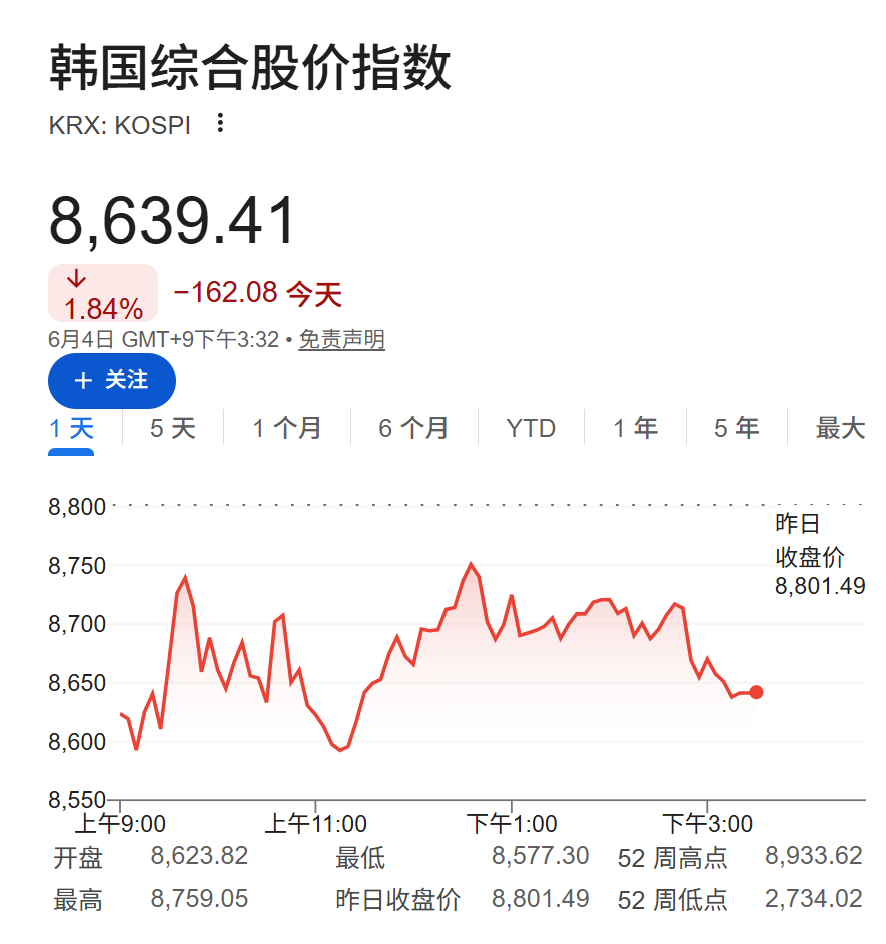
According to the Yonhap News Agency, Koo Yun-cheol stated after the meeting that the government is maintaining a high level of vigilance to prevent external uncertainties from evolving into market panic. "(The government) will take immediate measures to address excessive market volatility when necessary," he added. Attending officials believe that recent market fluctuations are closely related to the ongoing conflict in the Middle East and the sustained net selling by foreign capital in the stock market. The South Korean Ministry of Finance pointed out in a statement that "the recent rapid rise in the South Korean stock market has led foreign investors to conduct temporary rebalancing, and profit-taking behavior has intensified market volatility."
While officials emphasized that the fundamentals of the South Korean economy are solid—May exports surged 53.2% year-on-year, and the market capitalization of the stock market has jumped to sixth in the world—they also warned that the rising scale of stock financing loans could pose potential risks to the economy, and they will closely monitor related trends to protect investor interests.
Index's explosive rise highly concentrated, structural risks continue to accumulate
KOSPI's impressive performance conceals serious differentiation among its component stocks. Among the 835 constituent stocks, only 373 have risen this year, less than half; Samsung Electronics and SK Hynix have seen increases of approximately 200% and 250% this year respectively, with market capitalizations exceeding $1 trillion, together accounting for over 40% of the KOSPI's weight, while the remaining over 800 stocks contribute less than 30% to the index's rise.
Alongside the highly concentrated rise is the rapid expansion of leveraged speculative funding. Data from the South Korean Financial Supervisory Service shows that as of the first quarter of 2026, the balance of financing and securities loans from the top ten brokerages has approached 36 trillion won, nearly doubling from a year ago and reaching a nearly 20-year high; among them, the proportion of investors aged 50 and older reached as high as 62.3%, with the loan balance of those over 60 years old skyrocketing from about 30 trillion won to over 80 trillion won within a year. In the first quarter of 2026, the number of new securities accounts opened by those under 18 in South Korea has surged nearly tenfold compared to the same period last year.
Data from the Korean Exchange shows that since the beginning of this year, the total number of temporary trading suspension orders triggered in the main board market has reached the highest level since the 2008 financial crisis—the programmed trading halt order for "sidecar" has been issued 20 times this year, just six fewer than the 26 times issued throughout 2008. According to the rules, when the KOSPI 200 futures index's fluctuation reaches or exceeds 5% and lasts for at least one minute, programmed trading will be suspended for five minutes.
Wall Street attitudes diverge, bubble warnings rise
In the face of KOSPI's rapid rise, major Wall Street institutions show significant divergence in their attitudes. Goldman Sachs raised its KOSPI target from 9,000 points to 12,000 points and believes in its report that the rise of AI chip manufacturers' stocks is likely to continue, but warns that the risk of a pullback is increasing; the chief equity strategist for the Asia-Pacific region Timothy Moe and others wrote in the report, "We are more optimistic about the North Asia region, where profit growth is the strongest."
Citi, on the other hand, warned that the valuation of the South Korean stock market is at a high level compared to major global markets, and combined with the systemic risks of labor relations, the long-term willingness of foreign capital to allocate may be hindered, believing the current rise is driven more by short-term sentiment. Standard Chartered's global chief investment officer pointed out that going long on Korea has become a "highly crowded trade" and downgraded the semiconductor sector rating from "overweight" to "neutral," believing that a short-term adjustment is entirely reasonable.
Billionaire and founder of Bridgewater, Ray Dalio stated in a Bloomberg TV interview on Wednesday, "All great technological revolutions create bubbles." Emerging market investor, Cusana Capital founding partner and chief investment officer Rob Marshall Lee was more blunt: "The Korean market is a huge bubble." He pointed out that most South Korean companies have very low returns on equity, and the AI era will not bring fundamental changes; he warned that when the cycle reverses, the related companies' profit margins could plummet from 70% to negative values. "In the short term, I wouldn’t short; but looking 5 years ahead, you could very likely lose a lot of money," he said.
Fed hawkish signals strengthen, macro pressure continues to rise
The hawkish statements from Fed officials are simultaneously cooling market sentiment. Dallas Fed President Lorie Logan stated that policymakers may need to raise interest rates later this year to bring inflation back to target; New York Fed President John Williams told Yahoo Finance that there remains uncertainty in the interest rate outlook.
According to Bloomberg, recent data shows that the number of new jobs added by U.S. businesses is the highest since January 2025, indicating that despite rising energy costs, recruitment momentum remains strong. If Friday's non-farm payroll data confirm this, market expectations for Fed interest rate hikes will further strengthen. The yield on U.S. 10-year Treasury bonds fell slightly on Thursday by two basis points to 4.48%, after previously rising significantly due to high oil prices and a resilient labor market. Investors will also receive the weekly initial jobless claims data on Thursday to further assess the direction of the labor market.
Forex.com analyst Fawad Razaqzada stated, "If U.S. economic data continues to exceed expectations, investors may express a more hawkish Fed outlook by betting on a stronger dollar, especially against low-yielding or zero-yielding assets like the yen and gold." Meanwhile, according to Bloomberg citing informed sources, Japanese central bank officials are considering raising the benchmark interest rate by 25 basis points this month and assessing the possibility of further rate hikes within the year, which has driven the yen to strengthen against the dollar on Thursday.
免责声明:本文章仅代表作者个人观点,不代表本平台的立场和观点。本文章仅供信息分享,不构成对任何人的任何投资建议。用户与作者之间的任何争议,与本平台无关。如网页中刊载的文章或图片涉及侵权,请提供相关的权利证明和身份证明发送邮件到support@aicoin.com,本平台相关工作人员将会进行核查。


