The draft of the Clarity Act has been preliminarily approved, which will first provide a certainty framework at the federal level.
Written by: Maher, Foresight News
On May 14, the U.S. Senate Banking Committee passed the CLARITY Act with a vote of 15 in favor and 9 against, formally submitting the bill to the full Senate for a vote.
This moment has been awaited by the cryptocurrency industry for nearly a year. The House of Representatives had already passed the bill with a bipartisan high vote of 294-134 on July 17, 2025, but controversial provisions in the Senate version regarding stablecoin gains, DeFi exemptions, and ethical requirements delayed the process repeatedly.
It was not until May 12 that the U.S. Senate Banking Committee published the latest draft text consisting of 309 pages.
This bill, referred to by the industry as a "game changer," aims to end the years-long regulatory tug-of-war between the SEC and CFTC, and delineates the jurisdictional boundaries of digital assets in the form of federal law for the first time. It not only provides clear rules for exchanges, brokers, and DeFi developers, but also embeds consumer protection, anti-money laundering, and anti-CBDC provisions.
However, it is little known that the CLARITY Act once caused a rare rift in the U.S. political and business alliance, facing opposition from the American Federation of Labor and Congress of Industrial Organizations (AFL-CIO). What exactly does the CLARITY Act draft say?
Core Content of the 309-page Draft
The full name of the Clarity Act is the Lummis-Gillibrand Responsible Financial Innovation Act of 2026, which was formally proposed by Rep. French Hill (R-AR) on May 29, 2025. In June of that year, the bill passed through joint markup by the Financial Services Committee and the Agriculture Committee, and was voted on and passed in the full House on July 17. The bill was officially named the "CLARITY Act of 2025" and also included the "Anti-CBDC Surveillance State Act" section.
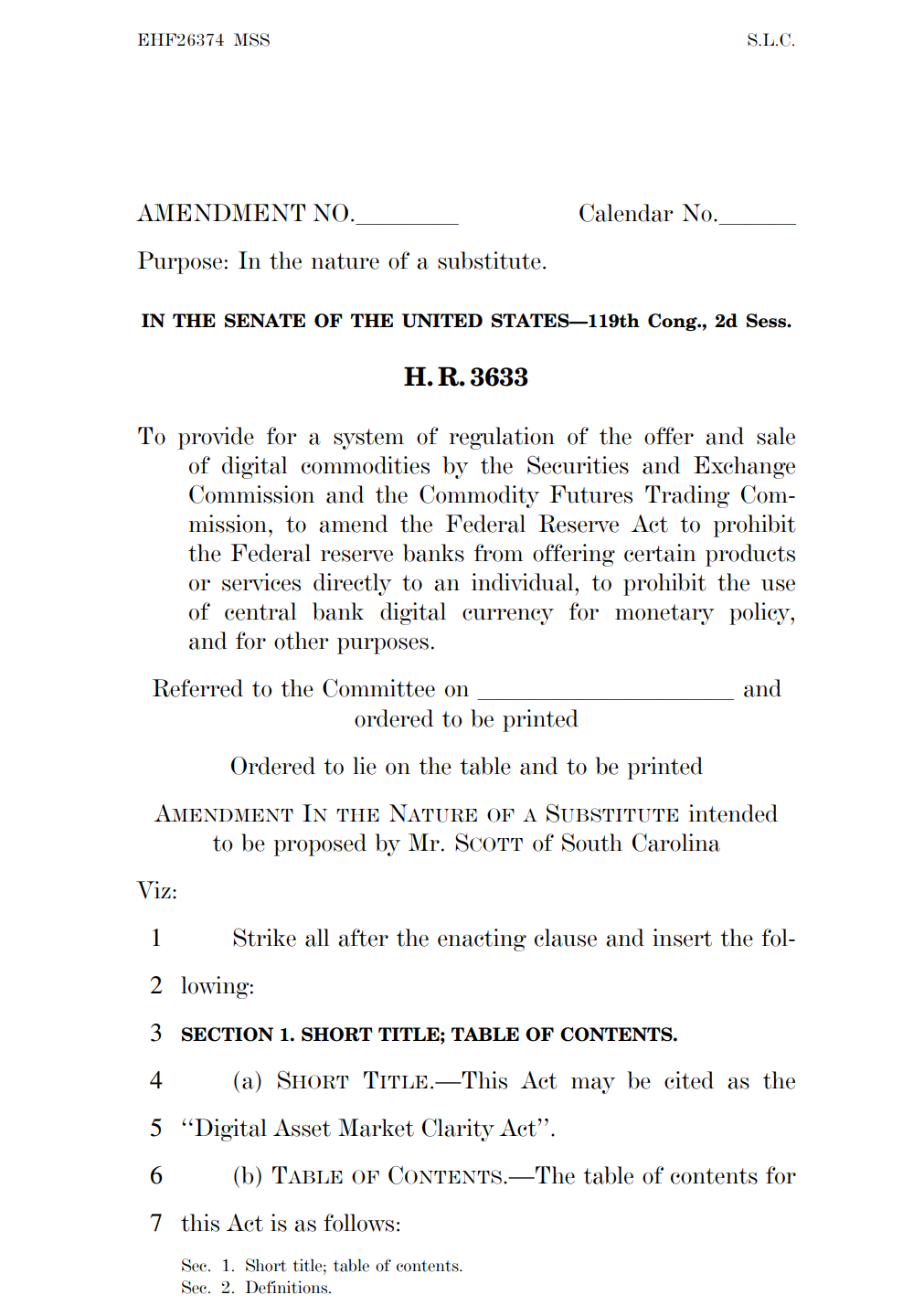
The draft, totaling 309 pages, is mainly divided into nine parts, which are
- Securities innovation, which stipulates disclosure requirements and exemptions related to subsidiary asset transactions, clarifies the characteristics of "network tokens," and treats them as non-securities under specific conditions.
- Combating illegal finance, bringing digital assets under the regulatory scope of the Bank Secrecy Act (BSA) and sanctions laws.
- Regulation of the DeFi industry, applying existing securities intermediary and BSA requirements to non-decentralized financial protocols.
- Banking and regulation, clarifying the permissibility of banks conducting digital asset activities. Prohibiting interest or returns on payments for payment stablecoins.
- Establishing a CFTC-SEC micro-innovation sandbox, including international cooperation, automated compliance research, securities tokenization, voluntarily adopting post-quantum cryptography standards, etc.
- Protecting software developers and customer property, protecting software developers, NFT safe harbor, non-fungible token research, blockchain regulatory certainty act, Keep Your Coins Act (self-custody protection).
- Protecting customer property.
- Customer protection.
- Other matters, etc.
The core of the draft revolves around the regulatory boundaries of the SEC and CFTC and the non-securities treatment of tokens (staking distribution, governance systems), etc.
The draft first clarifies the distinction between "digital goods" and "securities," thus delineating the jurisdiction of the SEC and CFTC. According to the latest excerpts from the text, the CFTC will have exclusive jurisdiction over "digital goods"—that is, mature network-native tokens whose value primarily derives from decentralized blockchain functionality; while the SEC will retain jurisdiction over "investment contracts" and assets in their initial issuance phase. The draft introduces the "mature blockchain test," which requires blockchain systems to meet conditions such as no single entity control, distributed ownership, and open source, such as BTC and ETH.
Once certified, relevant tokens will automatically convert to non-securities, allowing issuers to be exempt from certain SEC registration requirements, but they must continue to provide initial and semi-annual disclosures.
In simple terms: it changes from "potentially considered securities in the early stage" to "ordinary goods once matured," with significantly simplified regulation and greater innovation space.
As for intermediaries, digital commodity brokers, dealers, and exchanges must register with the CFTC and fulfill customer asset segregation, risk disclosure, and anti-money laundering (BSA) obligations. The bill specifically includes provisions of the "Blockchain Regulatory Certainty Act," providing clear exemptions for non-custodial DeFi protocols, node operators, and open-source developers—they do not need to register as money services providers or brokers as long as the protocols are truly decentralized (decentralized governance itself does not constitute "control").
The stablecoin provisions are the focal point of the latest compromise. The bill defines these as "permitted payment stablecoins" (i.e., compliant payment stablecoins such as USDC) and excludes them from the category of digital goods. The new text prohibits covered digital asset service providers from paying passive, stored interest or returns to U.S. customers but allows rewards based on real activities or transactions.
On May 12, the new text incorporated restrictions related to stablecoin rewards, as well as provisions of the "Blockchain Regulatory Certainty Act," clarifying that non-custodial developers do not fall under money transmitters. Coinbase, which previously withdrew support due to disputes over stablecoin reward provisions, has shifted to support, but banking groups still feel the restrictions are insufficient.
Additionally, the bill explicitly prohibits the Federal Reserve from issuing or directly providing CBDCs to individuals and requires federal agencies not to restrict the use of self-custody wallets, while reinforcing bankruptcy isolation protection, treating digital goods as "customer property."
These provisions are the result of extensive consultations with regulators, law enforcement agencies, financial institutions, innovators, and consumer advocates. The Senate version expands to nine titles, placing greater emphasis on combating illegal finance and consumer education than the House version.
Ending Regulatory Gaps, Institutional Funds Will Flow Back to the U.S.
For the past decade, cryptocurrency regulation in the U.S. has been in a "gray area." The SEC is known for its "enforcement-based regulation," and lawsuits against platforms like Coinbase and Ripple have subjected the industry to long-term uncertainty, leading to capital outflows and projects relocating to places like Singapore and Dubai. The passage of the Clarity Act will provide a certainty framework at the federal level for the first time.
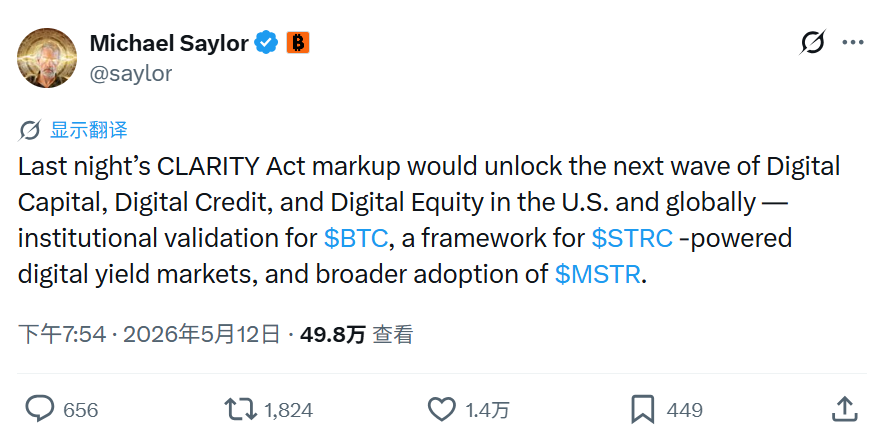
For the market, this means that institutional investors and traditional finance can enter more confidently. The CFTC's clear jurisdiction over the spot digital goods market will promote the expansion of more ETF products, bank custody services, and payment innovations. According to estimates by bill supporters, clear rules are expected to attract institutional funds back to the U.S. Michael Saylor stated that the deliberation of the CLARITY Act last night will unleash the next wave of digital capital, digital credit, and digital equity in the U.S. and globally, providing institutional validation for BTC.
A16z partner Chris Dixon and other crypto leaders have long called for "a clear rules path," believing that the bill will allow the U.S. to continue to lead in innovation.
For users and developers in the cryptocurrency industry, DeFi developers gain a "safe harbor," while ordinary users benefit from mandatory disclosures, asset segregation, and anti-fraud provisions. The CFTC will gain new tools to combat market manipulation and illegal financial activities. Meanwhile, the bill retains regulatory jurisdiction over unfair deceptive practices and requires the publication of digital asset fraud education materials.
From the perspective of national competitiveness, Senate Banking Committee Chairman Tim Scott clearly stated: "This bill prioritizes consumers, combats illegal finance, curtails crime and foreign adversaries, and keeps the future of finance in the U.S.
On May 8, SEC Chairman Paul Atkins pointed out during a speech at the "AI + Expo Special Competitive Research Project" that he supports a limited innovation exemption pathway and calls on Congress to pass the CLARITY Act to provide long-term certainty in legislative form. Atkins warned that over-regulation or uncertainty could push innovation overseas, and the U.S. should continue to lead the global market through understanding and adaptation.

However, there are opposing voices; according to Bloomberg, the American Federation of Labor and Congress of Industrial Organizations (AFL-CIO) released a letter to senators on Tuesday opposing the CLARITY Act, expressing deep concerns that the bill would lead to a large influx of digital assets into pension plans, retirement accounts, and the broader financial system, putting laborers at risk.
Controversies and Divergences: Banking Lobby, Democratic Resistance, and Internal Industry Games
Despite strong bipartisan support, the Clarity Act still faces multiple resistances. The biggest point of contention is the stablecoin gain provisions.
Let's clarify the core concept first: the so-called "permitted payment stablecoins" are those compliant stablecoins that are 1:1 pegged to fiat currency like the dollar, mainly used for daily payments and transfers (similar to regulated USDC). The bill clearly prohibits such stablecoins from paying any interest or "like deposit" passive returns to users, aiming to prevent crypto platforms from taking away traditional banks' deposit business. Any assets classified as "Payment Stablecoin" must have the core feature of not generating interest, otherwise they will face enormous compliance pressures.
The traditional banking industry has long been a steadfast ally of the Republican Party, but this time the bill is seen as directly touching on their core interests. Lobbying groups like the American Bankers Association (ABA) strongly oppose any form of "like deposit" returns, arguing that this will erode the bank deposit base and lead to significant capital outflows. They issued an urgent letter to CEOs of banks across the country early this week, urging a complete closure of loopholes that allow crypto platforms to bypass the GENIUS Act ban.
The cryptocurrency industry argues that excessive restrictions on rewards will severely stifle innovation and user incentives. Coinbase CEO Brian Armstrong withdrew support earlier in January 2026 due to similar provisions, causing a delay in deliberation; however, after the release of the latest compromise text in early May, he publicly responded with "Mark it up" (advancing deliberation), indicating that the industry has accepted the compromise.
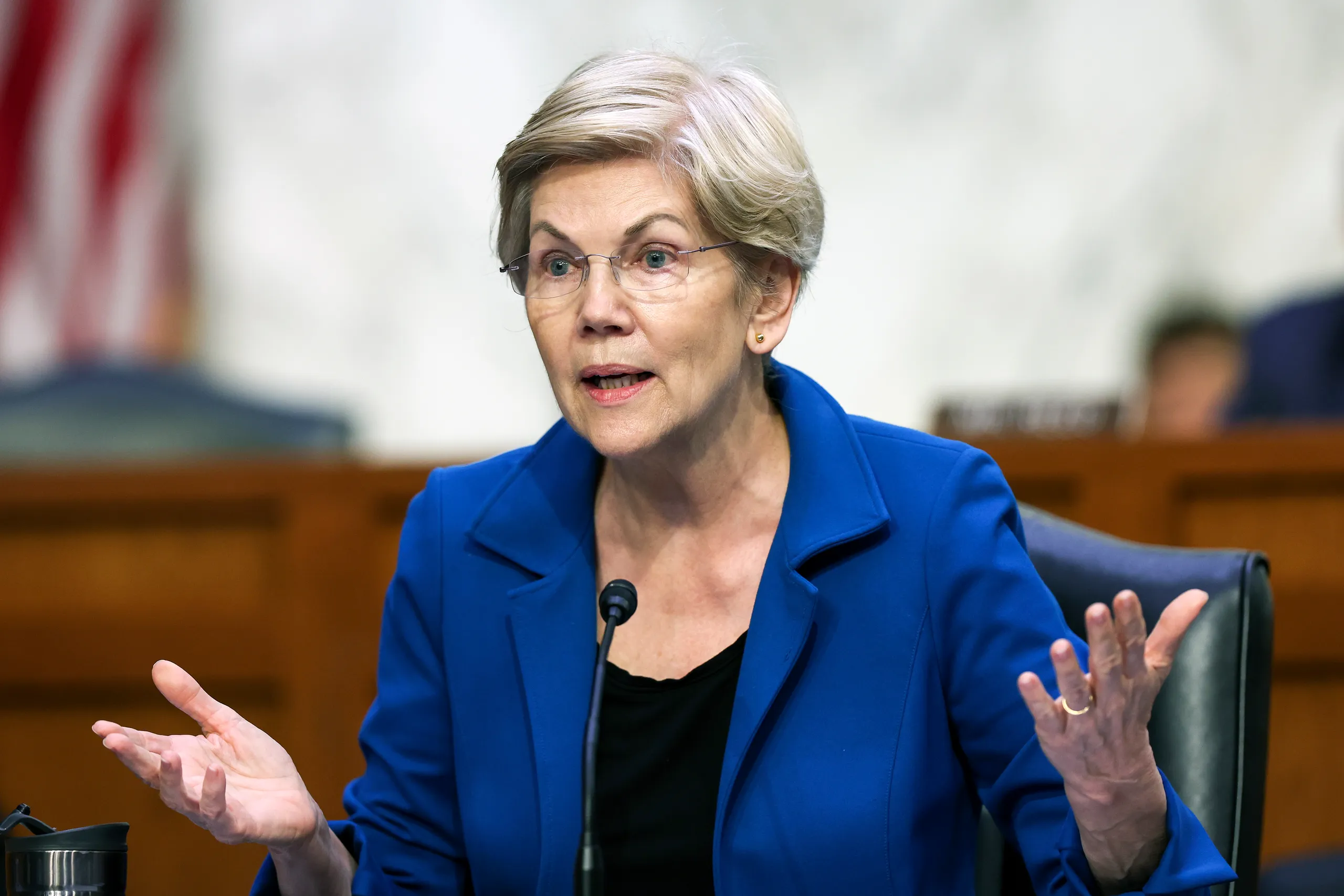
Elizabeth Warren
Democratic lawmakers, particularly senior members of the Senate Banking Committee like Elizabeth Warren, focus on consumer protection and ethical issues. She has criticized the bill for "weakening securities laws" and "greenlighting Trump corruption," pushing for 38 amendments to strengthen AML requirements, disclosure of officials holding crypto, and preventing public officials and their families from profiting from cryptocurrency. Warren pointed out that the Trump family has profited at least hundreds of millions of dollars from cryptocurrency transactions during his term, and that without sufficient firewalls, the bill could endanger investors and national security.
The harsher political reality lies in the Senate voting threshold: currently, Republicans occupy about 53 seats in the Senate, Democrats hold 45 seats, and there are 2 independents (typically acting with the Democratic caucus). To end debate and proceed to a final vote, a supermajority of 60 votes is required, meaning the bill must secure support from at least 5 Democratic senators to "flip" their vote.
The banking lobbying groups are seizing this crucial point, collaborating with some Democratic senators to create resistance—the back-and-forth on stablecoin earning provisions has been the largest variable in the previous progression of the bill.
The industry has also experienced fragmentation. Some view the DeFi exemptions as a money laundering risk, and the lobbying battle between banks and crypto has heated up. Senator Thom Tillis acknowledged that after months of tough negotiations with stakeholders, this is a product of bipartisan compromise.
Once the Clarity Act is passed, it will be formally reported to the full Senate by the committee, entering the debate and voting phase (60 votes are needed to end the debate). After voting approval, it will also need to coordinate and unify the text with the House version from 2025, and after both chambers vote consistently, it will be submitted to the President for signature. After the President signs, the SEC and CFTC need to complete the joint formulation of rules within 360 days for the core regulatory framework to officially take effect.
免责声明:本文章仅代表作者个人观点,不代表本平台的立场和观点。本文章仅供信息分享,不构成对任何人的任何投资建议。用户与作者之间的任何争议,与本平台无关。如网页中刊载的文章或图片涉及侵权,请提供相关的权利证明和身份证明发送邮件到support@aicoin.com,本平台相关工作人员将会进行核查。


