Author: WallStreetBets
Translation by: Felix, PANews
Editor's Note: NFTs have rarely been mentioned in the crypto space lately, with some claiming that the NFT narrative has died, not to mention specific NFT projects. Against this backdrop, some individuals in the NFT realm have come out to "set the record straight," including NFT analyst vangoya's article "A Long Read: Traditional Art is Dying, and NFTs are Becoming the Renaissance for a New Generation of Collectors". Recently, the WallStreetBets community also published an article to "give a shout-out" for "Pudgy Penguins." PANews has translated the article, and below are the details.
Why could "Pudgy Penguins" become the next Dogecoin?
Only by understanding what Dogecoin really proved can we answer this question. More importantly, we must understand what it failed to achieve.
Dogecoin proved to the world that culture can turn into money.
It achieved global scale with a simple idea (a meme that people can instantly understand). This familiarity translated into trust, which in turn translated into liquidity, listings on exchanges, and institutional attention.
However, Dogecoin left some regrets.
It became one of the most important assets in the crypto space but never managed to clarify how to maintain its status within culture and continue to grow; there was no coordinated effort to turn it into a global consumer brand; there was no physical retail footprint; no user onboarding process; and no ecosystem aimed at expanding its influence beyond the internet.
Nevertheless, it succeeded. This raises a simple question:
If you leverage the same cultural foundation and truly build on it, what would happen?
This is the origin of "Pudgy Penguins." "Pudgy Penguins" is one of the best examples of the evolution of the next generation of Memecoins. It's not just a meme, but a form of social currency.
From Memecoin to Social Currency
Over the past two years, Memecoins have consistently dominated the crypto market at different times.
They attracted significant attention, liquidity, and retail investors, something most "fundamental" projects find hard to achieve. But almost all Memecoins share a common flaw: they monetize through viral spread, yet rarely manage to sustain that hype.
Their lifecycle is predictable:
Idea -> Launch -> Narrative -> Peak -> Decline.
Once attention shifts, these assets lose value because they lack the foundation for continuously creating new hot spots.
Social currency changes all of this.
It does not rely on a single narrative but continuously creates new ones. It builds an ecosystem around itself: content, products, partnerships, distribution, retail, games, and community.
This ecosystem continually reinforces the asset's value. Memecoins react to culture while social currency creates culture. This is the key reason why the market currently underestimates their value.
“Pudgy Penguins”: A Self-Propelling Cultural Engine
“Pudgy Penguins” is the first Memecoin that feels like it was built with this idea from the very beginning.
It relies on the Pudgy Penguins brand, which has successfully broken into mainstream consumer culture beyond cryptocurrency. Its scale is not just talk:
- Over 400 billion total views on social media and GIF platforms
- Approximately 1 billion daily views
- More than 5 million followers across platforms
- Sold in over 10,000 retail stores worldwide, including Walmart, Target, Walgreens, and GameStop
- Established partnerships with well-known brands like Manchester City, PEZ, and Sotheby’s
This is rare in the crypto field. But more important than the numbers is how these numbers were generated.
“Pudgy Penguins” isn't passively waiting for viral spread but is actively creating it. Pengu is at the core of this machine.
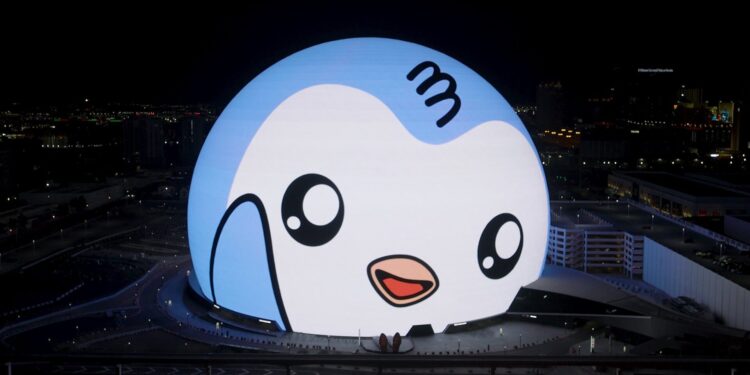
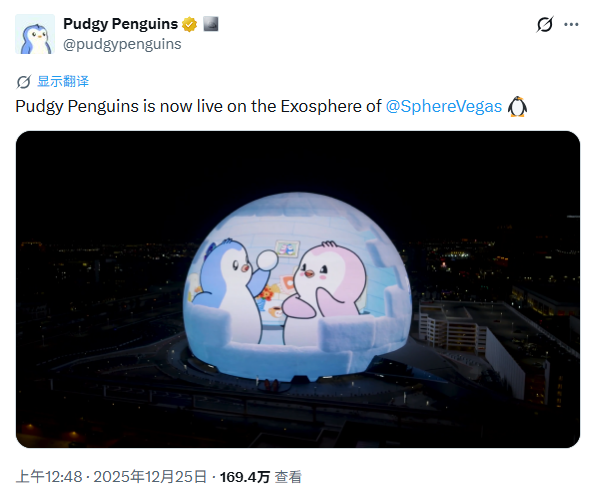
The brand has even appeared on a giant spherical screen in Las Vegas.
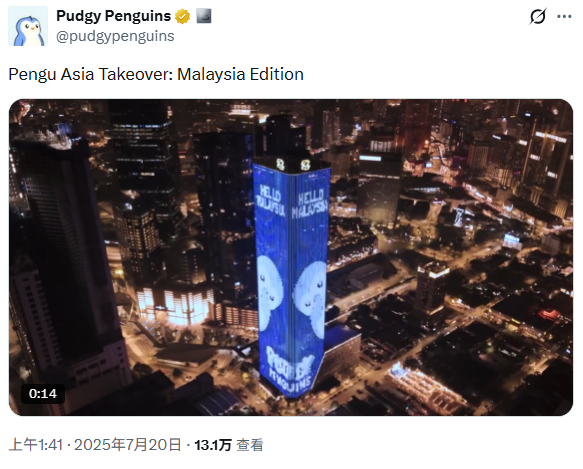
It has also appeared on large screens in major cities in Malaysia.
Its content is shared by many people who don't even realize they are interacting with a crypto-native brand. That's the uniqueness of “Pudgy Penguins.” It doesn't just exist online. It's everywhere.
Awareness Before Adoption
One of the biggest misconceptions in the crypto space is how users enter the market. They don’t start by researching tokens; they start with awareness.
Pudgy Penguins has been building this awareness in key channels for years: social media, retail shelves, games, and partnerships.
A parent buys a Pudgy toy at Walmart. The toy comes with a QR code. The QR code points to “Pudgy World,” where users can simply register by entering their email address, earning them a wallet in the background and receiving their first NFT without having to know anything about cryptocurrency.
This is user onboarding, not through complex processes, but through familiarity.
When users eventually open an exchange, they are not starting from scratch; they already know Pengu.
They have seen it, trust it. Faced with thousands of tokens, they are more inclined to buy what they are familiar with. This approach is one of the most underrated advantages in the crypto space.
Most projects are still struggling to explain what they are to the general public. Meanwhile, “Pudgy Penguins” has already made people feel familiar before the explanation begins.
Community
Every successful cultural asset in the crypto space has a strong community. But few crypto communities can extend beyond the crypto sphere, and this is where “Pudgy Penguins” stands out.
Most crypto communities are largely composed of traders, speculators, and those who are already deeply involved. “Pudgy Penguins” has built a broader audience.
On one hand, it has crypto-native users, NFT collectors, traders, and founders, who see $PENGU as one of the representatives of crypto culture. On the other hand, mainstream consumers interact with the brand daily through social media, toys, games, and content.
The latter is crucial.
One of the most interesting examples is the Instagram following of “Pudgy Penguins,” which reportedly has a significant portion of followers who are mothers aged 28-40. Almost no crypto project can naturally reach this demographic.
This means “Pudgy Penguins” is not just talking to people within the crypto Twitter (CT) circle. It reaches the general public, which is the right way to build a consumer brand.
Large institutional firms like Bitwise, VanEck, and Canary Capital have publicly expressed support for the “Pudgy Penguins” ecosystem. Traditional financial figures such as Bryan Pellegrino, legendary poker player Fedor Holz, and Mike Novogratz and Tom Lee have also publicly endorsed “Pudgy Penguins.”
This social recognition is hard to fabricate.
People publicly associate with “Pudgy Penguins” because the brand gives a sense of warmth, recognizability, and cultural relevance that most crypto projects cannot achieve.
Dogecoin once had one of the most powerful internet communities ever. But it was largely a decentralized chaos: fun, iconic, and culturally significant but lacking in organizational structure.
“Pudgy Penguins” draws from the same energy of internet nativity and transforms it into something more unified, scalable, and emotionally connected—a community people truly want to belong to. It represents the crypto sphere.
Institutional and Cultural Recognition
Historically, Memecoins have struggled to break into institutional spaces. Most Memecoins lack the credibility or brand safety required to establish serious partnerships. “Pudgy Penguins” is breaking this pattern.
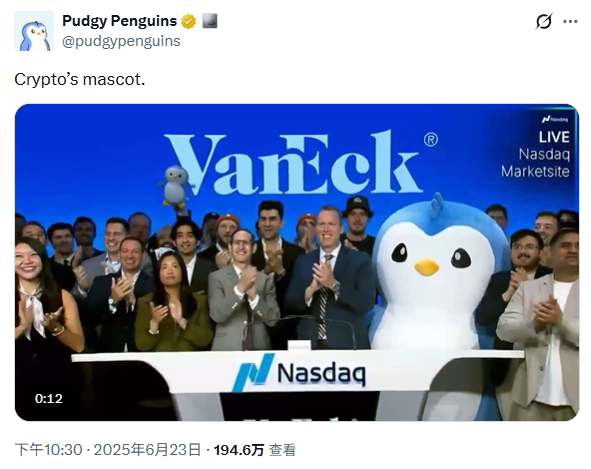
The “Pudgy Penguins” brand has appeared in events by VanEck and Bitwise, including commercials for Ethereum ETFs. The team even rang the Nasdaq opening bell with VanEck, an unprecedented moment for a crypto-native IP brand.
In terms of regulation, “Pudgy Penguins” has become the second meme asset to enter the formal SEC 19b-4 ETF application process in the US after Dogecoin.
Culturally, the brand continues to expand:
- Establishing partnerships with brands like NASCAR, PEZ, Sotheby’s, Manchester City Football Club, and Care Bears
- Several large companies, including Coinbase, use “Pudgy Penguins” as social media avatars
- Media outlets like The New York Times and Forbes have also covered it
Even in politics, the brand has garnered attention with members of Congress like William Timmons discussing “Pudgy Penguins” publicly in relation to the role of cryptocurrency in consumer markets. This cross-domain recognition is rare: retail, institutional, cultural, and political.
Most Memecoins would be lucky to touch any one of these areas. “Pudgy Penguins” has affected all four.
Dogecoin proved that memes can monetize. “Pudgy Penguins” is trying to show that memes can become a powerful distribution network.
Asian Expansion: The Ideal Market for “Pudgy Penguins”
While most Web3 brands have focused on western audiences, “Pudgy Penguins” has been actively expanding into Asian markets. This is one of the smartest parts of the entire strategy.
Asia has the strongest collectible and character IP market in the world. The economy around cute brands and characters thrives, as these brands and characters develop into global brands through retail, gaming, media, and peripheral products.
“Pudgy Penguins” is positioning itself within this system:
- Entering the $15.4 billion Japanese collectibles market
- Distribution through large retail chains like Don Quijote
- Entering convenience stores like 7-Eleven and FamilyMart
- Establishing partnerships with industry giants like Lotte in Korea and Suplay in China
This is not just expansion; it is an alignment with a cultural system that "has long understood how to scale IP globally."
More importantly, Asian culture is often exported from East to West. If “Pudgy Penguins” continues to gain traction, it won't just be simple growth. Instead, it will achieve compounded growth globally.
The Gap Between Dogecoin and “Pudgy Penguins”
Today, there is still a significant market cap gap between Dogecoin and “Pudgy Penguins.” There is ample reason for this gap. Dogecoin has a long history, liquidity, and a firmly established position in crypto culture.
But the market doesn't price assets based solely on history. It also prices trends, prevalence, and future potential. Dogecoin's success largely stems from its developmental momentum. “Pudgy Penguins” combines the same cultural appeal with advantages that Dogecoin never truly possessed:
- A large and continuously growing distribution engine
- Sustained large-scale content production
- Physical retail channels
- Institutional collaborations
- Government support
- Global expansion into key markets like Asia
In other words, it has everything Dogecoin has and some advantages that Dogecoin has never had.
If the market continues to favor cultural assets that can sustain and expand user interest, then this gap is not just a difference in valuation; it is a difference in developmental stages. This is exactly what many continue to overlook.
Dogecoin is proof of concept; “Pudgy Penguins” is a scaled-up consumer version.
Conclusion
Dogecoin has proven that internet memes can monetize. “Pudgy Penguins” is proving that internet memes can evolve into something much larger: a vibrant, continually evolving social currency deeply rooted in culture, commerce, and global distribution networks. The difference lies in execution.
Dogecoin captured a historical moment, while “Pudgy Penguins” is building a system that spans social media, retail, gaming, institutions, and global markets, consistently generating these moments.
If the adoption of cryptocurrency continues to be driven by familiarity and trust, then the assets that ultimately prevail will not be the most complex but the most well-known:
For Bitcoin, it is currency. For Ethereum, it is applications. For Dogecoin, it is the first cultural asset. And for “Pudgy Penguins,” it represents culture becoming an unstoppable force.
Further Reading: A Long Read: Traditional Art is Dying, and NFTs are Becoming the Renaissance for a New Generation of Collectors
免责声明:本文章仅代表作者个人观点,不代表本平台的立场和观点。本文章仅供信息分享,不构成对任何人的任何投资建议。用户与作者之间的任何争议,与本平台无关。如网页中刊载的文章或图片涉及侵权,请提供相关的权利证明和身份证明发送邮件到support@aicoin.com,本平台相关工作人员将会进行核查。


