Author: Wenser, Odaily Planet Daily
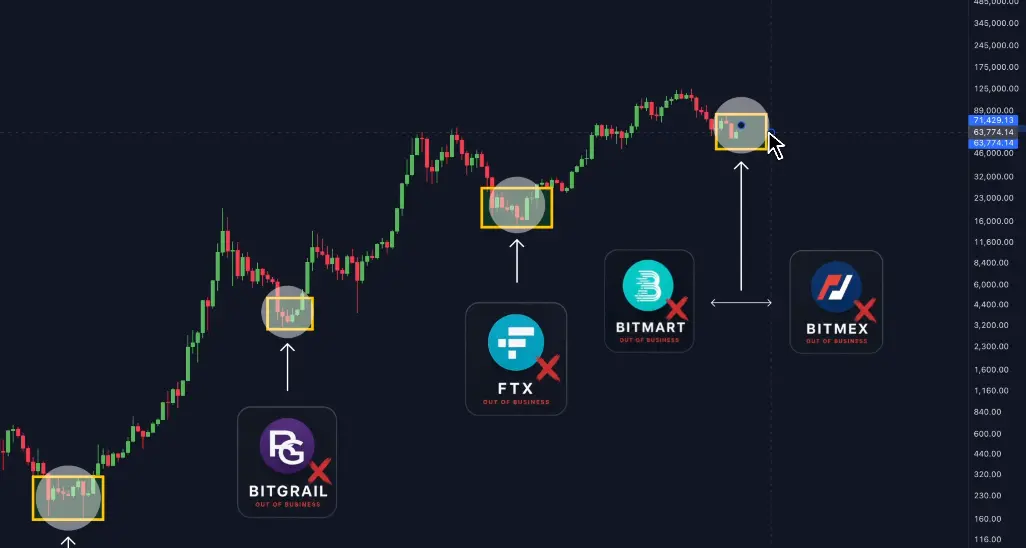
The wave of closures in the bear market is still spreading, with two major crypto exchanges announcing their shutdowns within just a week.
On the morning of July 26, the second-tier crypto platform BitMart officially announced that after a cautious assessment of the company's operational status, market environment, and future strategic direction, it has decided to orderly cease the operation of its trading platform: all trading services will cease on August 26, and the platform will shut down on January 31, 2027.
On July 23, BitMEX, the pioneer of perpetual contracts in crypto, announced that it would stop new user registrations immediately and would officially close on September 23, 2026. Many crypto OGs, including CZ, expressed their regrets and reluctance in response. Earlier in July, AscendEX (formerly BitMax) also announced its shutdown, citing MiCA regulations, market factors, and financial operational pressure as reasons.
Since the crypto market entered the bear phase on October 11 last year, dozens of crypto projects have announced their closures, including DeFi platforms, crypto wallets, on-chain DEXs, and crypto research institutions. In previous cycles, exchanges that possessed sustainable cash-generating abilities have subsequently shut down, which is regarded as one of the signals indicating the bottom of the bear market. Now a similar scene is unfolding again, seemingly signaling that the turning point may have arrived.
Two exchanges announced shutdowns in three days: market liquidity tightens, the reality of “no one trading coins” has set in
On the afternoon of July 23, BitMEX officially announced that it would officially close at 12:00 PM (Beijing time) on September 23, and new user registrations would cease immediately. The company stated that this decision was made by the board of its parent company HDR Global Trading Limited after a strategic review.
Three days later, BitMart issued a statement: “After a careful assessment of the company's operational status, market environment, and future strategic direction, we have decided to orderly cease the operation of our trading platform. New registrations, top-ups, and new trading orders will be suspended starting from 01:30 UTC on July 26, 2026; all trading services will cease at 01:00 UTC on August 26, 2026; and platform operations will officially terminate at 15:59 UTC on January 31, 2027. Withdrawal services will remain open.”
If they were not truly unable to sustain operations, these exchanges, which should naturally be cash cows that continuously generate revenue, would not face such an ending. The reasons behind these decisions are much debated in the market, but no definitive conclusions have been drawn.
CZ: The "crypto war" during the Biden administration is the main reason for BitMEX's fall
After the news of BitMEX's closure spread, Binance founder CZ expressed his regret and recalled, “BitMEX first launched 100x leveraged perpetual contracts in the crypto market in 2014, pushing the industry forward. At that time, BitMEX only supported BTC deposits, single-chain operations, and used a daily once and multi-signature wallet to handle withdrawals, which seemed inconvenient but helped the platform avoid hacker attacks in the long term.”
He also mentioned that four co-founders of BitMEX admitted to violating the Bank Secrecy Act (BSA) a month before the court proceedings, with each fined 10 million dollars and put under house arrest, although no one was imprisoned. However, he believes that BitMEX's business ultimately could not survive the “crypto war” during the Biden administration.
It is evident that CZ still has grievances against the high-pressure regulatory policies implemented on the crypto industry during the Biden administration, considering them the “last straw” that overwhelmed BitMEX—high-pressure regulations made it impossible for BitMEX to expand its business and sustain its operations.
Flashbots Strategy Executive: The BitMEX insurance fund mechanism may be the primary reason for the platform's closure
Hasu, the strategy executive at Flashbots, wrote that the structural issues of the BitMEX insurance fund could be a significant reason why the company chose to close rather than sell.
As early as 2018, he pointed out that the BitMEX insurance fund was not managed through segregated accounts and lacked a clear cap on fund size and final handling of excess assets, which could create incentives for more aggressive liquidation of users, expanding the insurance fund through liquidation, and ultimately realizing those assets. According to Hasu's estimates, the current scale of that insurance fund could be about 270 million dollars.
Hasu’s viewpoint is more focused, suggesting that BitMEX's downfall was due to an imbalance in the internal fund management mechanism leading to aggressive liquidation rules, which damaged its user base and platform operational strategy.
As for Bitmart's shutdown, it seems more sudden, hence the market is discussing a variety of different possibilities.
The mystery of Bitmart's shutdown: was it a funding explosion or internal mismanagement?
As a well-established exchange operating for 8 years with over 13 million users, Bitmart's announcement affected not just the users but also the substantial amounts of funds in their accounts. However, the ability to withdraw funds from the Bitmart platform seems to be a topic of much discussion.
Regarding Bitmart's closure, community discussions have focused on two aspects:
One side believes that Bitmart may have faced a funding explosion. Crypto KOL Joes pointed out that Bitmart's hot wallet address had shown unusual activity before, and issues regarding user account freezes, abnormal fund withdrawals, and transfer times had not been clearly responded to;
Others pointed out that the chaos in Bitmart's internal management was the main reason for its shutdown. WEEX BD manager DI wrote that “the atmosphere within Bitmart is chaotic, continuously deceiving employees, traders, and KOLs, and refusing to pay these individuals their deserved salaries and bonuses.” Some have even posted that Bitmart previously tricked a meme coin community member out of 30,000 dollars through listing fees; others checked the withdrawal announcement and found that Bitmart had set up multiple barriers for user withdrawals, banning automatic withdrawals in favor of manual operations, which could present risks of misappropriating user funds.
Of course, the truth will take time to verify, and it is not currently clear whether this is a result of competitor smear campaigns or a case of “when the wall falls, everyone pushes.”
Moreover, if the shutdowns of secondary and tertiary trading platforms like BitMEX and BitMart are only signals of the bear market hitting bottom, many layoffs at US-based compliant exchanges might also be one of the indicators of the bear market.
Coinbase, Kraken, Gemini layoff wave: crypto exchanges amputate limbs to survive
In May this year, Coinbase CEO Brian Armstrong stated that the company would lay off 14% of its employees due to market conditions and the company's transition to an AI-native architecture. Considering the previous statement from Coinbase platform head Rob Witoff that “Most Coinbase engineers operate 5 to 10 AI Agents simultaneously, with the comprehensive capabilities of an AI Agent equivalent to about 1,200 employees,” it seems AI has also had a huge impact on the organization of personnel in exchanges.
In March this year, Gemini exchange's official statement indicated that its employee count had been reduced by about 30% since the beginning of the year, and they are introducing AI tools to enhance productivity. Last year it suffered losses of 500 million dollars, and the plummeting stock price post-IPO, along with the lackluster market conditions, also placed considerable performance pressure on Gemini.
Additionally, the parent company of the US crypto exchange Kraken, Payward, announced in May this year that it would lay off about 150 people to streamline its organizational structure and prepare for the upcoming initial public offering (IPO).
The current market environment means that not only small exchanges are struggling, but even large exchanges need to stockpile “winter food” to weather the bear market, to prevent following the same path of shutdown.
After the wave of exchange shutdowns, who will bear the losses? Who will take over the users?
Compared to the exchanges that have confirmed their closures and the unclear channels for fund withdrawal and arrival times, many are more concerned about the corresponding settlement losses after the closures of BitMEX and Bitmart and how users will handle them. In this regard, BitMEX's situation is more awkward, while Bitmart's users and platform have received numerous “takeover offers” from other exchanges.
BitMEX may retain over 622 BTC due to forced liquidation
As mentioned earlier, the insurance fund of BitMEX may be the primary culprit behind the platform’s inability to continue operations.
Moreover, due to its aggressive liquidation rules and mechanisms, BitMEX is currently facing a proposed class-action lawsuit in the Southern District of New York filed by BKX Services Inc. and David Namdar. The plaintiffs claim that the exchange was involved in forced liquidation of leveraged positions to retain 622.66 BTC that should have been returned to traders.
Bitmart's takeover offers: Huobi, websea, MSX.COM all jumped in
After the Bitmart shutdown announcement, many exchanges and crypto platforms showcased their abilities, initiating their own “battle for users.”
Huobi officially wrote that it welcomes Bitmart users to join for C2C trading; and Bitmart employees also have a dedicated channel to join Huobi HTX.
MSX.COM's founder Bruce immediately wrote upon seeing the shutdown announcement, “Don’t close, I will acquire.” displaying a bit of entrepreneurial bravado.
Websea Chinese also wrote that it has opened an “anchoring channel” to facilitate Bitmart users in transitioning to their platform. Blockfinex also expressed a similar viewpoint.
It can only be said that the real business war may be hidden in the tweets labeled “peaceful home change,” hoping that Bitmart users’ assets will ultimately be handled properly.
Conclusion: The wave of closures in the crypto industry continues, and it is too early to conclude that the bear market has bottomed out
As of today, this bear market, which has lasted over six months, is still ongoing. Before the fall of BitMEX and Bitmart, the wave of project closures within the industry had already begun. In the past week, crypto research institutions Hazeflow, Cardano ecosystem wallet SecondFi, DEX aggregation protocol Odos, and DeFi platform Dango have all shut down, and many projects have quietly “softly exited” with social media updates ceasing and even teams disappearing.
Given the current situation, although there have already been cases of exchanges shutting down, it is still difficult to provide a conclusion that the bear market has truly hit bottom. After all, the crypto industry has not reached a point of total exhaustion and has yet to see catastrophic events comparable to historical incidents like Mt.Gox or FTX.
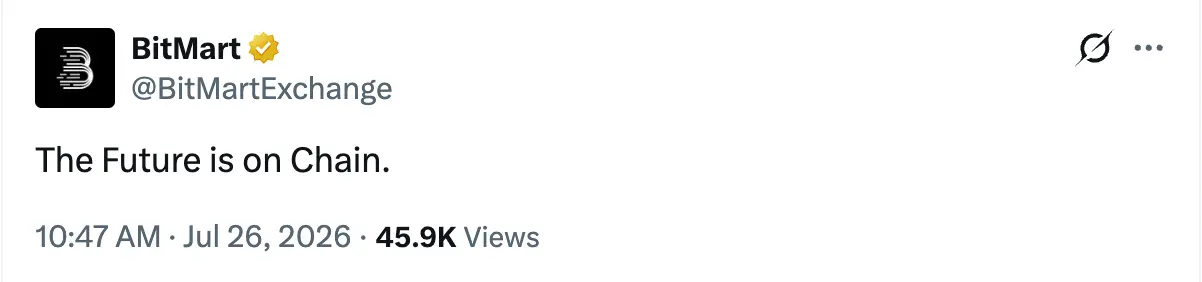
Regardless, the industry continues, just as the last tweet from Bitmart said: “The future still belongs to blockchain.”
免责声明:本文章仅代表作者个人观点,不代表本平台的立场和观点。本文章仅供信息分享,不构成对任何人的任何投资建议。用户与作者之间的任何争议,与本平台无关。如网页中刊载的文章或图片涉及侵权,请提供相关的权利证明和身份证明发送邮件到support@aicoin.com,本平台相关工作人员将会进行核查。


