
Author: Nancy, PANews
Recently, Polymarket has again made news about migrating out of Polygon. In the face of this phenomenally large application, multiple public chains have rushed to "recruit." However, as the current largest stakeholder, Polygon has yet to respond positively to this potential "going solo" plan.
Public migration plan, public chains collectively extend an olive branch
On April 25, Polymarket's new Vice President of DeFi Engineering, Josh Stevens, revealed in a post that the platform's business growth has significantly exceeded the current infrastructure's capacity. The team is fully advancing a series of major technical upgrades to address pain points under high-frequency trading and improve overall performance and user experience.
Among several renovation plans, the one that has garnered the most market attention is the "chain migration" that Polymarket is promoting. "We need more block space, lower gas costs, and shorter block times for instant settlement." In other words, Polymarket is preparing to switch chains.
Polygon was once the technical optimal solution for Polymarket to enter the prediction market. In the early stages, the prediction market had high demands for on-chain costs and execution efficiency. At that time, Polygon became the most suitable deployment choice due to its low fees, faster settlement speed, and relatively mature EVM ecosystem.
But as Polymarket's platform trading volume continues to rise, especially after the explosion of high-frequency trading demand, problems such as increased trading delays, poor order cancellation experience, and decreased execution efficiency during system congestion have gradually surfaced. For Polymarket, these issues have directly affected user retention rates and trading activity.
For example, PANews previously published an analysis indicating that attackers exploited the time difference between off-chain matching and on-chain settlement on Polymarket, repeatedly causing transaction failures at a very low cost, thereby clearing market maker orders and profiting. A single address could earn even tens of thousands of dollars in a day, while the cost of attack was almost negligible. This mechanism flaw directly led to market makers and automated trading bots on the platform facing forced order removals, passive position exposure, and even direct losses.
As of now, the official has not provided a clear solution for repair. Although the community has developed monitoring and early warning tools, they essentially remain patch-type defenses and cannot fundamentally resolve this architectural issue. Therefore, only by redesigning the matching and settlement mechanisms at a lower level can such attack risks be fundamentally eliminated.
In a sense, Polygon, which once helped Polymarket take off, is now gradually becoming the ceiling for its continued expansion.
This is not the first time migration news has surfaced. As early as the end of last year, there were reports in the market that the team had discussed launching its own L2 in the Discord community and gradually migrating out of Polygon. Now, Josh Stevens' public statement is seen as this plan having moved from internal discussion to the execution phase.
After the announcement, Sui, Solana, Sonic, Algorand, Sei, and others extended olive branches to Polymarket, providing reasons such as lower fees, faster transaction confirmation times, high throughput, high performance, and supportive of transaction-intensive applications.
For these public chains, if they can successfully accommodate a phenomenon like Polymarket, the significance goes beyond just adding a new project. It will directly bring massive real transaction flow, active user growth, and significant improvement in ecological attention. Especially with the current scarcity of applications outside the box, such opportunities are rare.
Supporting half of Polygon's territory, or leaning towards building L2
For Polygon, once Polymarket's migration plan is truly implemented, it could result in a massive loss at the ecological level.
Currently, Polymarket has become the most important traffic entry point for Polygon and is the core economic engine.
According to Dune data, from the latest daily fee composition, Polymarket has contributed 56.3% of the transaction fees for Polygon. For every $100 generated in fees by Polygon, about $56 comes from Polymarket. This means that Polymarket is the core source driving revenue growth for the entire Polygon chain.
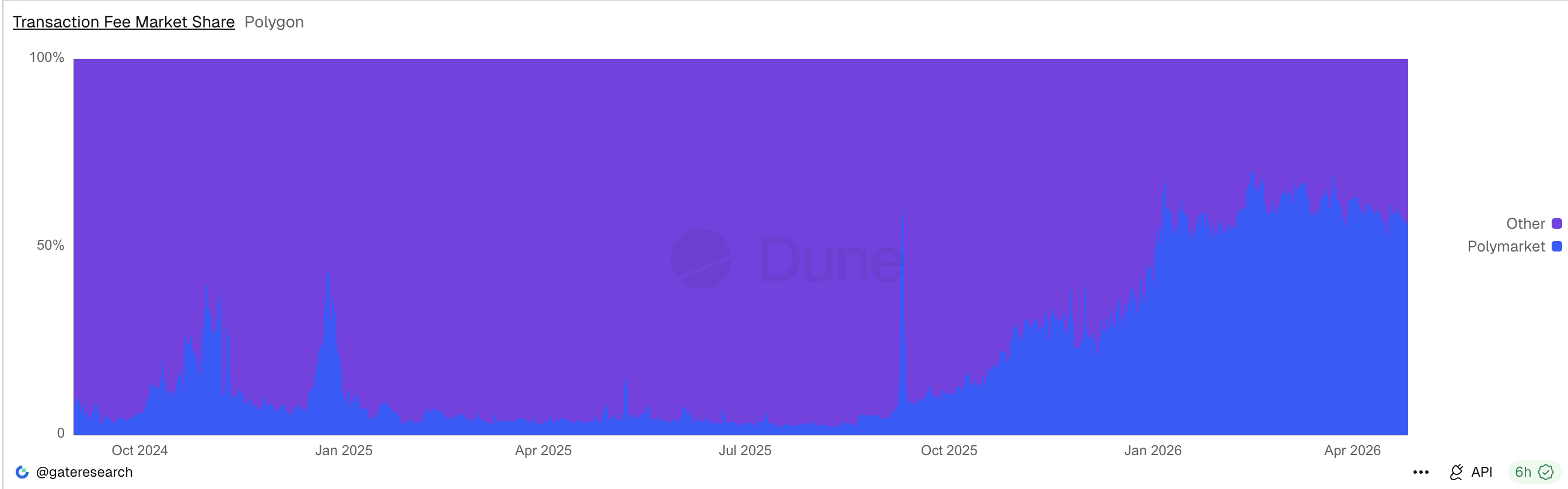
Looking at the longer time dimension, Polymarket has contributed about $72.9 million in fee revenue year-to-date, accounting for 61.3% of Polygon's total fee income (about $119 million).
In other words, Polymarket has become the largest single source driving Polygon's growth. If the ecosystem relies on a single top-tier application for a long time, once it is lost, the resulting impact often goes beyond just a drop in income; it may also trigger a shock to the overall ecological activity and market confidence.
In response to Polymarket's migration statement, Polygon officials have yet to respond positively. However, according to TheStreet Roundtable citing informed sources, Polygon is collaborating with Polymarket to address existing issues, and Polymarket has not conveyed any migration plans to Polygon.
Currently, Polymarket has not disclosed where it will migrate, but the market generally speculates that compared to directly migrating to other public chains, the possibility of Polymarket building its own Layer2 is higher. Whether it will use OP Stack, Polygon CDK, or other solutions remains to be further disclosed.
According to crypto KOL Blue Fox's analysis, if Polymarket chooses to build its own chain, it will have at least three advantages: first, it can fully control block space, block speed, and gas fees, allowing targeted optimization for prediction markets and possible future scenarios like Perps (perpetual contracts) to achieve low latency, high throughput, and low costs; second, it does not need to compete for resources with other dApps, making it more favorable for regulatory compliance arrangements, especially for compliance requirements related to the CFTC; third, there are already application chains like lighter as reference samples.
He further pointed out that the probability of Polymarket choosing Solana, Base, or Arbitrum is low. Among them, Solana's advantage is being fast and cheap, but Polymarket is part of the Ethereum ecosystem, and regarding contract architecture, ecological compatibility, and USDC asset circulation, the migration cost is very high. Currently, it mainly supports SOL deposit bridging and does not show any migration signs yet. As for Base, Arbitrum, and other L2 solutions, they may potentially be part of multi-chain expansion in the future, but may not necessarily serve as the main base.
Rebuilding the trading system, Polymarket undergoes a comprehensive upgrade
Besides chain migration, Polymarket has also simultaneously initiated a round of comprehensive upgrades covering products, infrastructure, organization, and funding to optimize the trading experience while preparing for further business expansion.
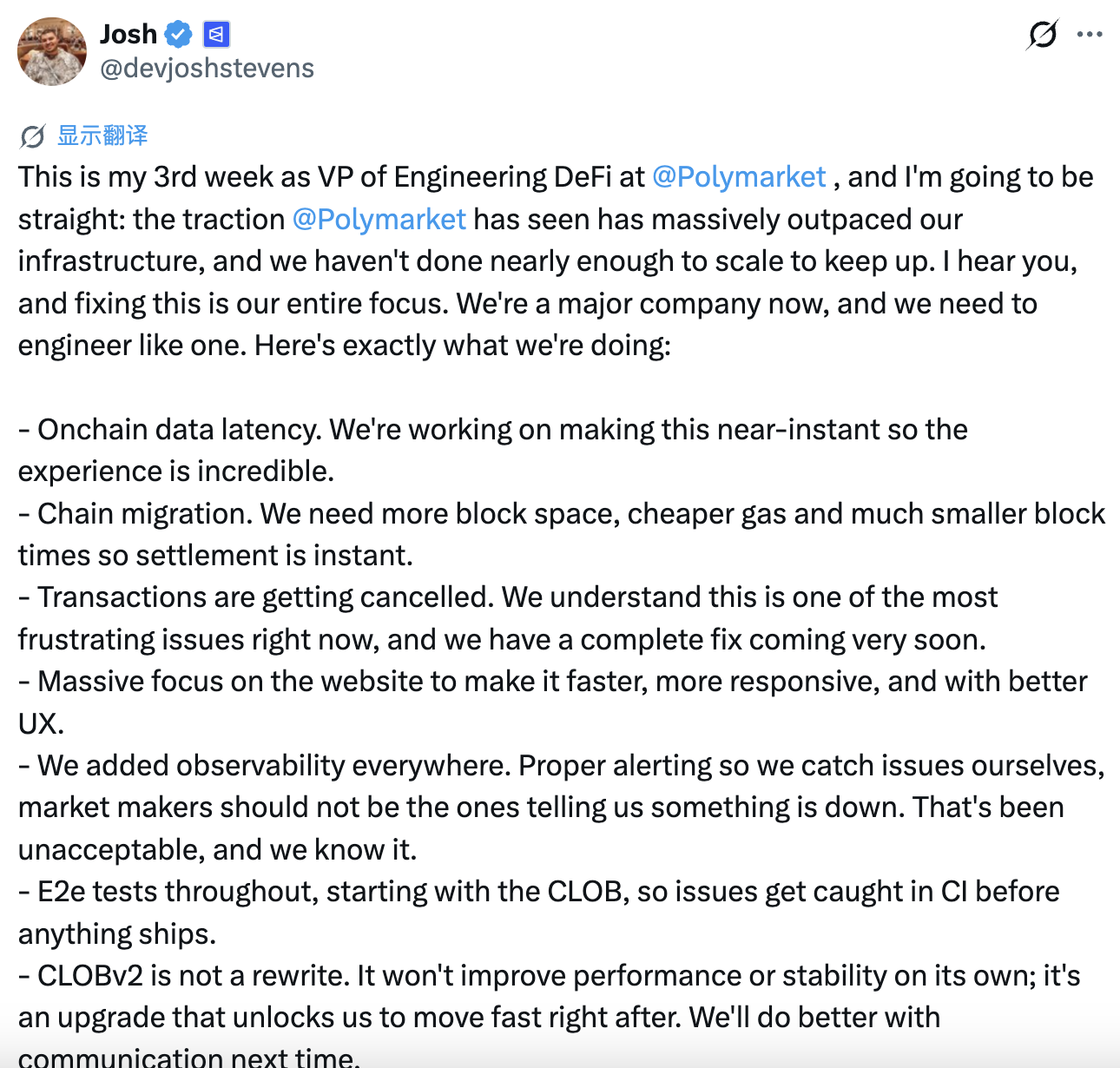
For instance, on the product side, Polymarket is optimizing the website, focusing on improving page loading speed, response efficiency, and overall interaction experience. Meanwhile, the team plans to release a unified TypeScript SDK to integrate all existing APIs. In the future, developers will only need a single WebSocket connection to access core functional interfaces, lowering the threshold for external teams to connect with Polymarket and facilitating faster growth for its ecological tools and third-party applications.
In terms of business expansion, Polymarket has confirmed it will launch a perpetual contract product, adopting a new smart contract architecture and using a backend system built from scratch with Rust. This signifies that the platform is transitioning from a single prediction market to a comprehensive on-chain trading platform.
On the organizational development front, Polymarket has initiated key position hiring, including heads for QA automation, development tools, internal tools, and data engineering, and is adjusting the team to be smaller, more focused, and with clearer responsibilities to improve execution efficiency and accountability.
On the security front, Polymarket stated it is currently collaborating daily with four security teams to ensure system security and user fund security.
Among all the upgrades, the most critical one is that the team is rebuilding the central limit order book (CLOB) from scratch. The team believes that the existing matching system can no longer meet the platform's continuously growing trading demands, and the new CLOB architecture will pave the way for future perpetual contracts and more financial products.
Josh Stevens admitted that the company's engineering capabilities have not yet matched its business growth pace, which has indeed disappointed users recently. He promised that significant improvements will continue to be pushed in the coming months, and starting next Friday, progress updates will be released weekly to enhance transparency and rebuild market confidence.
Meanwhile, Polymarket will undergo a new round of upgrades on April 28. This upgrade includes the launch of the new smart contract CTF Exchange V2, restructuring the order book system, and migrating collateral assets from USDC.e to the new collateral token Polymarket USD (pUSD).
USDC.e is the bridged version of USDC on Polygon by Circle. Historical attacks have proven that such assets pose long-term cross-chain bridge risks. For high-frequency, large-value flowing prediction markets, this is a significant hidden danger that cannot be ignored.
In contrast, pUSD is an ERC-20 token issued by Polymarket, fully backed by real USDC at a 1:1 ratio. After migrating to pUSD, Polymarket not only reduces systemic risks but also gains the power of minting to autonomously manage minting, redemption, reserve utilization rates, and settlement logic, significantly enhancing capital efficiency. According to Defillama founder 0xngmi's previous post, there are approximately $1.25 billion in funds in Polymarket users' wallets, and if they retain the interest income from this amount, at the current interest rate, they could earn an additional $54 million annually.
Moreover, having its own stablecoin structure also helps reduce asset compliance gray areas, paving the way for entering the U.S. market or attracting institutional funding.
As prediction markets truly move towards popularization, they will face not just on-chain users, but a broader audience of ordinary users. For Polymarket, right now, it needs system stability, settlement reliability, and optimized user experience. At the same time, as competition in prediction markets heats up, Polymarket also needs to seek a more stable and diverse revenue structure.
免责声明:本文章仅代表作者个人观点,不代表本平台的立场和观点。本文章仅供信息分享,不构成对任何人的任何投资建议。用户与作者之间的任何争议,与本平台无关。如网页中刊载的文章或图片涉及侵权,请提供相关的权利证明和身份证明发送邮件到support@aicoin.com,本平台相关工作人员将会进行核查。


