Author: David, Deep Tide TechFlow
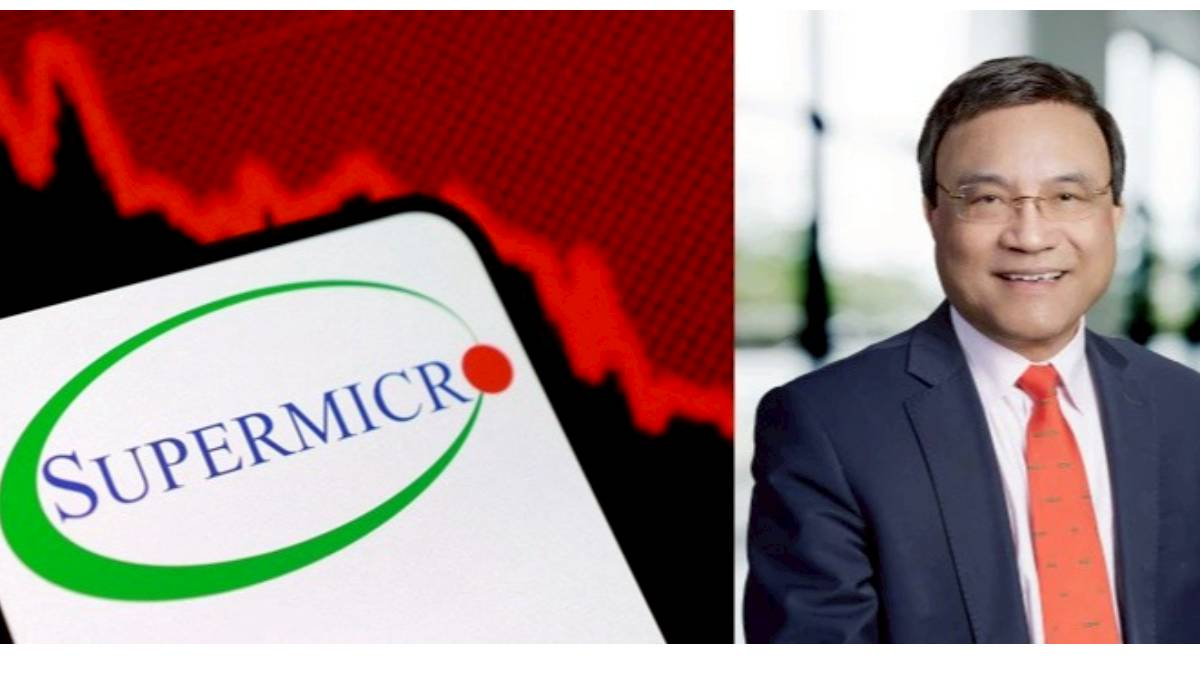
This morning, Wally Liaw, co-founder of Supermicro, was arrested in California.
Supermicro is one of the largest AI server manufacturers in the world and a core supply chain partner of Nvidia, which received a $13 billion order for Nvidia's Blackwell chips in one quarter last year.
Liaw has been with the company since its founding in 1993 and is currently the Senior Vice President and a board member.
He is charged with:
Smuggling Nvidia AI chip servers worth $2.5 billion to China through shell companies in Southeast Asia. The maximum prison sentence is 20 years.
The U.S. Department of Justice has classified this case as the largest AI chip smuggling case in history.
However, the details of this case are very movie-like.
According to the indictment, Liaw and his accomplices arranged for a Southeast Asian company to act as a "front" to purchase Nvidia GPU-equipped servers from Supermicro under the pretense of self-use. After arriving in Southeast Asia, staff would rip off the original packaging, pack them into unmarked boxes, and ship them to China.
The real goods were shipped, but Supermicro's compliance team and the U.S. Department of Commerce would regularly check the warehouse for inventory and scan serial numbers; the warehouse couldn't be empty, after all.
So they created thousands of fake servers.
The shells looked exactly the same, but there were no chips inside, they couldn't power on, and they were specifically placed in the warehouse for auditors to see.
Having only fake servers wasn’t enough; the serial numbers on the packaging had to match too. Staff used a hairdryer to heat the serial number stickers on the real goods, peeled them off intact, and then affixed them to the boxes of fake servers...
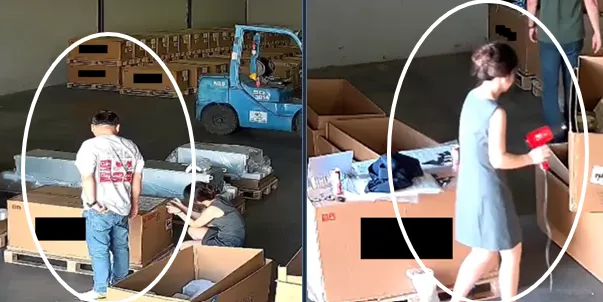
Auditors scanned the codes, and the system showed everything was normal.
Surveillance cameras in the factory captured the scene with the hairdryer. But the real goods were already en route to China.
Even more absurdly, there was an instance when Supermicro's own compliance team sent someone to check; accomplice Sun took photos and videos of the fake servers to send to the auditor, proving "the goods are all here."
On another occasion, an officer from the U.S. Department of Commerce's export control office personally came to inspect. Someone on-site even impersonated a lawyer to host the visit...
Mastermind Liaw is 71 years old and holds $430 million worth of Supermicro stock. By all accounts, he shouldn't be short on cash.
There’s another detail in the indictment. A broker forwarded Liaw a news link about several Chinese individuals arrested in the U.S. for smuggling AI chips.
Liaw's response was a string of crying face emojis, then he continued his activities.
After the news broke, Supermicro’s stock dropped 13% in after-hours trading. The company stated that Liaw has been suspended, accomplice Sun has been terminated, and Steven Chang, the sales manager at the Taiwan office, is currently on the run.
Supermicro was not listed as a defendant. The company asserts that it has a "comprehensive compliance system."
However, this company's compliance system has had issues before.
$2.5 billion, the chip smuggling assembly line
This smuggling chain was not established overnight.
The indictment shows that Liaw was very proactive during the operation. He directly used encrypted communication tools to ask the head of the Southeast Asian company: How much can we consume in January? How about February? March? April? Just give a rough estimate, then we will use this number to apply for chip quotas from Nvidia.
So the process was:
First confirm the demand from Chinese buyers, then take this amount to negotiate quotas with Nvidia, claiming it was for "self-use" by the Southeast Asian company. Once Nvidia approved the quota, the servers were assembled in the U.S., shipped to Taiwan, and then handed over to the Southeast Asian company, which would unpack and ship them to China.
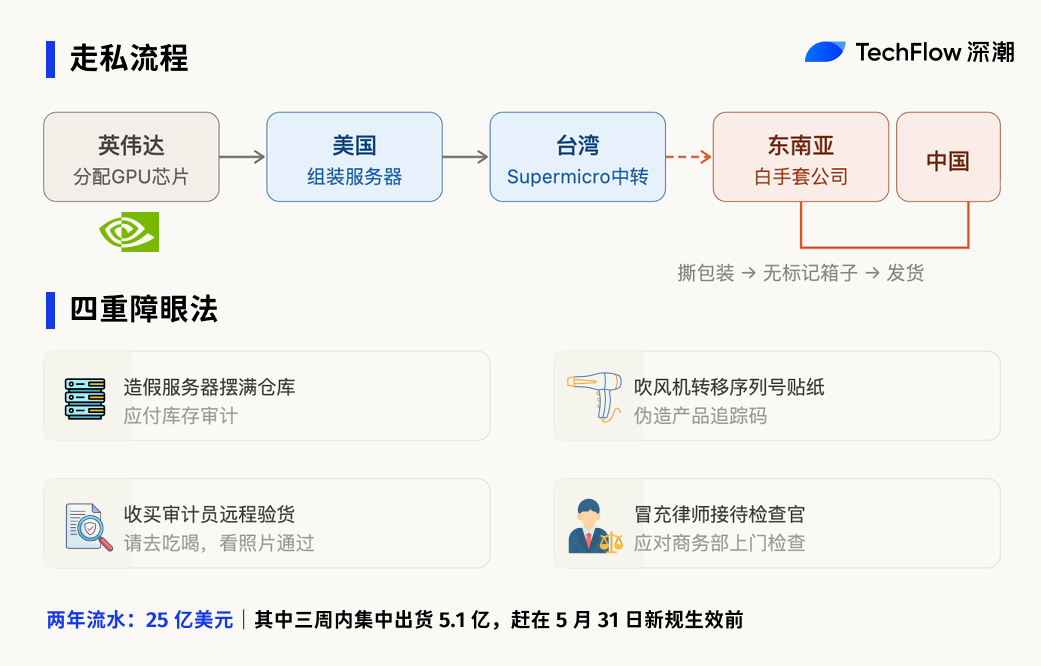
From clients to sources to logistics, Liaw connected the entire chain himself. He wasn't a middleman; he was the co-founder and business development head of Supermicro.
Using his own company's supply chain to smuggle his own company's products.
Between 2024 and 2025, servers worth $2.5 billion were funneled through this pipeline. The indictment states that this scale gradually expanded with one term used:
Increasingly audacious.
The boldest operation occurred from late April to mid-May 2025. In three weeks, servers worth $510 million were transferred from the U.S. to China via Southeast Asia.
Why the sudden acceleration? Possibly because Liaw saw a White House statement.
In early 2025, the U.S. government announced a new AI product export control rule, expected to take effect in mid-May, further tightening chip export scrutiny for regions like Southeast Asia. Liaw forwarded this news to the head of the Southeast Asian company with a note:
"We need to speed these up before May 13!"
May 13 is the effective date of the new regulation. Before then, the existing loopholes could still be utilized. Thus, the last three weeks turned into a race to finish. The volume that typically took several months was compressed into twenty days.
Meanwhile, Steven Chang at the Taiwan office was responsible for another task: ensuring that no one came to inspect for real.
The indictment states that he prevented auditors from checking the actual server storage areas in the Southeast Asian data center and specially arranged for someone he called a "friendly" auditor to conduct this review.
All the forged documents, fake servers, and hairdryer label peeling were put in place to ensure this assembly line went uninterrupted. And the speed of the assembly line reached its peak in the last three weeks.
But Supermicro wasn't the only one engaged in the chip smuggling business.
In the past two years, the U.S. Department of Justice has dismantled several chip smuggling networks, with scales ranging from tens of millions to hundreds of millions of dollars, and the methods became increasingly outrageous. Moreover, the identities of the participants have also upgraded.
The stricter the chip bans, the more respectable the smugglers
Supermicro is not the first to be caught.
Looking back two years, the chip smuggling business has gone through three generations of evolution. The identities of the participants continually upgraded, methods became more akin to legitimate business, and scales expanded.
The first generation was "ants moving houses."
When the chip ban came out in 2022, smuggling was still manual labor. International students, tourists, and purchasing agents would carry one or two Nvidia GPUs in their personal luggage through customs, claiming personal use if stopped.
Some stuffed chips into boxes of live lobsters; others strapped them to their bodies covered by fake pregnant bellies.
In Huaqiangbei, Shenzhen, there is a complete after-sales industrial chain for these chips. There are workshops specifically for repairing defective cards and disassembled chips, processing over 500 pieces per month, charging $1400 to $2800 per piece. Once repaired, they sell to data centers and AI startups.
Smugglers at this stage had no companies, no documents, relying on human effort and courage. Single transactions were small, but every little bit counts.
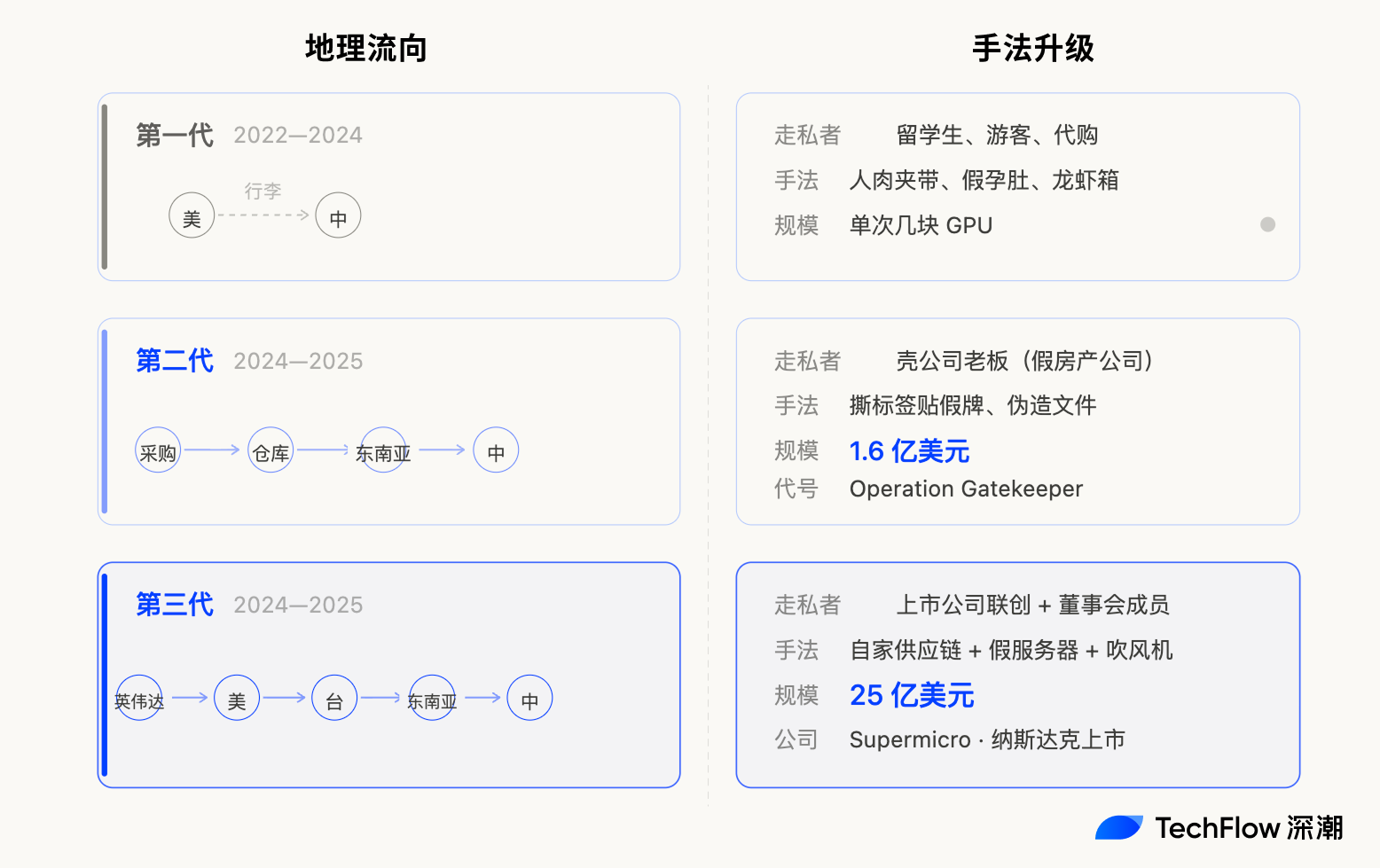
The second generation started using companies, selling dog meat under a sheep's head.
At the end of 2025, the U.S. Department of Justice dismantled a smuggling network code-named "Operation Gatekeeper." The mastermind was a 43-year-old man living in Houston named Alan Hsu, who bulk purchased Nvidia chips from Lenovo through his company and shipped them to a warehouse in New Jersey.
This company was called Janford Realtor, registered as a real estate company.
It never completed a single real estate transaction.
After the chips arrived at the warehouse, workers tore off the original Nvidia labels and affixed a fictitious company name—"SANDKYAN." Then they were transshipped through Malaysia and Thailand, ultimately entering China. The entire network shipped over $160 million in eight months.
The most dramatic scene of this case occurred when the net was closing in. FBI agents had secretly infiltrated the New Jersey warehouse and quietly removed all GPUs from inside. When the smugglers discovered the goods were missing, they thought they had been stolen and sent someone to the warehouse to "redeem" them.
The ransom reached $1 million; the person who came to negotiate was arrested by the FBI on the spot.
The third generation is specialized entities like Supermicro.
No longer fake companies, no longer middlemen, but the co-founder of a publicly listed company personally leading the operation.
No need to purchase chips from others; the company itself is a core supplier for Nvidia. No need to forge buyer identities, using the company's supply chain, customer relationships, and quotas to apply for chips, then bypassing the company's compliance team internally.
From ants moving houses to fake real estate companies, then to executives of publicly listed Silicon Valley companies. The commonality among three generations of smugglers is only one:
End buyers are all in China, and the chips are all from Nvidia.
The distinction is that the individuals carrying backpacks through customs in 2022 risked their freedom, while those operating in Silicon Valley offices in 2026 are wagering on a company worth hundreds of billions.
With each upgrade of the ban, the profits from smuggling leap to the next level, and the identities of those willing to get involved follow suit.
So how profitable is this business?
The black market price of a chip
Why can't smuggling chips be stopped? The answer lies in the pricing.
According to several overseas media reports, the price of high-end Nvidia GPUs on the black market in China is generally about 50% higher than those through legitimate channels in the U.S. The ban created price differences, which in turn created profits, leading to smugglers.
The demand side is rigid. Ray Wang, an analyst from semiconductor analysis firm SemiAnalysis, stated in an interview with CNBC:
More than 60% of leading AI models in China still run on Nvidia hardware. Training a large model requires thousands of high-end GPUs; without one, work cannot start.
This means Chinese AI companies don’t just "want to buy" Nvidia chips; they "must buy" them.
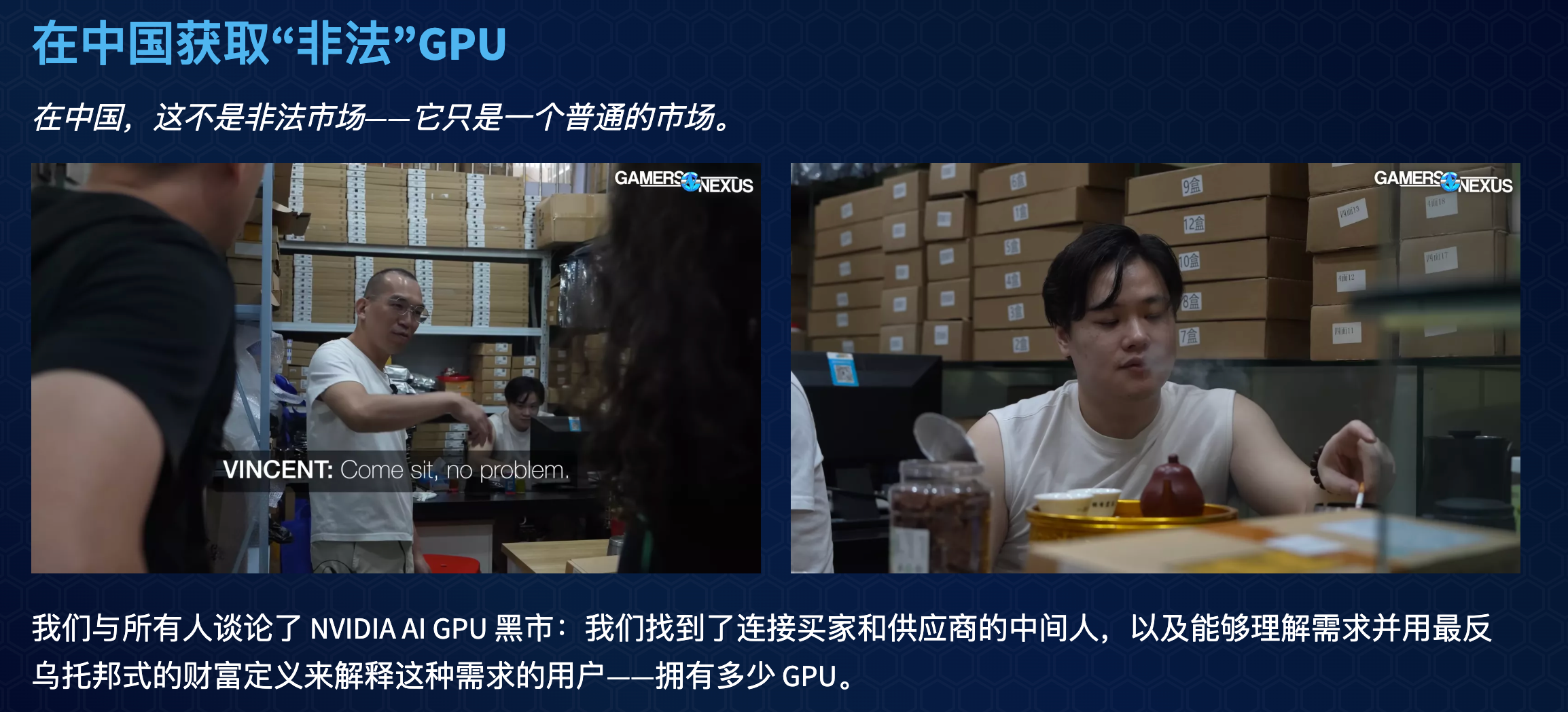
Image source:GamersNexus in-depth investigation into the Huaqiangbei chip market
What about the supply side?
Once chips leave Nvidia's factory, they pass through distributors, system integrators, and server manufacturers; each link is a potential smuggling entry. U.S. export controls mainly focus on the sales and shipping steps, relying on buyers to self-declare the final users.
Once the chips leave the U.S., the subsequent processes are largely reliant on self-regulation.
A Financial Times report last year estimated that in just the three months following April 2025, over $1 billion worth of embargoed chips flowed into China through various channels. Industry insiders estimate that the entire black market's monthly turnover may reach $1 billion...
Ironically, the U.S. government's own policies are also fluctuating.
In December last year, the Department of Justice loudly declared the dismantlement of the Operation Gatekeeper smuggling network and arrested multiple suspects. But on the same day, Trump announced on Truth Social that Nvidia would be allowed to sell H200 chips to China.
Later, the U.S. government opened another avenue, permitting Nvidia to sell lower-performance H20 chips to China, under the condition that Nvidia shares 15% of the sales with the U.S. government.
On one hand, they are cracking down on smuggling; on the other, they are selling themselves and taking a cut. This makes the entire ban system difficult to explain.
If you tell a chip broker that smuggling is illegal, they might respond: the government itself is selling, they just call it "conditional export."
The deeper paradox is that Nvidia is now the highest-valued company in the world, valued at $4.3 trillion. The more advanced its chips are, the greater the demand, the higher the black market premium, and the more lucrative the profits from smuggling.
A hairdryer won't blow away demand
What signals do people inside chip upstream and downstream companies see when the government simultaneously cracks down on smuggling and approves exports?
The main character of this article, Supermicro, also helped Musk build the Colossus AI computing cluster in 122 days, receiving a $13 billion order for Nvidia's Blackwell last quarter.
Those producing servers and those smuggling servers are the same group of people.
The $2.5 billion smuggling case ultimately fell apart over a hairdryer. Surveillance footage showing workers using a hairdryer to peel labels is now posted on the U.S. Department of Justice's official website, accessible to anyone.
The same week Liaw was arrested, Nvidia's CEO Jensen Huang publicly stated that the company is about to face a $1 trillion backlog of chip orders.
A trillion dollars' worth of demand is right there, and the black market premium is right there.
Perhaps the next person willing to pick up a hairdryer won't wait too long.
免责声明:本文章仅代表作者个人观点,不代表本平台的立场和观点。本文章仅供信息分享,不构成对任何人的任何投资建议。用户与作者之间的任何争议,与本平台无关。如网页中刊载的文章或图片涉及侵权,请提供相关的权利证明和身份证明发送邮件到support@aicoin.com,本平台相关工作人员将会进行核查。


