Written by: imToken
If one day, the core development team of Ethereum collectively "disappears," or if a sovereign nation demands the censorship of specific transactions, can Ethereum still remain open?
These questions may sound like extreme hypotheticals, yet they are increasingly becoming a reference point for the design of the Ethereum protocol.
In early March, Vitalik Buterin proposed a new expression, stating that the Ethereum community should consider itself as part of the "sanctuary technologies" ecosystem: these free and open-source technologies enable people to live, work, communicate, manage risks, accumulate wealth, and collaborate towards common goals while maximizing the ability to withstand external pressures.
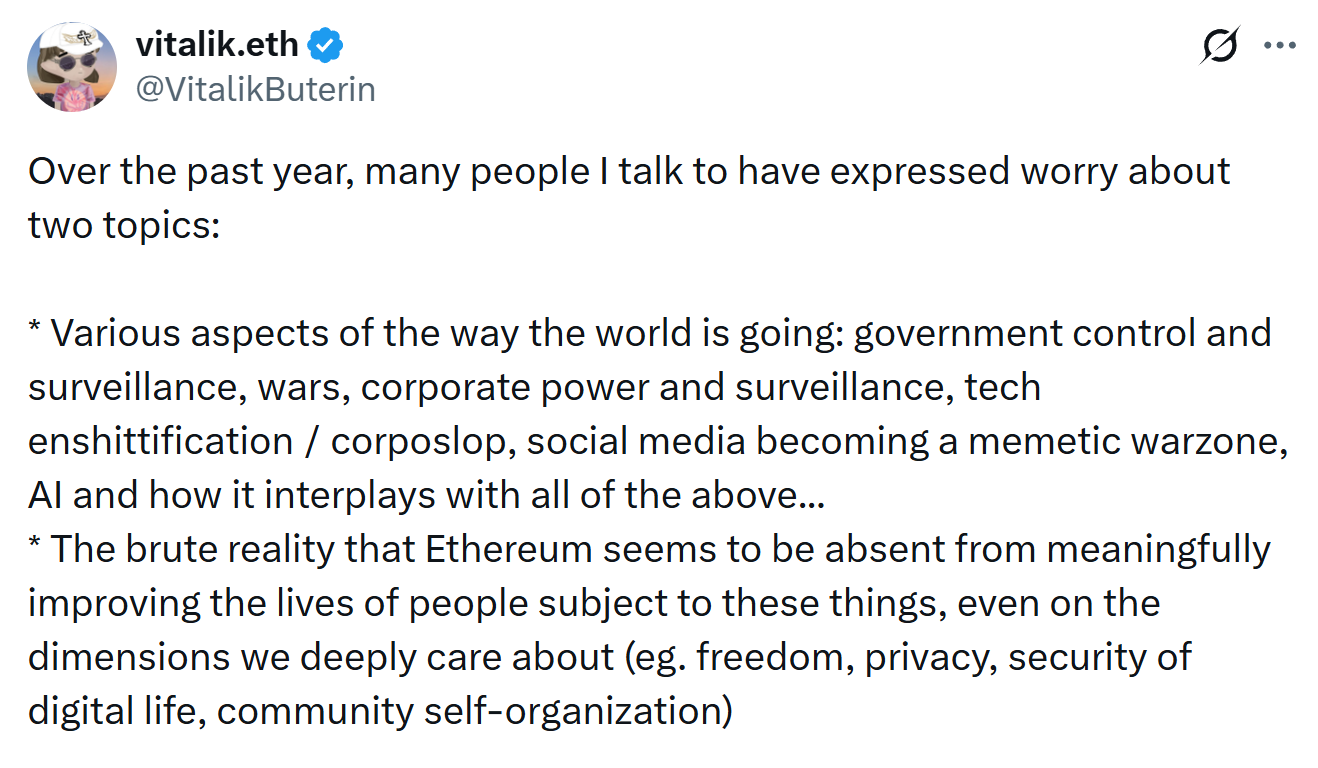
This expression appears to be an abstract upgrade of values, but when viewed in the context of Ethereum's recent protocol evolution, it actually corresponds to very specific engineering issues:
As block construction becomes increasingly specialized, the power of transaction ordering becomes more concentrated, and public mempool becomes more vulnerable to attacks and front-running, how should Ethereum continue to uphold the core bottom line of an "open network"—users’ transactions should not be easily blocked by a few people.
1. Vitalik Coined a New Term: "Sanctuary Technologies"
This time, Vitalik's starting point carries a rare frankness.
He did not continue to use grand phrases like "changing the world," but rather acknowledged that, up to today, Ethereum’s improvement to the real lives of ordinary people remains limited. For example, while on-chain financial efficiency may have improved and the application ecosystem has become richer, many achievements still remain within the internal cycle of the crypto world.
Thus, he proposed a new positioning method, suggesting that instead of viewing Ethereum merely as a financial network, it would be better to see it as part of a broader "sanctuary technologies" ecosystem.
According to his definition, such technologies typically share several common characteristics: they are open-source, free, and accessible for anyone to use and replicate; they help people communicate, collaborate, manage risks, and wealth; more importantly, they can continue to operate in the face of government pressure, corporate blockades, or other external interventions.
Vitalik even presented a vivid metaphor—true decentralized protocols should resemble a hammer rather than a subscription service. When you buy a hammer, it belongs to you, will not suddenly become ineffective due to the manufacturer's bankruptcy, and will not pop up a message one day saying "this feature is no longer available in your area."
Ultimately, if a technology is to fulfill its sanctuary function, it cannot rely on the continuous existence of a centralized organization, nor can it always place users in a passive position of accepting services.
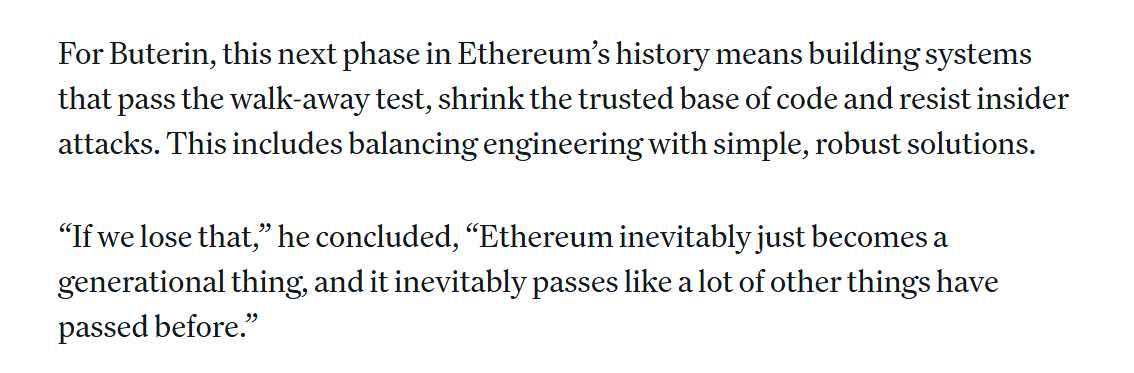
Image Source: CoinDesk
This undoubtedly evokes another standard that Vitalik has frequently mentioned to assess Ethereum's long-term value, which is the walkaway test. The test poses a very straightforward question: if all core Ethereum developers collectively disappear tomorrow, can the protocol continue to operate normally?
This is not a slogan but is rather an extremely stringent decentralization standard, as it truly asks not whether "there is a narrative of decentralization now," but whether "in the worst-case future, this system can still stand firm."
When this question is placed at the level of block production, the answer becomes very concrete: to pass the walkaway test, a chain must not allow transaction inclusion rights to remain long-term in the hands of a few, nor should public transactions be inherently exposed to risks of front-running, attacks, and censorship.
This is precisely the backdrop for the introduction of FOCIL and cryptographic mempool into the core discussion of Ethereum.
2. Censorship Resistance Returns to Protocol Center: FOCIL + Cryptographic Mempool
We need to carefully dissect the issues currently facing Ethereum's public mempool.
In recent years, Ethereum has increasingly moved towards specialization in block construction. To enhance efficiency and MEV extraction capabilities, the role of builders has become increasingly important; block production is no longer the ideal state where every validator independently constructs blocks locally. While this approach has real-world benefits, the costs are also clear:
Once block construction rights concentrate in the hands of a few powerful participants, censorship is no longer just a theoretical risk. Theoretically, any mainstream builder can selectively refuse to include certain transactions, such as transfers from addresses previously sanctioned, like Tornado Cash.
In other words, the issues facing Ethereum today are no longer just whether transaction fees are high or whether throughput is sufficient, but whether the public transaction infrastructure is still trusted by ordinary users.
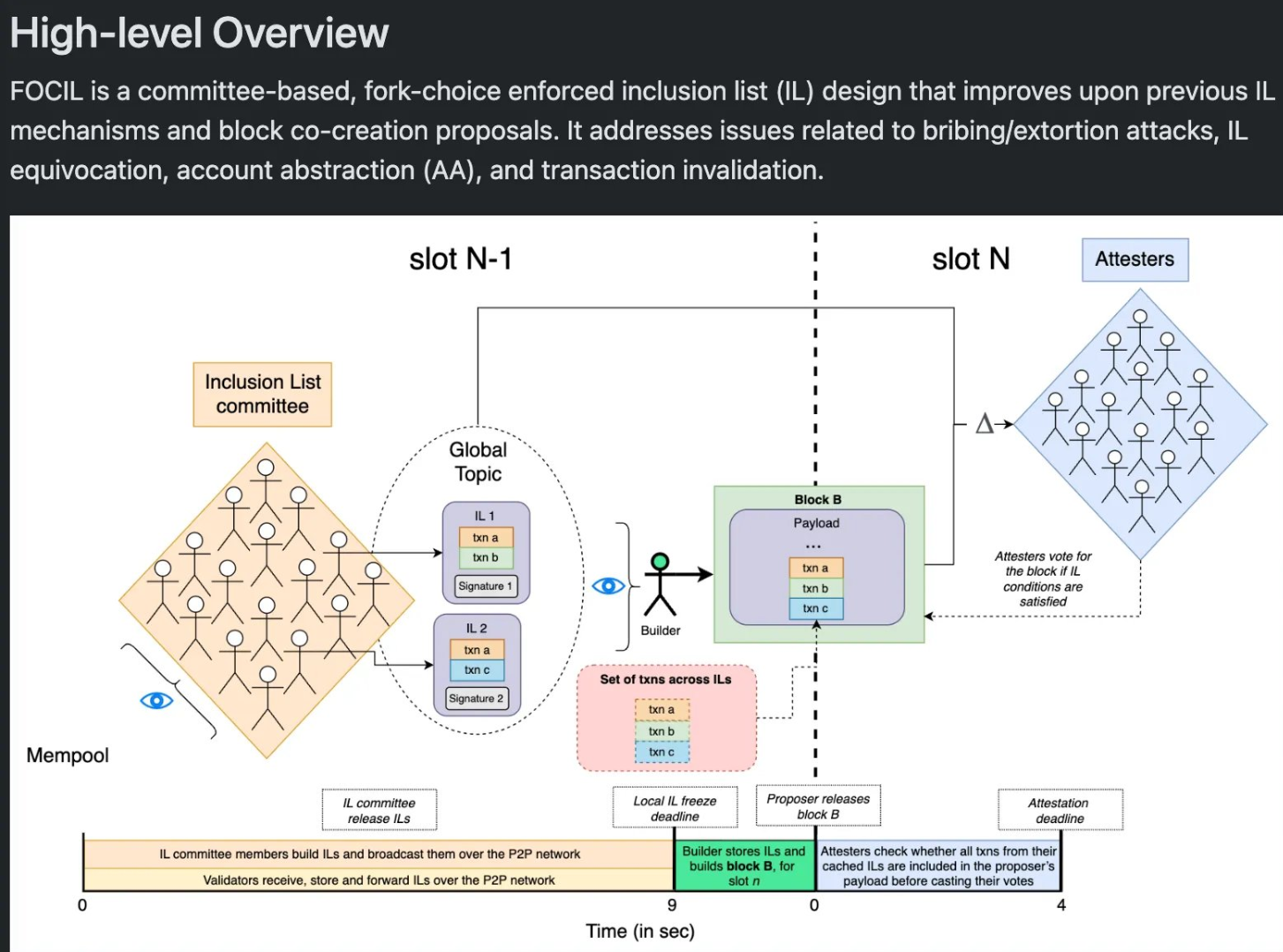
Thus, FOCIL (Fork-Choice Enforced Inclusion Lists) is Ethereum's protocol layer's direct response to the censorship issue. Its core idea is not complex; it introduces an Inclusion List mechanism that allows whether transactions can be promptly included in blocks not to be entirely determined by the unilateral will of proposers or builders.
Each slot selects an Inclusion List Committee from the validator set, and committee members form a list of transactions to be included based on their observations of the mempool and broadcast it; the proposer for the next slot must construct a block that meets the constraints of these lists, while attestors will only vote for blocks that meet the conditions.
In other words, FOCIL does not eliminate builders, but rather provides stronger inclusion guarantees for valid transactions in the public mempool through fork choice rules. This means that builders can still optimize ordering and enhance efficiency and yield concerning MEV, but they no longer hold the power to decide whether a legitimate transaction qualifies for inclusion in a block.
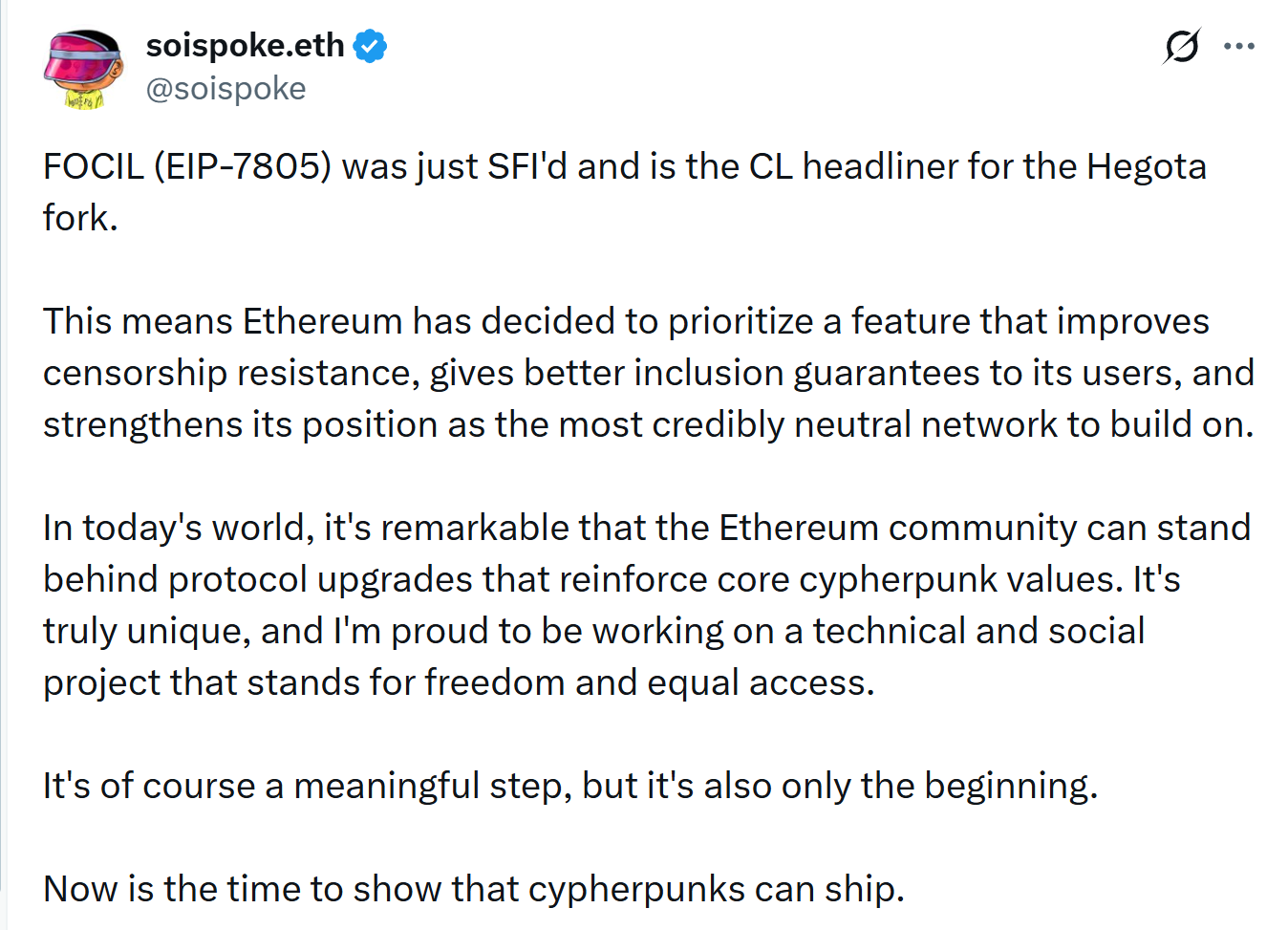
Despite being much debated, FOCIL has been confirmed as the core proposal of the upcoming major upgrade, Hegotá (Specification Freeze Included status), expected to go live in the second half of 2026 after the Glamsterdam upgrade.
However, FOCIL does not address another equally critical issue: before a transaction is truly packed into a block, has it already been fully revealed to the market? MEV seekers can then perform front-running, attacks, and reordering, especially since DeFi transactions are the easiest targets. For ordinary users, this means that even if their transactions are not censored, they may still be selectively targeted for harvesting before getting into a block.
This is the root of sandwich attacks.
The main proposals currently under discussion in the community are LUCID (proposed by Ethereum Foundation researchers Anders Elowsson, Julian Ma, and Justin Florentine) and EIP-8105 (Universal Enshrined Encrypted Mempool). The EIP-8105 team has recently announced full support for LUCID, with both teams collaborating to advance.
The core idea of the cryptographic mempool is:
- When users send transactions, the transaction contents are encrypted;
- Transactions are only decrypted once they are packed into a block and reach a certain number of confirmations;
- Before this, seekers cannot see the transaction intentions and cannot execute sandwich attacks or front-running;
- Thus, the public mempool becomes "securely usable" once again;
As researchers have noted, ePBS (execution layer proposer - builder separation) + FOCIL + cryptographic mempool collectively form the "Holy Trinity of Censorship Resistance," providing systematic defenses from the entire transaction supply chain.
Currently, FOCIL has been confirmed for inclusion in Hegotá; the cryptographic mempool proposal (LUCID) is actively striving to be included as another headline proposal for Hegotá.
3. What All This Means
If we broaden our perspective a bit, FOCIL and the cryptographic mempool are not just another set of new terminology on Ethereum's technology upgrade list; they serve more as a signal:
Ethereum is placing "censorship resistance" back at the center of protocol design.
After all, while the blockchain industry often talks about "decentralization," it is only when a transaction is truly censored, intercepted, or disappears from the network that most users will realize that decentralization is never the default state, but something to be actively pursued through protocol code.
As early as February 20, Vitalik expressed that there is an important synergistic effect between the FOCIL mechanism and Ethereum's account abstraction proposal EIP-8141 (based on 7701). EIP-8141 elevates smart accounts (including multi-signature, quantum-resistant signatures, key changes, gas sponsorships, etc.) to "first-class citizens," meaning that actions initiated from such accounts can be directly packed as on-chain transactions without additional encapsulation.
Some may question: does FOCIL increase the complexity of the protocol and could the cryptographic mempool lead to efficiency losses? Are these costs worth it?
This is precisely where the "sanctuary technologies" stand out; the truly unique value of blockchain may never just be about asset tokenization and transaction speed, but whether it can continue to provide people with a permissionless, hard-to-shut-down, and difficult-to-take-away digital outlet in high-pressure environments.
From this perspective, the significance of FOCIL and the cryptographic mempool becomes clear, as they aim to transform aspects that originally relied on goodwill, market-based equilibrium, or the "hope that nothing will go wrong" into more robust protocol rules.
When countless users can freely live, work, communicate, manage risks, and accumulate wealth on this "digital stable island" without worrying about being evicted or censored by any centralized entity—only then has Ethereum truly passed the "Walkaway Test."
And this is the ultimate significance of sanctuary technologies.
免责声明:本文章仅代表作者个人观点,不代表本平台的立场和观点。本文章仅供信息分享,不构成对任何人的任何投资建议。用户与作者之间的任何争议,与本平台无关。如网页中刊载的文章或图片涉及侵权,请提供相关的权利证明和身份证明发送邮件到support@aicoin.com,本平台相关工作人员将会进行核查。


