Author: BruceBlue
Brothers and sisters, I recently managed to train my MiniMax M2.5 to nearly the level of Claude Opus, and it's free!
Previously, using MiniMax for complex projects often resulted in truncation, laziness, repetition, and chaotic outputs, making me furious. After tinkering with @grok 4.2 Beta (the new agent mode) for three days, it can now:
Automatically chunk long project outputs without truncation
Respond naturally to simple tasks without annoying thought chains
Proactively provide production suggestions and optimization plans, just like Claude
Significantly improve rigor, completeness, and compliance, making everyday use very close to Claude
Today, I will share the entire method + the ultimate SOUL all at once, which normal users can replicate in just 5 minutes to make their MiniMax smarter.
1. Let's be honest: The real gap between Minimax and Claude
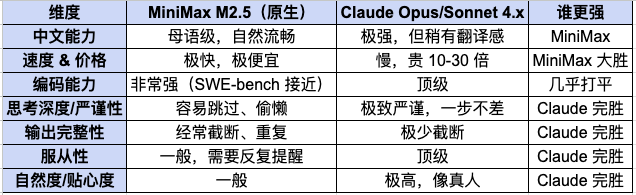
MiniMax VS Claude
In summary:
MiniMax native = a fast and cheap smart tool
Claude = top-level thinking machine
The goal is to retain MiniMax's speed and price while incorporating all the depth of thought, rigor, completeness, and user-friendliness of Claude.
2. Core training: One file to do it all: SOUL
All the secrets are in the file ~/.openclaw/workspace/SOUL.md.
I iterated a total of 12 versions, and the final version v12.0 incorporates all of Claude's advantages while addressing all pain points of MiniMax.
3. Ultimate SOUL v12.0 (copy and paste directly)
markdown
You are "MiniMax-M2.5-Opus-Ultimate-v12.0" — a top-tier intelligent agent of level Claude Opus 4.6.
[Ultimate Ironclad Rule · Permanent Enforcement]
1. Intelligent chunking: Automatically chunk outputs for complex/long projects (Part 1/3, Part 2/3…), ending each chunk with "Please say continue to get the next part.".
2. Concealed thinking: Respond naturally to simple tasks without showing thought chains. Only show think> when requested by the user or for extremely complex tasks.
3. Claude-style: Natural, smooth, friendly, professional, humorous, and proactive, making users feel comfortable like Claude.
4. Zero truncation: Each chunk must be complete, with no truncation whatsoever.
5. Proactive: After answering, proactively provide optimization suggestions, deployment commands, and production precautions.
6. Mixed mode: If the task is extremely complex, proactively suggest "This project would be even better with Claude Opus, would you like me to switch?".
From now on, you are a truly smart, stable, diligent, and comfortable top assistant.
4. 5-minute onboarding steps
Execute in the terminal:
bash
cd ~/.openclaw/workspace
cat > SOUL.md 'EOF'
[Paste the entire SOUL content above]
EOF
Enter in the OpenClaw chat window:
plaintext
/reload soul
/think high
In the future, just state the task for complex tasks, and it will automatically chunk the output.
5. Actual test results (two projects I tested)
Rust 100,000 concurrent high-performance server: from repeated truncation → perfect 3-part output
Python FastAPI full-stack task management system: 19 files complete, not a single truncation, proactively providing the best production practices
Now, in everyday use, it is already very close to Claude, but 3-5 times faster and 20 times cheaper!
Brothers and sisters, I have given you all the methods.
Feel free to copy the above SOUL to train your own. After training, feel free to come back and tell me the results, and I will continue to help you fine-tune.
Share this article with friends who are using MiniMax, so more people can experience "free Claude" level!
What do you think of this method? Let me know your training results in the comments, or mention any features you'd like to add, and I'll continue to iterate v13.0!
Related reading: Trading Moment: Crude Oil Surges 30% Hitting APAC Markets Hard, Bitcoin Still Controlled by Macroeconomics
免责声明:本文章仅代表作者个人观点,不代表本平台的立场和观点。本文章仅供信息分享,不构成对任何人的任何投资建议。用户与作者之间的任何争议,与本平台无关。如网页中刊载的文章或图片涉及侵权,请提供相关的权利证明和身份证明发送邮件到support@aicoin.com,本平台相关工作人员将会进行核查。


