
Author: Jae, PANews
In today's global financial landscape, the rickety old Babel Tower of traditional payment systems is facing fierce assaults from new forces.
On March 10, Circle's stock price exceeded $110, doubling from its low point earlier in the year. Behind the stock price rebound is the capital market's revaluation logic for the "stablecoin issuance" business model.
From the fluctuating stock prices on the New York Stock Exchange, to the trillions of dollars flowing on-chain, and the small payments circulating among AI Agents, while people still complain about the lack of innovation in cryptocurrencies and chase the AI trend, Circle has quietly and precisely positioned itself between the hegemony of settlement networks and the sovereignty of Agent currencies.
The Doubling of Stock Price, Geopolitical Crisis Becomes a Catalyst
In less than nine months, Circle completed its IPO, marking its coming of age in the mainstream capital market and passing the growth test of stock price "rebirth."
In the speculative frenzy during the early listing period, Circle, as the first publicly traded stablecoin, soared rapidly from its issuance price of $31 to $260, before falling back down to around $50. After experiencing a painful period, Circle's stock price surged again, breaking through the $110 mark.
Circle has shown a qualitative change from "speculative growth" to "performance-driven growth." The financial report released in February was the turning point. Circle's total revenue for fiscal year 2025 reached $2.7 billion, a 64% increase year-on-year. In Q4 of 2025, its revenue reached $770 million, representing a 77% increase, far exceeding market expectations.
A detail in the financial report deserves special attention: the net loss of $70 million for fiscal year 2025 was largely due to a $424 million stock-based compensation expense related to the IPO.
After excluding this one-time non-cash item, Circle's profitability would significantly improve, with a Q4 net profit of $133 million reflecting its true core, showing substantial year-on-year growth.
Circle is leveraging a typical operational leverage effect of fintech giants: the larger the circulation scale, the lower the marginal cost, and the more substantial the profit.
Complex global geopolitical games have unexpectedly benefited stablecoin issuers. Since the outbreak of the U.S.-Iran war, Brent crude oil prices have risen by about 15% in a week. This return of inflation expectations further decreased the possibility of interest rate cuts, while maintaining high rates provided a better profitable environment for Circle, which mainly generates income from government bond interest.
Mizuho Bank analyst Dan Dolev believes that inflation pressure from soaring oil prices will lead the Federal Reserve to delay interest rate cuts. Data from CME FedWatch indicates that the market's probability forecast for "no interest rate cuts" in 2026 has risen from 79.9% a month ago to 97.3%.
For ordinary enterprises, high interest rates mean higher financing costs, but for Circle, high interest rates mean higher reserve earnings. As long as interest rates remain elevated, Circle’s interest margin income will be maintained at a considerable level.
Currently, the circulation of USDC has reached $753 billion, with a year-on-year quarterly growth of 72%. Even minor fluctuations in interest margin can have a huge leverage effect on Circle's net profit.
This "higher for longer" interest rate environment has actually led to an increase in Circle's valuation multiples, surpassing the volatility of its short-term revenues.
It is worth mentioning that the recent surge essentially includes recognition of Circle's "settlement technology premium." The on-chain transaction volume of USDC surged to $11.9 trillion in Q4 last year, a 247% year-on-year increase.
Thus, Circle is not only a "financial management institution that earns interest spread," but also a "settlement technology network" capable of processing over $10 trillion in transactions quarterly, posing a threat to traditional payment giants.
Of course, the capital market's attitude is not without reservations. Although the stock price performed strongly, the over $47 million total reduction by Circle's executives in the past 90 days has cast a shadow, to some extent affecting investor sentiment.
USDC Monthly Transfer Volume Surpasses USDT, Power Shift Unfolds
In February, the stablecoin sector witnessed a moment of overtaking. According to Allium data, the total monthly transfer volume across the market reached $1.8 trillion, setting a new historical record.
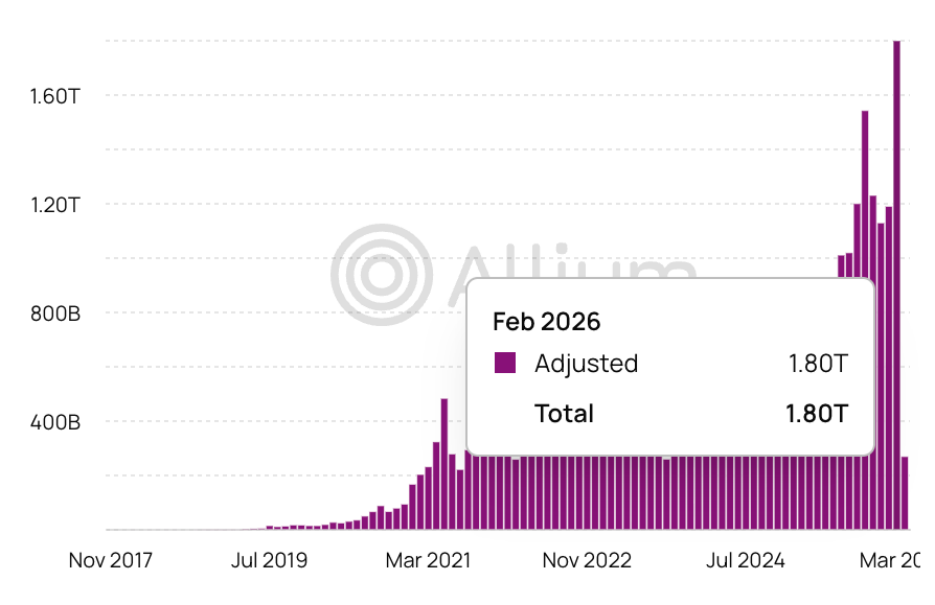
Behind this number, the power shift of "funding velocity" is more intriguing than market capitalization growth.
Although USDT still holds a dominant position with a market capitalization of $184 billion, USDC has made a decisive overtaking in funding velocity. In February's total transfer volume, USDC processed about $1.26 trillion, accounting for nearly 70%. Funding velocity determines who the true flow of blood is.
From the nature of the currency, USDT is approaching a store of value, mainly held in margin accounts in centralized exchanges; whereas USDC is evolving into a medium of circulation, skyrocketing in scenarios such as institutional settlement, prediction markets, and trade payments.
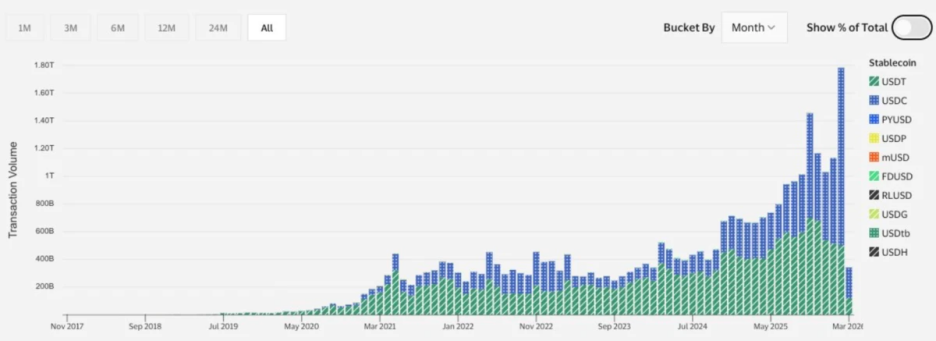
Circle's explosive growth in February was primarily due to its ecological positioning.
Visa's deep integration has been a catalyst. By introducing USDC settlement between acquiring and issuing institutions, traditional payment processes have bypassed the cumbersome correspondent bank systems, achieving all-weather settlement. This means that even on weekends when banks are closed, the funds from multinational enterprises can be settled on-chain in USDC, significantly enhancing capital efficiency.
The phenomenal rise of Polymarket has provided demand-side validation in native crypto scenarios. As a major settlement currency, USDC has played the role of "universal currency" in betting on the outcomes of major global events, significantly increasing its turnover rate.
Moreover, Circle's penetration into emerging markets such as Latin America and Africa is also beginning to show results. Local companies are increasingly using USDC as a tool to hedge against currency depreciation and facilitate cross-border trade settlements. In these regions, stablecoins are no longer speculative tools but are essential for survival.
Eliminating Micro Payment Pain Points, USDC Aims to Become the "Agent Financial Lexicon"
If the $1.8 trillion monthly transaction volume marks humanity's acceptance of stablecoins, then the 140 million AI Agent payments herald the arrival of the "Agent Finance" era.
In the past nine months, over 400,000 AI Agents with purchasing capabilities have exhibited extremely high payment activity, with 98.6% of the transaction volume opting for USDC.
Why USDC?
Data quoted by Circle's global market head, Peter Schroeder, shows that the average transaction amount for AI Agent payments is only $0.31. This small amount reveals the fundamental pain point of the Agent economy: micro payments.
When executing tasks, AI Agents incur costs such as API call fees, computing power rental fees, and data collection fees. Within traditional banking or credit card systems, processing a $0.31 transfer could result in transaction fees exceeding the amount itself. This expensive cost structure makes it difficult for Agents to conduct payments through traditional channels.
However, the economic account is merely the surface; the deeper reason for Agents choosing USDC is the technical components provided by Circle.
Circle's programmable suite allows developers to directly embed wallet management logic into AI code. Through the Model Context Protocol (MCP) server, developers can enable AI such as Claude, Cursor, or Windsurf to directly generate scripts that call for USDC payments. This ease of development also promotes USDC as the default option for Agent payments.
The Cross-Chain Transfer Protocol (CCTP) resolves the final hundred meters issue. Agents typically operate on low-cost, high-concurrency Layer 2 systems or high-performance public chains like Base or Solana. Within these networks, USDC transfer fees are less than a cent and can be completed in seconds. CCTP achieves seamless liquidity migration between different chains, which is particularly important for AI Agents that frequently call resources across chains.
Circle is traversing its "golden fork." The fundamentals have raised the valuation multiples, ecological positioning has driven growth expectations, and AI Agent payments have opened up a blue ocean business.
In a world full of uncertainties, the best business is to become a foundational infrastructure of certainty. Circle is poised to print the first legal currency for the upcoming AI civilization at the intersection of settlement network hegemony and Agent currency sovereignty, with its "central bank of the digital economy era" gradually taking shape.
免责声明:本文章仅代表作者个人观点,不代表本平台的立场和观点。本文章仅供信息分享,不构成对任何人的任何投资建议。用户与作者之间的任何争议,与本平台无关。如网页中刊载的文章或图片涉及侵权,请提供相关的权利证明和身份证明发送邮件到support@aicoin.com,本平台相关工作人员将会进行核查。


