On February 21, 2026, Bitdeer, a Bitcoin mining company headquartered in Singapore, posted a weekly report on its official social media that broke industry norms. The data showed that as of February 20, 2026, Bitdeer's self-operated Bitcoin holdings (excluding customer deposits) had dropped to zero. During the reporting period, the company produced 189.8 BTC and sold all of them, while its net reduction reached 943.1 BTC, completely emptying its Bitcoin reserves.
This "liquidation-style" sell-off triggered intense tremors in the cryptocurrency mining circle. Particularly noteworthy is that this action occurred at a dramatically significant time: according to the latest data, Bitdeer's self-operated computing power had just reached 63.2 EH/s, officially surpassing the long-established giant Marathon Digital's 60.4 EH/s, becoming the largest publicly listed self-operated mining company by computing power scale in the world.
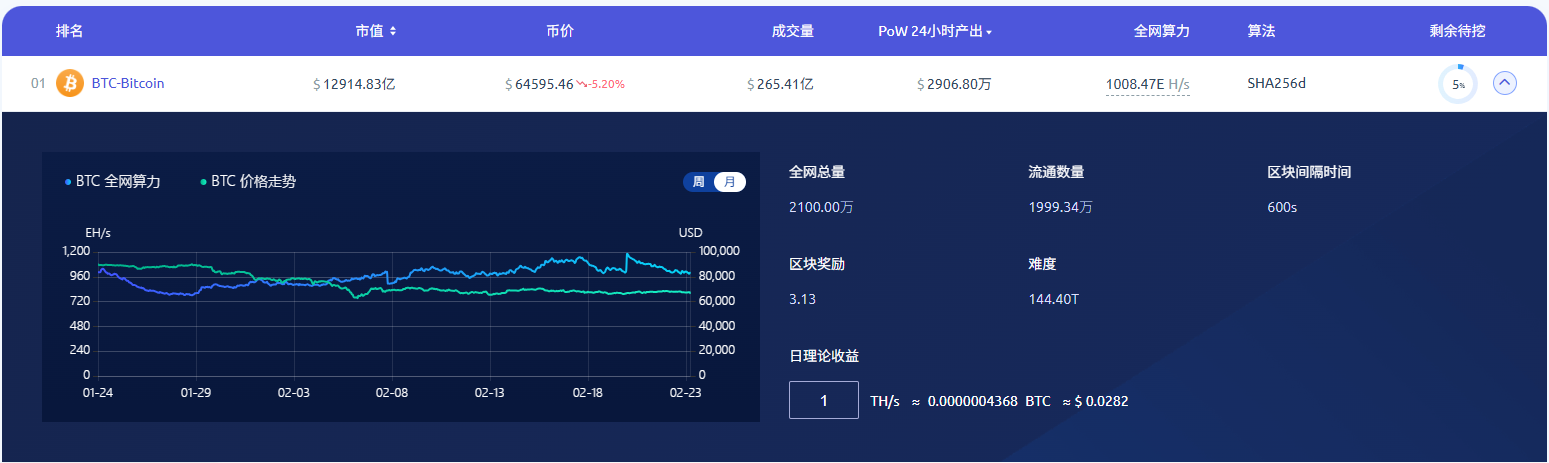
Holding the world's number one computing power while choosing not to hold a single Bitcoin. This seemingly paradoxical strategic choice not only announces the demise of the traditional mining belief of "mining equals holding" (HODL) but also reflects that under the extreme pressure of computing power economics, leading mining companies are accelerating their transformation towards Wall Street-standard corporate financial operations and AI computing infrastructure providers.
Bitdeer's emptying of Bitcoin reserves was not due to a bearish outlook but rather constrained by the currently deteriorating fundamentals of the mining industry. To understand the inevitability of this move, one must analyze the underlying data of the current Bitcoin network.
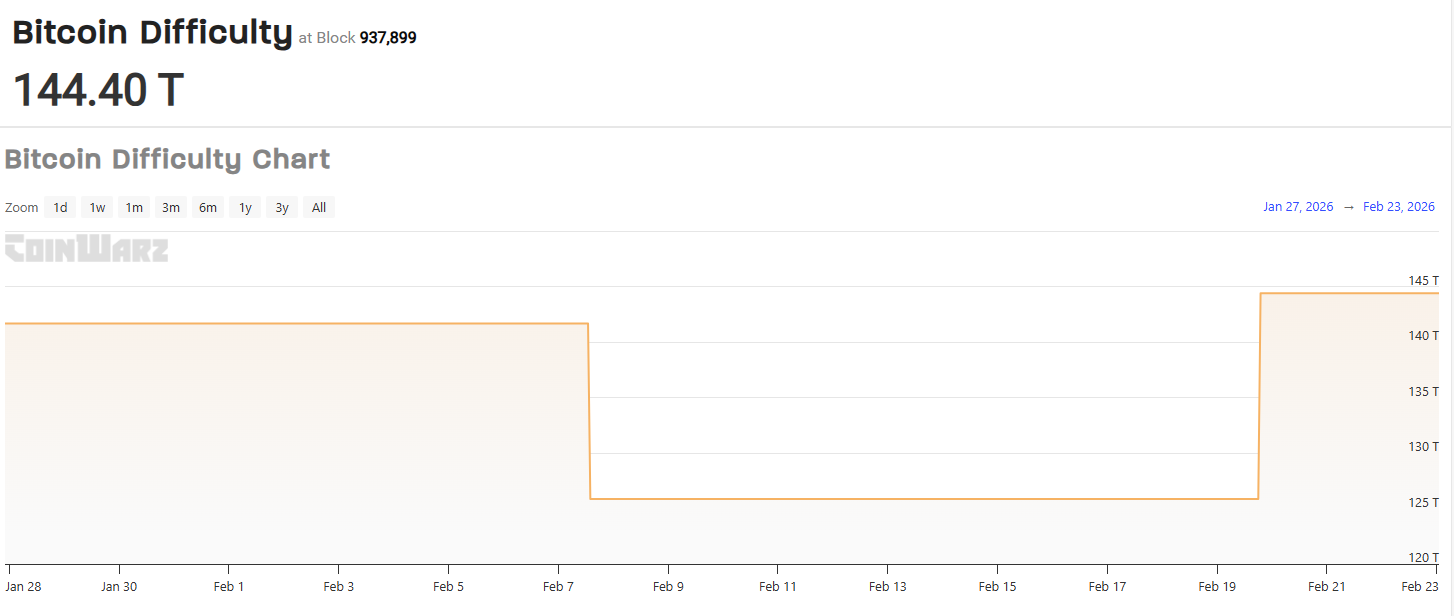
According to data from the past two days, the difficulty of the Bitcoin network surged from 125.86T on February 19 to 144.39T, an increase of 14.72%. This is the largest single adjustment since May 2021. This difficulty adjustment directly wiped out all operational breathing space that miners had gained earlier this year. The dramatic increase in network difficulty means that mining companies need to invest more computing power and electricity costs to maintain their original output share.
Even more fatal is the collapse of Hashprice (computing power price). Hashprice is the most critical quantitative indicator of miners' profitability, representing the expected fiat currency revenue generated by each unit of computing power (usually 1 PH/s) in a day. Due to the dual impact of surging network difficulty and price volatility, the global Hashprice has plummeted to less than 30 dollars/PH/s/day. This figure is approaching historic lows.
When Hashprice falls below 30 dollars, the vast majority of miners using outdated models or facing electricity costs above 0.06 dollars/kWh are on the brink of shutting down, or even in a state of negative gross profit. For giants like Bitdeer, although they possess economies of scale and certain energy cost advantages, the extremely compressed profit margins make it impossible to continue to bear the risk of anchoring assets in a highly volatile single cryptocurrency.
In today's environment of high capital costs, holding Bitcoin is a decision that carries a significant opportunity cost for mining companies. Every BTC hoarded translates into a reduction in cash flow that could be used for reinvestment, upgrading equipment, or repaying debt. In a period of severely compressed margins, "cash is king" has replaced "holding coins is king," and liquidation sales are the most direct defense against liquidity tightening.
Wall Street Financial Techniques: Convertible Bonds and Defensive Debt Restructuring
In the face of declining computing power revenues, Bitdeer's solution is not limited to selling Bitcoin; its actions in the capital market demonstrate highly mature financial engineering capabilities. On February 20, Bitdeer announced it would expand the issuance of its private placement convertible senior notes to $325 million, with the transaction expected to close on February 24, and initial purchasers having an option to purchase an additional $50 million in notes.
This financing of up to $375 million is meticulously designed, constituting a textbook-level defensive restructuring of the balance sheet:
Debt Deferral and Replacement ($138.2 million): Bitdeer will use $138.2 million to repurchase its existing 5.25% convertible senior notes due in 2029. This "new borrowing to pay old debts" operation, in a complex interest rate environment, is essentially aimed at optimizing the capital structure, extending the duration of the debt, and securing a more ample cash flow runway for the company's future strategic transformation. In the low Hashprice period, reducing short-term debt repayment pressure is crucial for the survival of the enterprise.
Cap Option Trading ($29.2 million): Bitdeer allocated $29.2 million for capped call transactions. This is a highly specialized derivative hedging strategy. Because convertible bonds come with conversion rights, if Bitdeer's stock price rises sharply in the future, exercise by bondholders would lead to an increase in total share capital, severely diluting the equity of existing shareholders.
The capped options serve as a form of "anti-dilution insurance," allowing the company to offset the dilution effect of bond conversion through the profits from call options when the stock price rises within a specific range. This sends a clear signal to the market: the management is confident in the company's long-term market value and is keen to protect the interests of existing shareholders.
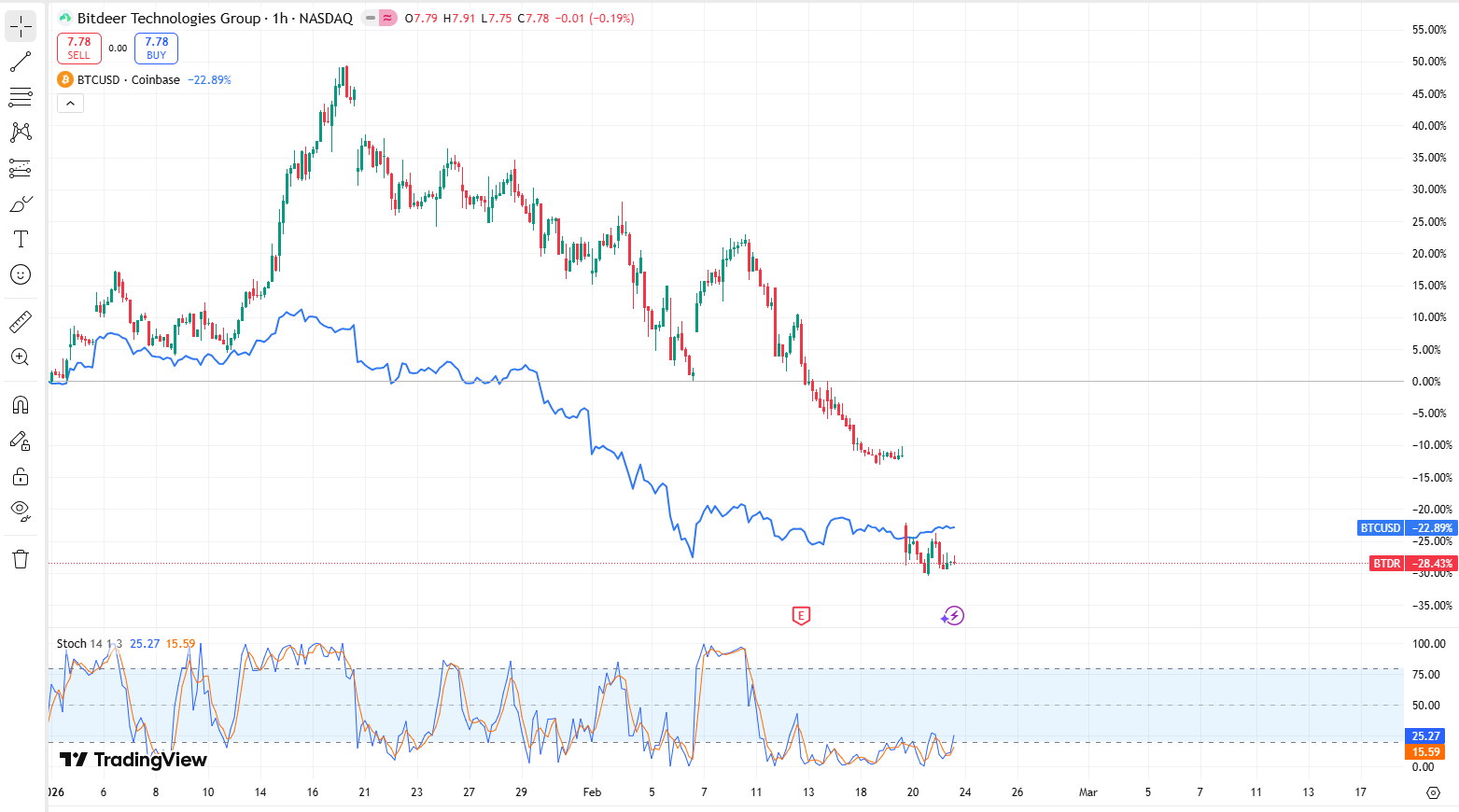
This complex maneuver demonstrates that Bitdeer's financial strategy has evolved from the rudimentary stage of the early cryptocurrency industry to the precise capital operation phase, aligned with top Nasdaq technology companies.
After deducting the costs of debt restructuring and options hedges, the remaining hundreds of millions in raised funds and the cash obtained from liquidating Bitcoin reveal Bitdeer's true ambition: to shed the label of a "pure Bitcoin mining company" and fully enter the high-performance computing (HPC) and artificial intelligence (AI) cloud service sectors.
Amid the explosive wave of generative AI, the global computing power market is facing an unprecedented supply-demand imbalance. Training and reasoning of large AI models require massive computing clusters, and behind these clusters is a tremendous demand for energy infrastructure (electricity and data center cooling).
Bitcoin mining companies have a uniquely advantageous arbitrage position in this macro context. Mining companies are essentially energy arbitragers, holding the world’s cheapest and largest scale electricity resources and highly scalable data center land. Bitdeer has explicitly stated that the new funds will be used for:
- Expanding HPC and AI cloud business scale.
- Developing proprietary ASIC mining equipment (achieving vertical integration of the hardware supply chain and reducing capital expenditures).
- Expanding high-standard data centers.
Transforming or upgrading low-margin Bitcoin computing power infrastructure into high-margin, stable cash flow AI data centers is currently the most critical transformation narrative for large mining companies. AI clients typically sign long-term, fixed-rate service contracts (such as PPAs), contrasting sharply with the revenue model of Bitcoin mining, which experiences dramatic fluctuations day by day along with Hashprice.
By liquidating Bitcoin and issuing convertible bonds, Bitdeer is essentially investing in a more certain future (AI infrastructure) with the inefficient past (coin hoarding).
Bitdeer, with a computing power of 63.2 EH/s, reaches the top in the world while simultaneously setting a record of "zero Bitcoin holdings." This phenomenon marks a complete underlying divergence in the commercial model of global listed mining companies.
In this logic, being the largest in computing power does not mean hoarding the most coins, but rather owning the largest cash flow-generating machine and the largest energy load capacity. When the profits generated by this machine fall below thresholds, unhesitatingly directing capital into higher return, more era-dividend AI tracks is the most rational choice according to quantitative and capital allocation principles.
In 2026, a challenging post-halving cycle, blindly hoarding coins is no longer a universal panacea. For investors in the financial market, this is no longer a story about "mining," but a hardcore narrative about energy, computing power scheduling, and Wall Street capital efficiency.
免责声明:本文章仅代表作者个人观点,不代表本平台的立场和观点。本文章仅供信息分享,不构成对任何人的任何投资建议。用户与作者之间的任何争议,与本平台无关。如网页中刊载的文章或图片涉及侵权,请提供相关的权利证明和身份证明发送邮件到support@aicoin.com,本平台相关工作人员将会进行核查。


