AI marketing should focus on real scene value rather than simply throwing money around. Qianwen's practical scene integration surpasses the short-sighted fission of Yuanbao.
Recently, the rhythm in the AI circle has clearly been a bit fragmented.
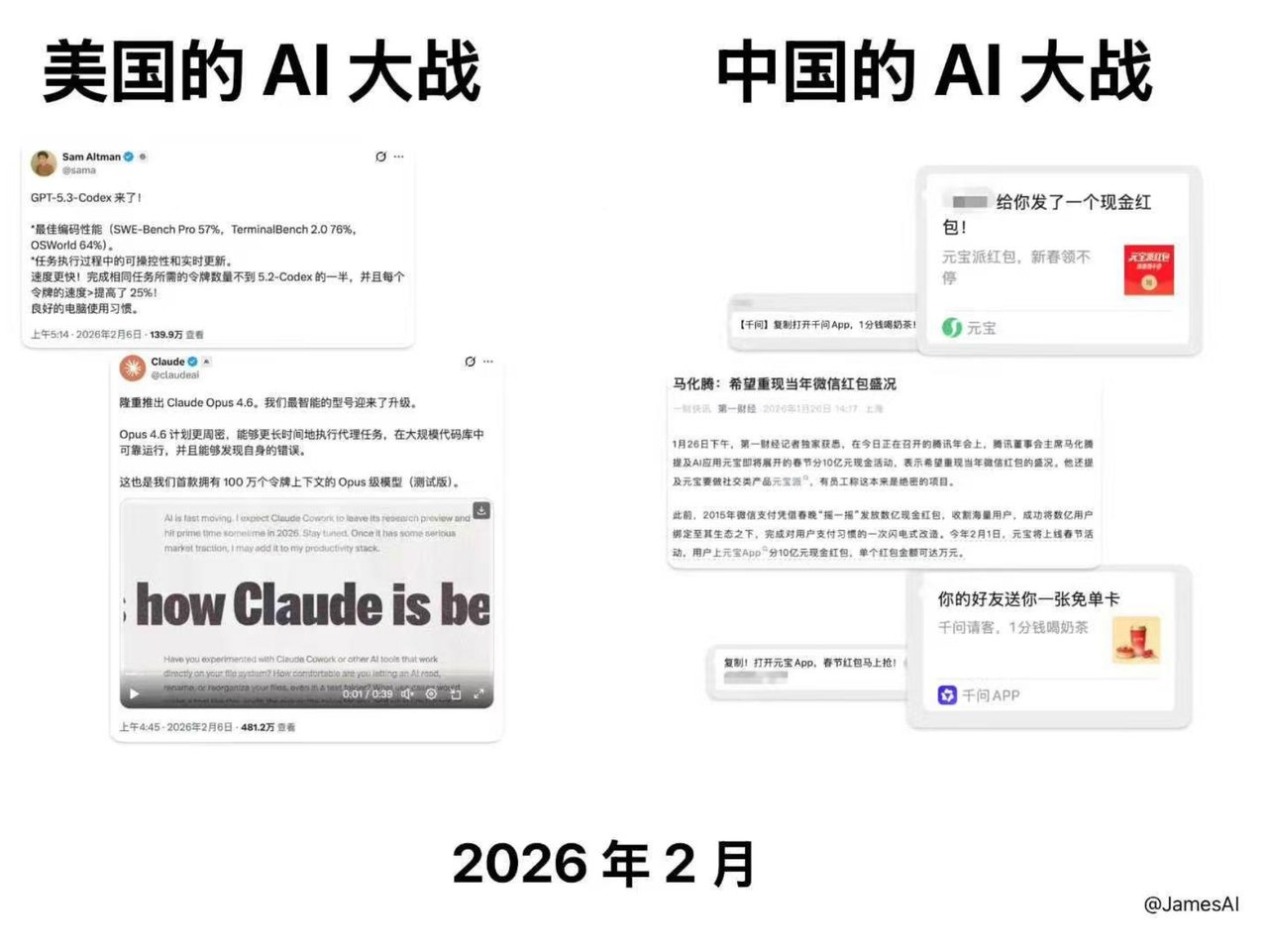
Image source: @JamesAI
On one side, overseas models are almost releasing a new version every day.
Before you have fully deployed OpenClaw, Moltbook and Codex have already been pushed to new heights.
On the other side, domestic tech giants are frantically "throwing money" for holiday marketing during the Spring Festival.
The Spring Festival remains the most competitive "traffic battlefield" for big companies.
Looking solely at the scale of investment:
Alibaba 3 billion > Tencent 1 billion ≈ ByteDance (not disclosed, but the value of the Spring Festival Gala sponsorship is several hundred million) > Baidu 500 million.
In fact, the Spring Festival, a national-level trillion-level traffic entry, has become a battleground that companies fight over every year.
If we rank the AI marketing strategies of this year's BBAT from "strong" to "weak" based on general public perception, it might look like this:
- Qianwen: Deeply integrated with Alibaba's consumption ecosystem, complex path, but the most solid long-term value.
- Doubao: Leveraging the Spring Festival Gala and Douyin ecosystem for nationwide exposure, strong in mindshare, but weak in conversion.
- Wenxin: Steady progress with red envelopes + interaction, has presence, but lacks breakthrough points.
- Yuanbao: Extremely aggressive in fission and user acquisition, but clearly lacks tool mindset and retention.
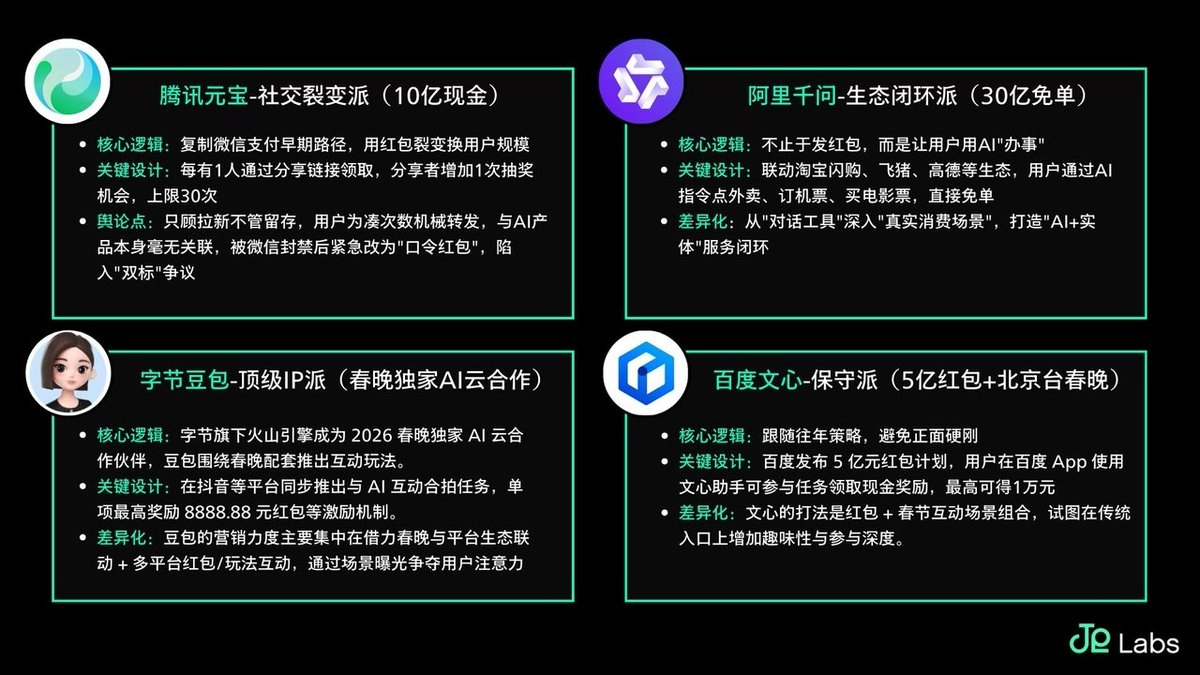
The common methods used every year are largely similar, but this year some are happy while others are worried.
Yuanbao's marketing backfired: Essentially using Web2 traffic era methods to market an AI era product.
Tencent's Yuanbao 1 billion red envelope plan faced a dramatic turn just three days after its launch—being "banned" by its own WeChat.
On February 4, the WeChat Security Center issued a notice pointing out that Yuanbao's Spring Festival marketing activities involved "inducing users to frequently share links to WeChat groups through 'completing tasks' and 'claiming red envelopes'," disrupting the platform's ecosystem, and restricting its direct opening within WeChat. Tencent's stock price fell by 3.53% that day.
Ironically, 11 years ago, it was WeChat's red envelope miracle during the Spring Festival Gala that reshaped the mobile payment landscape. Now, Tencent hoped Yuanbao would recreate this glory but forgot that the times have changed.
On the surface, Yuanbao merely crossed the red line of WeChat's ecosystem rules. But at a deeper level, this reflects a classic pitfall in AI product marketing:
1. Misalignment of Product and Growth Strategy Logic
AI is a typical "task-driven tool"—users actively use it when they encounter problems or need efficiency improvements.
Red envelope fission, in essence, is a "pulling emotional method"—users are not acting for the product's value but are driven by immediate benefits.
Red envelope fission has succeeded before.
Pinduoduo succeeded because its product and strategy naturally matched:
There is almost no cognitive cost, the path is extremely short, and the benefits are immediately visible and redeemable.
But AI products are quite the opposite:
- Relatively high learning costs
- Complex scene understanding
- Value is delayed in realization
It is a misalignment of product attributes and growth strategies, akin to opening a top-tier neurosurgery clinic and not promoting how great the lead surgeon is, but instead handing out eggs at the door to attract customers.
2. Only Acquiring New Users, Not Retaining Them: Data Illusion
From a backend perspective, Yuanbao's fission might seem "very successful":
Levels are spreading, DAU is surging, and the forwarding curve data looks great.
But the reality is: users have already categorized Yuanbao as "junk"—they claim the red envelope and then close the app, returning to the main group chat to discuss technology or DeepSeek.
This traffic is a one-time "bystander pool." After the Spring Festival, what remains is only the recognition of "that orange app that gives money," not the value recognition of an AI assistant.
3. Designing Solutions for KPIs, Not for Users
From an industry perspective, this operation feels more like a reactive response driven by data.
Doubao's DAU broke 100 million, while Qianwen and Wenxin also reached the billion-level scale, whereas Yuanbao remained at the 20 million level.
In the "big tech AI ranking competition," it indeed appears less dignified.
Under this pressure, growth targets began to take precedence, and "doing things" became more important than "doing the right things."
This also reflects a common issue among big companies: as long as the curve is rising, and the reports look good, short-term misalignments and long-term side effects can be temporarily ignored.
Qianwen's explosive orders: Landing practical application scenarios, offline order grabbing feeds back into marketing.
In contrast, Qianwen's strength lies in directly binding AI capabilities to users' real needs and Spring Festival scenarios, rather than simply acquiring new users or boosting traffic. Through Qianwen Agents, users can not only grab free meal vouchers but also connect to Taobao flash sales, place orders with Hema, and have them delivered directly to their homes, creating immediate, tangible value.
The core advantages are:
- Task-driven experience: Users use AI to complete actual consumption or life tasks, with low learning costs and clear rewards.
- Scenarios closely aligned with holiday pain points: Shopping, gift-giving, and preparing for the New Year during the Spring Festival, AI tools directly address users' urgent needs rather than just engaging in interactive games.
- Long-term mindset establishment: While users gain practical value, they develop trust and reliance on AI products, rather than just remembering "the app that gives red envelopes."
- Reusable mechanisms: This set of scenario-based play can be transferred to daily consumption, discount activities, and other nodes, extending user stickiness and activity.
Overall, Qianwen has managed to make AI "useful" in Spring Festival marketing, rather than just "fun," forming a closed loop from short-term stimulation to long-term value. If it increases expansion and more practical application scenarios, Qianwen agents will become very powerful throughout the entire Taobao ecosystem.
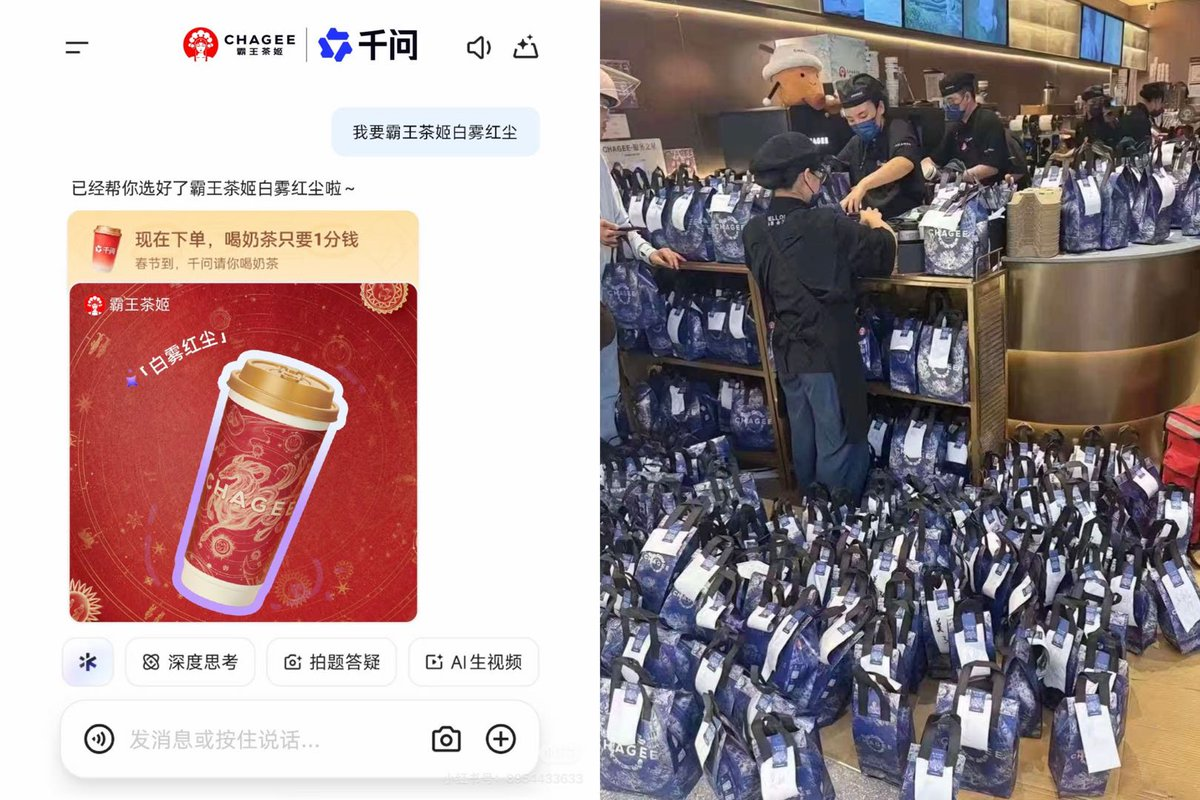
Image source from the internet.
How should AI Spring Festival marketing be done?
The Spring Festival is indeed a battleground for AI marketing—covering the widest user base, highest usage frequency, and most suitable for concentrated investment.
Grabbing red envelopes aligns with national sentiment, but using AI tools for this can easily be criticized. The key lies in whether AI addresses real pain points.
Based on the cases of big companies and industry trends, the correct approach for AI Spring Festival marketing should be:
1. From "Giving Red Envelopes" to "Getting Things Done"
Negative example: Yuanbao's red envelopes are completely disconnected from AI functions; users take the money and leave.
Positive example: Alibaba's Qianwen allows users to use AI to order takeout, book flights, and buy movie tickets, directly providing free orders. This not only lowers the threshold for trying but also lets users experience the value of "AI can get things done."
Suggestions for Spring Festival travel scenarios:
- Intelligent itinerary planning: Input departure location, destination, and budget, and AI automatically plans the optimal route home (combination of train/plane/rideshare).
- Ticket grabbing assistant: Real-time monitoring of available tickets, intelligently recommending transfer options, providing more feasible cost-effective solutions rather than just simple acceleration packages.
- Luggage checklist generation: Automatically generate a packing list based on destination weather, trip duration, and personal habits.
- Local customs crash course: For users returning home with partners/children, provide a crash course in local dialects and a one-click organization of gifts favored by locals, making New Year visits easier.
2. From "Throwing Money to Acquire Users" to "Saving Money to Retain Users"
Big companies throwing money to buy users has become a norm, but users are getting smarter—if you give 1 billion, they take it and leave.
High cost-effective strategies:
- AI generates personalized New Year greeting content: Based on the closeness of relationships and preferences, generate heartfelt New Year messages + AI greeting cards, solving the "awkwardness of mass sending."
- Intelligent organization of family albums: Upload photos from the entire year during the Spring Festival, and AI automatically categorizes and generates an annual memory video, addressing the "phone storage explosion" issue.
- Relative Q&A rehearsal: Input potential questions relatives might ask (salary, partner, having children), and AI generates appropriate response scripts, addressing "Spring Festival social anxiety."
3. From "Social Fission" to "Word-of-Mouth Fission"
WeChat's ban on Yuanbao essentially protects the social experience. AI marketing should not disrupt relationship chains but should enhance them.
Innovative plays:
- AI family group manager bot: Automatically organizes important information in family groups (meeting times, location changes), timely grabbing red envelopes to avoid missing out.
- Intergenerational games: Design AI interactive games suitable for grandparents, parents, and children to play together (e.g., AI guessing lantern riddles, AI writing couplets), allowing AI to bridge generational gaps.
- New forms of AI red envelopes: Instead of giving money, send "AI-generated exclusive blessing videos" or "AI-customized family tree diagrams," making sharing more prestigious.
4. From "Spring Festival Blitz" to "Long-Termism"
All Spring Festival marketing faces the same dilemma: after the heat fades, how to retain users?
Retention mechanism suggestions:
- Continuation of Spring Festival tasks: AI tasks completed during the Spring Festival (like generating New Year videos) automatically remind users to "use AI to create holiday content" during Lantern Festival, Qingming Festival, etc.
- Habit formation challenges: "7-day AI life challenge"—use AI to solve one practical problem each day (check the weather, make plans, write emails), and earn points upon completion (points can be withdrawn from WeChat/Alipay wallets without fees).
- Personalized memory: AI remembers users' needs during the Spring Festival (like "I need to return to my hometown in Henan every Spring Festival") and proactively provides related services the following year, planning trips in advance.
Making AI truly useful in "Spring Festival matters" is the best marketing.
A single flower does not make spring; a hundred flowers in bloom fill the spring.
I hope domestic tech giants can actively engage in marketing while striving to optimize their models. After all, a good product is the key, and I look forward to the next shining star of domestic AI.
免责声明:本文章仅代表作者个人观点,不代表本平台的立场和观点。本文章仅供信息分享,不构成对任何人的任何投资建议。用户与作者之间的任何争议,与本平台无关。如网页中刊载的文章或图片涉及侵权,请提供相关的权利证明和身份证明发送邮件到support@aicoin.com,本平台相关工作人员将会进行核查。


