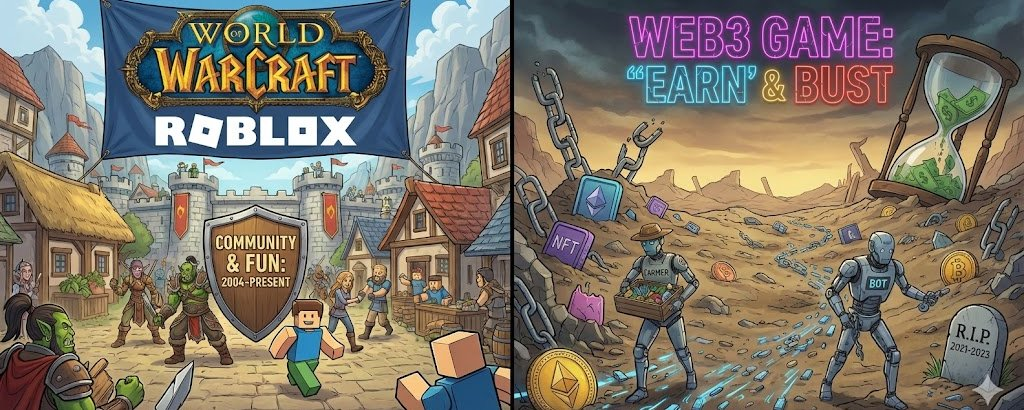
Author: Lao Bai, Advisor at Amber Group & former partner at ABCDE
Some time ago, I tweeted about my son crazily recharging Robux in Roblox to steal other people's items, lamenting that this game is way more impressive than Genshin Impact's gacha and Pop Mart's blind boxes, truly a god of spending. This resonated with many people, and that tweet became one of the most viewed recently.
The next day, I suddenly thought - why is it that in such a money-sucking game like Roblox, there seems to be no "gold farming studios"? Or, even if there are, why do they have almost no impact on the game's lifecycle? Coincidentally, a couple of days ago, @j0hnwang also brought up his previous writing on Roblox, discussing this matter. I had saved it before and went back to read it again.
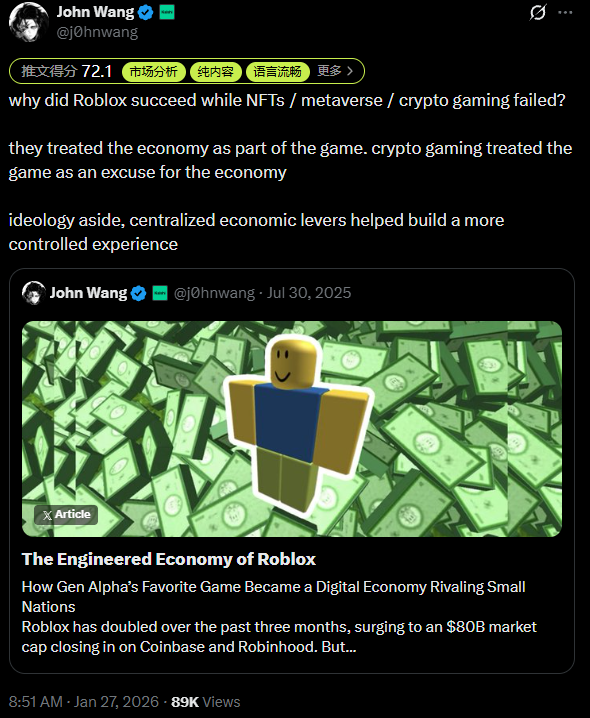
John's viewpoint is that Roblox treats its economic system as part of the game. In contrast, crypto games view the game as a facade for the economic system, believing that a centralized economic mechanism helps create a more controllable gaming experience.
This makes sense; the lack of fun in Web3 games has been criticized before, but this round of Web3 games has actually seen a significant improvement in playability, with the economic mechanisms being very centralized. Yet, the results have not changed, indicating that there must be other reasons.
Then I thought about World of Warcraft and Kaito. Some time ago, on the day X banned the Kaito API, I mentioned the following:
"Once behavior can be scaled, it will inevitably be industrialized."
From the "Chinese Farmer" in Web2's World of Warcraft back in the day to the later Web3 X2Earn scripts and gold farming studios, what we see now is the inevitable emergence of "AI mass account creation and multi-person matrix farming."
So, farming is not ruined by clever retail investors or KOLs, but by the attribute of 'replicability.' This is not just a problem for Kaito; it is essentially the fate of all incentive systems.
So what is the secret of World of Warcraft and Roblox? Why can't studios kill them? Why, after the first appearance of Chinese Farmers in the US servers, did the inflation of WoW gold lead to player complaints for a while, but then gradually accepted it, turning it into a fixed ecosystem within the game?
There must be something that Web3 games lack, and it is certainly not as simple as a centralized economic mechanism.
First, let's talk about World of Warcraft.
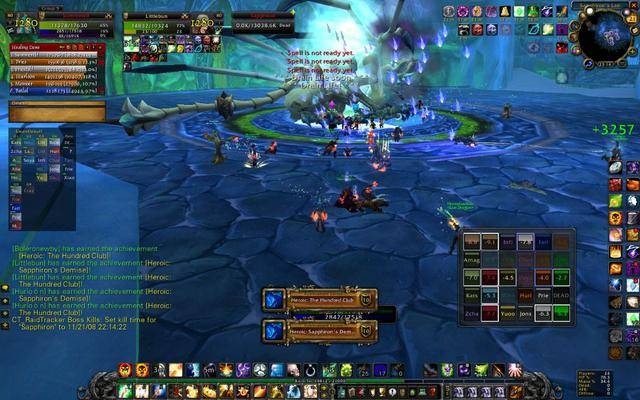
1. Gold is not the "ultimate value."
Anyone who has played WoW deeply should know that in the game, gold is basically not linked to your identity or status. Your achievements, rankings, and reputation cannot be directly bought with gold. When a top-tier item drops in a dungeon, you either roll for it or use DKP to bid based on contribution. The player who picks it up binds it directly, and it cannot be sold for money.
So, gold can only save you some time, but it cannot elevate you to a core player. Many domestic web games back then were completely the opposite, where RMB spending allowed big spenders to dominate everything, somewhat similar to the current style of Web3 games.
In essence, in World of Warcraft, everything "meaningful" - top-tier gear, achievements, titles, dungeon contributions, etc. - cannot be directly bought with gold. Therefore, while the act of farming can be industrialized, leading to the first batch of Chinese Farmers, it cannot dominate the core experience of the game. In other words, this "industrialization" is limited to the "marginal layer" of the game.
2. Official "absorption rather than confrontation."
After the emergence of gold farming studios, Blizzard took a series of actions that, in hindsight, were very clever.
- First, it was controllable by the official - allowing you to buy gold with real money, but the price is adjusted by the system, and there is no free financial exit, turning the underground black market into an official currency exchange.
- Second, they added various thresholds - such as daily and weekly quests, various cooldowns… No matter how many accounts you have or how high your level, you still have to wait patiently, diluting the advantages of industrialization.
- Third, they introduced more "meaningful things" that cannot be bought with gold, such as guilds, raids, and social reputation… This led to the emergence of gold groups and GKP, but various first kills in dungeons were always completed by top guilds first, and it was impossible for gold groups to achieve this, so farming in World of Warcraft is always a "second-class citizen."
As for Roblox, the logic is slightly different.
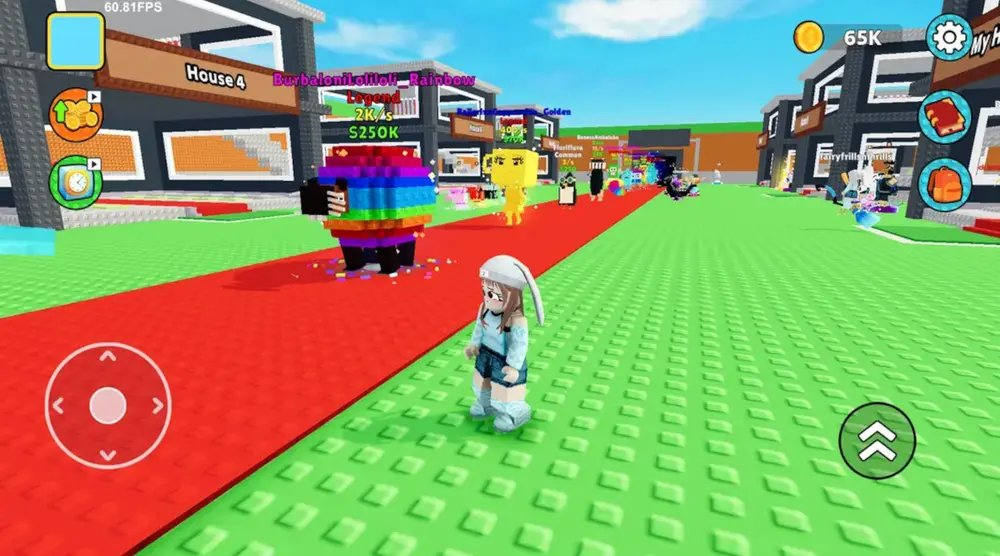
1. Encouraging creativity rather than repetitive labor.
If you look at the article I previously referenced about Roblox, you'll know that the most profitable activities in Roblox are not repetitive tasks like resource grinding, which yield little profit.
What truly makes money are activities like creating maps, designing gameplay, and managing communities.
These are hard to be scaled and replicated by studios; no matter how much you grind resources, you can't create a gameplay style that kids love (though with AI now, is it possible to "mass design"?).
2. The economic system is a closed loop, and asset exchange is not free.
This is somewhat similar to John's idea; buying Robux with a credit card is quick, but converting Robux back to cash is not as smooth. There are thresholds, delays, and proportional losses, making arbitrage and farming techniques ineffective here.
Moreover, most of the money in Roblox flows towards platform fees, various top creators, and in-game consumption, creating a closed-loop economic system with little overflow.
Of course, whether it's World of Warcraft or Roblox, being fun and having many players is the most important foundation for their success, without a doubt.
What is the real reason behind the collective demise of Web3 games?
Looking back, aside from the fun factor, perhaps the initial design intent of blockchain games has predetermined today's outcome.
Almost all blockchain games allow for "repeatable actions" + "freely exit-able assets."
In an era where the Web2 gaming system is already mature, this will inevitably lead to the final players of blockchain games becoming capital + scripts, rather than humans.
In other words, as long as Play is linked to Earn, this will be the result.
Whether you are Play 2 Earn, or the later improved Move 2 Earn, or Play & Earn, it is just a change of soup without changing the medicine; there is no essential difference.
This is somewhat like an impossible triangle for a game; between being fun, allowing speculators to make money, and enabling studios to scale, you can at most achieve two corners.
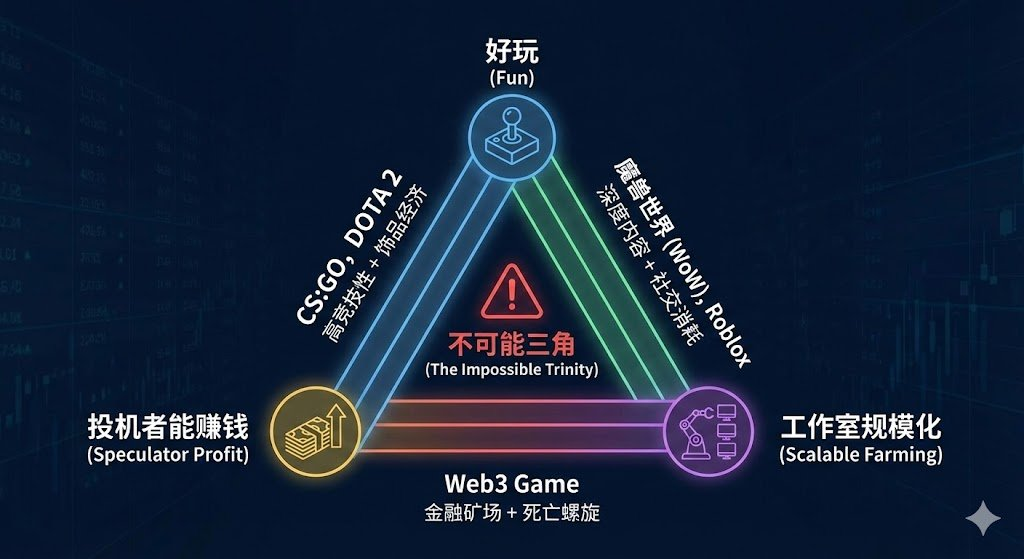
From this perspective, the issue with Web3 games is not the quality of the team or the scale of funding, but rather that from the very bottom genetic level, they cannot be "fun."
Is it feasible for World of Warcraft to go on-chain? Is it meaningful?
I remember when blockchain games were popular, we often enjoyed a scenario: what would happen if World of Warcraft went on-chain?
Not just the game going on-chain, but putting the entire economic system of World of Warcraft on-chain, including gold, items, mounts, etc., allowing these things to be freely traded, freely exited, and financialized.
Looking back now, it was quite naive; if this were done, WoW would inevitably be destroyed by the system.
The underlying axioms of World of Warcraft's success:
Meaning cannot be traded - the most valuable things, top-tier gear, achievements, titles… are almost all bound, non-tradable, and non-transferable. These represent what you have done, not what you own.
Progress does not equal wealth - your time investment, operational skills, and teamwork are your foundation for survival. Gold can only make you a bit more comfortable; it cannot allow you to leap across classes.
Players are not asset owners, but role players - this gear is what I earned/obtained through DKP, this boss is our guild's global first kill, this character is the result of my 10 years of effort… Once this becomes "I bought this, I invested in this," the character you are emotionally bound to will degrade into a skin of an asset account.
If we must talk about going on-chain, the things in World of Warcraft that are truly worth going on-chain are these - such as proof of a boss's first kill, the history of the guild, your achievement timestamps, records of world events… What should go on-chain are not assets and values, but memories and traces.
The greatness of World of Warcraft lies precisely in the fact that its most important things can never be sold.
From this perspective, "blockchain games must die."
It's not just blockchain games; we once treated blockchain as a hammer, seeing everything as a nail, wanting to knock on it. Little did we know that there are so many things in this world that do not need to be "financialized." Their meaning lies in being experienced, remembered, and told.
免责声明:本文章仅代表作者个人观点,不代表本平台的立场和观点。本文章仅供信息分享,不构成对任何人的任何投资建议。用户与作者之间的任何争议,与本平台无关。如网页中刊载的文章或图片涉及侵权,请提供相关的权利证明和身份证明发送邮件到support@aicoin.com,本平台相关工作人员将会进行核查。


