Author: Kanjian Finance
The arrival of a new cycle in non-ferrous metals has made the gold sector the biggest winner.
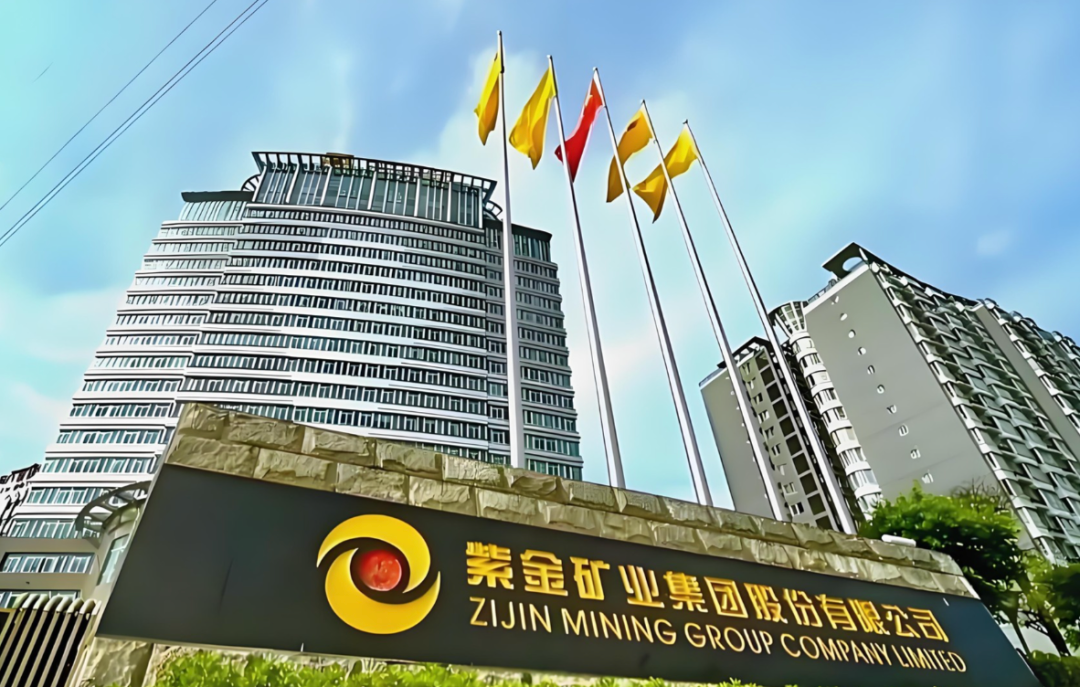
As the largest company by market capitalization in the A-share gold sector, Zijin Mining has also become one of the ultimate winners.
On January 6, Zijin Mining welcomed a "historic moment," with its stock price soaring over 6%, and its market capitalization briefly surpassing 1 trillion yuan. Throughout 2025, Zijin Mining's performance in the capital market has also been outstanding, with an annual stock price increase of 135.77% and a total market capitalization growth of 525.8 billion yuan.
Looking at the longer term, this marks the sixth consecutive year of rising stock prices for Zijin Mining. At the beginning of 2020, Zijin Mining's stock price was only 3.15 yuan per share, and now it has increased more than tenfold.
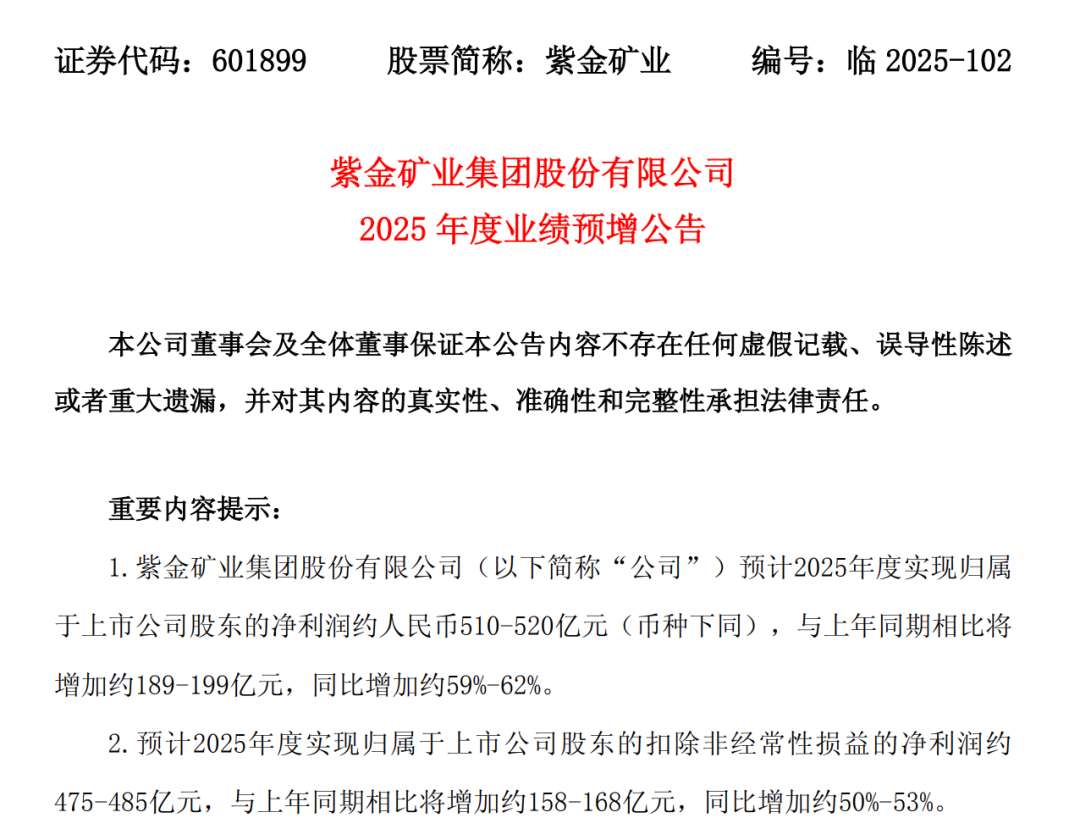
Behind the soaring stock price of Zijin Mining, the continuous rise in the prices of precious metals such as gold, silver, and copper is naturally an important driving force, especially gold. According to media reports, in 2025, precious metals entered a historically significant bull market, with London spot gold rising over 60% cumulatively, hitting historical highs 50 times throughout the year, marking the strongest performance in nearly forty years. Among Zijin Mining's main businesses, gold mining is the largest revenue source. Driven by the continuous rise in gold prices, Zijin Mining is expected to achieve a net profit of 51 billion to 52 billion yuan in 2025, averaging nearly 140 million yuan in net profit per day.
In addition to the rise in precious metal prices, the reason Zijin Mining's stock price has been able to rise for six consecutive years is more crucially its long-term layout around the two major resources of gold and copper.
According to Frost & Sullivan data, from 2019 to 2024, the average acquisition cost of the mines acquired by Zijin Mining was about 61.3 dollars per ounce, while the industry average acquisition cost during the same period was about 92.9 dollars per ounce, which is 52% higher than that of Zijin Mining. The low-cost advantage brought by precise global bottom-fishing has given Zijin Mining ample confidence to cope with cyclical fluctuations.
In the past two years, Zijin Mining has turned its attention to lithium resources. At the beginning of last year, Zijin Mining invested 13.7 billion yuan to acquire about 25% of the shares of Zangge Mining and gained control, incorporating multiple lithium salt lake resources in Tibet and Qinghai into its system. Through this move, the company's lithium resource reserves have significantly increased, currently controlling lithium resources equivalent to 17.88 million tons of lithium carbonate, ranking among the top ten globally.
Clearly, Zijin Mining's goal is not just to become a gold giant; breaking through the 1 trillion yuan market capitalization is by no means the "end point" for Zijin Mining.


Looking back, the current brilliance of Zijin Mining is inseparable from a mountain and a person.
The mountain is Zijin Mountain, which was once deemed "not worth mining" by experts; and the person is Chen Jinghe, who gave up a job in the provincial capital and actively volunteered to develop Zijin Mountain in the county.
Data shows that Chen Jinghe was one of the first university students after the resumption of the college entrance examination. After graduating from Fuzhou University with a geology major in 1982, he was assigned to the geological team in western Fujian. He led a team to explore Zijin Mountain for a full ten years, but the final exploration results were disappointing: the gold reserves of Zijin Mountain were only 5.43 tons, with only 1 gram of gold per ton of ore.
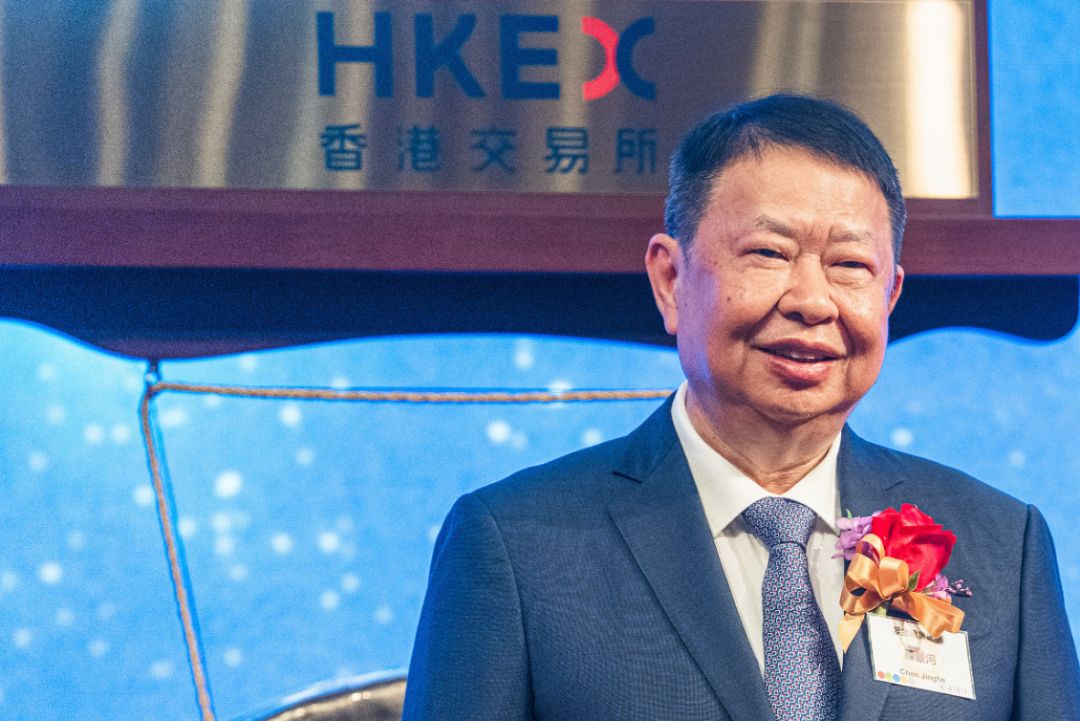
Due to the low gold content, the provincial department delegated the mining rights of this "poor mine" to Shanghang County. Unwilling to see the exploration results go to waste, Chen Jinghe gave up his position as a section chief in the provincial geological exploration department and became the general manager of the mineral company in Shanghang County, participating in the mining of Zijin Mountain, which is the predecessor of Zijin Mining. In a situation where no one was optimistic, Chen Jinghe boldly adopted the industry-disregarded heap leaching technology, significantly reducing the investment for an annual production of 50,000 tons of gold ore from 29 million yuan to 7 million yuan, and turned a large amount of waste ore into mineable gold ore.
Driven by technological innovation, Zijin Mountain transformed from a "waste mountain" into China's largest gold mine, with proven gold reserves exceeding 300 tons and a potential value exceeding 10 billion yuan.
In 2001, Shanghang Mining Company was officially renamed Zijin Mining. By this time, Zijin Mining had already taken shape, but Chen Jinghe was not satisfied and realized that if they remained fixed at Zijin Mountain, the mineral resources would eventually be depleted. With the national call for "Western Development" and "Revitalizing the Northeast Old Industrial Base," Zijin Mining began its journey of national development, in 2002 Zijin Mining took its first step towards national development by acquiring the Guizhou Mercury Cave Gold Mine at a low price.
Subsequently, Zijin Mining continued to seize opportunities, successively acquiring new Xinjiang Ashaer Copper-Zinc Mine, Jilin Hunchun Gold-Copper Mine, and Xiyulong Copper Mine. In 2003 and 2008, Zijin Mining was listed on the Hong Kong H-share and A-share markets, by 2013, Zijin Mining had become one of the companies in China with the most controlled metal mineral resources.
Although Zijin Mining was already quite successful at this time, for this trillion-yuan giant, it was just the beginning, and its real explosion began in 2015. At that time, the global mining industry was facing a winter, with Vale suffering a loss of 12.1 billion dollars and Glencore losing 4.964 billion dollars. During this industry downturn, Chen Jinghe chose to go against the tide, boldly implementing a "counter-cyclical acquisition" strategy, successively acquiring Australia's Phoenix Gold, Norton Gold Fields, Congo's Musonoi Mining, Barrick (Papua New Guinea), and several other projects.
In 2019, Zijin Mining targeted the Buriticá Gold Mine in Colombia, one of the highest-grade gold mines in the world, operated by Continental Gold. Ultimately, Zijin Mining acquired 100% of Continental Gold for 1.33 billion Canadian dollars at the end of 2019.
One acquisition after another has rapidly expanded Zijin Mining's scale.
By the end of 2022, the company held resource amounts (proven, controlled, and inferred) of 73.72 million tons of copper, 3,117 tons of gold, 11.18 million tons of zinc (lead), 14,612 tons of silver, and a lithium resource amount (equivalent lithium carbonate) of 12.15 million tons. It is precisely because of these years of acquisitions that Zijin Mining can reap the huge dividends of the precious metals bull market in 2025.


In addition to traditional gold and copper, Zijin Mining has also set its sights on lithium resources.
Lithium ore is known as the "white oil" for humanity's future. In the past two years, the explosive growth of new energy vehicles and energy storage has led to a surge in demand for upstream metal resources such as lithium, nickel, and cobalt.
As a giant in non-ferrous metals, Zijin Mining naturally sees the huge opportunities behind lithium resources. In 2021, Chen Jinghe proposed the goal of "striving to become an important player in the global lithium industry." However, Chen Jinghe and Zijin Mining did not rush to enter the market but instead continued the previous counter-cyclical layout strategy, acquiring a large amount of lithium mines during the industry downturn.
Zijin Mining's first lithium mine layout was in 2021. In October of that year, Zijin Mining acquired Canadian Neo Lithium for approximately 4.939 billion yuan, whose core asset is the 3Q salt lake project in Argentina, which has the advantages of high grade and low impurities. This acquisition also marked Zijin Mining's official entry into the new energy mineral field, taking the first step in the global lithium resource layout.
2022 was a key year for Zijin's domestic lithium resource expansion. In April of that year, Zijin Mining spent 7.682 billion yuan to acquire 70% of the equity of the Lagocuo salt lake lithium mine in Tibet; two months later, Zijin Mining acquired 71.14% of Hunan Houdao Mining for 1.8 billion yuan, successfully securing 100% of the mining rights of the Xiangyuan lithium polymetallic mine. By this point, Zijin Mining had formed a core structure of "two lakes and one mine" centered on the 3Q salt lake in Argentina, the Lagocuo salt lake in Tibet, and the Xiangyuan lithium mine in Hunan, with the three assets having equivalent lithium carbonate amounts of 7.63 million tons, 2.14 million tons, and 2.16 million tons, respectively, totaling over 10 million tons.
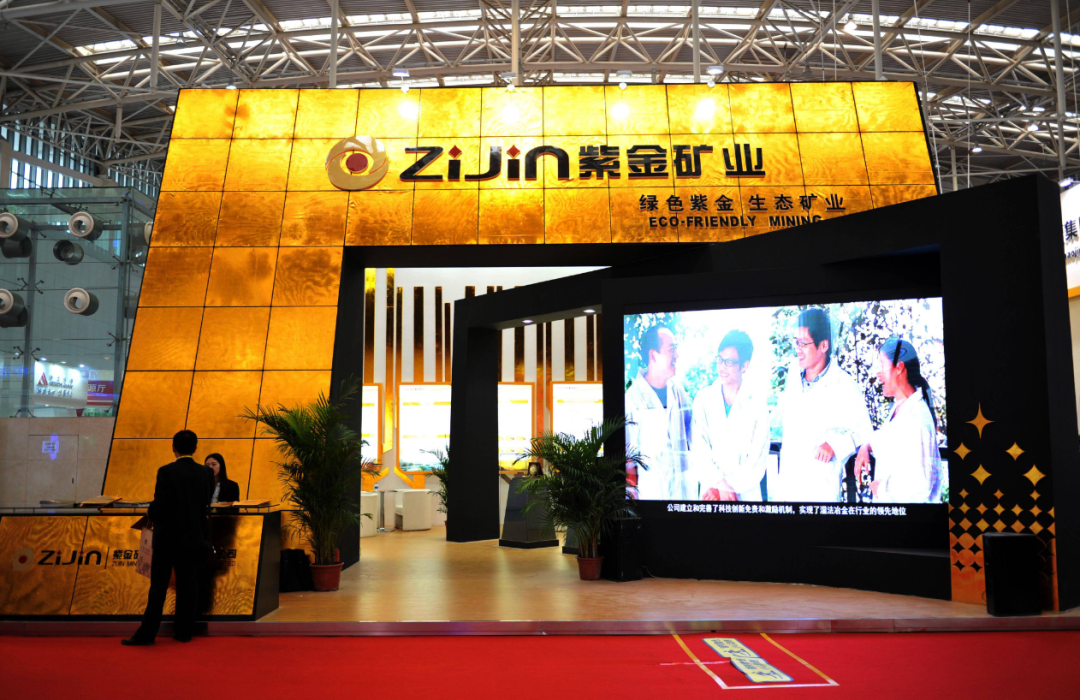
In 2023, due to oversupply, the price of lithium carbonate plummeted, and mining investment risks increased. Although Zijin Mining slowed down its acquisition pace, it continued to increase investment in high-quality lithium mines. In July of that year, Zijin Mining obtained a 20% stake in Shenghe Lithium through capital increase, acquiring minority rights in the core lithium mine Yajiang Cuola in western Sichuan. In October, Zijin Mining received approval from the Ministry of Mines of the Democratic Republic of the Congo for exploration rights to the northern section of the Manono lithium mine, which ranks fourth globally in terms of clay and hard rock lithium mines with an equivalent of 16.4 million tons of lithium carbonate.
After a series of operations, Zijin Mining now controls over 12.15 million tons of lithium carbonate equivalent, ranking ninth globally and third in the industry domestically, only behind Tianqi Lithium and Ganfeng Lithium.
However, the story does not end here.
At the beginning of 2025, Zijin Mining made its largest single investment in history, acquiring approximately 24.82% of Zangge Mining for 13.729 billion yuan, gaining control. It should be noted that this investment is not just a simple financial investment; Zijin Mining not only achieved absolute control over the cooperative Xizang Julong Copper Mine but also obtained potassium fertilizer resources and lithium extraction capacity from the Chaqi salt lake under Zangge, as well as rights in several salt lakes such as Mami Cuo and Longmu Cuo in Tibet, elevating its lithium resource reserves to a new height.
In summary, the explosive growth of gold and copper in 2025 has driven Zijin Mining's total market capitalization to surpass 1 trillion yuan. Although there has been a slight pullback currently, Zijin Mining's upward cycle has not ended. It is worth noting that the second growth curve of lithium resources also makes Zijin Mining's future full of potential, so for Zijin Mining, 1 trillion is not the end; the future remains bright.
免责声明:本文章仅代表作者个人观点,不代表本平台的立场和观点。本文章仅供信息分享,不构成对任何人的任何投资建议。用户与作者之间的任何争议,与本平台无关。如网页中刊载的文章或图片涉及侵权,请提供相关的权利证明和身份证明发送邮件到support@aicoin.com,本平台相关工作人员将会进行核查。


