Author: RootData Research
I. Overview of the Development of Cryptocurrency Exchanges in January
1. Overall Trading Volume Declined, Down 51.2% Year-on-Year
In January 2026, the overall trading volume of global cryptocurrency exchanges showed a significant decline, with market activity dropping for consecutive months. The total trading volume was $1.2 trillion, down 51.2% from the same period last year. The total market capitalization of cryptocurrencies fell to $2.57 trillion, a decrease of 20.7% year-on-year, demonstrating that market liquidity and risk appetite are both at low levels.
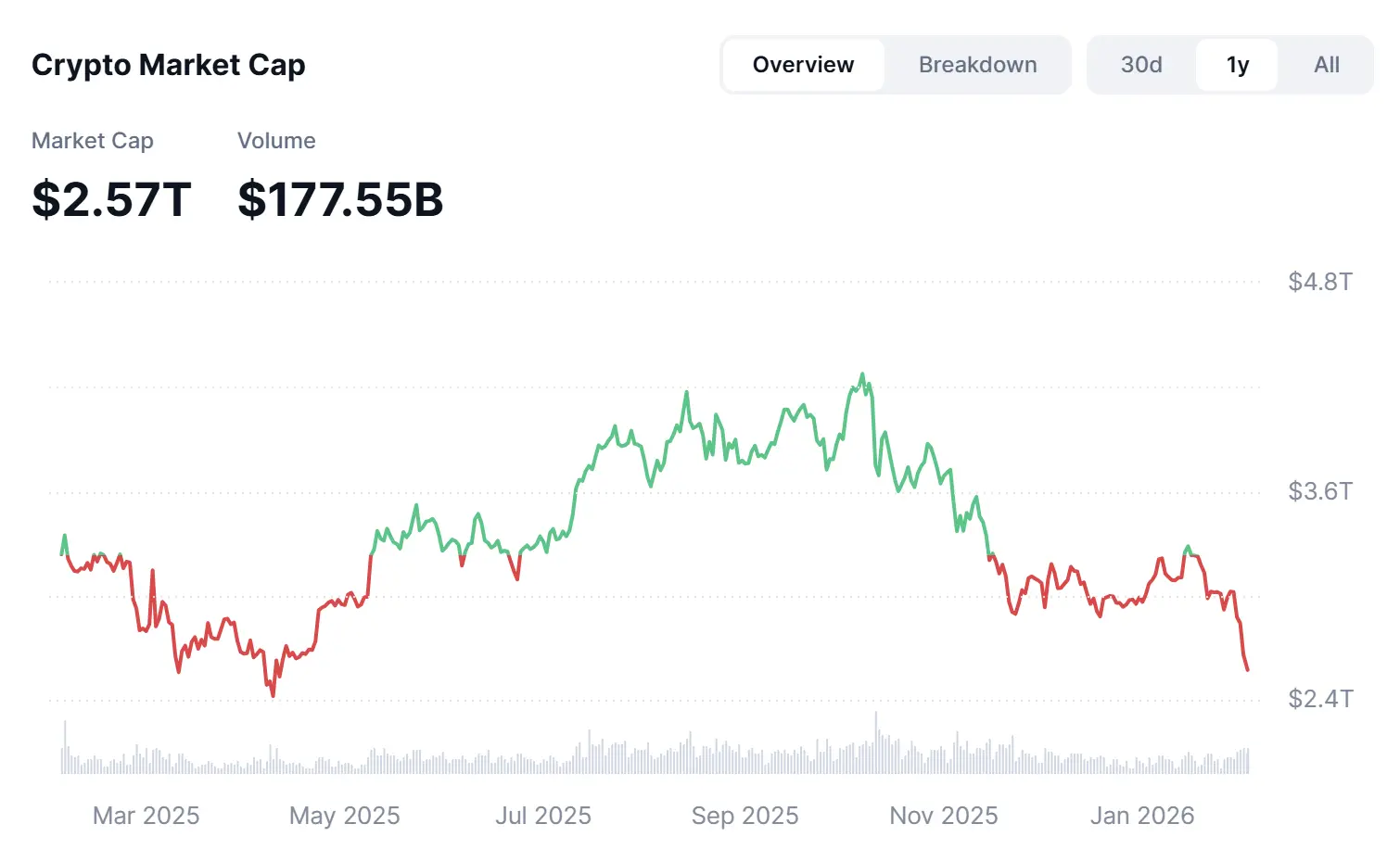
From a temporal perspective, the trend of the cryptocurrency market in January showed a structural characteristic of "stable at the beginning - weak in the middle - sharp decline at the end." In the early stage of the month, under the inertia influence of the rebound at the end of the previous year, the prices of Bitcoin and mainstream assets remained relatively stable, and market sentiment did not show obvious deterioration; some exchanges even experienced temporary recovery in short-term trading volume. However, this recovery did not establish a foundation based on continuous inflow of new funds, but rather showed more a rotation of existing funds within low volatility ranges.
As the month progressed, market fatigue gradually became apparent. On one hand, Bitcoin repeatedly faced resistance in key technical zones and failed to effectively break through critical price levels, resulting in an increase in cautious sentiment among investors; on the other hand, overall trading depth and order volume continued to weaken, and the scale of open contracts in the derivatives market declined simultaneously, indicating that high-frequency trading and leveraged funds were accelerating their exit.
By the end of the month, the cryptocurrency market exhibited a significant turning point, and market sentiment rapidly deteriorated. After consecutive declines, Bitcoin prices fell below the critical psychological level of $75,000, triggering a chain of stop-losses and forced liquidations, further amplifying the declines of mainstream altcoins, with the daily liquidation amount surpassing $2.55 billion, creating the third highest record in history.
Overall, the persistent sluggishness of the cryptocurrency market in January 2026 was not due to a single factor, but rather the result of multiple adverse conditions overlapping. Firstly, the uncertainty in the macroeconomic environment continues to suppress high-risk assets, with repeated disturbances in global interest rate policies, inflation expectations, and geopolitical risks leading funds to prefer a defensive posture, and the willingness to allocate to risk assets has consistently declined. Secondly, the sharp correction of Bitcoin in high price ranges weakened market consensus on "long-term one-sided appreciation," prompting institutions and high-net-worth investors to reassess their positions and reduce the frequency of active trading.
Moreover, the large amounts of leverage and short-term speculative funds accumulated during the previous bull market cycle have been continually washed out during this pullback phase, further compressing the trading foundation for exchanges. In the absence of a clear narrative and new funds driving the market, it has entered an adjustment phase characterized by deleveraging and frequency reduction in trades, which has also become the core background for the significant year-on-year decline in trading volume of global cryptocurrency exchanges in January.
2. Frequency of New Listings on Exchanges Greatly Reduced, Quality Projects Tend to Delay Token Issuance
According to statistics from RootData, there were only 26 new tokens launched on major cryptocurrency exchanges in January, setting a new low for the past year. Among them, 18 projects were first issued through Binance Alpha, reflecting that the liquidity of Binance Alpha is still recognized by project parties.
Kraken was the exchange with the most new tokens listed, reaching 22 in total, which included both new tokens such as SENT and SPACE, as well as existing tokens like HSK, BGB, HYPE, and ALEO, reflecting Kraken's relatively proactive and open strategy regarding token listings by introducing mature tokens and supplementing liquidity assets to maintain platform asset richness and user activity. Exchanges like Gate and Bybit also listed more than 10 new tokens.
Other mainstream exchanges mostly maintained new listing numbers between 6-10, and nearly all were new token assets. Due to constraints from overall shrinking fund sizes, insufficient secondary market support, and diminished market-making depth, newly issued tokens often find it challenging to receive sustained buying support at the initial listing phase, leading to "listing price collapse" and falling below initial market valuations. According to statistics, the vast majority of new tokens listed on all major exchanges showed a downward trend in January, with only a few tokens like SENT and ACU experiencing price increases during the month.
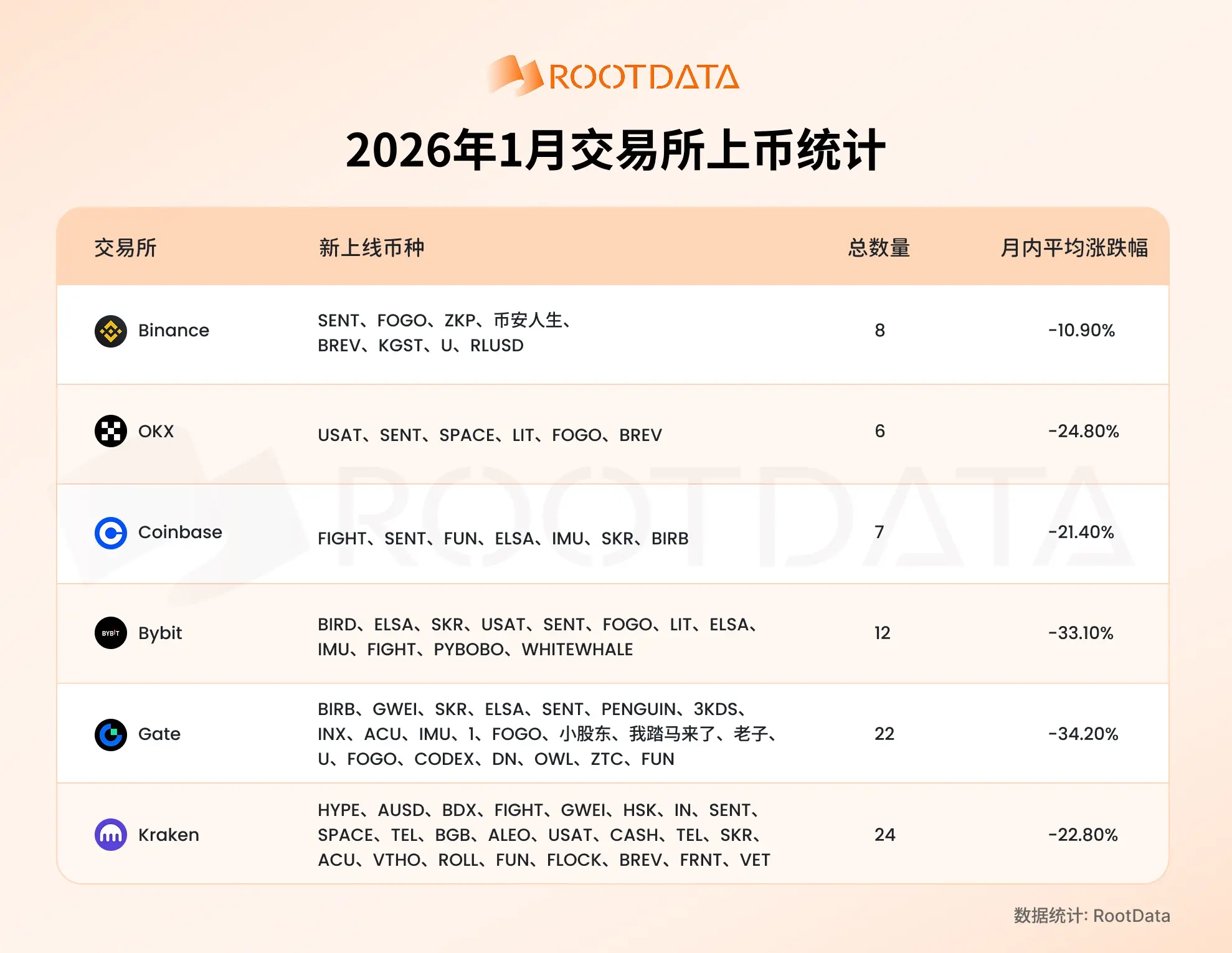
Currently, the range of choices for token listings is quite limited; most quality projects are reluctant to issue tokens under the current market conditions. The only project with an FDV exceeding $1 billion is Sentient, and most tokens have fallen below former private market valuations.
From a broader perspective, the decline in listing frequency is the result of the interplay between market cycles, liquidity environment, and project financing logic. As trading volumes continue to shrink and risk appetite declines, exchanges are placing more emphasis on risk control for new listings and liquidity pressures, while project parties tend to delay token issuance, waiting for more favorable market windows. This "dual contraction" is gradually reshaping the supply rhythm of crypto assets, causing exchanges to transition from previous high-frequency expansions to an obvious cooling period for new listings.
Moreover, among the newly listed tokens on these exchanges, over 70% of them received a transparency score above 80% from RootData, reaching A-grade range, indicating that projects with high transparency tend to pass the exchange listing audits more easily.
3. Gold Tokenization Trading Volume Hits New Highs, Exchanges Accelerate Layout
In January 2026, the total trading volume of gold tokenization, represented by PAXG and XAUT, reached $32.88 billion, an increase of about 140% from the previous month, becoming the fastest-growing crypto asset category by trading volume, in stark contrast to the overall decline of the crypto market. The main influencing factors include:
1) Soaring Spot Gold Prices: In January, gold prices broke through the psychological threshold of $5,000/ounce, once hitting a high of $5,312, with a monthly increase of 22%. This was driven by multiple macro factors, including global geopolitical tensions, sustained inflation expectations, uncertainty in the Federal Reserve's interest rate path, ongoing central bank purchases of gold, and a weak dollar, prompting investors to flock to traditional safe-haven assets.
2) Continuing Slump in the Crypto Market: During the same period, mainstream crypto assets like Bitcoin showed lackluster performance or even significant pullbacks, leading cryptocurrency investors to seek more stable value storage tools, with gold as one of the main hedges and stabilizers.
3) Maturity of the RWA Track and Liquidity Advantages: Gold tokenization offers 24/7 trading, fractional ownership, zero storage/custody fees, and DeFi integration (usable as collateral for lending/yield farming), making it more convenient and efficient compared to traditional gold ETFs or physical gold bars. This month, Tether issued an additional 192,000 XAUT, which currently has a market capitalization of about $900 million, accounting for 25% of the current cumulative issuance, significantly enhancing the liquidity and depth of the XAUT gold token and providing a more favorable investment market for institutional investors.
As a result, mainstream exchanges have also launched targeted measures regarding gold tokenization to capture this trend and enhance platform stickiness and market share:
1) Binance officially launched the “TradFi Perpetual Contracts” category, with the first products being gold (XAUUSDT) and silver (XAGUSDT).
2) UPBIT listed Tether Gold (XAUT) for the first time and supports trading in KRW, BTC, and USDT; on the same day, Bithumb listed the XAUT KRW trading pair.
3) Bybit introduced the XAUT spot yield plan, attracting potential new users with up to an 11% annual interest rate; balances exceeding 0.1 XAUT qualify for a basic annual interest rate of 1%.
4) HTX listed the tokenized gold PAXG, XAUT, and the tokenized silver XAG perpetual contracts
II. Cryptocurrency Exchange Rankings Driven by Transparency
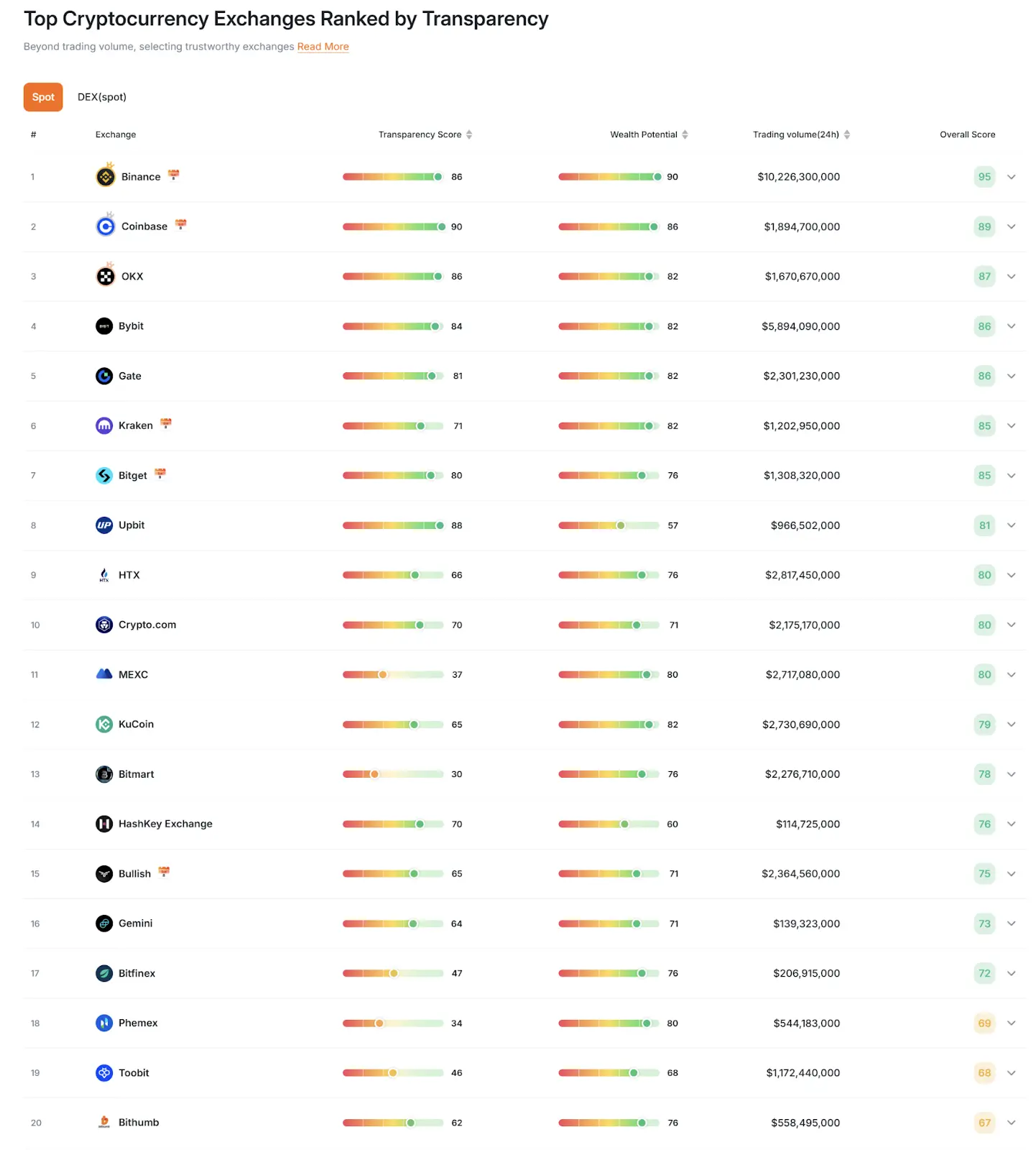
In the January cryptocurrency exchange ranking compiled by RootData, Binance, Coinbase, OKX, Bybit, Gate, Kraken, Bitget, Upbit, HTX, Crypto.com, MEXC, Kucoin, Bitmart, Hashkey Exchange, Bullish, Gemini, Bitfinex, Phemex, Toobit, Bithumb ranked in the top 20.
This ranking is based on rich data from RootData, integrating various indicators such as trading volume, reserve fund size, token performance, compliance, transparency, etc., while avoiding the influence of trading volume manipulation and other cheating behaviors on the rankings, providing an objective reflection of the competitiveness and ranking of exchanges in the crypto market.
Among them, Binance, Coinbase, and OKX occupy the top three spots due to their strong comprehensive capabilities. While Upbit, HashKey Exchange, and Gemini ranked in the top 20 based on their scores in compliance and transparency, even though their trading volumes are comparatively lower among leading exchanges. Bitmart, Phemex, and Toobit, while having large trading volumes, ranked lower due to their low transparency scores.
III. Major Exchange Cases and Analysis
Binance
In January, Binance's overall trading volume was $396.8 billion, an increase of 10.5% from the previous month, but down 52.1% from the same month last year, about four times the trading volume of the second-ranked exchange.
In terms of token listings, Binance launched 8 new assets in the spot market this month, including SENT, RLUSD, FOGO, U, ZKP, Binance Life, BREV, and KGST. In the contract market, it introduced 20 new assets including INX, BIRB, FIGHT, and GWEI, among which 5 assets belonged to Binance's newly launched TradFi perpetual contract category, including gold and Tesla stocks.
At the end of the month, Binance also faced significant public attacks, with the incident stemming from a statement made by Ark Invest founder Cathie Wood on a television program, stating that Bitcoin's recent return from its highs was influenced by the $28 billion deleveraging event caused by Binance's software failure last October. This statement rehashed Binance's "irresponsible" conduct during the 1011 incident, leading to criticism from many well-known industry figures. In response, Binance announced it would convert $1 billion stablecoin reserves from the SAFU fund into Bitcoin reserves within 30 days.
Bybit
In January, Bybit's overall trading volume was $75 billion, a decline of 16.2% from the previous month and down 68% from the same month last year, with this decline relatively large among leading exchanges, yet it still ranked fourth in RootData's exchange rankings.
This month, Bybit newly listed 10 spot assets including BIRD, ELSA, SKR, USAT, SENT, FOGO, LIT, ELSA, IMU, FIGHT, PYBOBO, and WHITEWHALE. In business moves, Bybit announced the launch of yield-generating collateral stablecoin BYUSDT for retail traders, representing a tokenized form of users' USDT earning balance, which can be used as margin in Bybit's unified trading account.
Bybit also released its 2026 vision at the end of the month, positioning itself as a "new financial platform," aiming to go beyond its initial positioning as a cryptocurrency exchange, and become a unified financial platform connecting cryptocurrency, traditional markets, and real-world financial services. Its specific plans include the launch of retail-grade banking service layer MyBank, listing TradFi products such as stock Contracts for Differences/Forex/commodities and indices, and deploying AI as core infrastructure at various operational stages.
OKX
In January, OKX's overall trading volume was $57.8 billion, an increase of 4.9% from the previous month but down 37.8% year-on-year. OKX ranked third in the RootData exchange rankings this month.
In terms of listings, OKX launched six tokens in the spot market this month including USAT, SENT, SPACE, LIT, FOGO, and BREV, a significant increase compared to the number in December (2 tokens), and in the contract market, seven tokens were listed including SPACE, ACU, FUN, FOGO, ZAMA, RIVER, and ZKP, while also delisting seven spot assets including ULT, GEAR, VRA, DAO, CXT, RDNT, and ELON.
In business terms, OKX officially announced the launch of the OKX Planet Community, benchmarked against Binance Square, aiming to create a cryptocurrency community that integrates information acquisition, trading opportunity sharing, active creators, and deep communities. This product has already entered internal testing, attracting quality KOLs and creators through a weekly cash prize pool.
At the end of the month, OKX founder Xu Mingxing delivered a rare lengthy speech via video at a company event, sharing his thoughts on company operations and the industry. He stated that in 2026 OKX would focus on three directions: compliant trading services, multi-asset on-chain infrastructure, and payment and wallet experiences. Xu further emphasized that X Layer is one of OKX's core infrastructures, and OKB, as an ecological token and gas token, has clear, long-term positioning.
Coinbase
In January, Coinbase's overall trading volume was $70.05 billion, an increase of 15.7% from the previous month, but down 56.5% year-on-year. Coinbase ranked second in the RootData exchange rankings this month.
In terms of listings, Coinbase launched seven assets in the spot market this month, including FIGHT, SENT, FUN, ELSA, IMU, SKR, and BIRB.
In addition to its existing business lines, Coinbase continues to expand into more business lines, by partnering with Kalshi, it extends its prediction market services to users in all 50 states of the U.S.; it has also announced plans to fully launch tokenized stock trading functions in the coming weeks to build an “all-in-one exchange.”
On a strategic level, Coinbase announced the establishment of an independent advisory committee on quantum computing and blockchain to assess the impact of quantum computing on the blockchain ecosystem. Coinbase also announced its collaboration with Bermuda and Circle to build a completely on-chain economic system, deploying digital asset infrastructure among governments, enterprises, and consumers.
Gate
In January, Gate's overall trading volume was $79.9 billion, an increase of 9.3% from the previous month and an increase of 26% year-on-year, also being the only leading exchange with a year-on-year increase. Gate ranked fifth in the RootData exchange rankings this month.
In terms of listings, Gate launched 22 cryptocurrencies in January, significantly more than Binance, OKX, Coinbase, and other exchanges, second only to few exchanges like Kraken. This reflects Gate's hope to stimulate users' trading willingness through more new tokens, but it also led to several tokens experiencing declines exceeding 90%.
In business terms, Gate TradFi opened up traditional financial asset Contracts for Difference (CFD) trading services covering gold, silver, forex, indices, commodities, and some popular stocks. At the beginning of the month, Gate also launched the AI market assistant GateAI, helping users make judgments and execute trades more effectively in the complex market environment, becoming one of the first exchanges to integrate AI chatbots.
Other Important Exchange Dynamics:
- Kraken launched DeFi Earn products in the U.S., Canada, and Europe, providing users with convenient on-chain yield opportunities.
- KuCoin appointed former London Stock Exchange Group (LSEG) executive Sabina Liu to lead its European operations.
- KuCoin Web3 launched a decentralized Web3 wallet with native support for perpetual trading within the wallet.
- Bybit announced its latest positioning as a "new financial platform," creating a unified financial platform that connects cryptocurrency, traditional markets, and real-world financial services.
- Bitget appointed Oliver Stauber as CEO of its European operations and established a regional headquarters in Austria.
- Bitpanda announced plans to launch a unified investment platform integrating stocks, ETFs, and cryptocurrencies, with an IPO planned in Frankfurt in the first half of 2026, targeting a valuation of €4 to €5 billion.
免责声明:本文章仅代表作者个人观点,不代表本平台的立场和观点。本文章仅供信息分享,不构成对任何人的任何投资建议。用户与作者之间的任何争议,与本平台无关。如网页中刊载的文章或图片涉及侵权,请提供相关的权利证明和身份证明发送邮件到support@aicoin.com,本平台相关工作人员将会进行核查。


