Author: Amelia I Biteye Content Team
In the past century, almost all economic growth models have assumed one premise: the next generation will have more than this generation.
More population means more abundant labor, a larger consumer market, and more predictable long-term returns.
But this premise is failing globally.
China, Japan, South Korea, Europe, and even the United States - declining birth rates are transitioning from "statistical data" to a structural reality.
And when "people" are no longer the most abundant, cheapest, and replicable production factor, the entire narrative of technology and institutions will be forced to rewrite.
The emergence of Web3 and AI is not a coincidental technological wave, but an inevitable response to the era of population deflation.
I. Population Gap: An Underestimated Systemic Risk
When discussing population decline, many discussions only focus on "labor shortages."
But if you only understand it as a "labor issue," you will severely underestimate its destructive power.
What population deflation truly erodes is a deeper three-layer structure.
Labor: From a cyclical issue to an irreversible structural scarcity
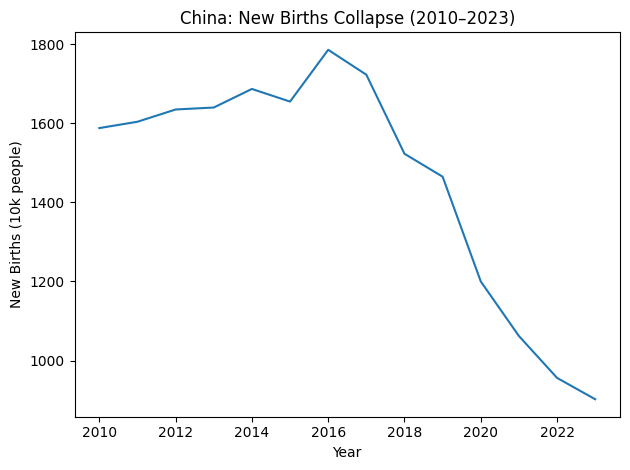 China's birth rate gap (2010–2023)
Visually, what you see is not a "decline," but a clear cliff-like drop.
Taking China as an example:
In 2016, the number of newborns was about 17.86 million
In 2023, the number of newborns is about 9 million
By 2025, it will drop below 8 million
In just seven years, it has been directly halved.
What does this mean?
The people born in 2023, when they enter the labor market around 2045, will not be "a little less," but "half as many."
This is not a cyclical fluctuation, but a collapse of population structure.
More critically, this trend has been confirmed by long-term forecasts: according to the United Nations' "World Population Prospects 2022" report, China's working-age population (ages 15–64) will decrease by about 170 million from 2020 to 2050.
In the past, the business system assumed one premise: "People can always be hired; it's just a matter of price."
But in the era of population deflation, the problem has changed.
Delaying retirement, introducing immigrants, and providing childbirth subsidies are all slow variables.
And the business system cannot wait twenty years.
This is precisely where all technological narratives begin to deform.
Attention and Creator Supply Shrinking in Sync: The Hidden Pitfall of Web2
The decrease in the young population brings not only a decline in labor but also a more hidden and deadly problem: who will produce content, and who will consume content?
The number of content producers is decreasing
The speed of spreading new culture and new narratives is slowing down
The logic of platform traffic growth is failing
The model that Web2 relies on, "user growth → traffic → advertising → commission," is fundamentally built on population expansion.
When new users no longer appear, platforms begin to become inward-looking, rules start to change frequently, and trust between creators and platforms collapses.
And this is the most difficult structural flaw for Web2 to repair in the era of population deflation.
Systemic Collapse of Long-term Demand: Long-termism is Being Forced to Reassess
Real estate, education, long-term consumer goods, pension systems…
The common point of these systems is: they all imply one assumption: there will be more people in the future.
When this assumption is broken, all "long-term assets" will be repriced.
II. Why is AI a Necessity in the Era of Population Deflation?
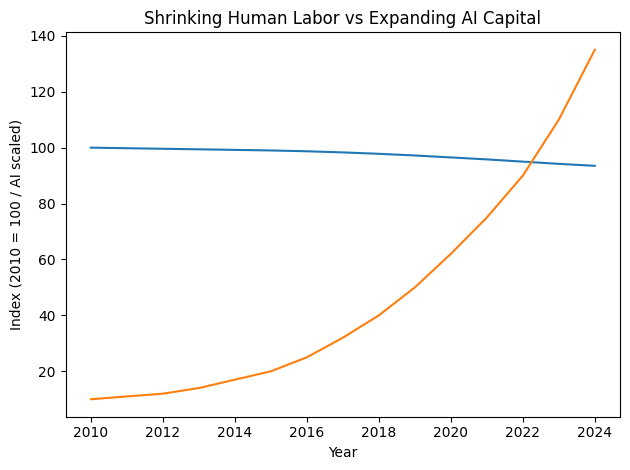
Human labor contraction vs. AI capital index expansion
On one side is a slow but certain decline, and on the other side is exponential growth. The only "labor" that can still expand is not human.
If population deflation changes the problem itself, then AI is becoming the only viable answer.
AI is not an efficiency tool, but a "dehumanizing tool"
We are used to describing AI as an "efficiency tool."
But in the real world, it is not solving efficiency problems but a structural problem: the system no longer needs that many people.
AI customer service, AI content generation, AI research assistants, AI trading systems - their significance is not to make people 20% faster, but to remove "people" from being a necessary condition of the system.
In a world of population deflation, the real question is no longer: "Can this position find someone?" but rather: "Does this process still need human participation?"
AI is not replacing inefficient people; it is rewriting the entire society's dependency assumption on "human labor."
AI is the only labor force that can grow exponentially
Population: linear growth, or even negative growth
AI: computing power, models, data → exponential expansion
This is also why, in a context of strong macro uncertainty, capital still chooses to heavily invest in AI.
Because in the era of population deflation, only AI has the "scalable expansion capability."
AI allows "individuals" to become production units again
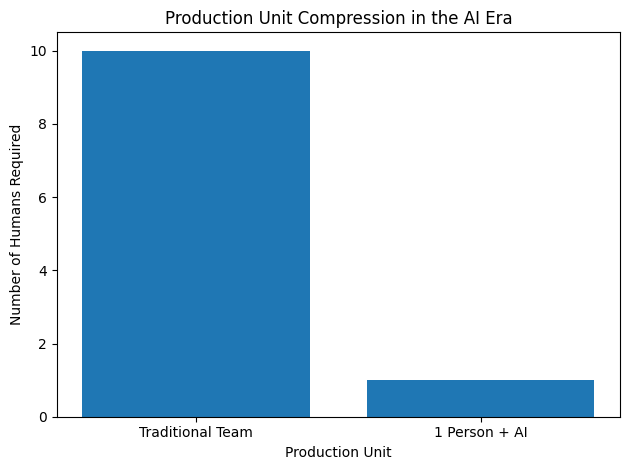
Compression of production units (team → individual + AI)
From "10-person teams" to "1 person + AI," production units are being rapidly compressed.
AI is giving rise to a new organizational form:
One-person companies
Super individuals
Solo founders
AI native creators
When society cannot mass-produce young people, the system can only choose to amplify individuals.
III. What Role Does Web3 Play Here?
If AI solves the question of "who will work," then Web3 addresses a more fundamental issue:
In an era of fewer people, how do we collaborate, distribute, and build trust?
How to Collaborate at Low Cost in an Era of Fewer People?
DAOs, permissionless collaboration, project-based contributions—
Web3 reconstructs "organization" from long-term employment relationships to temporary, flexibly combinable collaborative networks.
As hiring becomes increasingly expensive, trust and settlement must be automated.
How to Distribute Value in an Era of Fewer People?
In an age where labor is becoming scarce, if value distribution is not transparent, the system will quickly lose participants.
Tokens, on-chain incentives, and instant settlements do not solve "speculation," but a real problem:
How to ensure that scarce labor is willing to stay and continue to build?
How to Establish Long-term Trust in an Era of Fewer People?
The younger generation's trust in long-term commitments is collapsing:
Distrust in pensions
Distrust that platforms will not change rules
Distrust in the long-term incentives of centralized institutions
Smart contracts and on-chain rules essentially answer:
When there are not enough people and not enough trust, can the rules execute themselves?
IV. Web3 + AI: A Complete Solution for the Era of Population Deflation
An increasingly clear judgment is forming: Web3 is not a competitor to AI, but the institutional shell of the AI era.
What do AI agents need?
Identity
Wallet
Autonomous trading capability
Programmable rules
These happen to be the native capabilities of Web3.
In the not-so-distant future, we may see:
AI native companies
AI autonomous DAOs
AI-to-AI economic collaboration
In this system, humans may no longer be the largest group of economic participants.
V. In Conclusion: What Does This Mean for Individuals?
For individuals, it is a cruel but real fact: you will no longer be lifted by the dividends of "population growth."
But it also means new opportunities:
AI amplifies individual productivity
Web3 allows individuals to directly participate in the global system
A world with fewer people is actually more friendly to high-cognition, high-action individuals
If you are an investor/creator, here are action suggestions from Biteye:
For investors:
Population deflation is a certainty variable on a 20–30 year scale, not macro noise
All business models relying on "population expansion" should be discounted in valuation
There are only three categories worth long-term attention:
AI that can directly replace human labor
Tools that can amplify individual productivity
Web3 infrastructure that can operate in low-trust environments
For creators/individuals:
Do not assume "platforms will provide you with long-term returns"
Try to transform yourself into:
Nodes that can be amplified by AI
Personal brands that can migrate across platforms
Independent production units that can settle directly
After all, in the era of population deflation: the system will not take care of you, but the system needs you.
This is not an era of increasing numbers of people,
But an era where each individual must become stronger; and what you must rely on is AI and Web3.
免责声明:本文章仅代表作者个人观点,不代表本平台的立场和观点。本文章仅供信息分享,不构成对任何人的任何投资建议。用户与作者之间的任何争议,与本平台无关。如网页中刊载的文章或图片涉及侵权,请提供相关的权利证明和身份证明发送邮件到support@aicoin.com,本平台相关工作人员将会进行核查。


