Author: Di Yafan
In 2022, a Stanford graduate's net worth once exceeded $2 billion.
The OpenSea he created is the world's largest NFT trading market, valued at $13.3 billion.
Just months before the NFT bubble burst, he made a more critical decision to leave.
Two years later, his new company grew tenfold in 7 months, securing investments from a16z, Sequoia, and Menlo, with a valuation of $500 million.
His name is Alex Atallah. His new company is called OpenRouter.
This is a story about timing and methodology replication.
Who is OpenRouter? What does it do?
If you are an AI application developer, you must know the name OpenRouter; its main function is to help developers solve the pain of model switching:
Want to use Claude to write code but find it often lacks capacity
Want to use GPT for analysis, but the price makes you wince
Want to try open-source models but find you have to rewrite a set of API integrations
Each model vendor's API is different. Every time you switch models, you have to change the code.
What OpenRouter does is somewhat like Trip.com, putting all airlines into one app.
One API, access to 300+ models. 60+ providers. Switching models? Change one line of code.

OpenRouter as a multi-model aggregation layer
Two startups, the same methodology
Before starting his ventures, Alex Atallah already had a solid software background: Stanford Computer Science major, Palantir engineer, co-founder and CTO of OpenSea…
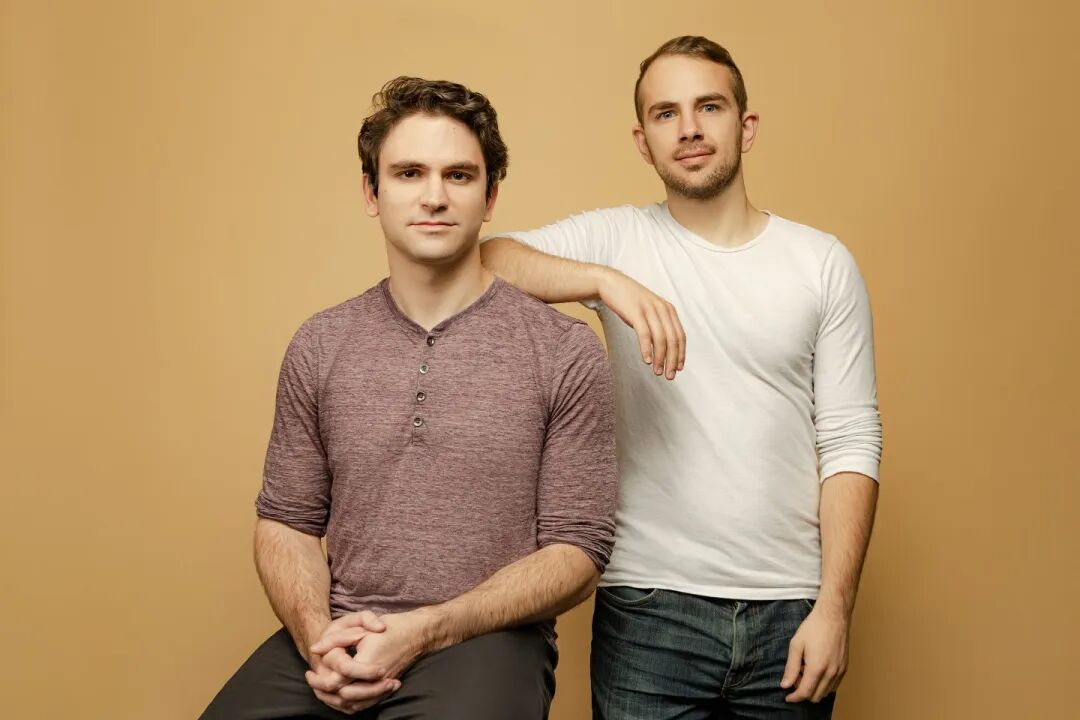
OpenSea founders Alex Atallah (left) and Devin Finzer (right)
He explained the commonalities of his two startups in a podcast:
"OpenSea organized this very heterogeneous inventory and put it together in one place… You see a lot of those similarities with how AI works today."
What is his methodology?
Find a "fragmented ecosystem" and then create an "aggregation layer."
NFT era: metadata standards varied → OpenSea aggregation
AI era: API standards varied → OpenRouter aggregation
Alex said something in a podcast that impressed me: If it only costs $600 to train a large AI model, there could be tens of thousands or even hundreds of thousands of models in the future. At that point, they will need their own 'market.'
At the beginning of 2023, this was an extremely counter-consensus judgment. The mainstream narrative at the time was that OpenAI was far ahead, and other models were just following.
But Alex was right.
Today, there are thousands of open-source models. Claude, Gemini, Llama, Mistral, DeepSeek… new players enter the market every few weeks.
In a world of explosive model growth, a "aggregation layer" is needed. This is exactly where OpenRouter fits in.
An underestimated huge market
The success of OpenRouter comes from the visible trend in the AI market today, where "inference" will replace "training" as the main focus.
The difference between inference and training, and the future trend of this market, was clearly explained yesterday in Groq's interpretation, feel free to check it out.
COO Chris Clark's perspective can be referenced:
"We believe that inference costs will eclipse salaries as the dominant operating expense for most knowledge-based companies over the next five to 10 years."
This can actually be seen from OpenRouter's own data.
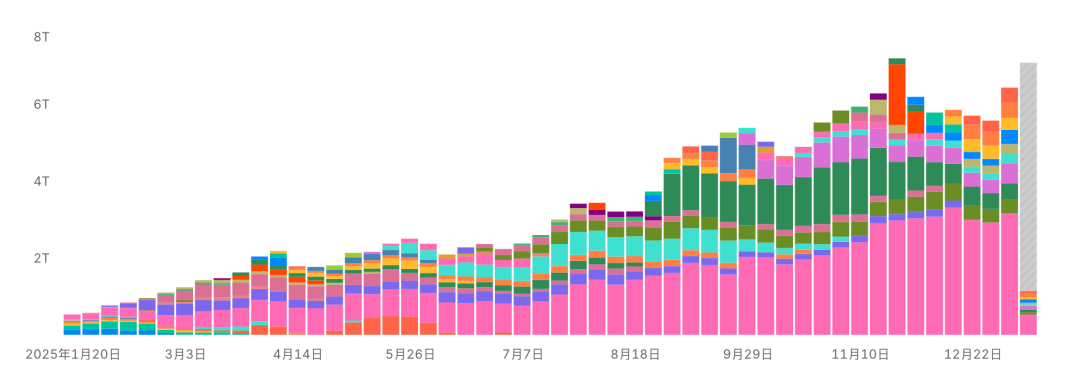
OpenRouter's token consumption approaches 80 trillion
Industry-renowned AI model "Dazhong Dianping"
As one of the earliest participants in this field, OpenRouter has a unique advantage: leaderboard.
After processing over 100 trillion tokens, they know:
Which model is the strongest at writing code
Which model offers the best value
Which model suddenly excels at specific tasks
This leaderboard has become an important reference in the industry, with high recognition in the developer community.
What’s even more outrageous? In April 2025, a mysterious model called "Quasar Alpha" went live on OpenRouter.
Days later, everyone learned: This is GPT-4.1, and OpenAI chose to exclusively launch it on OpenRouter.
Because OpenRouter has a killer asset: the largest multi-model usage dataset on the internet.
Every day, millions of developers call different models here. OpenRouter knows:
Which model performs best on what tasks
Which provider is the most stable
Which time period is the cheapest
This data has created the industry's most authoritative LLM leaderboard. According to Menlo Ventures, even Andrej Karpathy (former Tesla AI director, co-founder of OpenAI) has publicly recommended it.
Once the data flywheel starts turning, it’s hard for newcomers to catch up.
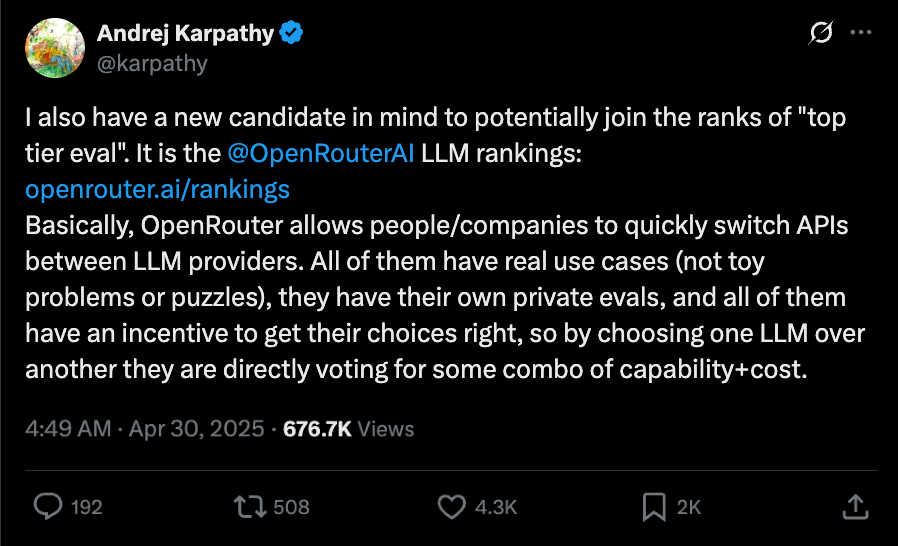
Andrej Karpathy mentions OpenRouter LLM rankings on X
How does OpenRouter make money?
OpenRouter's business model is relatively simple: If you spend $100 on a model, they take $5.
They charge according to the pricing set by the model vendors. They earn a "toll fee," not a "markup."
This model aligns well with the intermediary business model in Europe and the U.S.:
Maintain a neutral position: If OpenRouter had its own models, would you trust its leaderboard?
Naturally grow with the market: The larger the AI market, the more they earn
Network effects: More users → more accurate data → more valuable leaderboard → more users
Alex's original words: "We want developers to not feel vendor lock-in. We want them to feel like they have choice and they can use the best intelligence, even if they didn't before."
Financial data (as disclosed)
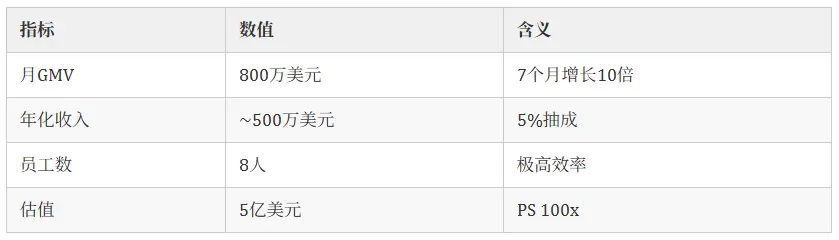
8 people, annualized nearly $100 million GMV.
This productivity ratio is among the leading levels in similar startups.
Big market, small space
Having discussed the highlights, it’s necessary to address some issues with this model:
OpenRouter's core advantages are "data" and "community," and the flywheel has begun to turn (more users → more accurate data → more valuable leaderboard), but this model also means it is closely tied to the prosperity and decline of the developer ecosystem.
This business cannot thrive without an increasing number of small and medium developers, as they do not have the time to do this kind of aggregation development and lack the scale to negotiate prices with AI vendors, so they need an intermediary to accomplish this.
For large companies, this may have some value during testing, but when it comes to real-scale deployment, they will likely bypass it.
In fact, it’s not just large companies; even medium-sized projects with higher usage will want to avoid it. For example, there is currently an open-source alternative called LiteLLM, which is free and can be self-deployed.
Cost-sensitive developers will ask: “Why should I give you 5%?”
If competition intensifies, this commission rate may drop from 5% to 3%, or even 2%.
At that time, whether it can maintain the recently disclosed 100 times valuation is uncertain.
Of course, it is still in the early stages and will continue to grow rapidly; its upper limit is just a question to consider in analysis.
Understanding OpenRouter in one minute
Q1: What is OpenRouter?
OpenRouter is an LLM (large language model) API aggregation platform. Through a single API interface, developers can access over 300 models (including GPT-4, Claude, Llama, etc.) without having to integrate each model vendor's API separately.
Q2: What is the difference between OpenRouter and LiteLLM?
Both provide LLM API aggregation, but the models are different. OpenRouter is a hosted SaaS that charges a 5% commission; LiteLLM is an open-source project that can be self-deployed at no cost. OpenRouter's unique advantage is its public model leaderboard and broader provider coverage.
Q3: Who is the founder of OpenRouter?
Alex Atallah, a Stanford University Computer Science major, co-founder and former CTO of OpenSea (the world's largest NFT market). He left OpenSea in 2022 and founded OpenRouter in 2023. His net worth once exceeded $2 billion.
Q4: How much has OpenRouter raised?
In June 2025, OpenRouter completed a total of $40 million in funding (seed round + Series A), led by a16z and Menlo Ventures, with Sequoia participating, and a valuation of approximately $500 million.
Q5: Why does OpenAI test new models on OpenRouter?
According to OpenRouter, OpenAI has tested new models on its platform anonymously to obtain unbiased feedback from developers. This indicates that the OpenRouter community has a certain influence in the industry.
免责声明:本文章仅代表作者个人观点,不代表本平台的立场和观点。本文章仅供信息分享,不构成对任何人的任何投资建议。用户与作者之间的任何争议,与本平台无关。如网页中刊载的文章或图片涉及侵权,请提供相关的权利证明和身份证明发送邮件到support@aicoin.com,本平台相关工作人员将会进行核查。


