Author|Shirley@IOSG
Recently, a16z crypto opened an office in Seoul to provide Go-to-Market support for its portfolio companies across the Asia-Pacific region and is hiring regional leads to offer comprehensive support to project teams.
Following the previous research on "Focusing on the Chinese Crypto Market: A Brief Overview of the Web3 KOL and Agency Marketing Ecosystem," this article will focus on the South Korean market. Given South Korea's unique economic environment, rapid adoption of digital assets, and emerging regulatory framework, this report on local exchanges, media, institutions, research companies, and blockchain activities aims to provide valuable reference resources for investors, startups, community builders, and stakeholders.
1. Why is the South Korean market becoming increasingly important in the crypto space?
South Korea is widely regarded as a global cryptocurrency hotspot, with crypto trading deeply embedded in its financial culture. It has become one of the most vibrant cryptocurrency markets in the world. The year 2025 is set to be a decisive year for the industry. With over 16 million crypto users, a strong mobile adoption rate, and a tech-savvy population, South Korea's crypto landscape is thriving at an unprecedented pace.
Adoption Analysis
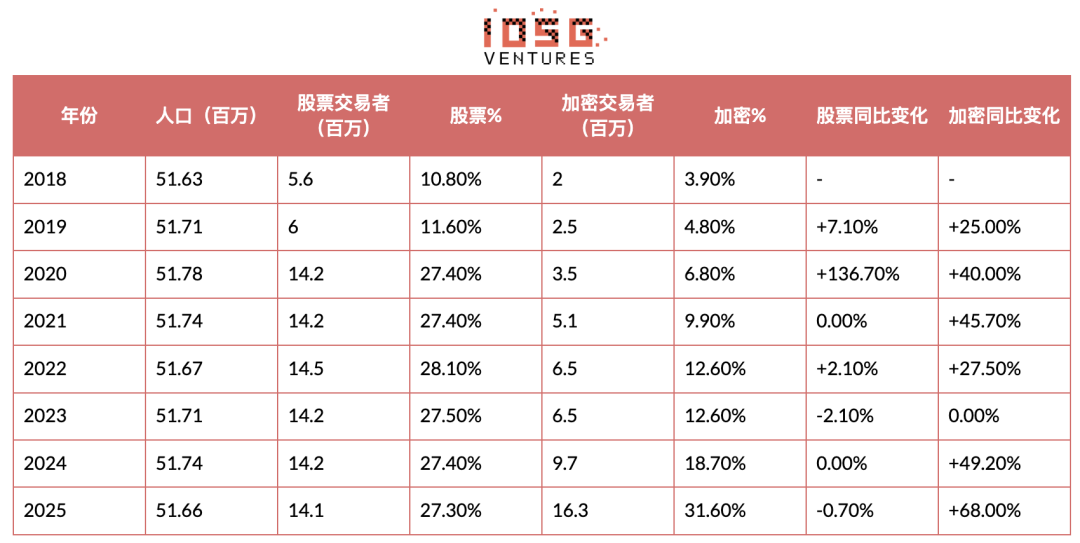
Analysis of South Korean Stock and Cryptocurrency Traders (2018-2025)
From 2018 to 2025, South Korea has experienced a significant shift in investment patterns. The number of stock traders increased from 5.6 million (10.8% of the population) to 14.1 million (27.3%), a growth of 152%. More notably, the number of cryptocurrency traders skyrocketed from 2 million (3.9%) to 16.3 million (31.6%), marking a staggering growth of 715%. By 2025, cryptocurrency traders are expected to surpass stock traders for the first time, reflecting a significant shift in retail investment preferences.
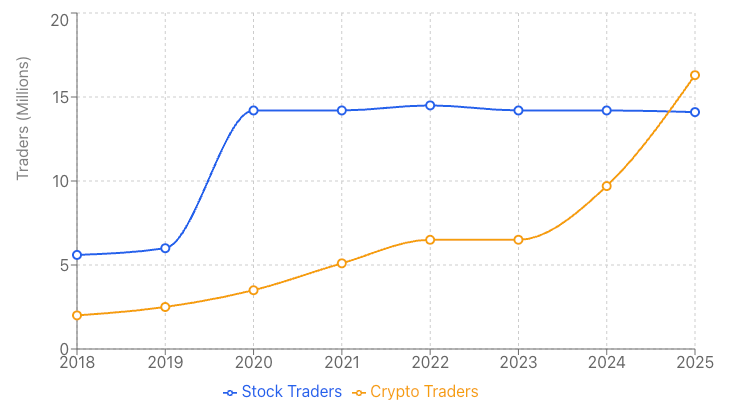
▲ Trader Growth Trend (Millions)
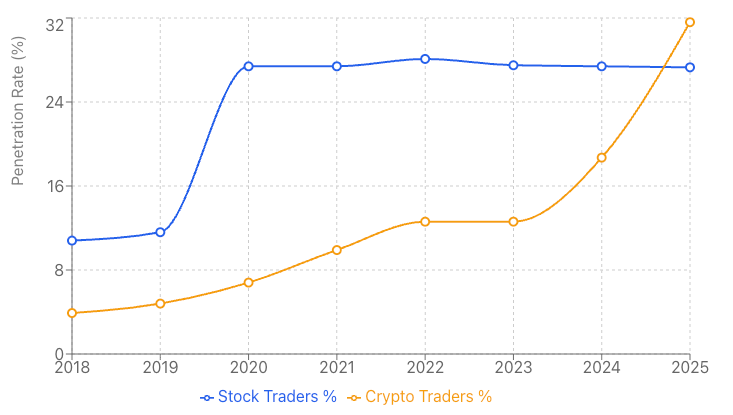
▲ Population Penetration Rate (%)
Key Findings
Stock Traders: Increased from 5.6 million (10.8% of the population) in 2018 to 14.1 million (27.3%) in 2025, experiencing explosive growth (136.7%) during the COVID-19 pandemic in 2020, and stabilizing at around 14.2 million since 2021.
Cryptocurrency Traders: Soared from 2 million (3.9% of the population) in 2018 to 16.3 million (31.6%) in 2025, achieving an astonishing growth of 715% over the period, with significant acceleration in 2024-2025, adding nearly 7 million traders.
First Surpassing Stock Traders in 2025: From 2024 to 2025, strong performance of Bitcoin, approval of U.S. ETFs, and Trump’s pro-crypto stance drove explosive growth. Cryptocurrency traders surged from 9.7 million to 16.3 million, surpassing stock traders for the first time in South Korean history, reflecting a fundamental shift in retail investment preferences.
Surpassing Stocks: Surge in Cryptocurrency Adoption and Market Impact in South Korea
According to FinTechWeekly, by March 2025, South Korea had over 16 million cryptocurrency account holders, surpassing stock investors, with the adoption of digital assets reaching new heights in the post-election momentum. The total number accounts for over 30% of the population. Among them, Upbit has approximately 5.4 million users (53% of the domestic market), Bithumb around 3.8 million users (37%), Coinone about 300,000 to 500,000 users (5%), and Korbit around 100,000 to 200,000 users (2%).
In terms of user numbers, the 16 million+ crypto users served by South Korean centralized exchanges (over 30% of the country's population) account for about 3% of the estimated 560 million cryptocurrency owners/users globally in 2025. Notably, global data includes all cryptocurrency holders, most of whom use centralized exchanges, while South Korean users primarily utilize regulated local platforms.
Despite Bitcoin dominating the holdings, South Korea is becoming a major player in the fiat-to-crypto space globally. According to Chainalysis's report on the "2025 Global Crypto Adoption Index," while the U.S. remains the largest fiat deposit channel in the world, with total transaction volume exceeding $2.4 trillion—nearly four times that of the second-highest country—South Korea follows closely with an impressive transaction volume of $722 billion. This strong performance highlights the country's growing importance in the global crypto ecosystem. In comparison, the EU's fiat-to-crypto transaction volume is slightly below $250 billion, underscoring the scale of the South Korean market. Among the top 20 countries in the index, South Korea ranks 15th. With its rapid adoption and strategic position as one of the largest crypto hubs, South Korea continues to solidify its role as a key player in the global crypto economy.
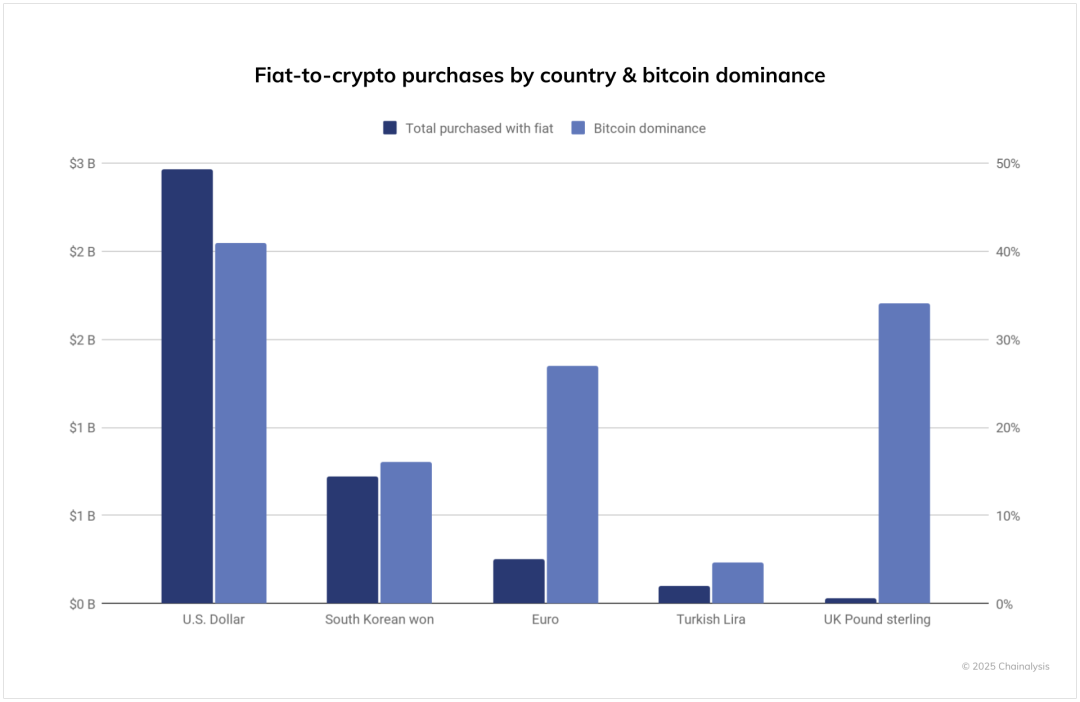
▲ Source: Chainalysis
Exchange Analysis: The influence of South Korean cryptocurrency exchanges is growing not only regionally but also globally. Exchanges like Upbit, Bithumb, and Coinone dominate trading volumes and continue to evolve under South Korea's robust regulatory framework. As of October 2025, local centralized exchanges account for about 1.9% of the global daily trading volume and approximately 3% of the total users of global centralized exchanges. However, when specifically measuring spot trading, South Korea's share reaches about 16% of the global centralized exchange spot trading volume, highlighting the country's significant influence in retail-driven fiat-to-crypto trading, despite its smaller proportion of total users.
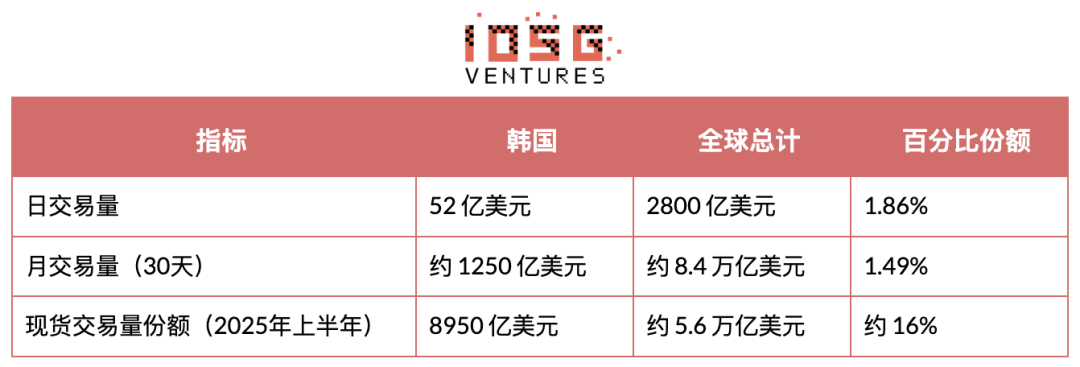
▲ Trading Volume Analysis Global Comparison (Q4 2025) (asksurf.ai)
Compared to major global markets, South Korea maintains its leading position as a gateway for fiat-to-crypto transactions and leads in trading value in the Asia-Pacific region, thanks to an exceptionally high per capita adoption rate (30% vs. global 6.8%) and a highly active retail trading culture.
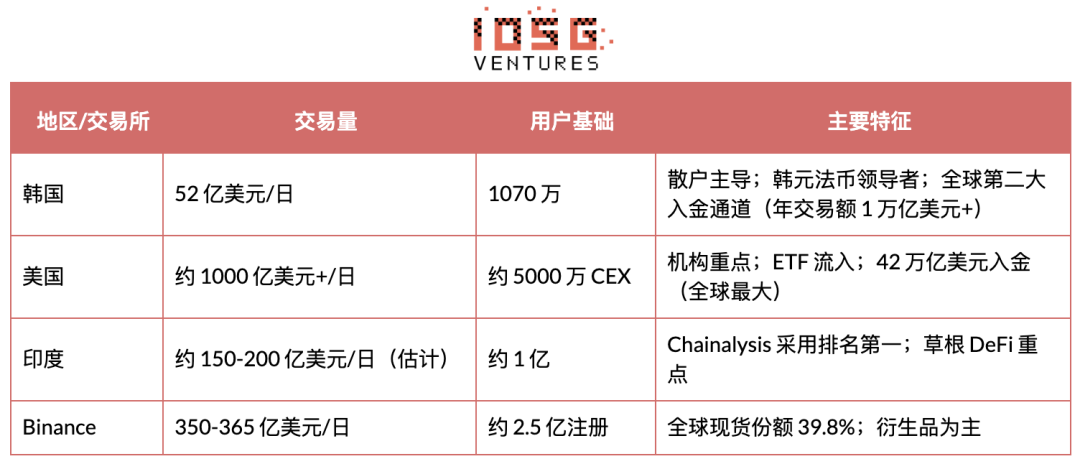
▲ South Korea vs. Major Market Comparison (Q4 2025) (asksurf.ai)
Regulatory Impact
South Korea is one of the first countries to establish a clear framework for trading and compliance. The government's stance has gone through different phases in its regulatory journey, each responding to market developments:
2017-2018: Suppression and Stabilization: Viewing crypto as a speculative threat, authorities implemented bans on ICOs, margin trading, and anonymous accounts to safeguard financial stability.
2019-2021: Pragmatic Regulation: A shift towards controlled acceptance emerged. A strict AML/KYC framework was enforced, culminating in the enactment of the 2020 Act on Reporting and Using Specific Financial Transaction Information, which established key reporting standards for Virtual Asset Service Providers (VASP).
2022-2023: Focus on Investor Protection: Triggered by significant events like the Terra-Luna collapse, this period prioritized consumer protection. The government introduced token security guidelines and over-the-counter brokerage rules, laying the groundwork for future institutional products.
2024-Present: Institutional Integration: Cryptocurrency has become a mainstream political and financial issue. The landmark Digital Asset Basic Act (DABA), passed in June 2025, established a comprehensive regulatory framework covering asset classification, issuance rules, stablecoins, and taxation. This period is characterized by a pursuit of balanced growth, with laws like the Virtual Asset Users Protection Act imposing strict penalties for misconduct.
This evolution reflects the government's continuous learning in crisis response, technological maturity, and recognition that cryptocurrency has become a permanent component of the financial landscape. To date, public figures, companies, and exchanges are also subject to disclosure and strict monitoring. South Korea is unlikely to quickly relax regulations but will continue to gradually refine policy standards, balancing investor protection and market growth. Over time, this may lead to expanded institutional participation, including banks providing digital asset services and securities firms engaging in tokenized financial products.
With 16 million users holding approximately $70.3 billion (102.6 trillion KRW) in crypto assets, the market depth in South Korea is undeniable. For any crypto project, entering the South Korean market is shifting from an option to a strategic necessity, especially before token generation events (TGE). In terms of market promotion, language and cultural barriers are significant challenges that cannot be overlooked. Therefore, collaborating with local crypto participants is essential, particularly media, GTM agencies, research companies, and even some KOLs.
2. Key Marketing Strategies for Long-Term Success in the South Korean Market
Realistic Success Expectations: Long-term success in South Korea depends on coordinated marketing with clear milestones. Institutions emphasize that at least 2-3 months are needed before listing to build brand awareness and community engagement; expecting rapid trading volume increases in the first two months is unrealistic.
Duration of Activities and User Attention: Activities lasting over three months may lose user attention due to market congestion and rapidly moving retail traders. Institutions aim to maintain momentum without dragging activities too long.
Focus on Brand Awareness and Community Building: Building brand awareness, attracting key opinion leaders (KOLs), issuing press releases, and community building, rather than solely focusing on increasing trading volume, can yield more long-term followers and project token holders.
KOL Engagement: Establishing strong, meaningful relationships with KOLs requires activities, translations, and incentives, such as whitelist spots, to facilitate better project understanding and advocacy.
Customized Marketing for Different Customer Types: Marketing services are tailored for pre-TGE, post-TGE, and B2B institutional clients: Pre-TGE clients require 2-3 months of urgent, concentrated marketing support to prepare the market in South Korea. Post-TGE projects continue marketing to maintain momentum and assess team strength. B2B clients focus on institutional outreach, gaining exposure and professional events outside of retail channels.
According to institutions, projects like 0G and SaharaAI have benefited from institutional support, with institutions contributing up to 40% of their node sales. SUI grew from $0.4 to $4 in two years, highlighting the importance of close coordination between internal marketing, institutional coordination, and market maker strategies. The South Korean crypto market has a decentralized institutional and research landscape, with a few dominant players and varying reputations. In the next section, I will briefly introduce the main local media, institutions, and research companies.
For the second half of the content, please read: "IOSG In-Depth Observation (Part 2): A Practical Guide to the South Korean Crypto Market—Core Participants and Ecological Map Explained."
免责声明:本文章仅代表作者个人观点,不代表本平台的立场和观点。本文章仅供信息分享,不构成对任何人的任何投资建议。用户与作者之间的任何争议,与本平台无关。如网页中刊载的文章或图片涉及侵权,请提供相关的权利证明和身份证明发送邮件到support@aicoin.com,本平台相关工作人员将会进行核查。


