Author: Nancy, PANews
The "mindless feel-good drama" that was once ridiculed has surprisingly become a reality. The raid scene from the American TV series "Jack Ryan" seven years ago recently played out in Venezuela, with President Maduro and his wife being captured in the dead of night, leaving many in disbelief.
As the regime changed overnight, global attention unexpectedly turned to this country mired in inflation. In addition to its restructured oil resources, rumors suggest that Venezuela has secretly established a "shadow reserve" of over $60 billion in Bitcoin, a staggering hidden fortune that is now attracting market interest and speculation.
Gold Converted to Bitcoin for "Hedging," USDT Becomes Hard Currency
The U.S. launched a raid on Venezuela, waking the entire city from its slumber. Tension, fear, and unease enveloped the streets as people held their breath, grappling with the uncertainty of the future in both their lives and minds.
Reports indicate that some local wealthy individuals are converting gold into Bitcoin to avoid physical risks, as gold is cumbersome to carry, while Bitcoin offers flexibility and anonymity.
In fact, in today's Venezuela, cryptocurrencies have deeply penetrated daily life, becoming essential means for hedging, trading, and wealth storage.
Here, the fiat currency bolívar, which once represented national credit, has devolved into worthless paper found everywhere on the streets; meanwhile, crypto assets like USDT and Bitcoin have become the hard currency that people rely on for survival.
Venezuela was supposed to be a wealthy nation, sitting on the world's largest oil reserves, accounting for 17% of the globally proven total, even surpassing the oil kingdom of Saudi Arabia. However, this once prosperous country, which had the fourth highest GDP per capita in the world, has fallen into a deep abyss due to long-term political and economic management issues. Today, there are no oil tycoons throwing money around, only citizens struggling in the quagmire of inflation.
In extreme inflation, the sovereign currency has lost its credibility and weight. People carry bags of cash for transactions, ATMs are perpetually emptied, bolívares are made into crafts for sale, and even robbers must carry POS machines during their crimes.
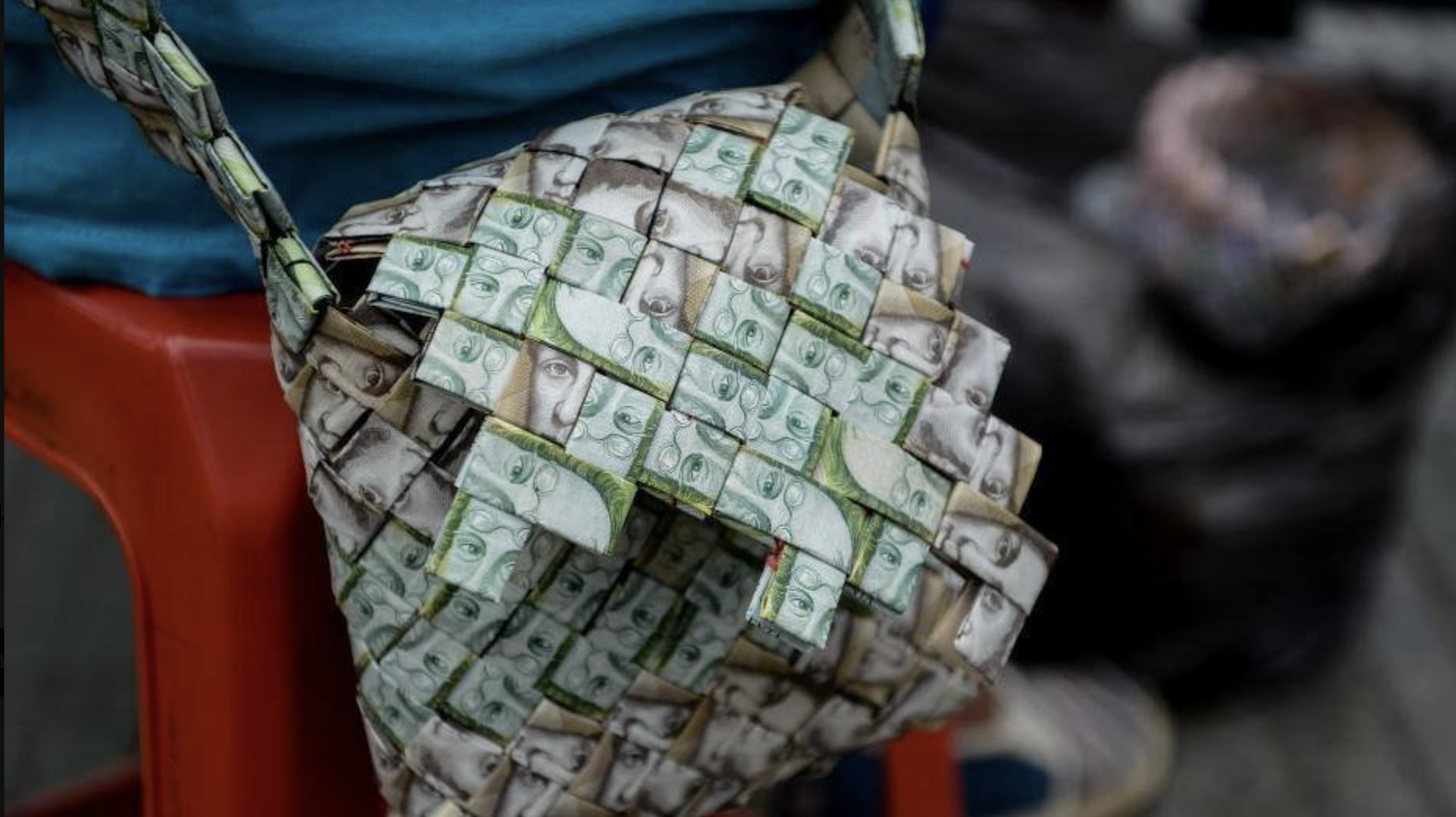
The people of Venezuela have been forced to embark on a financial migration.
According to Chainalysis's 2025 report, Venezuela ranks 18th in the global cryptocurrency adoption index, with a crypto trading volume of up to $44.6 billion from July 2024 to June 2025. José Gregorio Rodríguez, chairman of the Venezuelan Commercial Services Council, revealed last month that over 30% of businesses, services, and enterprises in the country have begun using cryptocurrencies.
Today, stablecoins have become the de facto digital dollar in Venezuela's daily commercial activities, with many turning to USDT and other dollar-pegged stablecoins as their preferred settlement tools. The amount of USDT used by the Venezuelan government in public and private payment settlements has even at times exceeded that of cash dollars.
Locals often jokingly refer to USDT as "Binance dollars," as the P2P (peer-to-peer) trading of Binance, the world's largest crypto exchange, dominates the local market. People buy and sell USDT or other assets through this platform, and many merchants, due to government crackdowns on black market exchange rate platforms, directly reference the real-time USDT/bolívar exchange rate on Binance for pricing and settlement.
Moreover, even Venezuela's crucial oil industry primarily settles in USDT. According to local economist Asdrubal Oliveros, about 80% of Venezuela's crude oil sales revenue is settled in the stablecoin USDT. The country's oil production had grown to over 1 million barrels per day at that time, generating annual revenues exceeding $12 billion. This illustrates the extent of USDT's prevalence in Venezuela.
The First Country to Issue Tokens, Allegedly Holding Over 600,000 Bitcoins
Venezuela has also become one of the earliest crypto pioneers among sovereign nations.
In 2018, to combat U.S. economic sanctions, Venezuela became the first country to "eat the crab." The Maduro government launched the Petro, a cryptocurrency backed by the country's oil reserves. From a financial innovation perspective, this was not only the world's first legal digital currency but also seen as an early attempt at RWA tokenization.
However, trust is Venezuela's scarcest resource. Despite the government's strong push, the Petro was difficult for the public to understand and was deemed a scam, ultimately leading to the failure of this six-year experiment. In 2024, the government officially closed the Petro crypto wallet, converting remaining assets into local currency.
In 2022, the Venezuelan government also attempted to legalize the crypto mining industry and incorporate it into the national regulatory framework, requiring miners to hold licenses.
Due to extremely cheap electricity, crypto mining once flourished in Venezuela. The profits from a single Ethereum or Bitcoin mining machine could often support a family. The Venezuelan military even converted camps into massive mining centers and established dedicated repair centers to refurbish and fix mining machines.
However, a shocking scandal changed everything. The state-owned oil company (PDVSA) used USDT to bypass sanctions and sell oil, resulting in approximately $21 billion in revenue mysteriously disappearing or being misappropriated. Following the corruption incident, the government's attitude towards cryptocurrencies shifted dramatically, officially banning mining under the pretext of regulating excessive energy consumption and confiscating thousands of devices. Due to the lack of a stablecoin business environment in Venezuela, local exchanges have not developed.
However, as the U.S. has tightened oil sanctions on Venezuela in the past two years, Maduro has proposed to revisit the crypto path. The potential crypto reserves of this early participant have once again drawn market attention due to U.S. military actions.
Analysts from Serenity, based on public information, claim that the Maduro regime has quietly established a vast crypto shadow empire. It is estimated that Venezuela may control between $56 billion to $67 billion in crypto assets, with implied Bitcoin holdings possibly exceeding 660,000 coins. If this data is accurate, Venezuela would leap to become the fourth largest holder of Bitcoin globally.
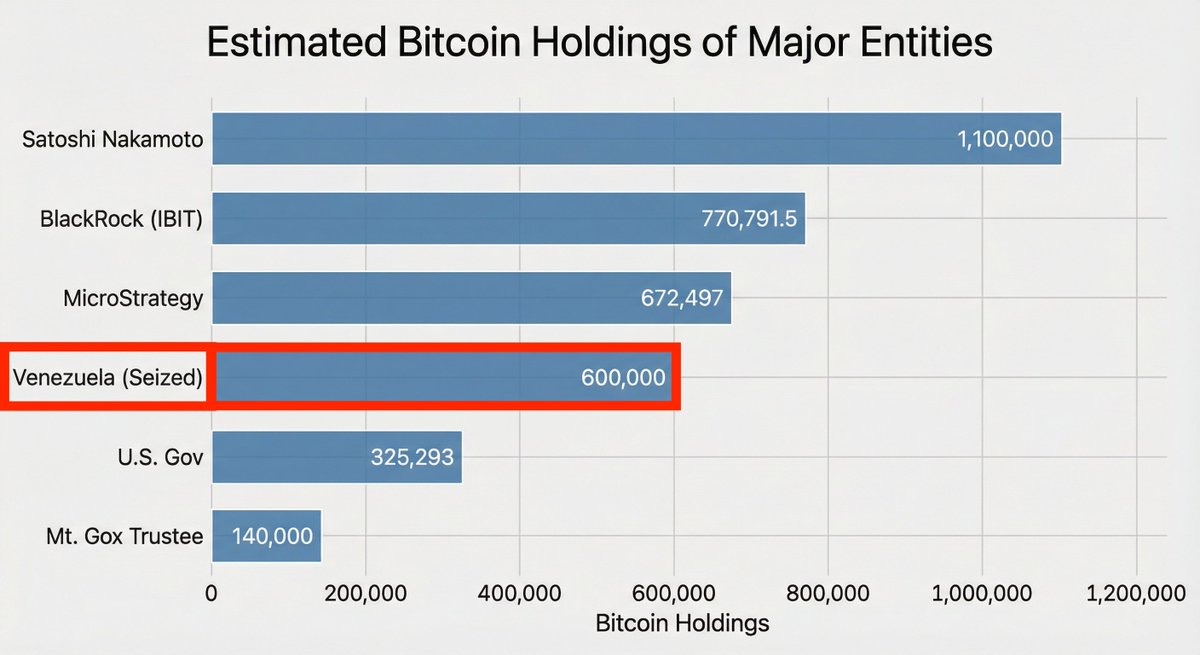
Further analysis by Serenity indicates that from 2018 to 2020, Venezuela reportedly converted gold into Bitcoin. According to historical data from The Wilson Center and Reuters, the Maduro regime liquidated approximately 73 tons of gold at that time, valued at around $2.7 billion, and Whale Hunting intelligence disclosed that this gold was immediately converted into 400,000 Bitcoins to evade U.S. Treasury freezes, with an average price of $5,000, now worth about $45 billion to $50 billion.
From 2023 to 2025, Venezuela obtained Bitcoin through crude oil exports, currently valued at approximately $10 billion to $15 billion. Previously, due to the failure of the Petro experiment, Venezuela turned to USDT as a substitute for oil dollars during crude oil sales. Upon realizing that USDT has a freeze address function, Venezuela began converting USDT into Bitcoin. According to local economist Asdrubal Oliveros, about 80% of Venezuela's crude oil sales revenue is currently settled in stablecoins (especially USDT). The country's oil production had grown to over 1 million barrels per day, generating annual revenues exceeding $12 billion.
During the period from 2023 to 2024, Venezuela also seized approximately $500 million in Bitcoin through mining crackdowns.
It is rumored that the private keys to these assets are held by a small group of trusted agents, with key figures including Venezuela's Minister of Industry and National Production, Alex Saab, who use mixers, cold wallets, and other methods to obscure the flow of assets.
Although the inference of a "shadow reserve" is compelling and aligns with Venezuela's logic of evading sanctions, there is currently a lack of direct on-chain evidence. According to publicly tracked data from Bitcoin Treasuries, Venezuela has confirmed holdings of only 240 BTC (approximately $2.23 million) since the end of 2022.
Now, with Maduro's future uncertain, if such a large Bitcoin reserve truly exists, there is uncertainty about whether it will be seized by the U.S. government.
Regardless of the actual scale of holdings, for the Maduro government and other sanctioned economies, the significance of crypto assets has long transcended financial innovation itself; they serve as a medium of exchange for ordinary people's livelihoods and have become a weapon for the nation to maintain survival and circumvent global financial blockades. A quiet arms race in cryptocurrencies has already begun among sovereign nations worldwide.
免责声明:本文章仅代表作者个人观点,不代表本平台的立场和观点。本文章仅供信息分享,不构成对任何人的任何投资建议。用户与作者之间的任何争议,与本平台无关。如网页中刊载的文章或图片涉及侵权,请提供相关的权利证明和身份证明发送邮件到support@aicoin.com,本平台相关工作人员将会进行核查。


