Source: Stacy Muur
Translation: Ken, ChainCatcher
In mid-December, a16z released its annual "2026 Grand Blueprint." Below is a list of focuses organized based on the main arguments in its vision.
1. Reshaping Payments, Stablecoins, and Financial Rails
Argument: Stablecoins will become the settlement layer of the internet, not just the settlement layer of cryptocurrencies.
The story of stablecoins has moved past the proof-of-concept stage. Today, their annual transaction volume has reached trillions of dollars; the question is no longer whether stablecoins are effective, but whether they can seamlessly integrate with the real-world financial system.
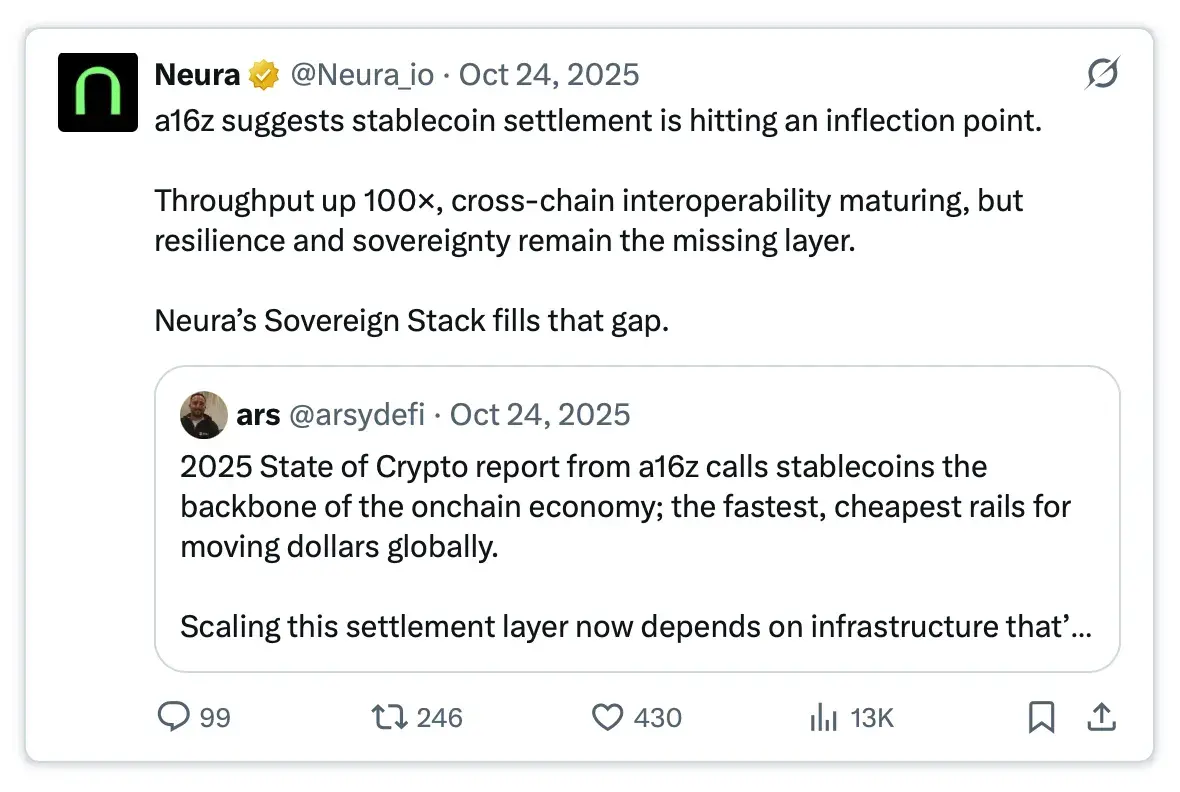
a16z's argument is crucial here: stablecoins are not just currency; they are an upgrade to the ledger. If stablecoins can coexist with existing systems, providing real-time settlement, programmability, and global coverage, banks and fintech companies will not need to rewrite decades-old traditional software. This shifts the focus of value capture from issuing stablecoins to distribution, compliance, and integration.
Who Will Prevail in 2026?
Embedded payments.
Issuers (crypto-native banks) and wallets.
Bank-level compliance + APIs.
Global, programmable settlement.
Watchlist:
Circle (USDC): Regulatory legitimacy + distribution + liquidity advantages. Focus: payment APIs, bank integration, inter-agent usage.
m0: Zero-fee USDC issuance based on modular infrastructure. Worth noting: L2 native minting, stateless agents, browser-level stablecoin user experience.
Ether_fi: The hottest new banking competitor in 2026; offers yields through tokenized treasuries, cashback, and seamless payments; growth connecting cryptocurrencies and fiat.
Plasma: Marketed as the first Neobank built entirely around stablecoins, targeting global users (especially in emerging markets) to meet their daily financial reliance on dollar-backed stablecoins.
Stablecoin (Bridge) | Stripe integration: Infrastructure for abstracting crypto layer inflows and outflows. Focus: integration of regional payment rails.
x402 ecosystem: Focus: advancing "service for Agent" and "executed by Agent" programmable payments through native HTTP-level settlement.
2. RWA: Native Issuance, Not Just Tokenization
Argument: Tokenization alone is not enough. To truly enhance efficiency, the source of funds must move on-chain.
The first wave of real-world asset applications primarily focused on tokenizing existing off-chain tools (such as loans, government bonds, and credit products) and distributing them to cryptocurrency users. While this improved accessibility, it largely retained the original inefficiencies: opaque underwriting processes, high service costs, slow settlement speeds, and fragmented liquidity. In many cases, tokenization was merely a new packaging of old processes.
a16z's core insight is that the true advantage of cryptocurrencies lies not in replicating traditional financial structures but in fundamentally reshaping the credit system from the ground up. When loans are initiated on-chain, underwriting logic becomes programmable, service costs drop significantly, and risks can be priced and monitored in real-time. It is here that cryptocurrencies cease to be merely distribution channels and begin to become financial infrastructure.
Who Will Prevail in 2026?
On-chain underwriting
Transparent risk pricing
Compliant credit mechanisms
Abundant liquidity (often achieved through perpetual contracts)
Watchlist:
Centrifuge: On-chain credit rails for real-world assets; focus: institutional trading flows and default performance.
Blackrock (BUIDL): Tokenized money market fund on Ethereum; focus: the amount of funds flowing into tokenized government bonds and the adoption speed of traditional finance (TradFi).
Maple: Institutional lending with underwriter governance; focus: credit limit expansion and net yield vs. default risk.
Plume: Composable credit infrastructure for programmable debt; focus: custom underwriting logic and DAO use cases.
Pendle: Yield stripping of tokenized earnings; focus: RWA adoption rates in government bonds and private credit for PT/YT.
Ondo: Tokenized government bonds and credit funds; focus: compliant USDC to RWA pipeline and L2 expansion.
Backed: Regulated ETF and bond token packaging; focus: DeFi-native compliance rails.
3. The Internet Becomes Banking (Smart Agents and Payments)
Argument: As AI agents begin to trade autonomously, payments can no longer be an external system tacked onto applications. They must be internet-native: instant, programmable, and fully automated.
The key shift is from user-driven execution to intent-driven execution. Agents no longer click buttons or approve invoices; they recognize conditions, fulfill obligations, and autonomously trigger actions. In this model, traditional payment processes (invoicing, batch processing, reconciliation, settlement windows) are no longer operational details but structural bottlenecks.
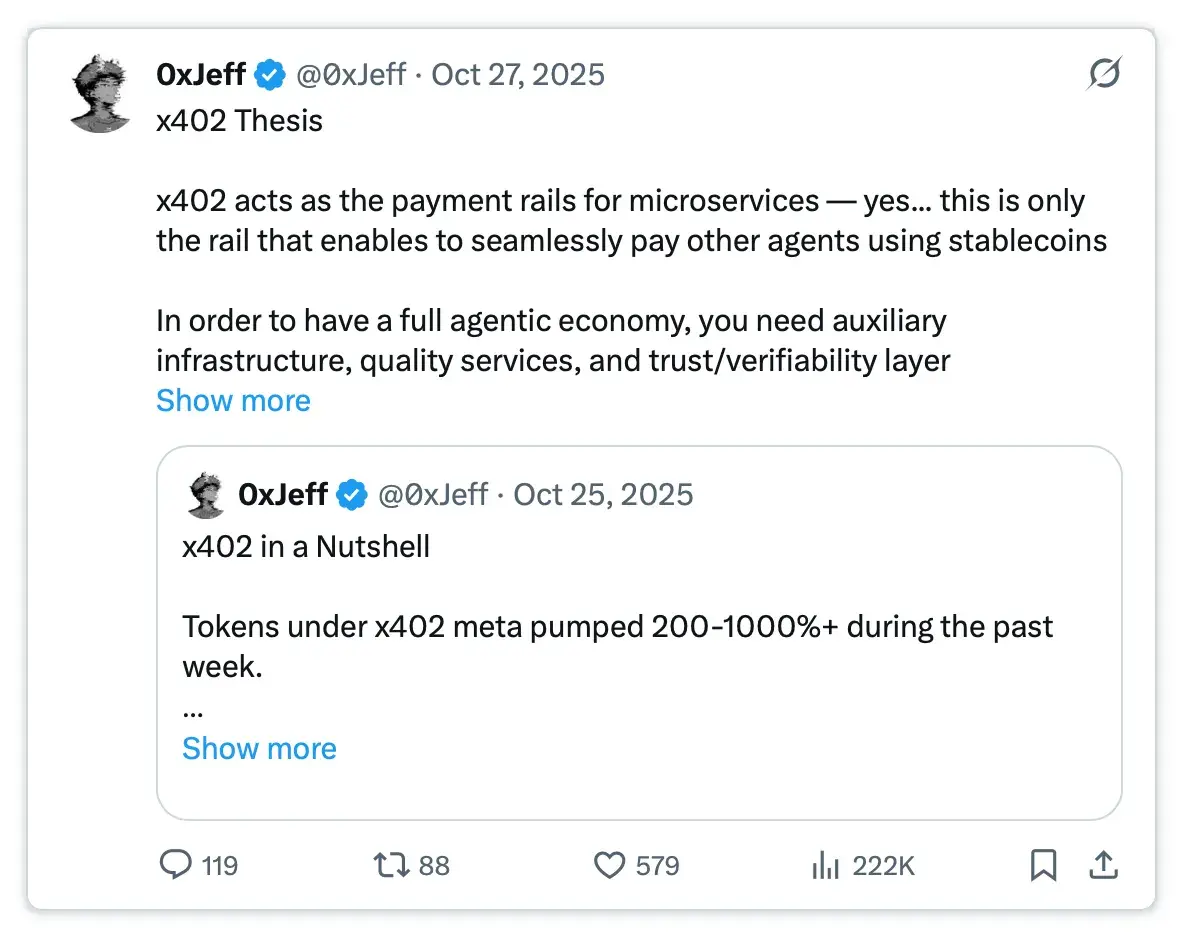
Blockchain introduces a different model. Smart contracts can achieve global final settlement in seconds. Emerging underlying technologies further drive this process, making value transfer more responsive and composable: agents can immediately pay other agents for data, computation, or service fees upon task completion, with rules directly embedded in the code, eliminating the need for intermediaries to enforce them. Currency is no longer a separate operational layer but begins to operate like network traffic, which the internet can natively handle.
Who Will Prevail in 2026?
Agent-native identity.
Programmable payment rails.
User experience without "human" intervention.
Watchlist:
Catena: Identity and compliance infrastructure for AI Agents; establishing "Know Your Agent" (KYA) standards. Focus: Agent onboarding, enterprise-level integration.
Nevermined: Data marketplace infrastructure for autonomous Agents; enabling permissioned payments between Agents for access, computation, and services. Focus: executable data licenses, Agent monetization flows.
KiteAI: AI-native Agents with embedded payments and real-world task completion capabilities. Focus: intent-based automation, real economic throughput.
ASI: Open ASI + blockchain integration layer; cross-Agent collaboration and computational monetization. Focus: Agent settlement standards, autonomous service economy.
EigenCloud (via EigenAI): Deterministic AI Agents for decentralized strategy execution and autonomous protocol operations. Focus: intent-driven finance, composable economic agency.
Fetch: Multi-Agent collaboration protocol enabling decentralized computing + services. Focus: on-chain task execution, measurable Agent GDP.
x402 implementation: Agent settlement, protocol-level payments, inter-agent transactions.
4. Privacy as a Major Moat
Argument: Privacy leads to user lock-in. Public blockchains commoditize users.
The core insight of a16z's privacy theory is simple: block space has become interchangeable, but confidentiality has not. Performance, cost, and throughput are no longer enduring differentiators. If everything is public, users can migrate freely, liquidity can bridge instantly, and applications can compete in a zero-profit environment. Privacy breaks this symmetry.
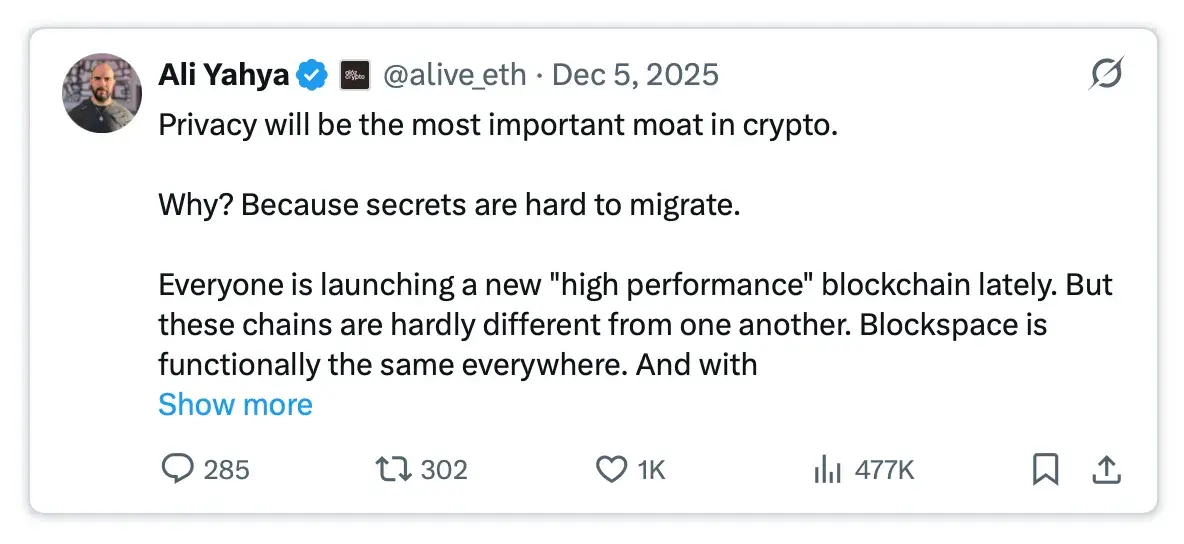
Once users, institutions, or applications put sensitive information such as state balances, strategies, counterparties, identities, and metadata into a privacy-preserving environment, switching costs naturally arise. This creates a privacy network effect: the more activity within a private domain, the higher the value of staying within it, and the greater the risk of leaving due to the potential for boundary information leakage.
Who Will Prevail in 2026?
Private execution environments
Zero-knowledge-based data access control
Privacy protection enabled by default, rather than as an add-on feature
Watchlist:
Aztec: Private smart contracts + ZK-native Rollup. Focus: developer attractiveness, private DeFi primitives.
Nillion: Decentralized MPC for private computation; institutional data hosting use cases are breakthrough signals.
Arcium: Confidential computing layer in the Solana stack; focus: performance scaling and Solana-native integration.
Aleo: ZK cloud computing platform with native incentives; enterprise-level zkCloud usage is the North Star metric.
Walrus and Seal: Key components of the Sui stack, enabling fully on-chain data and privacy.
Payy_link: Privacy-preserving stablecoin wallet that combines crypto privacy with utility, allowing for gas-free, fully private, and optionally compliant sending/receiving of stablecoins like USDC.
Zcash: Shielded transfers via ZK-SNARKs; the launch of Halo 2 and the expansion of programmable privacy are key.
Monero: Default privacy L1 with ring signatures; robustness under surveillance pressure remains its core moat.
5. Security: From "Code is Law" to "Norms are Law"
Argument: Audits are insufficient to solve the problem. Runtime enforcement will become standard practice.
The past two years have made one thing clear: audit failures are not due to a lack of auditor capability, but because audits themselves are static, localized, and fundamentally unable to comprehensively reflect dynamic systems. Today, protocols operate in adversarial environments influenced by factors such as maximum extractable value (MEV), composability, oracle delays, and extreme scenarios driven by incentive mechanisms, which often only emerge after deployment and frequently under extreme market conditions.
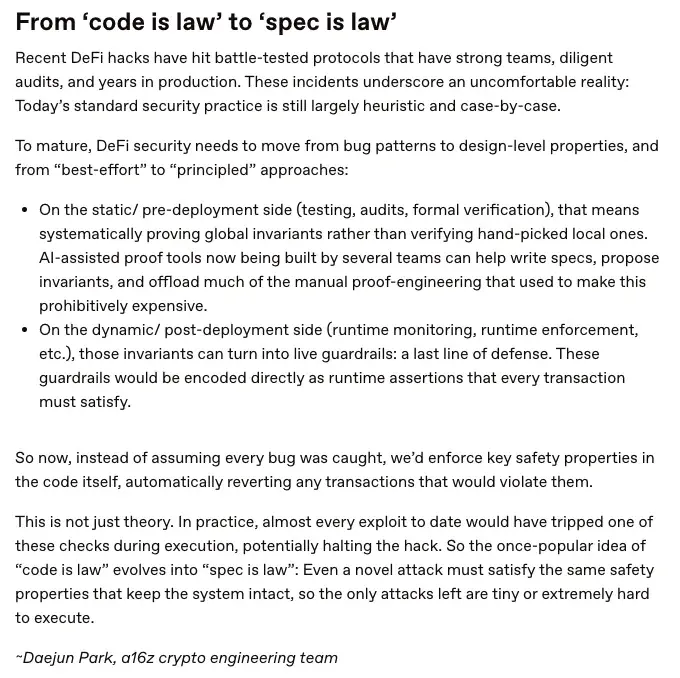
a16z concludes (a conclusion widely accepted in the industry) that security must be elevated to a new level: from checking whether the code is correct to enforcing system-level invariants that must be absolutely unbreakable. This marks a shift in security policy from "code is law" to "norms are law," where protocols formally define which rules must always hold (e.g., collateral limits, value conservation, solvency conditions, ordering constraints) and continuously enforce these properties, not just at deployment.
Who Will Prevail in 2026?
Runtime protections
Formal specifications
AI-assisted verification
Continuous monitoring
Watchlist:
OpenZeppelin: A runtime rule execution and upgrade security platform with deep protocol integration.
Trailofbits: An advanced security research company shifting towards real-time invariant enforcement through tools.
SpearbitDAO: A research-driven audit collective launching a continuous audit pipeline (as opposed to static snapshots).
Cyfrin: A smart contract security company building educational pipelines and formalization-first tools; gaining influence in the modular L2 ecosystem.
Immunefi: A unified on-chain platform for bug bounties, audits, and AI-driven threat detection to protect crypto projects from exploitation.
Runtime monitoring startups.
6. Scalable Prediction Markets
Argument: Prediction markets are evolving from niche gambling venues to real-time information infrastructure for the internet.
The core shift pointed out by a16z is not merely "more markets" or higher trading volumes, but a restructuring of prediction market architecture. As block space costs decrease, oracle performance improves, and user experience friction diminishes, markets are no longer sporadic events related to elections or sports but begin to function as a continuous signal extraction layer. Everything can be listed for trading: macro data releases, protocol upgrades, regulatory votes, corporate actions, and even the probabilistic outcomes of long-tail events.
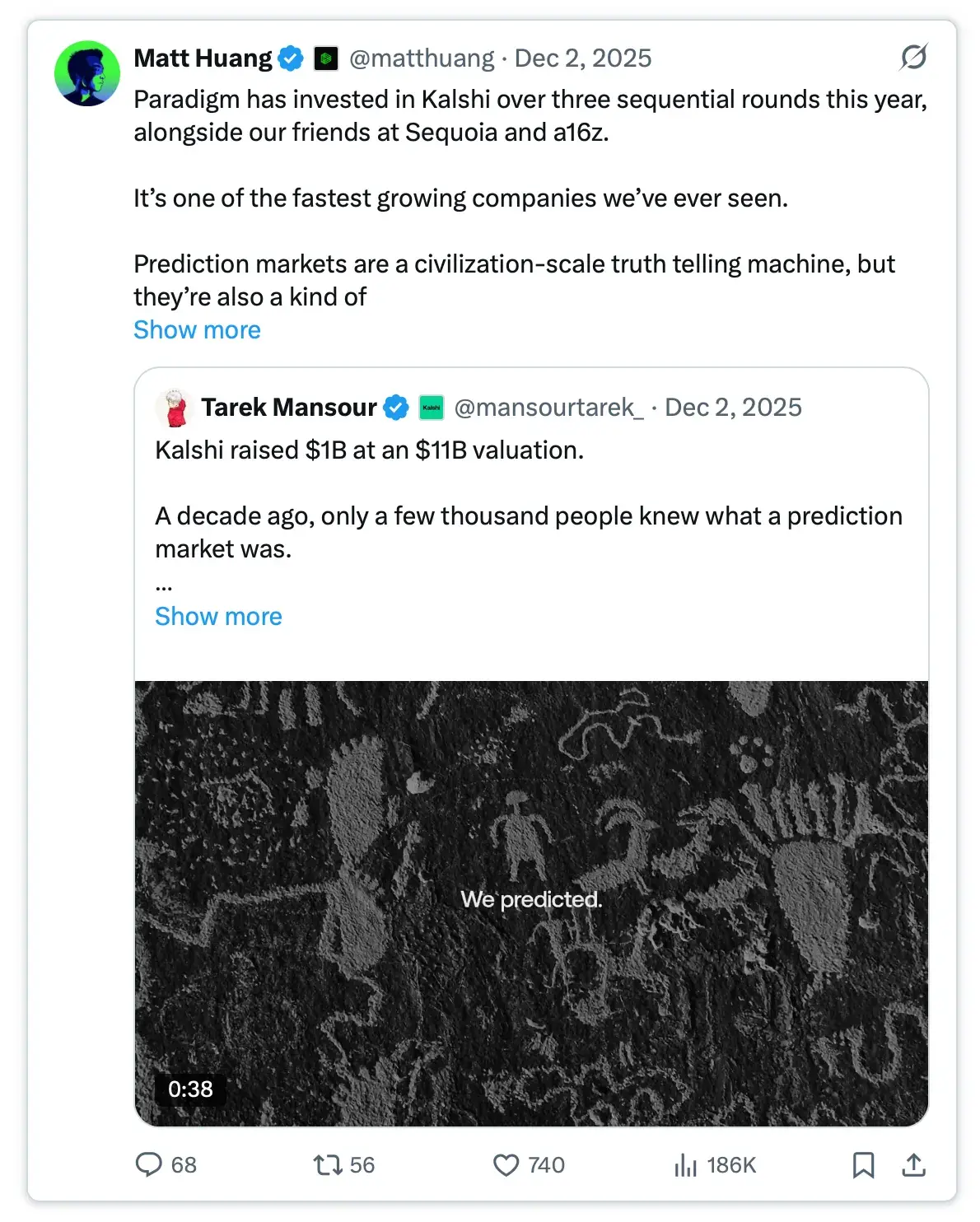
Liquidity is dispersed across thousands of micro-markets, but price discovery improves as information is no longer constrained by polls, surveys, or centralized analysts.
Who Will Prevail in 2026?
Prediction markets capable of listing everything.
AI Agents trading continuously.
Decentralized and probabilistic solutions.
Watchlist:
Polymarket: The leading decentralized prediction platform on Polygon; monthly trading volume exceeds $1 billion, dominating the cryptocurrency space.
Kalshi: A U.S. exchange regulated by the Commodity Futures Trading Commission; monthly trading volume exceeds $1.3 billion and has top app downloads in the legal market.
FractionAI: Dubbed the first AI agent prediction market, where agents can compete in a transparent on-chain environment with real-time portfolios.
Opinion: A high-growth event trading exchange with a monthly nominal trading volume exceeding $700 million, making breakthroughs in the cryptocurrency-native gambling space.
Myriad Markets: Decentralized event market infrastructure; trading volume exceeds $10 million, with active on-chain betting covering various niches.
7. zkVMs and Verifiable Computing
Argument: Proofs are leaving the blockchain and entering the cloud.
The core turning point pointed out by a16z is not a slight increase in the speed of zero-knowledge proofs, but that zkVMs are crossing a threshold, proving that general-purpose computation is no longer a luxury unique to blockchains but a viable system primitive, thanks to a significant reduction in proof overhead (from about 1,000,000 times to about 10,000 times), GPU-native provers, and memory usage suitable for practical production environments.
Together, they open up a mechanism where ordinary CPU workloads (cloud jobs, backend services, financial models, machine learning inference, legacy enterprise code) can be executed once and then verified anywhere, transforming trust assumptions about cloud providers, data pipelines, and off-chain execution into cryptographic guarantees rather than contractual commitments, creating a world where correctness, not reputation, is the default security model for distributed systems.
Watchlist:
RiscZero: A zkVM with general Rust computing capabilities; has a reliable leading position in cloud-compatible proofs.
Succinct: SP1 zkVM (based on RISC-V/LLVM) suitable for arbitrary Rust/LLVM code; focuses on fast verification, lightweight clients, and off-chain data feeds, with GPU-native proofs (e.g., proving in real-time on 16 GPUs), precompilation for efficiency, and recursion for on-chain/off-chain use.
Brevis_zk: A zk co-processor for querying on-chain/off-chain data; designed for generating modular proofs within applications.
Axiom_xyz: A ZK co-processor for verifiable computing on on-chain/off-chain data; supports arbitrarily expressive off-chain computations (e.g., historical queries) and verifies ZK proofs on-chain.
ZKML stack implementation: A framework for verifiable ML inference via ZK proofs/SNARKs (e.g., ZKML, DSperse, JSTprove); circuits optimized for production ML workloads (e.g., GPT-2, neural networks) to reduce overhead (proof/verification speed improved by 5-22 times).
8. Wealth Management Goes On-Chain
Argument: Active, personalized wealth management will become commonplace.
With the native tokenization of assets (including yield cash, publicly traded stocks, private credit, and illiquid alternative assets), rebalancing is no longer an event but a continuous process. This process is executed by smart contracts, responding to real-time changes in interest rates, volatility, and risk premiums, rather than quarterly meetings or advisor workflows.
AI-assisted asset allocation engines are increasingly playing the role of co-pilot, transforming user constraints into executable strategies; decentralized financial infrastructure such as automated vaults, tiered yield products, and permissioned risk-weighted asset pools provide the necessary depth to implement these strategies without sacrificing compliance or capital efficiency. The result is not "smart advisory," but programmable wealth, where portfolios can self-adjust according to risk curves, rotating from tokenized government bonds to credit, from Beta to Carry, from liquidity to illiquidity, with settlement, custody, and reporting abstracted away.
What Will Be the Winners?
Automated rebalancing
Yield cash
Tokenized private markets
Watchlist:
Veda: Modular vault infrastructure supporting real-time, strategy-based rebalancing across yield primitives; very much aligned with this argument.
Upshift: A permissioned vault platform with risk monitoring strategies and KYC access; partially aligned with compliant RWA access directions.
Midas: Tokenized government bonds and BTC yield strategies with on-chain reserve proofs; very suitable for compliant, programmable cash flows.
Base: Coinbase's L2 Base App integrates wallets, trading, social sources, mini-programs, and on-chain yields (like USDC APY); achieves seamless, abstracted wealth management through one-click DeFi and RWA access.
Morpho: A non-custodial lending vault that automatically rebalances between P2P and liquidity pool markets; aligns with programmable credit allocation and real-time yield optimization.
Infinit: An AI-driven super app with strategies for one-click automated yield, delta-neutral positions, cross-chain bridging/swapping, and RWA optimization; achieves self-adjusting wealth through multi-agent collaboration, aligning with programmable portfolio directions.
Click to learn about ChainCatcher's job openings
免责声明:本文章仅代表作者个人观点,不代表本平台的立场和观点。本文章仅供信息分享,不构成对任何人的任何投资建议。用户与作者之间的任何争议,与本平台无关。如网页中刊载的文章或图片涉及侵权,请提供相关的权利证明和身份证明发送邮件到support@aicoin.com,本平台相关工作人员将会进行核查。


