Everything you hoped for may have already arrived, but its form is somewhat different from what you envisioned.
Written by: Jill Gunter, Co-founder of Espresso
Translated by: Luffy, Foresight News
Ten years ago, I embarked on a career in the cryptocurrency industry because I saw it as the most suitable and effective tool to address the various issues I witnessed during my brief career on Wall Street.
I found that the current state of the financial system has given rise to three major social ills, and I firmly believe that cryptocurrency technology can tackle these challenges.
1) Poor Currency Management

Hugo Chávez was responsible for causing Venezuela's inflation rate to soar above 20,000%.
My career began as a bond trader, focusing on Latin American sovereign debt, and I personally experienced the hyperinflation and capital controls in countries like Venezuela and Argentina. The obstinacy of national leaders deprived entire generations of their livelihoods and savings, leading to a significant widening of domestic bond spreads and pushing the country out of capital markets. The injustice this situation inflicted on individuals has been a tragedy both in the past and present.
Of course, Chávez and Cristina Kirchner (the former presidents of Venezuela and Argentina, respectively) are not the only "villains" in this tragedy.
2) Financial Barriers on Wall Street
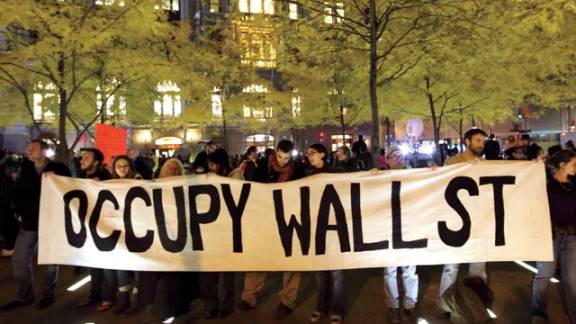
Do you remember the protests at Zuccotti Park in Manhattan in 2011?
A few years after the 2008 financial crisis, I joined Wall Street. Before joining, I had read Michael Lewis's "Liar's Poker" and thought the depiction of the 1980s Wall Street's reckless speculation culture was an outdated stereotype. I also knew that the Dodd-Frank Act had been enacted the year before, and this congressional reform was supposed to thoroughly eradicate the speculative atmosphere on trading desks in lower Manhattan.
From an institutional perspective, rampant speculative behavior had indeed been curtailed, and trading departments focused on directional bets had mostly been eliminated. However, if you knew where to look, you would find that the spirit of speculation had never truly dissipated. Many leaders left after the 2008 industry purge had taken over their bosses' risk positions at the market bottom and then profited immensely from Ben Bernanke's quantitative easing policies. What kind of incentive orientation would this experience instill in these new trading "tycoons"? Even having experienced the harshness of the crisis, this new generation was still indoctrinated with the idea that betting on the company's balance sheet could still lead to a successful career.
In my first year on Wall Street, I had to pass through the "Occupy Wall Street" protest crowd every day on my way to and from work. The longer I stayed on Wall Street, the more I identified with this street movement; they wanted to break the privileges of Wall Street and end the situation where ordinary people bore the brunt of its reckless gambling.
I agreed with the movement but did not support its methods. The process of passing through the protest crowd was actually quite uneventful; their actions were not proactive. They held up signs claiming to be the "99%," but in my view, they lacked a clear demand for what they wanted from the "1%."
To me, the answer was obvious: the problem was not just Wall Street's gambling addiction, but also that Wall Street had access to "casinos," investment opportunities, and industry information that ordinary people would never have. And when Wall Street lost its bets, it was the ordinary citizens who paid the price.
This is not something that can be solved by simply adding a few rules for Wall Street; the core issue is to create a fair competitive environment for ordinary people.
3) Obscure and Outdated Financial Systems
Back in 2012, I realized that to push the financial system towards a more open, fair, transparent, and inclusive direction, its underlying systems must be upgraded.
As a junior trader in the trading room, I spent hours every day after the market closed reconciling accounts with the back office, tracing bonds that should have settled weeks ago, and confirming that all derivative positions did not have "wrong-way risk."
How could these processes not yet be fully digitized?
Of course, on the surface, many aspects have been digitized; we use computers and electronic databases. But all these databases require human intervention to be updated. Keeping information consistent across parties is a massive, costly, and often opaque task.
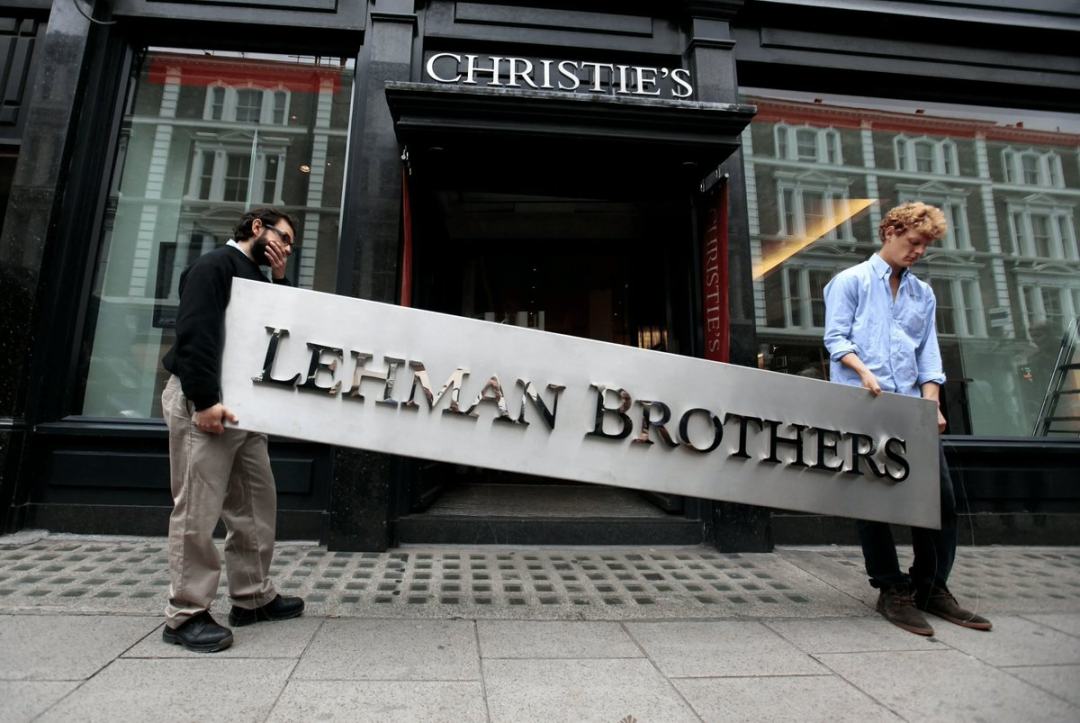
I still remember one thing: even four years after Lehman Brothers' bankruptcy, Barclays Bank, which acquired its assets, still could not clarify Lehman Brothers' exact assets and liabilities. It sounds absurd, but when you think about the conflicting or incomplete database records, everything makes sense.
Bitcoin: A Peer-to-Peer Electronic Cash System
Bitcoin is incredibly cool.
It is an asset like gold, unmanipulated and independent of monetary policy; its issuance and circulation model allowed ordinary people around the world to use it as an investment tool for a decade before institutions could truly intervene on a large scale; it also introduced a new type of database called blockchain, which eliminates the need for clearing, settlement, or reconciliation processes, allowing anyone to run and update it directly.
Bitcoin has been (and still is) an antidote to my disillusionment with Wall Street. Some use it to evade inflation and capital controls; it allows the "99%" to invest ahead of Wall Street; its underlying technology has the potential to completely replace the obscure and inefficient systems that banks rely on, building a new digital and transparent system.
I had to drop everything and dive into this endeavor. But at that time, the skepticism from the outside world was overwhelming, with the most common argument being, "Isn't this just something for drug dealers?" In 2014, apart from dark web markets like "Silk Road," Bitcoin had almost no other application scenarios, and it was not easy to refute such skepticism; you had to really "imagine" to see its potential.
During those agonizing years, I sometimes felt that this technology might never truly take off… But suddenly, the whole world began to pay attention to it and projected their fantasies onto this technology.
The Peak of Fantasy
For years, I had hoped that people would see the potential of blockchain technology, but in 2017, I suddenly became a skeptic in the industry, and the feeling was complex.
On one hand, it was because I was in the industry environment of Silicon Valley, and on the other hand, it was the zeitgeist; everyone wanted to start a blockchain project. Some pitched me ideas like "blockchain + journalism," and there were headlines saying "blockchain enters the dental field," and at those times, I couldn't help but think, "No, that's not how it's supposed to be used!"
However, most of these people were not trying to pull a scam; they were not looking to create vaporware, issue tokens to fleece retail investors, or launch meme coins. They genuinely believed in the diverse potential of the technology, but this enthusiasm was both misleading and irrational.
From 2017 to 2018, the industry fantasy reached its peak.
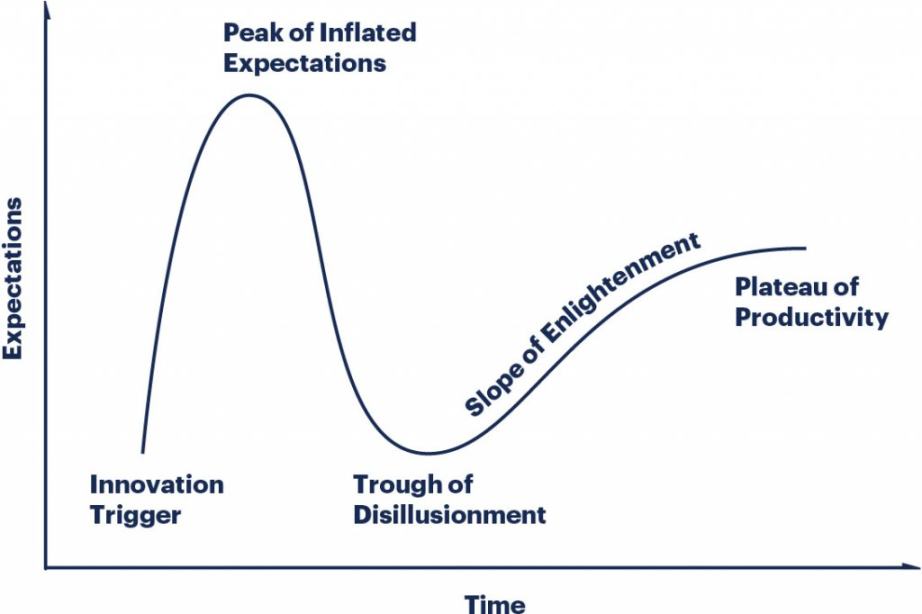
Gartner's Technology Maturity Curve
The cryptocurrency and blockchain industry did not ascend along the slope of enlightenment as promised in Gartner's classic "hype cycle" chart; instead, it oscillated between frenzy and disillusionment every 3 to 4 years.
To understand the reasons behind this, one must recognize a fact: while blockchain is a technology, it is deeply tied to the asset class of crypto assets, which have a very high beta coefficient and significant risks, making them highly susceptible to macro market fluctuations. Over the past decade, the macro market has been extremely volatile: in a zero-interest-rate era, risk appetite rises, and crypto assets experience a boom; when a trade war hits, risk appetite declines, and crypto assets are declared "dead."
To make matters worse, the regulatory environment in this emerging field has also fluctuated greatly, coupled with catastrophic events like Terra/Luna and FTX that destroyed massive capital, making the industry's high volatility unsurprising.
We All Long to Change the World
Staying deeply engaged in the industry (whether through projects, investments, commentary, or other work) is an extremely challenging endeavor.
Everyone knows that starting a business is not easy, and starting a business in the cryptocurrency industry is even harder. Industry sentiment and the funding environment are unpredictable, product-market fit is difficult to ascertain, legitimate entrepreneurs may be summoned or even imprisoned, and one has to watch helplessly as a president issues tokens to run a scam, destroying the remaining mainstream credibility of the industry… It's absolutely insane.
So I completely understand why someone, after eight years of deep engagement in the industry, would feel that their life has been wasted.
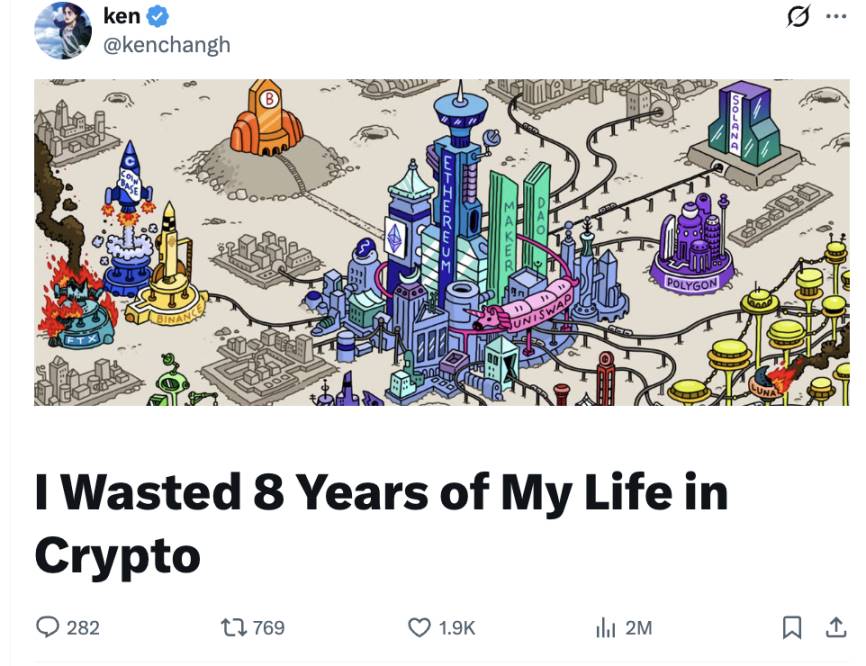
https://x.com/kenchangh/status/1994854381267947640
The author of this tweet admits that they thought they were joining a revolution, only to find out they were just helping to build a giant casino, and they regret having contributed to the "casino-ization" of the economy.
But one must understand that no anti-establishment movement can achieve perfection; every revolution has its costs, and any change must go through growing pains.
Elizabeth Warren and the "Occupy Wall Street" movement once tried to shut down Wall Street's casino, but the meme stock craze, the bull market in crypto altcoins, prediction markets, and decentralized exchanges for perpetual contracts have brought Wall Street's casino to the public.
Is this a good thing? To be honest, I'm not sure. For most of my time in the cryptocurrency industry, I felt like we were just repeating the construction of consumer protection systems. However, many of the existing so-called consumer protection rules are either outdated or misleading, so I believe that breaking boundaries again might be a good thing. If my initial goal was to create a fair competitive environment, then I must say we have indeed made progress.
To fundamentally reform the financial system, this step is essential. If we want to fundamentally change who and how financial returns are obtained, it will inevitably lead to the "casino-ization" of the economy.
Report Card
It's easy to feel disillusioned, but it's hard to remain optimistic.
However, if I assess the current state of the industry against the goals I had when I entered it, I would say things are overall quite good.
Regarding poor currency management: we now have Bitcoin and other sufficiently decentralized cryptocurrencies that can serve as viable alternatives to fiat currencies, which cannot be seized or devalued; coupled with privacy coins, assets can even be untraceable. This is a tangible advancement in the process of human freedom.
Regarding Wall Street's monopoly: indeed, the casino has been "democratized"; now it's not just Wall Street that can gamble recklessly on junk assets and bring itself down! But seriously, I believe society as a whole is progressing, no longer overly intervening in the risk-bearing capacity and methods of the public. After all, we have always allowed ordinary people to buy lottery tickets while shutting them out from the best-performing stock investment opportunities over the past decade. The early retail investors in quality assets like Bitcoin and Ethereum have shown us what a more balanced world could look like.
As for the issue of obscure and outdated database systems: the financial industry has finally begun to face better technological solutions. Robinhood has already adopted blockchain as the underlying technology for stock trading products in the EU; Stripe is building a new global payment system based on crypto rails; stablecoins have also become mainstream products.
If you entered the industry for the sake of revolution, take a closer look: everything you hoped for may have already arrived, but its form is somewhat different from what you envisioned.
免责声明:本文章仅代表作者个人观点,不代表本平台的立场和观点。本文章仅供信息分享,不构成对任何人的任何投资建议。用户与作者之间的任何争议,与本平台无关。如网页中刊载的文章或图片涉及侵权,请提供相关的权利证明和身份证明发送邮件到support@aicoin.com,本平台相关工作人员将会进行核查。

