Ownership of control, how to ensure sustainability, and whether "decentralization" is gradually giving way to corporate logic.
Written by: Oluwapelumi Adejumo
Translated by: Saoirse, Foresight News
On November 10, when Uniswap's management submitted the "UNIfication" proposal, the document read more like a corporate restructuring than a protocol update.
The proposal plans to activate previously unused protocol fees, circulate funds through a new on-chain treasury engine, and use the proceeds to buy and burn UNI tokens. This model is akin to stock buyback programs in traditional finance.
A day later, Lido also launched a similar mechanism. Its decentralized autonomous organization (DAO) proposed to establish an automatic buyback system: when the price of Ethereum exceeds $3,000 and annual revenue exceeds $40 million, excess staking rewards will be used to buy back its governance token LDO.
This mechanism deliberately adopts a "counter-cyclical" strategy—stronger in bull markets and more conservative when market conditions tighten.
These initiatives collectively mark a significant transformation in the DeFi space.
In recent years, the DeFi sector has been dominated by "Meme tokens" and incentive-driven liquidity activities; now, leading DeFi protocols are repositioning around core market fundamentals such as "revenue, fee capture, and capital efficiency."
However, this shift also forces the industry to confront a series of thorny issues: ownership of control, how to ensure sustainability, and whether "decentralization" is gradually yielding to corporate logic.
The New Financial Logic of DeFi
For most of 2024, DeFi's growth primarily relied on cultural hype, incentive programs, and liquidity mining. Recent actions such as "re-enabling fees" and "implementing buyback frameworks" indicate that the industry is attempting to more directly tie token value to business performance.
Taking Uniswap as an example, its initiative to "plan to burn up to 100 million UNI tokens" redefines UNI from a purely "governance asset" to an asset closer to a "protocol economic equity certificate"—even though it lacks the legal protections or cash flow distribution rights of equity.
The scale of such buyback programs should not be underestimated. MegaETH Lab researcher BREAD estimates that, at current fee levels, Uniswap could generate approximately $38 million in buyback capacity each month.
This amount would exceed the buyback rate of Pump.fun but fall short of Hyperliquid's approximately $95 million monthly buyback scale.

Comparison of token buybacks for Hyperliquid, Uniswap, and Pump.fun (Source: Bread)
Lido's simulated mechanism structure shows that it could support a buyback scale of about $10 million per year; the repurchased LDO tokens will be paired with wstETH and put into liquidity pools to enhance trading depth.
Other protocols are also accelerating similar initiatives: Jupiter will use 50% of its operating income for JUP token buybacks; dYdX will allocate a quarter of network fees to buybacks and validator incentives; Aave is also formulating specific plans to invest up to $50 million annually to drive buybacks through treasury funds.
Keyrock data shows that since 2024, income-linked token holder dividends have increased more than fivefold. In just July 2025, the spending or allocation amount for buybacks and incentives across various protocols reached approximately $800 million.
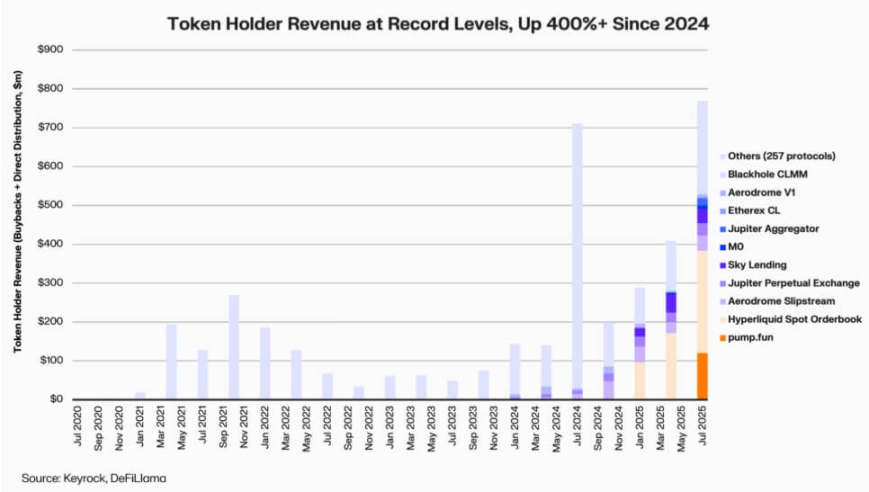
DeFi protocol holder income (Source: Keyrock)
As a result, about 64% of the income from leading protocols now flows back to token holders—this stands in stark contrast to the previous cycle of "prioritizing reinvestment, then distribution."
Behind this trend is a new consensus forming in the industry: "scarcity" and "recurring income" are becoming the core of DeFi's value narrative.
Institutionalization of Token Economics
The wave of buybacks reflects the deepening integration of DeFi with institutional finance.
DeFi protocols are beginning to adopt traditional financial metrics such as "price-to-earnings ratio," "yield thresholds," and "net distribution rates" to convey value to investors—who are increasingly viewing DeFi projects through the lens of evaluating growth companies.
This integration provides fund managers with a common analytical language but also brings new challenges: the original design intent of DeFi did not include institutional requirements such as "discipline" and "information disclosure," yet the industry now needs to meet these expectations.
Notably, Keyrock's analysis has pointed out that many buyback plans heavily rely on existing treasury reserves rather than sustainable recurring cash flow.
This model may support token prices in the short term, but its long-term sustainability is questionable—especially in a market environment where "fee income is cyclical and often tied to token price increases."
Additionally, Blockworks analyst Marc Ajoon believes that "self-determined buybacks" typically have limited market impact and may lead to unrealized losses for protocols when token prices decline.
In light of this, Ajoon advocates for establishing a "data-driven automatic adjustment system": allocating funds when valuations are low and shifting to reinvestment when growth indicators are weak, ensuring that buybacks reflect actual operational performance rather than speculative pressure.
He stated:
"In its current form, buybacks are not a panacea… Due to the existence of the 'buyback narrative,' the industry blindly places it above other paths that may yield higher returns."
Arca's Chief Investment Officer Jeff Dorman holds a more comprehensive view.
He believes that corporate buybacks reduce the number of shares outstanding, but tokens exist in a unique network—its supply cannot be offset by traditional restructuring or merger activities.
Therefore, burning tokens can drive the protocol towards a "fully distributed system"; however, holding tokens can also reserve flexibility for the future—if demand or growth strategies require, tokens can be issued at any time. This duality makes capital allocation decisions in DeFi more impactful than those in the stock market.
Emerging New Risks
While the financial logic of buybacks is simple and direct, its impact on governance is complex and far-reaching.
Taking Uniswap as an example, its "UNIfication" proposal plans to transfer operational control from the community foundation to the private entity Uniswap Labs. This centralization tendency has raised alarms among analysts, who believe it may replicate the hierarchical structures that "decentralized governance was supposed to avoid."
In this regard, DeFi researcher Ignas pointed out:
"The original vision of cryptocurrency 'decentralization' is struggling."
Ignas emphasized that this "centralization tendency" has gradually emerged over the past few years—the most typical example being that DeFi protocols often rely on "emergency shutdowns" or "core team accelerated decision-making" when addressing security issues.
In his view, the crux of the problem is that even if "concentrating power" has economic rationality, it can undermine transparency and user participation.
However, supporters counter that this concentration of power may be a "functional necessity" rather than an "ideological choice."
Eddy Lazzarin, Chief Technology Officer of venture capital firm a16z, described Uniswap's "UNIfication" model as a "closed-loop model"—in this model, the income generated by decentralized infrastructure flows directly to token holders.
He added that the DAO will still retain the power to "issue tokens for future development," thus balancing flexibility and financial discipline.
The tension between "distributed governance" and "executive decision-making" is not a new issue, but its financial implications have significantly expanded.
Currently, the treasury managed by leading protocols amounts to hundreds of millions of dollars, and their strategic decisions can impact the entire liquidity ecosystem. Therefore, as the DeFi economy matures, the focus of governance discussions is shifting from "the idea of decentralization" to "the actual impact on the balance sheet."
The Maturity Test of DeFi
The wave of token buybacks indicates that decentralized finance is evolving from a "free experimentation phase" to a "structured, metrics-driven industry." The "free exploration" that once defined the field is gradually being replaced by "cash flow transparency," "performance accountability," and "alignment of investor interests."
However, maturity also comes with new risks:
Governance may tilt towards "central control";
Regulators may view buybacks as "actual dividends," leading to compliance disputes;
Teams may shift their focus from "technological innovation" to "financial engineering," neglecting core business development.
The durability of this transformation depends on executive-level choices:
A "programmatic buyback model" can embed transparency through on-chain automation, preserving decentralized characteristics;
A "self-determined buyback framework," while faster to implement, may weaken credibility and legal clarity;
A "hybrid system" (linking buybacks to measurable, verifiable network metrics) may be a compromise solution, but there are currently few proven cases in the actual market that demonstrate "resilience."
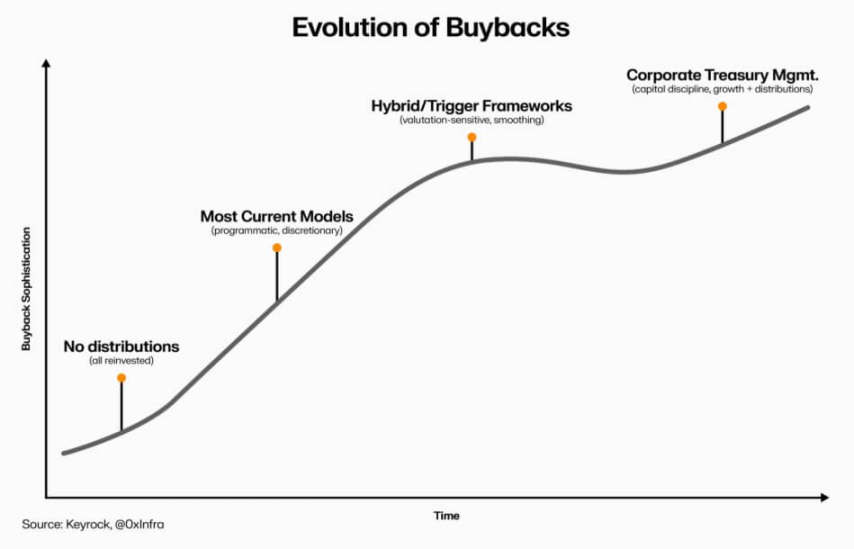
Evolution of DeFi token buybacks (Source: Keyrock)
But one thing is clear: the interaction between DeFi and traditional finance has surpassed "simple imitation." Today, the field is integrating principles of "treasury management," "capital allocation," and "balance sheet prudence" while retaining its "open-source foundation."
Token buybacks are a concentrated manifestation of this integration—they combine market behavior with economic logic, driving DeFi protocols to transform into "self-funded, income-oriented organizations": accountable to the community, measuring success by "execution outcomes" rather than "ideology."
免责声明:本文章仅代表作者个人观点,不代表本平台的立场和观点。本文章仅供信息分享,不构成对任何人的任何投资建议。用户与作者之间的任何争议,与本平台无关。如网页中刊载的文章或图片涉及侵权,请提供相关的权利证明和身份证明发送邮件到support@aicoin.com,本平台相关工作人员将会进行核查。


