Authored by: Tia, Techub News
Anoma's goal is to provide a universal intent machine interface for applications. This means that with Anoma, developers can write applications based on intent and distributed intent machines, rather than based on transactions and specific state machines. Anoma provides a common standard for intent and applications, which does not limit what types of intent can be expressed, but allows for interoperability of state, network, and applications. In a broad sense, Anoma standardizes the verification of whether an intent is met, but does not standardize the way solutions are computed. Intents and applications written with Anoma can be sorted, matched, and settled anywhere.
Anoma has built a complete framework by breaking down the smallest unit of collaboration into "intent" as the lowest level. It is believed that when Anoma accumulates enough users, a myriad of intertwined "intents" will emerge, leading to novel product creations and unprecedented collaborative experiences. Today, the team has sparked many novel ideas about the applications that could be built on Anoma, and the following is a brief introduction to these application concepts.
Public Signal
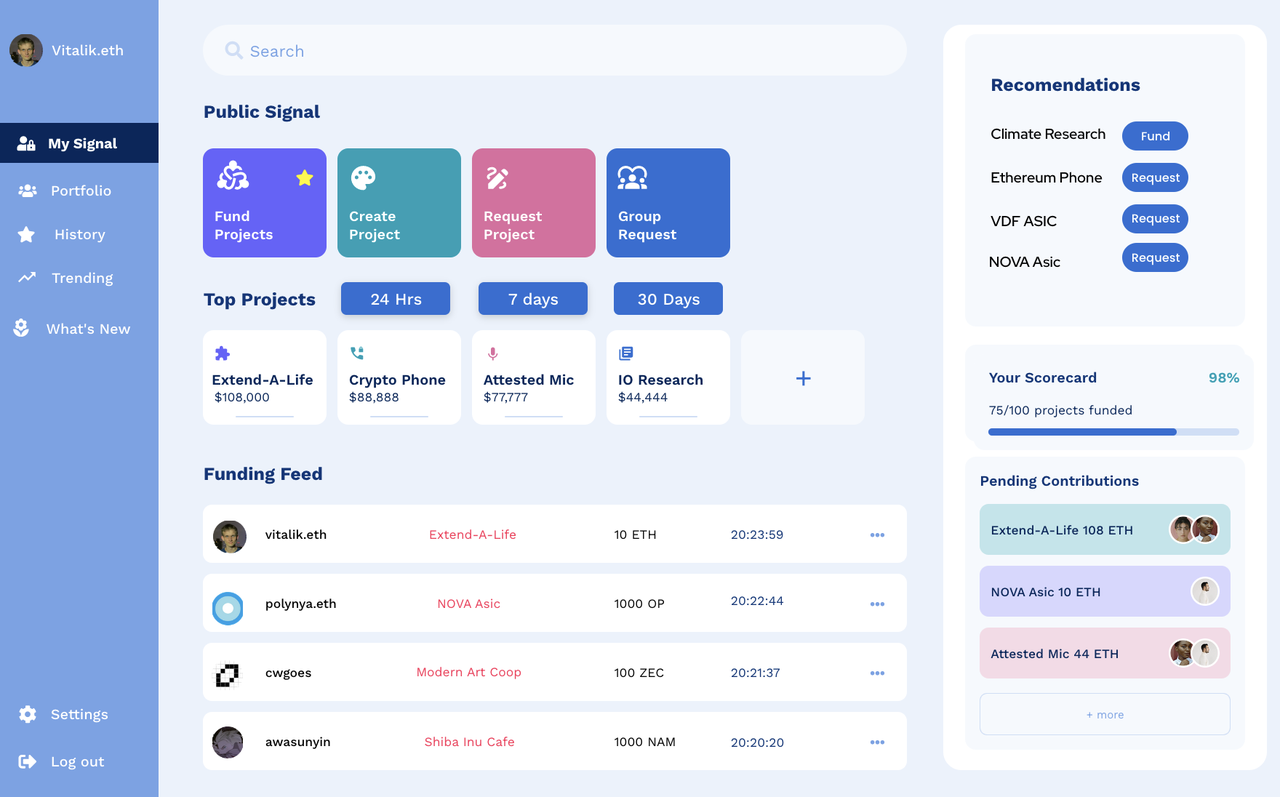
Public Signal is a financing platform. Currently, mainstream public goods financing platforms such as Kickstarter typically operate on a project basis, where the project party in need of funds publishes relevant information about their project on the platform, and funders decide whether to donate. This is a demand-side market. The difference with Public Signal is that its intent-based architecture allows funders to express their needs, such as setting an intent to "donate to the Earth's ecological restoration project" and donating to that intent.
When funders donate based on intent, it can bring about a benefit where a group of users with common intent needs can obtain products exclusive to that specific group through crowdfunding. For example, when a group of users who share the common desire to produce a universal and blockchain-compatible encrypted phone form an autonomous community and donate to it, this will prompt the production side to respond. At this point, consumers will no longer passively accept products, but will have the initiative to influence the direction of product development through intent.
Of course, intent-based donations can have more examples, such as,
Identity-based: Donate 1 ETH to any project that receives over 10 ETH in donations to Vitalik.
Information-based: Donate 1 ETH to any project conducting superconductor research.
Incentive-based: Donate 10 ETH to any project offering a refund bonus.
Threshold-based: Donate 10,000 NAM to any project that raises over 50% of its funding goal within 1 week or less.
Scale-free Kudos
Traditionally, it is commonly believed that currency was born as a medium of exchange for barter. However, in David Graeber's book, we can see that the concept of credit emerged before the birth of currency. In tribal societies, people kept simple records of who gave what to whom and settled regularly. This was the prototype of early scale-free currency. If a resident had good credit, they could obtain what they needed when necessary, and then repay with other goods in the future.
In today's world, this form of accounting cannot be scaled, so we live in a world of legal credit currency. In the world of legal currency, currency is issued only by a few (hopefully) trusted institutions, such as governments and banks, and people trade not personal credit in their daily interactions, but debts issued by these institutions.
This brings about the problem of centralization of trust in legal currency. There may be a few individuals who prioritize personal interests over public interests and become controllers of the currency supply mechanism, using some of the currency for their own private purposes.
Scale-free kudos is a credit currency that anyone can issue. Since the usual form of repayment is in the form of the counterparty's credit currency, the parties exchanging credit (which may be heterogeneous) have a common interest in each other's future success. If I teach you something and you owe me money, I don't care if what I taught you is right or wrong, I just want to persuade you to pay me more money. If I teach you something and you pay me with credit, then I might want to teach you something correct and useful, so your credit will be valuable to me in the future. This is the main idea of scale-free kudos, for more details, see the article Towards Heterotopia - The Cultural and Technical Foundations of Returning to the World of Scale-Free Credit Currency.
Prediction Market
The prediction market is used to aggregate information and predict future events, and is therefore also known as a "futures market for ideas" or an "information market." It can serve as a tool for gathering information and consolidating it into accurate estimates, allowing everyone to use these estimates to make decisions, and the trading price for a particular event is the likelihood of that event occurring.
The prediction market can be used not only for weather forecasts or political election predictions, but also to create free markets for different topics, allowing people to connect money with their opinions. Extending this concept, perhaps in the future, the prediction market could serve as an alternative to traditional news sources, creating a new form of information driven by financial incentives for truth, rather than by clickbait.
In Anoma's architecture, users will make predictions based on intent. The benefit of doing so is that there is no need to rely on "solvers" to update the oracle on many markets. Therefore, in a sense, users are more capable of capturing the MEV of the prediction market. More importantly, if incentivized properly, it can keep the solving market decentralized.
Multichat
In the Web2 world, centralized servers store all data, and user data on social apps cannot be migrated. Major social apps build their own moats by increasing the cost of user migration. Multichat is a decentralized social app built on Anoma. Users can control their information visibility preferences, and because Anoma is intent-based, it has intent composability, meaning that even different programs, as long as there are composable intents, can be matched and settled. At the same time, it will also incorporate ZKP to encrypt the original data.
Time Banks
Unlike currency as a medium of exchange, time banks allow users to deposit time or earn "time credits" by providing skills to those with credits. Currently used mainly in the elderly care industry, for example, young people can contribute time to care for the elderly, and then they can save this time and redeem it when they reach the age when they need care. A time bank built on Anoma can use Anoma for accounting and settlement.
免责声明:本文章仅代表作者个人观点,不代表本平台的立场和观点。本文章仅供信息分享,不构成对任何人的任何投资建议。用户与作者之间的任何争议,与本平台无关。如网页中刊载的文章或图片涉及侵权,请提供相关的权利证明和身份证明发送邮件到support@aicoin.com,本平台相关工作人员将会进行核查。


