Authors: Xiyou, ChainCatcher
Editors: Marco, ChainCatcher
"The point system is a poisonous means for project parties to manipulate the market, and in the future, we will no longer participate in point-based interactive activities," this is the latest statement from an old OG, excluding point-based and brushing projects as new criteria for screening interactive projects.
After EigenLayer announced the conditions for the EIGEN token airdrop on April 30, the controversy over point-based airdrops has not stopped. That evening, during the live broadcast of Bankless with EigenLayer's founder, user comments were even disabled.
In addition to the airdrop shares being lower than the expectations of some users and the linear unlocking of airdropped tokens, EigenLayer also restricted users' IP addresses when claiming the airdrop, causing users who had already accumulated a large number of points to be disqualified from claiming the airdrop due to their IP addresses being blocked.
The controversy surrounding EigenLayer's airdrop has pushed the point-based model to the forefront, exposing the long-standing issues of hoarding, dilution, and issuance hidden under the point-based reward system.
The sentiment against point-based activities has reached an unprecedented high, with statements refusing to participate in point-based activities beginning to spread within the community. The founder of Compound spoke out, declaring "the era of points is over," and the founder of the "originator of airdrops" suggested that projects "issue tokens instead of points." The once popular point-based system seems to have fallen out of favor in terms of reputation.
The Controversial "Point System": Dilution, Hoarding, Game for Large Holders, and Non-transparent Calculation Rules
Before the EigenLayer airdrop controversy, the point-based system had already been embroiled in multiple disputes, including hoarding, dilution errors, PUA users, games for large holders, and non-transparent rules. The EigenLayer controversy simply brought to light the long-standing issues hidden by the point-based system.
"Hoarding" and games for large holders are the most criticized issues.
Taking the EigenLayer airdrop as an example, it was announced on April 30 that the snapshot date for the airdrop was March 15, but several large holder addresses seemed to have known the insider information in advance, as they coincidentally transferred all the deposited tokens the day after the airdrop snapshot.
For instance, the legendary trader GSR coincidentally transferred his wBETH worth $7 million on March 16, the day after the EigenLayer snapshot, and a wallet newly funded by Binance also withdrew all the wBETH worth $13 million from EigenLayer on the same day.
These suspiciously precise transfer timings have led users to suspect that these individuals had insider information.
Layer2 network Blast, which promoted the point-based system, was pointed out by community users for secretly issuing a large number of gold points to certain Dapps without making any announcements or disclosures.
Due to the popularity of the point-based decentralized GPU project io.net, it was questioned by users in April for hoarding points. It was suspected that the project team and VC institutions disguised themselves as ordinary users to collectively mine points.
Furthermore, issues such as point dilution, data errors, and PUA users frequently arise due to the non-transparent and unclear calculation rules of point-based projects.
Similarly, after the official upgrade of the io.net system, multiple GPU mining users found errors in their platform's point data. Subsequently, the official statement indicated that the point values displayed on the website were only from internal testing, based on past snapshots and partial placeholder values, and did not reflect the real points in the Ignition reward plan. These issues have yet to be resolved, and the confusion in io.net's point data and the calculation of multiple cards as a single card remain unsolved.
In February, the staking protocol EtherFi became embroiled in a controversy over "point dilution and point theft." Community members reported that under the same staking amount and duration, EtherFi had about 10% fewer EigenLayer points compared to the Renzo staking protocol. The official response stated that the point data displayed on the protocol's homepage was indeed incorrect, and users actually received many more EigenLayer points than the currently displayed data.
In March, the new point-based gameplay "Word-of-Mouth Backfire" released on the Blast mainnet was accused of being PUA. The new rule required users to migrate ETH points to the mainnet to enjoy a 10x inflation, but the migration required a gas fee of around $50, which was too high for small retail users. Furthermore, users found that the inflation factor after migration was a random number between 0 and 10x.
Although the Blast official later claimed that it was a UI calculation error and the loophole had been fixed, it still left behind criticism of the non-transparent calculation rules of the point system.
For users who did not migrate to the mainnet, it meant that their points would no longer have the opportunity to double, and the value of their existing points would be diluted. If they wanted to cash out, they would have to wait for more than ten days after withdrawing their funds to the mainnet, leaving participating users in a difficult position. If they did not continue to invest and interact with Dapps, their points would be diluted by others.
Some community members expressed that Blast had led users into a situation where they could not get off the ride, not only erasing their previous contributions but also diluting the points they had genuinely earned, while also exposing them to risks such as new projects like Rug.
One netizen described the gameplay of Blast's mainnet points as similar to a situation where your mother-in-law initially said that a dowry of 100,000 yuan would be enough, but on the night before the wedding, she suddenly asked for more money.
Furthermore, as the current point-based systems are mainly calculated based on the volume and duration of deposited funds, the financial strength of large holders has unilaterally dominated, clearly becoming a "game for large holders."
In EigenLayer's airdrop, Justin Sun alone received 3.55 million EIGEN tokens, accounting for a high percentage of 4.26% of the total airdrop in the first season.
Regarding the current point-based activities of projects, crypto user @sunlc_crypto stated on social media that they are not planning to participate in any brushing or point-based projects in the future.
Everyone is desperately trying to increase their trading volume to earn points, but ultimately, the interpretation of the rules is entirely in the hands of the project party. How points are exchanged for tokens, or even whether they are exchanged according to points, is entirely at the discretion of the project party.
Behind the Controversy of the Point System: Input and Output Are Not Proportional
At present, the point-based gameplay of most projects is largely similar, mainly focusing on the simple stages of "recruiting, depositing funds, earning points, and striving for airdrops." The rampant point-based gameplay has led to aesthetic fatigue and even criticism.
Ken, a crypto project operator, stated in an interview with ChainCatcher that the point-based system itself is not the problem. Its essence is to encourage users to interact more actively with the project in exchange for points, transforming qualitative measurement standards into quantifiable indicators. If used properly, points are a good way to collect relevant community information about the project.
"The current controversy behind the Web3 point system is that the input and output for users are not proportional," Ken explained. The core of point system design is to achieve a balance between the platform's input and output and the user's input and output.
In the Web2 world, the most important aspects of point system design are where the points come from and where they go, that is, how points are obtained and how they are consumed.
From the platform's perspective, the core of point system design is to set corresponding point rewards for tasks that the platform wants users to complete. After points are issued to user accounts, efforts should be made to guide users to consume the points, while continuing to generate output, thereby increasing the platform's revenue.
From the user's perspective, the value of points is paramount, that is, whether the things that points can be exchanged for have value and are desirable, as well as whether the time and effort spent to earn points match the value of the points exchanged.
In the current Web3 world, the point system is mainly used by project parties as an incentive tool to attract customers and funds through the expectation of token airdrops. Users need to recruit, interact, deposit funds, earn points, and then strive for a possible airdrop opportunity, which is not 100% guaranteed.
The project parties harvest real TVL and user data through the point mechanism, and the valuation subsequently rises.
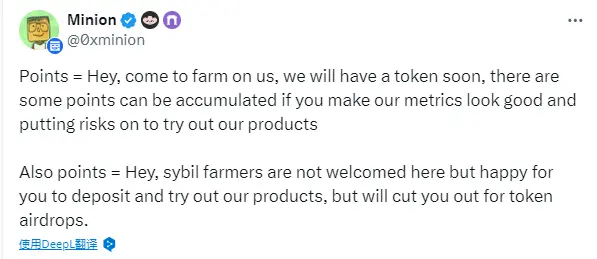
Crypto user 0xminion once stated on social media that the project parties' points imply to users, "come and farm with us, we will soon have tokens. If you make our metrics look good and take the risk to try our product, you can accumulate some points." Some points are not welcome to users who only deposit funds and try out the product, but they will be excluded from the token airdrop eligibility.
As recently, the Solana ecosystem derivative product Drift Protocol, after launching a points trading activity for several months, initiated an airdrop. However, the airdrop reference was not based on points, but was distributed to OG users. Early users who were attracted by the points ended up empty-handed, with potential financial and time costs.
Furthermore, the current point system mainly revolves around deposits or trading volume. The acquisition of these points is based on asset quantity, participation duration, fund size, and number of trades, with a certain withdrawal restriction period. This means that users need higher time and financial costs compared to previous airdrop formats.
Under the point system, the final airdrop benefits for users who only deposit funds may not be higher than before. The calculation of the input and output ratio may even result in a loss, leading to what is commonly referred to as being "counter-brushed."
Some users in the community complain that the point system is a poison used by project parties to lure users into airdrops. By leveraging the expectation of point-based airdrops, project parties attract a group of users and TVL, leading to a continuous increase in the valuation of the project, attracting more investment. In this process, the project parties incur zero costs, and even though there are some airdrops later on, the project parties do not incur any costs for issuing these tokens, while users invest real money, time, and effort.
The mismatch between the final airdrop benefits and the input and output ratio is the fundamental reason for the criticism of the point system.
Furthermore, due to the large-scale private placements and high FDV airdrop models brought about by the points, the total value of airdropped tokens that users ultimately receive is far lower than expected. Once the tokens are listed, their value continues to decline, resulting in what can be described as a loss.
Business Opportunities Derived from the Point System
Because it is a "wolf in sheep's clothing" game, and there are successful cases in the past, the point system is still worth trying for project parties.
In December, the staking network Blast launched a points incentive strategy, and within one day of its launch, the TVL exceeded $100 million. Within three months, it attracted a whopping $2.3 billion in funds, marking the beginning of the point system craze.
More and more Web3 projects are joining the ranks of using point rewards and launching their own point-based growth strategy. Users can earn points by participating in specific tasks, and the higher the points, the greater the probability and quantity of airdrops they will receive later on.
Projects such as the Layer2 networks Arbitrum, Starknet, Scroll, and Linea, as well as the Solana ecosystem's exchanges Backpack and Drift, AI product io.net, Bitcoin ecosystem Layer2 networks B²Network and BounceBit, and the rise of the Eigenlayer restaking concept have further fueled the popularity of the point system. Projects such as Renzo, Puffer Finance, Eigenpie, Swell, KelpDao, and Ether.Fi have engaged in fierce battles over points, allowing for dual mining or multiple benefits.
In February of this year, The Block reported that there were already 14 projects issuing over 111.5 billion points.
With the hype surrounding points, some project parties have seen entrepreneurial opportunities and have developed specialized point trading platforms and third-party point design products, such as the point financial product Pionex.
In April, crypto KOL @MrBlock warned that the point market could be the next token market, advising users not to miss out.
In December of last year, the point trading OTC market Whales Market was established, allowing users to trade their earned points in a peer-to-peer manner, solving the problem of how to price points.
For example, the current price of Blast points is $0.00009, the price of Eigenlayer points before the token listing was $0.198, and the price of BounceBit points is $0.012.
According to Dune data, as of May 10, the Whales Market platform has completed trading volume of approximately $110 million, with over 30,000 users.
Currently, there are also point trading platforms such as Michi Protocol and PointMarket, as well as products like Pendle that tokenize future point benefits.
There are also third-party products designed for points, such as the on-chain point management tool Stack, which completed a $3 million seed round of financing led by Archetype in March.
The Web3 reputation platform Trusta Labs is also working on building a fair and auditable third-party point platform, allowing project parties with point needs to publish their points on this platform.
The emergence of the point trading market allows users to discover the value of their points. Combined with the clear point acquisition system of projects, users can estimate the potential return on investment and lock in point profits early on through trading platforms, avoiding being "counter-brushed."
How to Design a Reasonable Point System?
Regarding the criticism of the non-transparent rules of the point system, crypto user Yelo, in an interview with ChainCatcher, stated that the current Web3 point systems are mostly designed and issued by the project parties themselves, and the points are off-chain. This means that project parties can adjust the point system as they please. Additionally, the supply of points can be unlimited, and the ways in which points are used and exchanged can be modified, giving the project parties complete control over the final interpretation and use of the points.
Simon, the CTO of the on-chain reputation platform Trusta Labs, also stated in an interview, "Off-chain points are based on the centralized project party database for statistics and storage, and there is indeed the possibility of bad project parties engaging in hoarding with fake accounts and fake points. At the same time, the total issuance of points, the subsequent token exchange ratio and method have never been determined and disclosed like TGE."
To address this issue, it can be achieved through on-chain points or third-party supervision platforms, making the total allocation of points and the historical records of the distribution methods transparent. There are already on-chain point products on the market, such as Stack, which can tokenize points in an ERC20 manner, supporting the traceability of each point distribution data.
He also emphasized that when designing a point system, project parties should pay attention to setting different weights for different reward behaviors. For example, in pure staking fund incentive-based points systems like Blast and Eigenlayer, the top rankings are dominated by large holders with substantial fund investments, which may exclude a large number of genuine users willing to participate in the project from receiving widespread support in the community.
In terms of the usage scenarios for points, crypto user Nancy, in an interview with ChainCatcher, mentioned that the actual usage of points in Web3 is relatively limited. Apart from being used to strive for airdrops and exchange for tokens, there are no other usable scenarios. In the Web2 world, points have multiple uses, including exchanging for goods, enjoying discounts, or other benefits.
"Can the points of Web3 projects be designed for various types of rewards, from discounts, product benefits, to ownership and governance of the project, and even directly affecting income?" Nancy suggested.
Regarding how to design a reasonable point system, KatieWav, a researcher at the crypto institution Archetype VC, once stated that the main goal of a project's point system should be to encourage product usage, rather than point accumulation. Ensuring that the point plan ultimately brings users back to their product ecosystem is the key to successfully launching a point growth-driven flywheel, rather than encouraging potential user behavior that leads to point airdrops, and directly converting points into product advantages to help with product feedback, improvement, and testing specific features is the way forward.
She gave the example of the social platform Farcaster Warps, where points earned on the platform can be used as gifts for other users or for discounts when purchasing NFTs within the platform, reducing the risk of speculative participation.
免责声明:本文章仅代表作者个人观点,不代表本平台的立场和观点。本文章仅供信息分享,不构成对任何人的任何投资建议。用户与作者之间的任何争议,与本平台无关。如网页中刊载的文章或图片涉及侵权,请提供相关的权利证明和身份证明发送邮件到support@aicoin.com,本平台相关工作人员将会进行核查。


