Mind Network is the first re-staking solution designed for AI and PoS networks based on FHE.
The Holy Grail of Cryptography - Fully Homomorphic Encryption
On May 5th, Ethereum founder Vitalik once again shared his 2020 article on FHE (Fully Homomorphic Encryption) on Twitter, igniting continued interest and discussion about the application of FHE technology. Vitalik's article delves into the relevant mathematical principles, and the original English version can be found here.
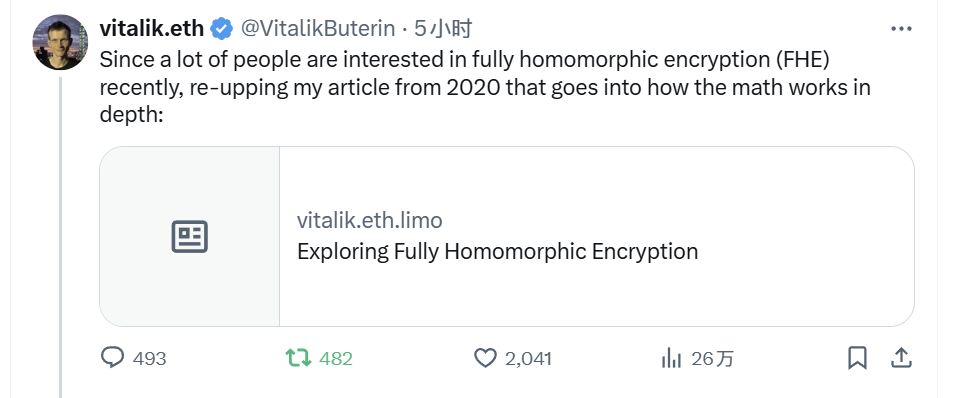
FHE (Fully Homomorphic Encryption) is known as fully homomorphic encryption computation in Chinese, and like ZK, it is one of the forefront areas of cryptography, also known as the Holy Grail of cryptography.
In simple terms, fully homomorphic encryption allows for direct computation of encrypted data without the need for decryption.
When 1+2, it is easy to obtain the result 3, but when encrypted, Encrypt(1)+Encrypt(2) can still yield Encrypt(3). This is the essence of FHE, where ciphertext computation equals plaintext computation after encryption.
Unlike ZK, FHE places more emphasis on data privacy and security in the application of Web3. From current applications, it is not difficult to see that ZK is more focused on scalability.
Although ZK technology, particularly ZKRollup, is more well-known in the Web3 space, FHE is gradually unleashing its unique potential in multiple fields, especially in AI.
Mind Network
Mind Network is the first re-staking solution designed for AI and PoS networks based on FHE.
Just as EigenLayer serves as a re-staking solution for the Ethereum ecosystem, Mind is the re-staking solution for the AI field. Through re-staking and the FHE consensus security solution, it ensures the token economic security and data security of decentralized AI networks.
Looking at the team background, the main members of Mind are primarily professors and doctors in AI, security, and cryptography, from institutions such as Cambridge, Google, Microsoft, and IBM. The core members have been selected as one of the 12 global Ethereum Foundation Fellows and have conducted research in cryptography and security in collaboration with the Ethereum Foundation research team. Mind's world-first FHE+Stealth Address solution—MindSAP (research paper link, original article for everyone to read and understand) has solved the problem raised by Vitalik in the Stealth Address Open Problem, attracting considerable attention in the Ethereum community and publishing papers and giving presentations multiple times.
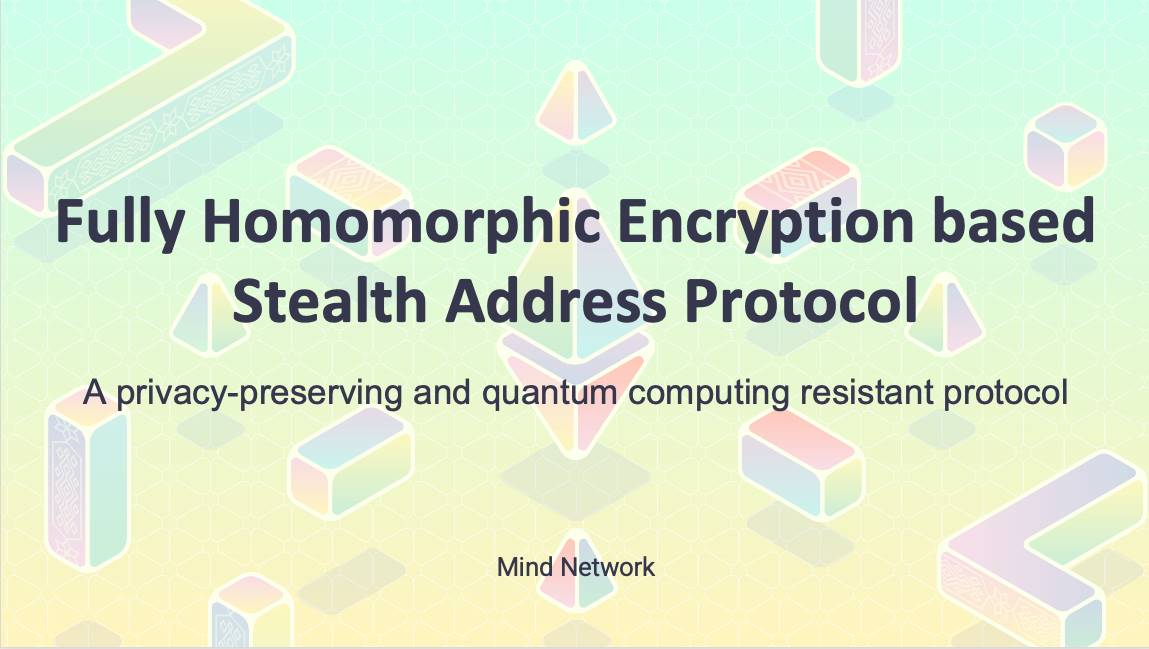
In 2023, Mind Network was selected for the Binance Incubator and completed a $2.5 million seed round of financing with participation from well-known institutions such as Binance. It also received the Ethereum Foundation Fellowship Grant, was selected for the Chainlink Build Program, and became a Channel Partner signed by Chainlink.
In February 2024, Mind Network became a key partner in the FHE field for the renowned cryptography company ZAMA.
Recently, Mind Network has further accelerated the expansion of its ecosystem, providing AI network consensus security services for io.net, Singularity, Nimble, Myshell, AIOZ, and others, and providing an FHE Bridge solution for the Chainlink CCIP. It also provides AI data security storage services for IPFS, Arweave, Greenfield, and others.
FHE+AI, Addressing Core Pain Points of AI
At the Web3 conference in Hong Kong in April of this year, Vitalik expressed his future expectations for FHE in scenarios such as Encrypted Voting. FHE, as a forefront of cryptography, is also the ultimate direction pursued by Ethereum in cryptography.
The founder of ZAMA recently published an article about its "Master Plan." It outlines the company's vision to create an end-to-end encrypted network HTTPZ ("Z" stands for "Zero Trust") and proposes to make FHE ubiquitous in the blockchain and artificial intelligence fields.
Several key points of focus in the AI field, including training, tuning, usage, and evaluation, all face the same challenge in the decentralized process: how to remove trust assumptions. For example:
When an AI model is being trained, it needs to conduct cross-validation to select the best training results.
Before an AI service is used, it needs to rank existing services to determine the best service.
AI models also need continuous tuning and iteration, requiring independent evaluation.
In centralized scenarios, these processes are based on trust assumptions about large companies providing endorsements. However, in the decentralized process, without endorsements, verifying the fairness and effectiveness of collaboration among all participants is a challenge, and this is precisely where FHE empowers.
For example:
When an AI model is being trained and needs to conduct cross-validation, the best training results can be selected through anonymous voting, removing assumptions similar to those of OpenAI.
Before an AI service is used and needs to rank existing services, the quality of each service can be determined through anonymous ratings, removing assumptions similar to those of an AI AppStore.
When AI models need continuous tuning and iteration and require independent evaluation, trustworthy evaluations can be completed through random sampling, removing assumptions about evaluation organizations.
The involvement of FHE can also enable AI to achieve zero trust, filling in the trust assumptions that ZK still requires off-chain aggregation for.
There are many examples of AI that can be cited, including how zero trust can enable AI agents and multi-agents to better achieve intelligent interconnection and achieve good governance.
Furthermore, FHE's unique ciphertext computation capabilities can also address two other challenges: data privacy and data ownership:
Who can see our data? = Data privacy
Who does the data that AI gives us belong to? = Data ownership
FHE can ensure that data is always encrypted on the user side and only exists in ciphertext form outside the user, including storage, transmission, and computation.
So far, apart from FHE, data can only be encrypted in storage and transmission. However, once it involves computation, the ciphertext needs to be decrypted into plaintext, which exactly makes users lose ownership of the data. In real life, there are many examples of this. Once your plaintext data is copied by someone else, they can make many copies, and you have no way of knowing if others are using your data. You can only rely on the self-declaration of the data user and third-party supervision. FHE can allow users' ciphertext data to require the user's consent for decryption and viewing of plaintext data, even if it is copied. This way, users can always perceive the dynamics of the data, achieving data availability and tradability without visibility, protecting data privacy and truly protecting data ownership.
Such features are urgently needed for the combination of AI and Web3, as it allows for public staking in an encrypted manner to achieve consensus and prevent malicious behavior and waste.
The Next Big Thing in AI
From this perspective, the combination of AI and Web3 is a must-have, and FHE for AI is like the "next big thing" for Apple.
Recently, IO.NET and Mind Network announced a deep collaboration to co-create solutions to enhance the security and efficiency of artificial intelligence. IO.NET will integrate Mind Network's fully homomorphic encryption solution into its distributed computing platform to help strengthen the security of its products.
For details about the collaboration, please refer to: Mind Network and io.net Partners up for Advanced AI Security and Efficiency
IO.NET has set a good example for the combination of AI and FHE in distributed computing.
For example, users provide computing power, and AI developers rent the computing power.
When a developer comes to an AI project and presents a requirement, it is split by the system, and the computing power provided by the user is used for the calculation.
This involves several issues: Whose computing power is being rented? Is the result of the calculation correct? Will renting computing power leak the privacy of both parties?
- Whose computing power is being rented?
Normally, the selection of nodes is based on test tasks, which means periodically releasing requirements to test which nodes are online and ready to accept requirements.
During this process, there may be targeted manipulation by related nodes to gain priority, similar to MEV attacks.
In response, Mind provides a fair distribution mechanism through FHE. Since requests and data are encrypted, nodes cannot use this information to make advantageous selections.
- Is the result of the calculation correct?
In distributed computing, ensuring the correctness of the calculation result requires a certain level of consensus, i.e., voting.
When nodes know each other's choice results, there may be collusion, leading to unfair and incorrect results.
FHE encrypted computation allows voting results between nodes to be mutually encrypted, but still allows participation in the final calculation, ensuring fair results.
- Will renting computing power leak the privacy of both parties?
The core of FHE is data security. It is encrypted during computation and also encrypted for the problem to be computed, naturally avoiding privacy leaks.
Looking at Restaking
IO.NET itself can be seen as a PoS network, where nodes need to stake IO tokens to receive IO rewards from contributing computing power.
The potential issue is that if the staked token price fluctuates too much, it will affect the validators and network security.
Mind's solution to this is Dual Staking, and even Triple Staking.
Staking supports liquidity staking tokens for BTC/ETH and blue-chip AI network tokens, diversifying risks and increasing the overall security of the network. Essentially, it is an advanced version of shared security for Restaking.
At the same time, Mind also supports Remote Staking, where LST/LRT assets do not require actual cross-chain transactions, ensuring the security of assets.
Just a few days ago, Mind also completed the Glaxe testnet task, with over 650,000 active users participating and generating 3.2 million testnet transaction data.
According to official sources, Mind's mainnet protocol will be launched soon, so it's worth keeping an eye on.
In Summary
In conclusion, we find that Mind, while discussing FHE and AI, is actually focused on "security," using cryptography to address various core security issues.
Restaking ensures token economic security; Remote Staking ensures asset security; FHE ensures data security; AI+FHE ensures consensus security.
The blockchain's foundation is based on cryptography, and perhaps it will find the future's answers in cryptography.
In addition to AI networks, Mind Network is also expanding the applicability of its solutions, collaborating in multiple directions such as decentralized storage, EigenLayer AVS network, Bittensor Subnet, cross-chain bridges, demonstrating the enormous potential of FHE.
At Web3 in 2024, if the ZK has set the stage for the field of cryptography, then FHE will be the main theme in the second half of the year. At the same time, the heat of AI remains high. With the triple narrative of AI+FHE+Restaking and the aura of investment from the Ethereum Foundation and Binance, whether Mind can lead FHE, with the launch of the mainnet, will soon be revealed.
免责声明:本文章仅代表作者个人观点,不代表本平台的立场和观点。本文章仅供信息分享,不构成对任何人的任何投资建议。用户与作者之间的任何争议,与本平台无关。如网页中刊载的文章或图片涉及侵权,请提供相关的权利证明和身份证明发送邮件到support@aicoin.com,本平台相关工作人员将会进行核查。


