TL;DR:
- Axelar is part of both the whole-chain and Cosmos ecosystems. The whole-chain track will gain more growth space and market attention as trading volume and the number of public chains increase during the bull market. The more direct catalysts may come from Layerzero and Wormhole issuing coins. The Cosmos ecosystem is developing healthily, and the overall rise in the ecosystem by the end of 2023 has also attracted market attention to the Cosmos ecosystem.
- Axelar has accumulated deep technical advantages in the whole-chain track and will become the core target in the whole-chain narrative. Axelar has achieved interoperability among 56 chains, surpassing competitors like Layerzero. GMP and AVM simplify the multi-chain development process for developers, helping them achieve full-chain contract deployment and liquidity integration.
- In this round of the cycle, the basic cross-chain deployment of cross-chain protocols can basically only be external verification bridges. Compared to similar cross-chain protocols, Axelar has satisfactory performance in terms of security, number of cross-chains, and the number of integrated dApps. Compared to direct competitors Layerzero and Wormhole, Axelar's valuation is much lower.
- Axelar is the main channel connecting the Cosmos ecosystem and EVM chains, especially the connection between Osmosis and EVM chains. As a liquidity gateway for the Cosmos ecosystem and EVM chains, it will directly benefit from the growth of the Cosmos ecosystem.
1 Fundamental Analysis: Axelar unlocks more cross-chain possibilities
1.1 Axelar Cross-Chain 101
Axelar is developed based on the Cosmos SDK and is compatible with all EVM chains. It is an application chain designed to connect all blockchains, achieve true interoperability, and support bridging any information/assets. In terms of implementation, Axelar belongs to the external verification cross-chain protocol, and it is a complete PoS public chain with an independent decentralized network and validators.
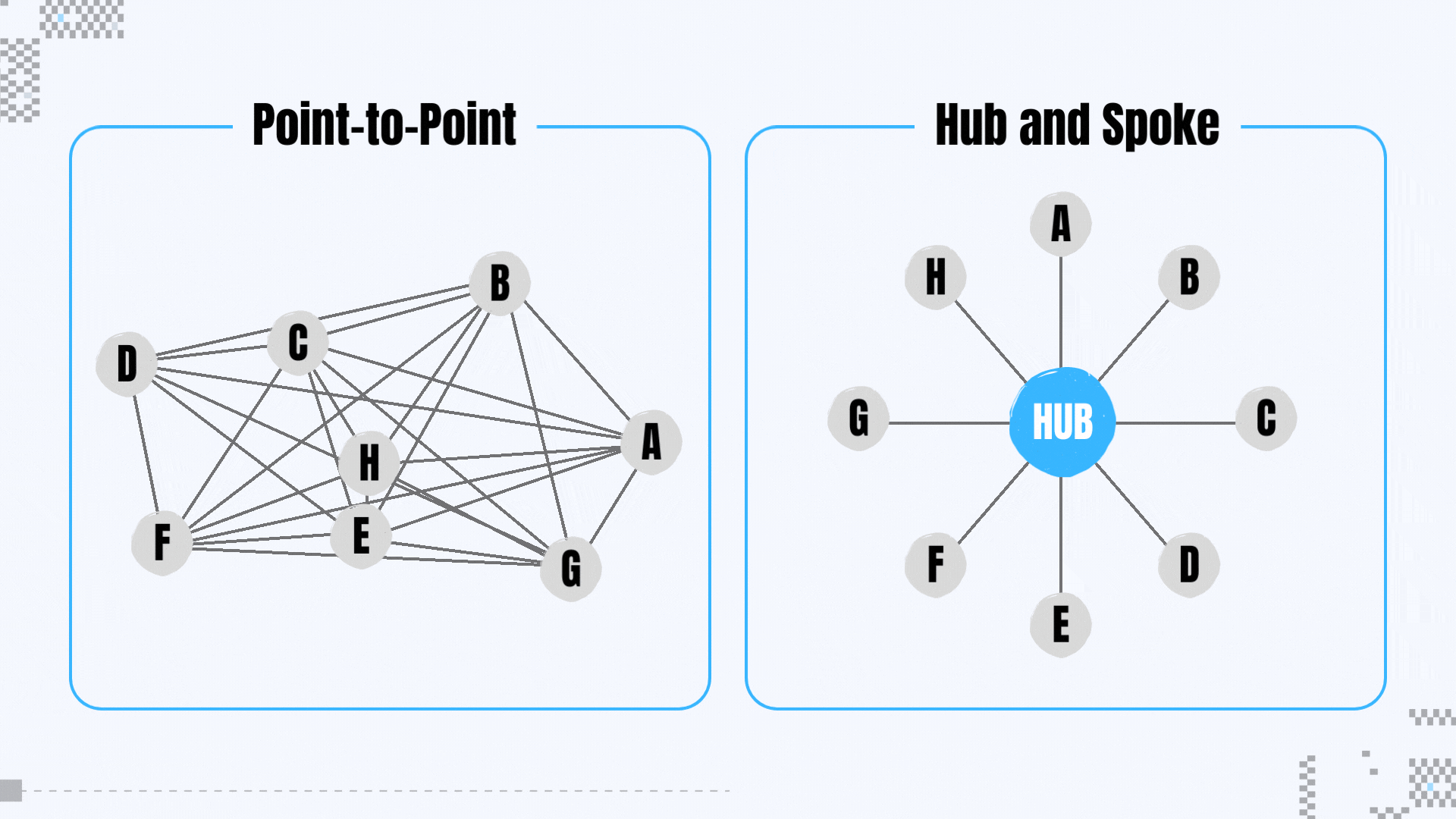
Axelar is built using a central hub-and-spoke topology, similar to the Hub-Zone topology of the Cosmos ecosystem. Each public chain is directly connected to Axelar (the hub), enabling indirect connections rather than point-to-point connections, reducing the number and complexity of connections and improving the scalability of connections.
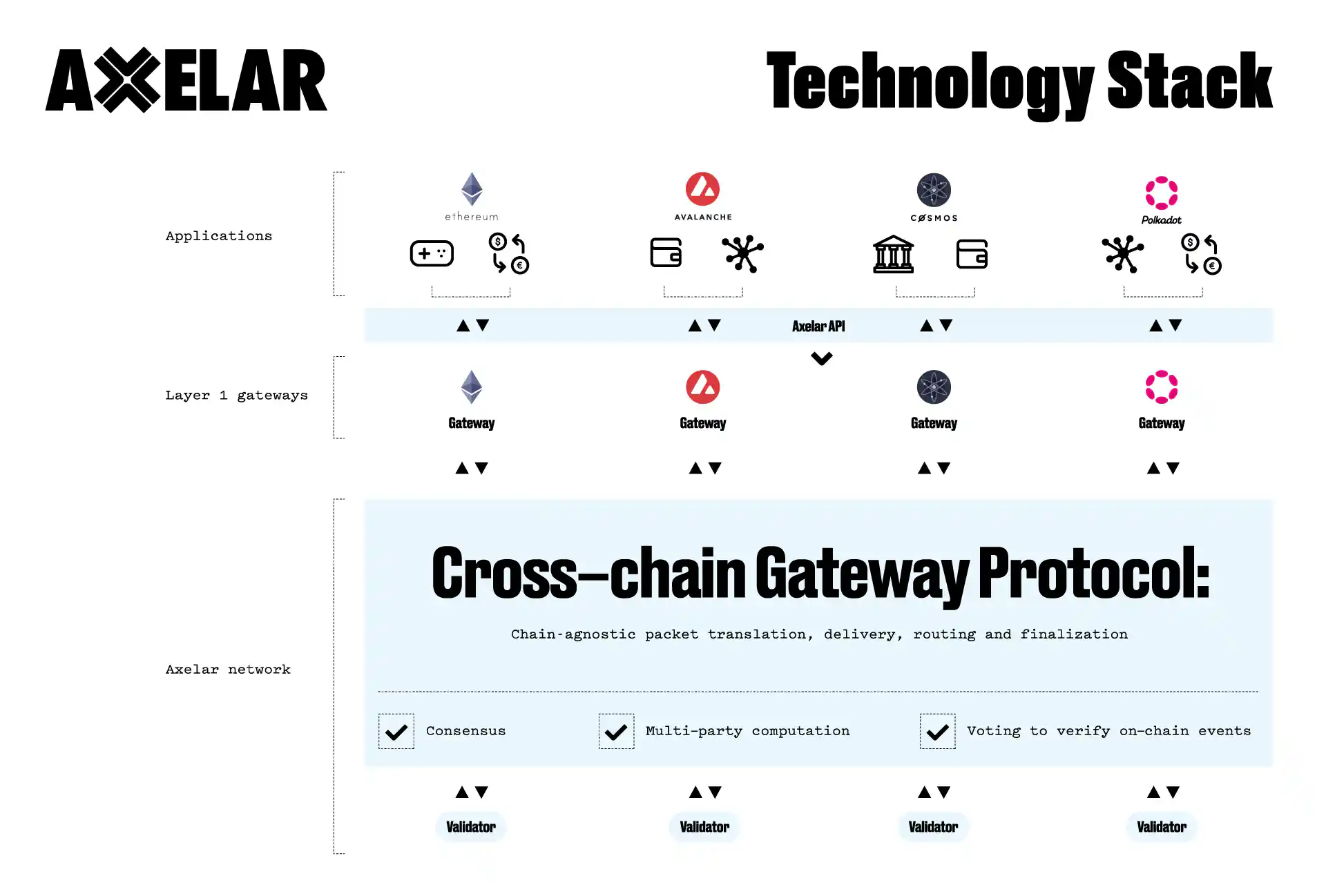
In terms of specific implementation, Axelar's technical stack mainly includes three key components: decentralized network/gateway smart contracts/API, and developer tools. The decentralized network serves as the trust and transport layer for Axelar's cross-chain, consisting of a dynamic, decentralized set of validators responsible for validating on-chain events and executing read/write operations on gateway smart contracts deployed on connected public chains. The gateway smart contract, together with the decentralized network, forms the core infrastructure layer. Validators monitor the source chain's gateway smart contract and read transactions, then reach consensus on the validity of transactions and write them to the target chain's gateway for cross-chain transaction execution. The API and developer tools are the application development layer, enabling developers to easily add general interoperability to their blockchains and applications.
For cross-chain protocols, security is the most critical requirement. Axelar mainly ensures the system's security through three mechanisms:
First, secured by the Proof of Stake (PoS) consensus of $AXL, which is the mechanism for external validators to reach consensus on cross-chain transactions. The security of Axelar's cross-chain fundamentally depends on the security of the Axelar public chain under PoS consensus. It relies on a dynamic and permissionless set of validators, providing higher security compared to external verification bridges relying on PoA or multi-signature.
Second, Quadratic Voting further enhances the decentralization of the consensus mechanism. Quadratic Voting, where the cost of voting equals the square of the number of votes, is used to mitigate the threat of oligopoly monopolies to network security and avoid the monopoly's review of transactions. Axelar implemented Quadratic Voting for verifying and processing cross-chain transactions in the Maeve upgrade at the end of August 2022.
Third, other security measures apart from the consensus mechanism, mainly including rate limiting and network key rotation. Axelar's gateway has rate limiting to restrict the amount of assets that can be transferred within a given time interval. In addition, validators are encouraged to rotate keys every two months to protect the network from continuous attacks. Furthermore, the Axelar network and contracts are 100% open source, and a bug bounty program will incentivize inspection and submission of potential vulnerabilities.
1.2 General Message Passing (GMP)
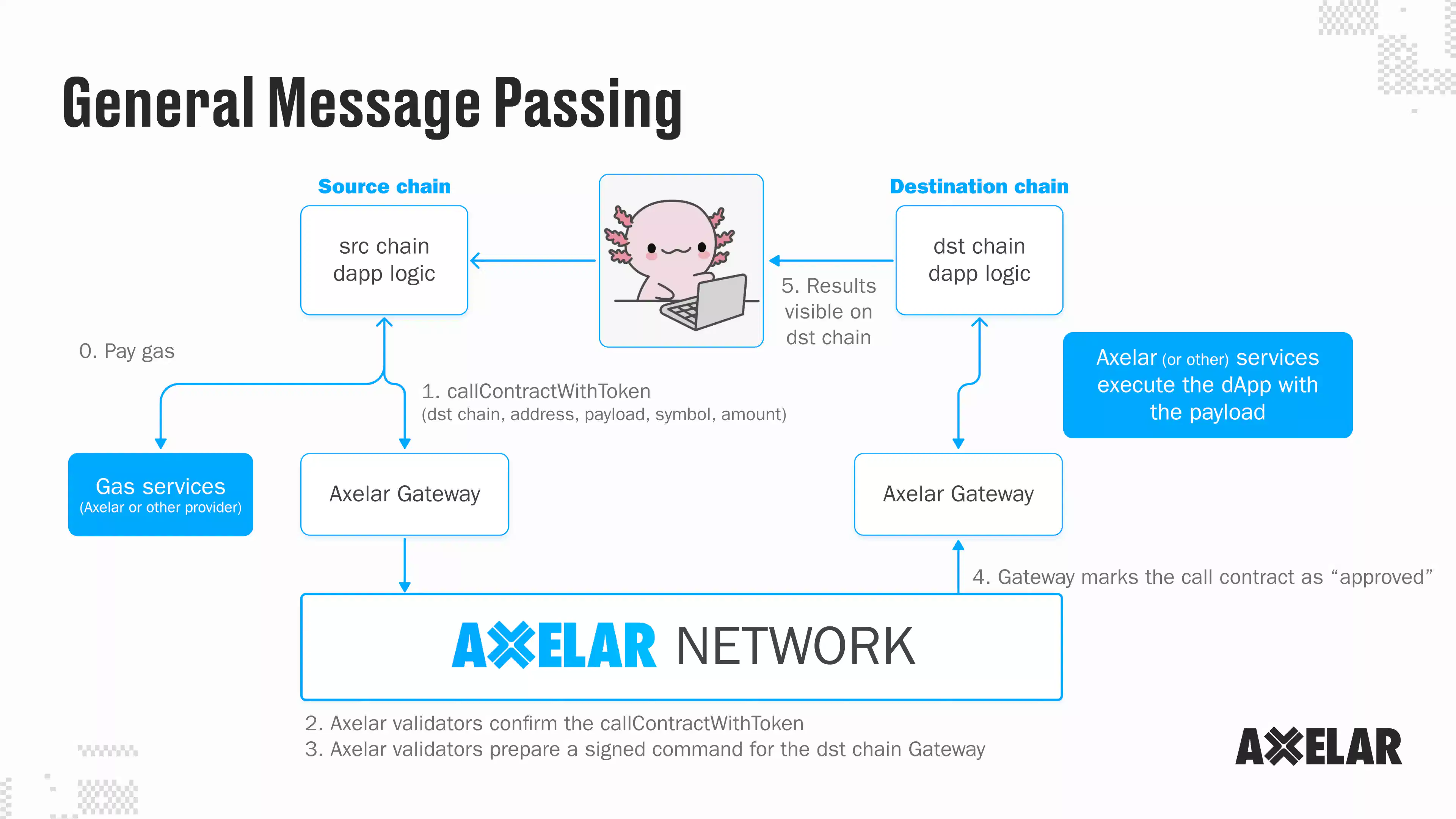
General Message Passing goes beyond the concept of bridging assets, allowing developers to build native cross-chain applications and abstract chains for users to make cross-chain function calls and state synchronization. The implementation process and working principle of Axelar GMP are as follows:
Users initiate a call on the source chain, which enters the Axelar gateway contract from the source chain and is passed to Axelar's decentralized network. Axelar's validators confirm the call, deduct the usage fee, and prepare to initiate the transaction on the target chain. Once this call is approved, it enters the target chain's gateway through the Gateway-to-Gateway process and is eventually executed. This process takes approximately 120 seconds and is verified and secured by Axelar's PoS mechanism.
1.3 Axelar Virtual Machine (AVM)
Building on General Message Passing, Axelar is becoming the underlying protocol for Dapp development. To enhance customization and simplify multi-chain development, Axelar has developed AVM, which, supported by Cosmwasm, transforms interoperability into a programmable layer, allowing developers to write smart contracts on Axelar that abstract cross-chain tasks, simplifying the user experience. Currently, three functions have been implemented based on AVM:
- Interchain Amplifier: Allows developers to establish connections with the Axelar network without permission, connecting to all chains in the Axelar ecosystem by paying the cost of developing a connection, thus "amplifying" resources. Permissionless connections will promote rapid expansion of the ecosystem connected by Axelar.
- Interchain Maestro: If developers want to deploy contracts on multiple chains, they need to repeat the deployment process multiple times, consuming a lot of time and cost. Interchain Maestro allows developers to build a contract once and run it on multiple chains, reducing the cost of extending or cloning contracts to other chains.
- Interchain Token Service: A component of Interchain Maestro, released on the testnet in July 2023. It allows developers to easily deploy cross-chain tokens, reducing the cost of deploying tokens on multiple chains. These tokens can achieve interoperability, solving the problem of fragmented liquidity across multiple chains, improving DeFi liquidity, simplifying cross-chain liquidity mining and staking, allowing cross-chain collateral, and creating chain-agnostic wallets, among other things. Sushi is one of the earliest applications to adopt the Interchain Token Service.
1.4 Token Economics: New proposals will effectively reduce the inflation rate
AXL has three main uses:
- Rewards: Token holders can stake AXL in validator pools to earn rewards. Network validators generate blocks by staking AXL and verify and vote on messages to earn commissions.
- Fees: Used to pay for cross-chain fees on the Axelar network.
- Governance: Allows token holders to participate in governance proposals such as parameter changes or protocol upgrades.
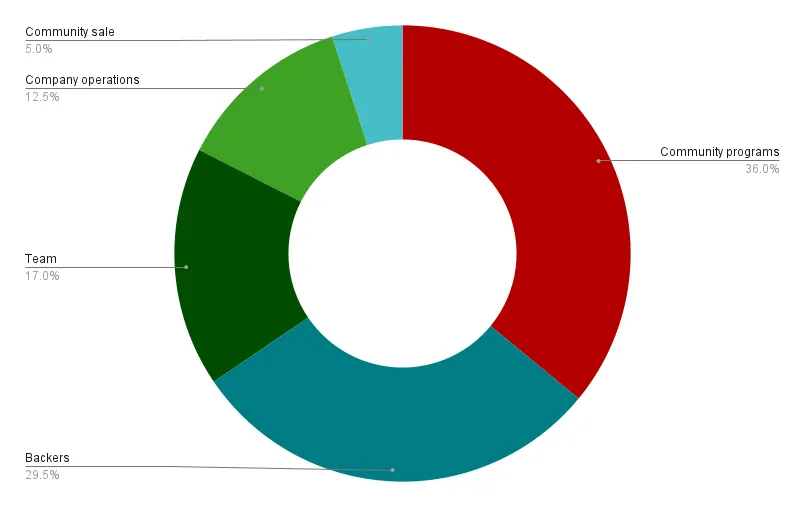
AXL tokens were issued in September 2022 with an initial supply of 1 billion and no maximum supply. The token distribution and unlocking schedule are as follows. The current circulating supply is 535,564,229, the total supply is 1,128,220,669 (according to Coingecko data), and the staked amount is 761 million (according to Axelarscan data), resulting in a token inflation rate of 6.1%.
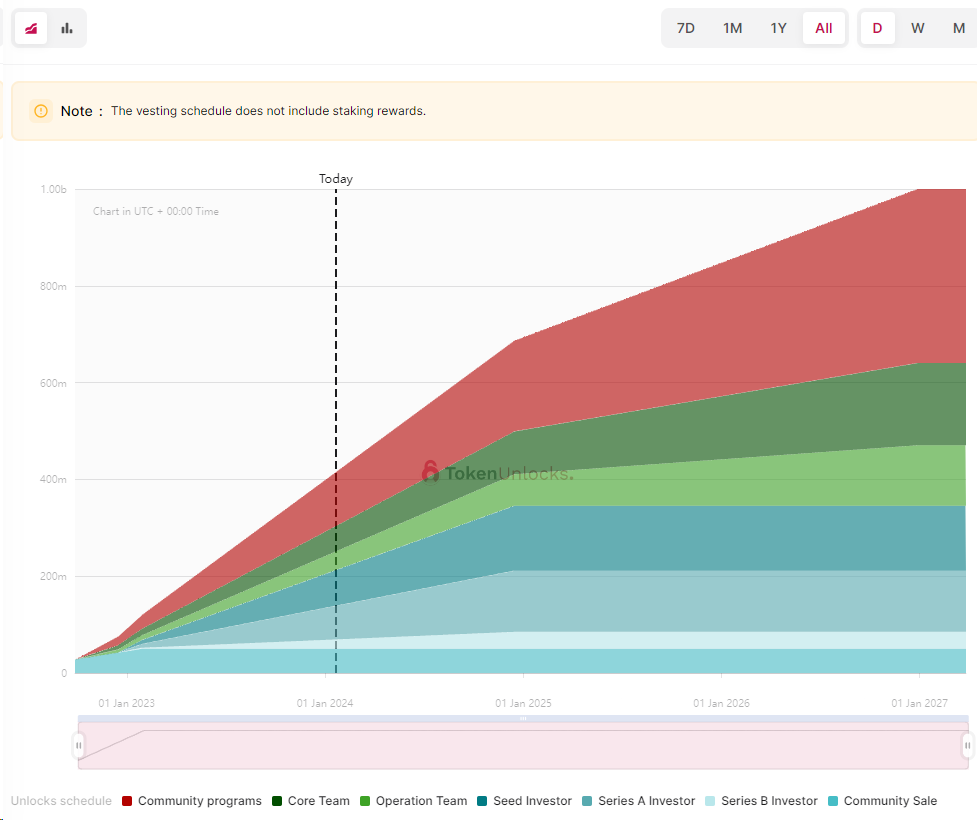
In December 2023, the community passed a proposal to reduce the inflation rate of AXL. The inflation rate of AXL is mainly composed of three parts: TM (Tendermint) consensus, MSigs inflation, and external chain inflation. The first two constitute the basic inflation rate, while external chain inflation refers to the reward for nodes verifying information from public chains outside the Cosmos ecosystem. In the first year, each chain has an inflation rate of 1%, which decreases to 0.75% in the second year, and 0.5% in the third year.
There are two main ways to reduce inflation in this proposal: reducing the external chain inflation rate and implementing a gas burning mechanism.
First, before the proposal was passed, the external chain inflation rate was 0.75%, resulting in a total inflation rate of 11.5% (1% basic inflation rate + 0.75% * 14). The proposal decided to change the external chain inflation rate to 0.3%, reducing the total inflation rate to 5.2%. Considering the upcoming inclusion of 5 EVM chains, the inflation rate will reach 6.7%. This proposal reduces the overall inflation level and also increases Axelar's capacity to accommodate connections with external chains.
The second method is the gas burning mechanism. When users conduct cross-chain transactions, they need to pay gas to Axelar, which is then redistributed to stakers. This proposal decides to burn this portion of gas and remove it from the supply.
1.5 Recent Project Developments: High-quality Ecosystem Expansion
Since the second half of 2023, Axelar has formed partnerships with several leading projects, rapidly increasing its market share in the interoperability market:
- On June 16th, the Uniswap Foundation released a cross-chain bridge evaluation report, approving Axelar's protocol for specific use cases on Uniswap. Uniswap's assessment states that Axelar is the only decentralized cross-chain platform with 75 nodes, strong security practices, and a general message passing mechanism that allows users to interact with any contract function on any chain with a single click.
- On June 23rd, Axelar became the official cross-chain bridge on Filecoin, bringing liquidity to DEX and AMM on FVM: Axelar-wrapped assets will become standard cross-chain assets in the Filecoin ecosystem.
- On July 11th, Microsoft partnered with Axelar. Axelar provides cross-chain services to Microsoft customers through the Azure Marketplace.
- On September 12th, Squid achieved direct token swaps between Ethereum, various EVM-compatible chains, and the Cosmos ecosystem, currently supporting 14 EVM chains and 48 Cosmos chains.
- On September 14th, Lido chose Axelar and Neutron to launch wstETH on Cosmos. Neutron and Axelar provide liquidity.
- On November 13th, Ondo Finance partnered with Axelar to launch the Ondo bridge. Any chain integrated with Axelar can issue Ondo's USDY.
- On November 15th, JPMorgan, Apollo, and Axelar formed a partnership.
- On November 21st, Frax used Axelar to expand to new chains through a proposal.
- On December 14th, it was announced that Vertex was integrated, making Vertex the leading DEX project to integrate Axelar after dYdX, Uniswap, and Pancakeswap.
1.6 Summary: Axelar has a leading technological advantage in the whole-chain track
"Interoperability is the future," and Axelar has accumulated deep technical advantages in the whole-chain track, making it the core target in the whole-chain narrative. Omnichain includes two dimensions: achieving interoperability with as many blockchains as possible, connecting EVM and non-EVM chains, and going beyond asset cross-chain to achieve the transfer of any message and data. Based on the liquidity center of Cosmos, Axelar has already achieved interoperability among 56 chains, surpassing competitors like Layerzero. Additionally, Axelar supports arbitrary message passing, and the establishment of AVM further upgrades the message passing function, simplifying multi-chain development for developers and helping them achieve full-chain contract deployment and liquidity integration. Overall, the progress in product delivery and the expansion of partnerships fully demonstrate Axelar's technical accumulation in the whole-chain track, confirming the solid foundation of Axelar.
2 Competitive Landscape Analysis: Why Axelar is the most market-demanding cross-chain protocol?
2.1 Track Analysis: What kind of cross-chain protocol do we need?
Before analyzing Axelar's competitors, it is necessary to review the overall landscape of the cross-chain track: Why is the cross-chain protocol still a growing track? What kind of cross-chain protocol do we need? What types of cross-chain protocols are currently available in the market?
Why is the cross-chain protocol still a growing track?
First, as the number and diversity of blockchains rapidly expand due to blockchain scalability and increasing demand for customization, more and more public chains are being developed. Many Dapps, including dYdX, are choosing to migrate to application chains. The growth of modular blockchains, generalized rollups, and application chains is rapidly increasing the number and diversity of blockchains, making blockchain interoperability particularly important in the multi-chain era. Cross-chain protocols are the most important underlying infrastructure for achieving blockchain interoperability.
Second, according to L2beat data, the TVL of cross-chain bridges is $6.7 billion, a decrease of nearly 90% from the previous peak of $56 billion. The coming bull market will bring an increase in on-chain interactions and cross-chain demand, and the increasing number of blockchains will also increase the reliance on cross-chain technology. With the emergence of new technologies and architectures for cross-chain bridges, the industry scale of the cross-chain track still has high growth potential.
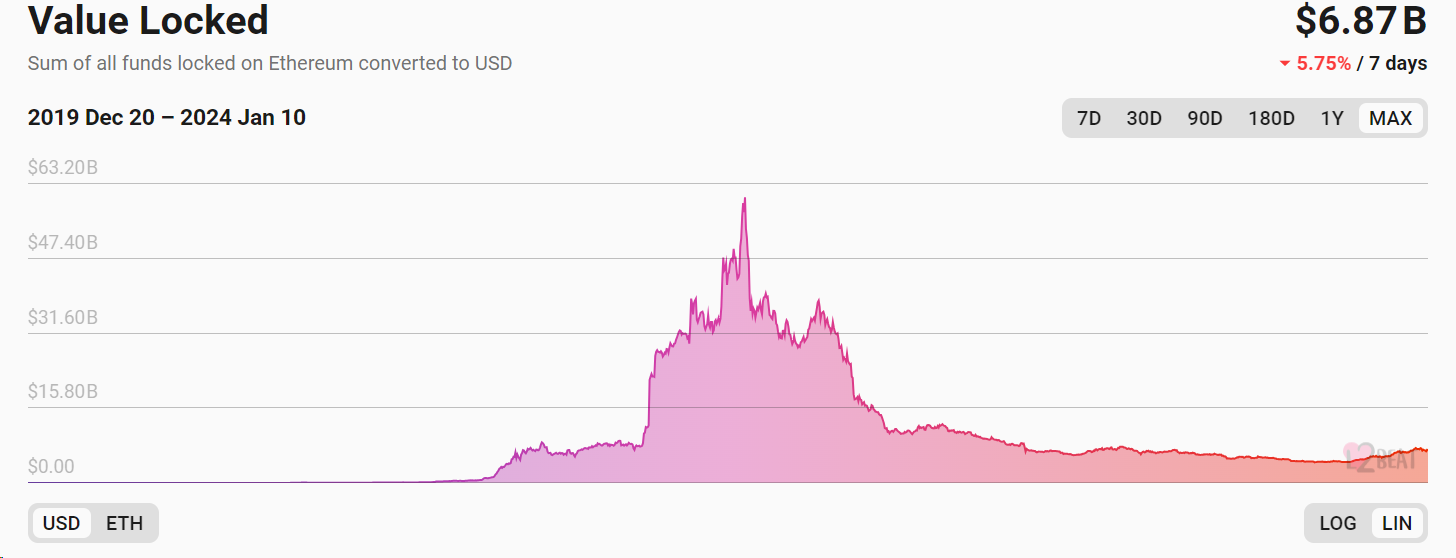
Third, although blockchain interoperability and cross-chain protocols are crucial for the industry, the development of the cross-chain track is still not satisfactory. On one hand, cross-chain bridges are still one of the most severely affected targets of hacker attacks and losses, raising concerns about security. On the other hand, cross-chain protocols in the market still mainly focus on asset cross-chain bridges, and cross-chain protocols that allow seamless cross-chain development for applications are still in the early stages of development. Therefore, for such an important underlying technology, there is still significant room for improvement in cross-chain protocols from a technical perspective.
What kind of cross-chain protocol do we need?
According to the cross-chain analysis framework proposed by Connext founder Arjun Bhuptani, there is an impossible triangle for cross-chain interoperability: security (trustlessness), generality, and scalability. These three points precisely summarize the core requirements of the market for cross-chain protocols.
First is security, where the highest level of security is achieved by not adding any trust assumptions outside the underlying chain and having the same level of security as the underlying chain. Security remains the most important issue for cross-chain protocols, as evidenced by the recent cross-chain bridge attack on Orbit Chain on January 1st, resulting in a loss of $81.5 million.
Second is generality, which involves supporting the transfer of any message between different blockchains. Currently, the cross-chain track is mainly focused on asset bridges that support the transfer or exchange of cross-chain assets. However, this is not enough for cross-chain protocols. On one hand, while it is possible to transfer or exchange cross-chain assets, liquidity (funds, users, traffic, etc.) between different chains is still fragmented. On the other hand, this requires users to still engage in complex cross-chain behavior when transferring between different blockchains, increasing the user threshold. Therefore, cross-chain protocols are exploring arbitrary message cross-chain, which enables cross-chain contract calls, liquidity aggregation, and the construction of cross-chain applications.
Third is scalability, which involves easily adapting to more blockchains, especially achieving cross-chain between heterogeneous chains with low development time and cost. Connecting more blockchains will bring a wider user base, funds, and traffic.
As the cross-chain protocol evolves, our expectations for cross-chain protocols have evolved from multi-chain to cross-chain, and then to omnichain, interchain, chain abstraction, or chain-agnostic.
Specifically, multi-chain refers to deploying Dapps on multiple blockchains, resulting in multiple instances or versions of the same Dapp in different blockchain ecosystems. Cross-chain represents the process of mutual communication and transactions between blockchains, where multiple smart contracts deployed on multiple chains form a unified application. Omnichain further enhances the scalability and breadth of cross-chain protocols, achieving interoperability among various heterogeneous chains. Interchain, chain abstraction, and chain-agnostic further hide cross-chain, gas, native assets, and other information from users, optimizing the user experience. Cross-chain protocols will be the core technology to achieve chain abstraction.
According to the trust layer division, existing cross-chain protocols can be divided into three types: native verification, external verification, and local verification. Native verification involves deploying a light node of the source chain on the target chain to verify messages from the source chain. External verification introduces a group of external witnesses to verify cross-chain messages, while local verification involves direct verification of transactions by the trading counterparty.
In addition, many cross-chain protocols using new technologies are under development, with the most anticipated being ZK Bridge, a cross-chain solution that uses ZK technology for light node expansion. However, this technology is still in the research and development stage, with high development difficulty and a long development cycle.
In conclusion, although bridge-based on light clients has higher security, it can only be developed for specific chains at present. External verification remains the main solution for current cross-chain protocols. In this cycle, the cross-chain protocol that can achieve full-chain cross-chain deployment is basically an external verification bridge. The more decentralized the external verification network and the stronger the security of the consensus mechanism, the more it can meet the market's expectations for cross-chain protocols.
2.2 Comparative Analysis: Axelar is the Best Cross-Chain Solution to Meet Market Demand
Based on the analysis of the cross-chain track, cross-chain protocols that use external verification and support general message passing remain the main players in this cycle and are also direct competitors of Axelar. Representative protocols include Wormhole, Layerzero, Chainlink CCIP, and Celer. After comparison, we believe that Axelar is the most competitive cross-chain solution in terms of security, general message passing, and ecosystem growth.
2.2.1 Most Important Factor: Security
The security of cross-chain protocols depends on the consensus mechanism of the trust layer, i.e., how information is verified. Axelar uses the DPoS mechanism, Wormhole uses the PoA mechanism, Layerzero uses a dual security mechanism with Oracle and Relayer separation, CCIP uses its own oracle network verification, and Celer uses a dual security mechanism with DPoS and optimistic verification.
Wormhole, which uses the PoA mechanism, has been the subject of theft events. In July 2023, the Multichain security incident resulted in the loss of over $265 million, making it largely uncompetitive. Wormhole itself suffered a hack in February 2022, with a loss of approximately $226 million. The PoA mechanism involves a small number of trusted entities to verify cross-chain messages, with little economic incentive and a lack of security.
Layerzero V1 uses a dual verification mechanism, with the protocol consisting of three core components: Oracle, Relayer, and Endpoint. The security of Layerzero depends on trust in Oracle and Relayer to ensure they do not collude. However, Layerzero allows project teams to configure and run their own Relayer and Oracle, which still requires trust in the project entity, leading to ongoing security concerns.
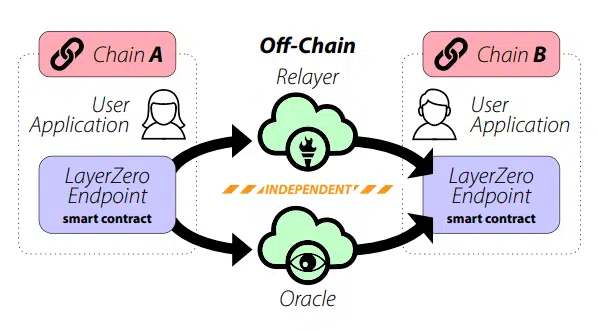
Recently, Layerzero released the technical whitepaper for V2, where message verification is completed by the Decentralized Verification Network (DVN), and the Executor is responsible for delivering verified messages and triggering transactions on the target chain. Message verification uses an X of Y of N mechanism, such as 1 of 3 of 5, which means selecting 5 validating DVNs, with 1 DVN required to complete the verification and any 2 other DVNs to jointly complete the verification. Currently, the main entities running DVNs include industry-leading entities such as Blockdaemon, Google Cloud, Animoca, Delegate, Gitcoin, Nethermind, P2P, StableLab, Switchboard, Tapioca, LayerZero Labs, and Polyhedra. However, it still requires trust in these entities, especially when the number of DVNs is limited, which introduces more trust assumptions compared to the PoS mechanism.
Chainlink CCIP:
Chainlink CCIP's message delivery is monitored and signed by Chainlink DONs, then relayed to the target chain for transaction execution. In addition, Chainlink CCIP also introduces a risk management system, which operates independently of the oracle network as a new verification layer. Risk management nodes monitor all Merkle roots of submitted messages on each target chain and independently reconstruct the Merkle tree of all messages on the source chain. If any anomalies are detected, the risk management nodes can vote to stop CCIP. The security of CCIP is mainly ensured by DONs, which have safeguarded assets worth billions of dollars and facilitated trillions of dollars in on-chain transaction value. However, the overall development progress of CCIP has been relatively slow, as it only entered the early access phase in the mainnet in mid-2023, despite being launched in 2021.
Celer IM:
Celer IM is monitored, routed, and verified by the State Guardian Network (SGN), which is a PoS blockchain built on the Cosmos SDK, with validators staking $CELR. Additionally, Celer provides a second security model, optimistic verification, where messages are submitted to the chain and enter an "isolation zone" before being executed, allowing time for confirmation before final execution. However, it's important to note that Celer's validator network currently only has 22 validators, including authoritative entities in the industry such as IOSG, Hashkey, Binance, Ankr, and InfStones. Concerns have been raised about the same entities operating multiple validators, and the conditions for becoming a validator are not clearly defined in the official documentation. The optimistic verification mechanism mainly relies on Dapp running the App Guardian to verify transactions, requiring Dapp's self-maintenance and trust, and does not reduce the trust assumptions to a 1/N level.
In summary, in terms of security, we have reason to believe that Axelar stands out among the various solutions. Axelar's security was recognized by Uniswap in June, acknowledging its "comprehensive cryptographic economic mechanism to ensure the security of the protocol."
In terms of mechanism design, relying on dynamic, decentralized, permissionless PoS networks for verification is the solution with the lowest trust assumptions.
In terms of specific data, we can further compare Axelar and Celer, which also primarily use the PoS mechanism. The comparison data can be divided into two major categories: (1) validator-related and (2) token lock-up value-related.
(1) Validator-related: Axelar has three times the number of validators (75) compared to Celer (22). The decentralization of validators is evaluated by the sum of the voting weight of the top 10% of validators, with lower values indicating greater decentralization. Axelar's validators are more decentralized compared to Celer.
(2) Token lock-up value-related: Axelar's locked token value is as high as $795,420,281, approximately 15 times that of Celer. The ratio of staked token value to TVL is 3.72 for Axelar, indicating a relatively healthy level, while Celer's ratio is less than 1, posing a higher risk of malicious behavior.
In terms of scalability and ecosystem development, Axelar is leading in capturing the interoperability market, with the most connected public chains and a rapidly expanding ecosystem, integrating nearly 100 Dapps and collaborating with companies such as Microsoft and JP Morgan. Axelar's market share in cross-chain DEX has exceeded 50% based on market trading volume, with notable Dapps such as dYdX, Uniswap, Pancakeswap, and Vertex adopting Axelar as their cross-chain solution.
Supported Public Chains | Integrated Dapps | Planned Integrated Dapps | Representative Blue-Chip Projects ---|---|---|--- Axelar | 56 | 62 | 30 | dYdX, Lido, Uniswap, Pancake, Squid, Sushiswap, Frax, Metamask, Decentraland
Wormhole
30
68
15
Frax, Lido, Raydium
Layerzero
48
87
/
Curve, AAVE, Pancake, Radiant, Balancer
CCIP
7
No official data available
/
/
Celer
45
No official data available
/
/
2.2.3 Summary: Axelar is the most comprehensive and mature cross-chain solution
Based on the above analysis, Axelar is currently the best solution in the market to meet the requirements for security, scalability, and arbitrary message delivery. Wormhole and Layerzero are currently the two most prominent projects in the cross-chain race, with high expectations for airdrops. While Axelar's fundamentals are comparable to Wormhole and Layerzero, its Fully Diluted Valuation (FDV) is currently less than half of theirs, positioning it at an undervalued level in the cross-chain field.
Verification Mechanism | Connected Public Chains | Ecosystem | Market Cap | FDV or Fully Diluted Valuation ---|---|---|---|--- Axelar | DPoS + Quadratic Voting | 56 | 62 + 30 | $501,347,130 | $1,016,772,630 Wormhole | PoA | 30 | 68 + 15 | / | The Block Beats Layerzero | Dual verification with separate Oracle and Relayer | 48 | 87 | / | The Block Beats CCIP | DON message verification + risk control management | 7 | / | $11,256,847,756 | $19,173,647,260 Celer | DPoS + Optimistic Witness Hybrid Verification | 45 | / | $91,352,633 | $161,816,247
3 Axelar is a key gateway to the Cosmos ecosystem
Another reason to pay attention to Axelar is its role in the Cosmos ecosystem. We will address two questions: why the Cosmos ecosystem is worth paying attention to, and why Axelar is an essential target for positioning within the Cosmos ecosystem.
The first question, why is the Cosmos ecosystem worth paying attention to?
Firstly, the narrative of application chains will be an important theme in this cycle, and Cosmos itself is built around the theme of application chains, with each chain designed to host applications and seamlessly connect with each other through shared communication standards. Despite facing challenges from the Ethereum Rollup ecosystem, Cosmos has unique advantages due to its technical standards. It allows developers to build a more sovereign Layer1 with higher autonomy in token economics and technology, rather than relying on Ethereum's L2/L3. Additionally, Cosmos achieves interoperability between multiple chains through the IBC protocol, enabling seamless transfer of assets and data across different blockchains, providing advantages in cross-chain capabilities that other ecosystems find difficult to match. Furthermore, dYdX's transition from the Ethereum ecosystem to the Cosmos ecosystem to build an application chain has attracted significant attention to the narrative of application chains within Cosmos. Therefore, both technically and in terms of market attention, Cosmos is expected to play a significant role in the narrative of application chains.
Secondly, recent upgrades to Cosmos will lead to a healthier ecosystem. Two important upgrades include the Replication Security introduced on March 15, 2023, allowing blockchains in the Cosmos ecosystem to abandon their own validator sets and rely on the validators of the Cosmos Hub to ensure security, empowering ATOM and reducing the development complexity of application chains. Additionally, Noble's collaboration with Circle to introduce native USDC in the Cosmos ecosystem addresses the lack of native stablecoins in the ecosystem, reducing systemic risk.
Lastly, the Cosmos ecosystem is thriving. The rapid growth of the Cosmos ecosystem has led to significant price increases for multiple projects in 2023, including Celestia, Injective, Osmosis, Kujira, and Neutron, rekindling market attention to the Cosmos ecosystem, with generally positive sentiment towards Cosmos.
The second question, why is Axelar one of the best targets for positioning within the Cosmos ecosystem?
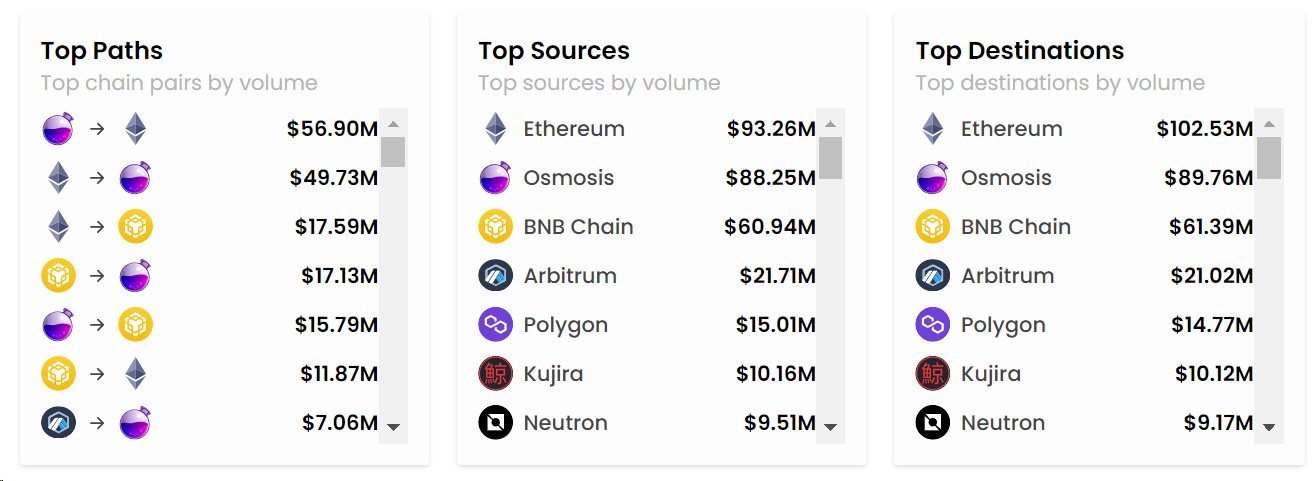
Axelar is the main channel connecting the Cosmos ecosystem with EVM chains, especially the connection between Osmosis and EVM chains. In the past 30 days, the total cross-chain volume between Osmosis and Ethereum through Axelar amounted to 106.63M, making Axelar the primary pathway for cross-chain transactions from Osmosis to the EVM ecosystem. As more applications are built within the Cosmos ecosystem, the demand for connections between the Cosmos ecosystem and other ecosystems will increase. Axelar is the most important channel for connecting the Cosmos ecosystem with other ecosystems, directly capturing the value of the expansion of the Cosmos ecosystem.
4 Conclusion: Strong fundamentals and opportune timing
Based on the analysis above, we believe that Axelar is a worthwhile target for positioning at this stage, for two main reasons: strong fundamentals and opportune timing.
Firstly, from a fundamental perspective, Axelar has a clear technological advantage in the cross-chain race, with significant advantages in cross-chain quantity, message and data transmission, and full-chain application development. As a general cross-chain protocol, Axelar demonstrates satisfactory performance in terms of security and scalability.
In terms of security, Axelar uses a dynamic, permissionless validator set for message transmission verification, with a quadratic voting mechanism and sufficient validator quantity, token lock-up value, and validator decentralization, making it one of the most secure solutions among external verification protocols.
In terms of scalability, Axelar currently has the highest number of integrated public chains and is the most important channel for connecting the Cosmos ecosystem with EVM chains. The Hub-Spoke architecture saves costs in connecting to more public chains, while AVM reduces the difficulty for developers to access the Axelar Network and build cross-chain Dapps. Recently, Axelar has established partnerships with multiple blue-chip projects and enterprises, demonstrating its ability and potential for ecosystem expansion.
Secondly, in terms of timing, Axelar is positioned in a race and narrative that is expected to have significant growth potential and market attention in the future.
Axelar is part of both the full-chain and Cosmos ecosystem narratives. The full-chain race is expected to gain more growth potential and market attention as trading volume and the number of public chains increase during the bull market. A more direct catalyst may come from the issuance of tokens by Layerzero and Wormhole, leading to a market frenzy for the entire full-chain race. Layerzero has already indicated that it expects to complete token distribution in the first half of 2024. As a direct competitor to both, Axelar's FDV is significantly lower than the primary valuation of the two, and may undergo value discovery upon the completion of this event. The Cosmos ecosystem is experiencing healthy growth, with the ecosystem-wide price increases at the end of 2023 attracting market attention to the Cosmos ecosystem. Axelar, as the liquidity gateway between the Cosmos ecosystem and EVM chains, will directly benefit from the growth of the Cosmos ecosystem.
免责声明:本文章仅代表作者个人观点,不代表本平台的立场和观点。本文章仅供信息分享,不构成对任何人的任何投资建议。用户与作者之间的任何争议,与本平台无关。如网页中刊载的文章或图片涉及侵权,请提供相关的权利证明和身份证明发送邮件到support@aicoin.com,本平台相关工作人员将会进行核查。


