Introduction:
Friends who are starting a blockchain project will encounter the first issue in legal matters, which is registering a company. Registering a company does not pose legal difficulties for traditional projects, but for blockchain projects, due to regulatory issues in mainland China, most blockchain projects will go overseas. For founders, registering a company overseas is a relatively unfamiliar area, and combined with the business characteristics of blockchain projects, sometimes registering a company may not meet the actual needs. So, how many companies need to be registered? The answer to this question requires the project party to flexibly choose based on their own scale, whether to issue Tokens, and strategic and business needs.
01 Why Set Up Multiple Companies
Generally, some small-scale blockchain projects may only register a technology company in the early stages of the project, mainly used for the development and maintenance of blockchain technology, as well as for paying developer salaries, renting offices, paying for some software subscriptions, and accumulating intellectual property and other operational tasks. This technology company is usually registered in the founder's country or region, as this makes it convenient to manage the team, pay salaries, and enjoy tax benefits.
For larger-scale blockchain projects, especially those involving multiple businesses, it may be considered to establish different technology companies for different businesses. If the project involves business operations, marketing, and profit models, it may be considered to register an independent business company to handle business affairs.
If the project operates globally, it may be necessary to register companies or branches in different countries to meet local regulations and operational needs.
Once the project decides to issue Tokens, a separate entity for Token issuance is needed for the following reasons:
1. Facilitate financing. It makes it easier for investors to know which company is specified in the investment documents.
2. Prepare a legal opinion for Token listing. Because most Token listing platforms require a Token legal opinion, and in most cases, without a registered legal entity, this legal opinion cannot be prepared.
3. Reduce regulatory risks. Some countries and regions have strict restrictions or bans on the issuance and trading of Tokens, and countries and regions that welcome blockchain technology may not necessarily welcome Token issuance, such as mainland China.
4. Tax planning. Since Token issuance may involve substantial profits, establishing a separate entity for Token issuance in a country or region with preferential tax rates will reduce the tax burden.
In choosing the location for the establishment of the Token issuance entity, tax and regulatory factors are the main considerations. In general, the British Virgin Islands (BVI) and the Cayman Islands, as well as onshore locations such as Singapore and Hong Kong, are preferred locations for the Token issuance entity by project parties or investors. BVI and the Cayman Islands do not have taxes such as corporate income tax, profits tax, and have a relatively relaxed regulatory attitude towards virtual currencies. From the perspectives of taxation and regulation, BVI and the Cayman Islands are convenient choices.
02 Building Different Companies
In the case of establishing multiple companies, the question naturally arises of how to build a structure that facilitates the management of multiple companies. A common and mature framework is the structure of OK Group as shown in the following diagram.
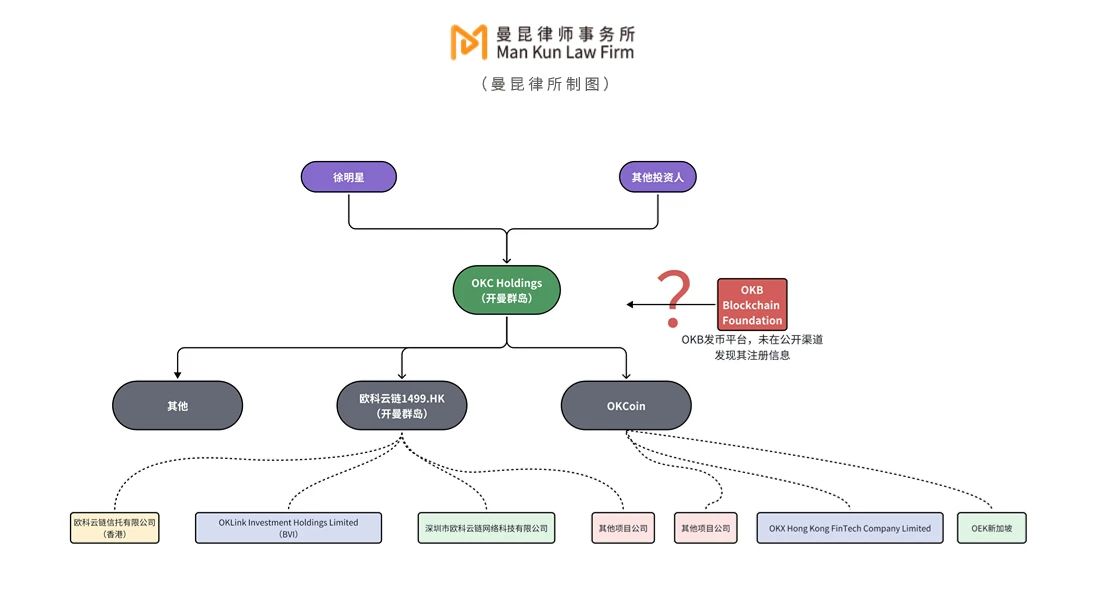
According to publicly available information, OKLink (OKLink) and the parent company of OKCoin, OKC Holdings, are registered in the Cayman Islands. Xu Mingxing became the largest shareholder and actual controller of OKC Holdings through several offshore companies registered in the BVI. The subsidiaries of OKLink, the specific project companies, include OKLink Trust Limited (Hong Kong), OKLink Investment Holdings Limited (BVI), Shenzhen OKLink Network Technology Co., Ltd., and so on. The subsidiaries of OKCoin include OKX Singapore, OKX Hong Kong, OKX Brazil, and so on, established according to actual business needs.
At the same time, OK Group also established a foundation specifically for the issuance of its Token. However, Man Kun Law did not find the partnership situation of its foundation through public channels, but speculated that among its partners should include some offshore companies in the OK Group's equity structure and some individual investors.
Other project parties can completely refer to the structure of OK Group and combine it with their own needs to build their own multi-layer structure.
03 Legal Form of DAO
Although the aforementioned are all centralized company structures and some legal means adopted to achieve centralized management, in some blockchain projects, founders may still use the form of DAO for issues such as community governance to achieve "decentralized autonomy."
However, if the form of DAO relies solely on smart contracts without any legal appearance, DAO members will face the risk of being considered as a general partnership, and then DAO members will bear unlimited legal risks. As in the case of the Commodity Futures Trading Commission (CFTC) v. Ooki DAO, because Ooki DAO did not form any legal entity, the court considered that OOKI Token holders who influence Ooki DAO governance proposals through token voting can be deemed to voluntarily participate in Ooki DAO governance and need to bear personal responsibility for DAO activities.
Therefore, establishing a company for DAO will protect DAO members from potential endless legal, tax, financial, and other liabilities; at the same time, the establishment of the company will also standardize the financial management procedures of DAO, such as ensuring AML and KYC procedures for grants from the DAO Treasury.
04 Recommendations from Man Kun Law
Whether a blockchain project should establish one or multiple companies is a highly compliant and practical issue that requires consideration of multiple factors, especially in legal supervision and taxation.
免责声明:本文章仅代表作者个人观点,不代表本平台的立场和观点。本文章仅供信息分享,不构成对任何人的任何投资建议。用户与作者之间的任何争议,与本平台无关。如网页中刊载的文章或图片涉及侵权,请提供相关的权利证明和身份证明发送邮件到support@aicoin.com,本平台相关工作人员将会进行核查。


