The solution of Chronicle Protocol is not only more cost-effective and transparent in technology, but also focuses on business feasibility and sustainability.
Written by: Ryan Allis
Translated by: DeepTech TechFlow
Editor's note: The oracle track has attracted market attention due to the recent airdrop of projects. In addition to tokens and revenue, the current oracle market faces common issues in business models, operating costs, and security. This article details the new oracle Chronicle launched by the oracle team split from MakerDAO, which attempts to address these common issues through technical and economic design.

Most people in the DeFi field have heard of oracles, but fewer understand how important oracles are to many products and protocols we use in our daily lives. Even fewer people know the cost of building or using oracles.
The current landscape is fragmented, and the quality of oracles available may feel like a gamble. Even in the case of "leading" providers, there are instances of poorly designed and supported oracles leading to illegal liquidations of DeFi users.
In addition, especially for price feed oracles, there is either unclear or non-existent service level agreements between oracle providers and users. Many initial price feed oracles are designed to be permissionless. This sounds great, but in practice, it means anyone can freely read the value reported by the oracle on-chain, while the oracle provider needs to pay significant gas costs to regularly update the value of the Oracle report.
This prompts oracle providers to operate as lean as possible, with little guidance on how to securely and reliably utilize the Oracle, and guidance on technical support when things go wrong. Oracles are critical infrastructure protecting billions of dollars in value, and end users need more support from oracle providers.
Unsustainable Model
Protocols still using traditional permissionless oracles have almost no other choice but to spend raised funds or market sell their tokens to pay for oracle operating costs (mainly gas and developer costs). There are even some providers issuing "demands" to dapps using oracles, requiring them to sign contracts and start paying fees, even though the oracles are permissionless.
In the medium to long term, this model is not commercially viable. It is also not transparent and predictable, and is not prepared for commercial users to inevitably transition to a pay-as-you-go access model as the industry matures.
This has already happened in most recently developed oracle utilities, such as verifiable randomness and cross-chain messaging, where access is controlled by a paywall.
Security and Operating Costs
Most of the current oracle business models and commercial landscapes are manifestations of the limitations of this technology. The secure construction of oracles requires a large amount of resources, and operating on-chain, especially on chains like Ethereum, is extremely expensive due to gas fees.
This has led to many oracles being highly centralized, with varying levels of security. Why? Oracle security comes from validators, the more validators (or participants) proving the authenticity of the value reported by the oracle, the safer the oracle is from the risk of manipulation of that value. Just like Ethereum, any attacker would need to control the majority of validators to manipulate consensus and convince the oracle to report an illegal value.
This is the case for all oracle providers, as they all use the same ECDSA signature scheme to protect oracles. 1 validator = 1 signature, and each ECDSA signature requires gas to verify on-chain. Therefore, all oracle providers limit the number of validators, and thus the number of signatures, to manage the operating costs of their oracles. Overall, this reduces the security of oracle protocols. In some cases, the number of validators may be very low.
Fundamentally Different Approach
As a foundational component supporting everything from cross-chain bridges to DeFi and DePIN, this trade-off between security and decentralization with cost severely limits the future growth of oracles.
However, there is light at the end of the tunnel. The new oracle Chronicle launched by the oracle team split from MakerDAO utilizes a signature aggregation scheme called Schnorr to address the trade-off between security and operating costs.
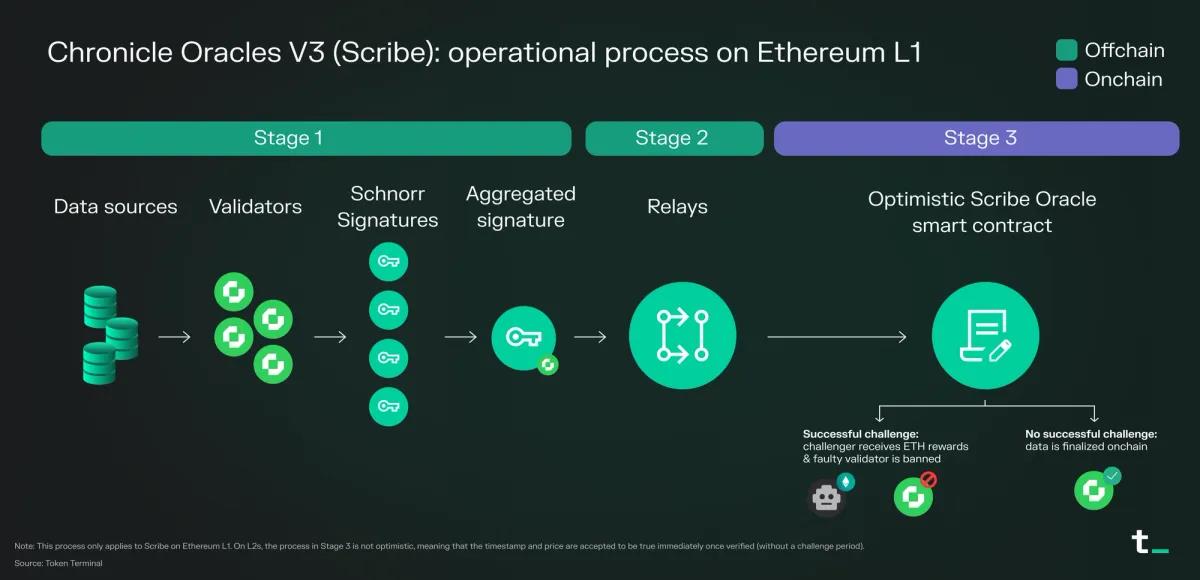
The Chronicle Labs team has created a new type of oracle called Scribe, which solves the "oracle problem" at the cryptographic level and can scale to any number of validators without increasing operating costs.
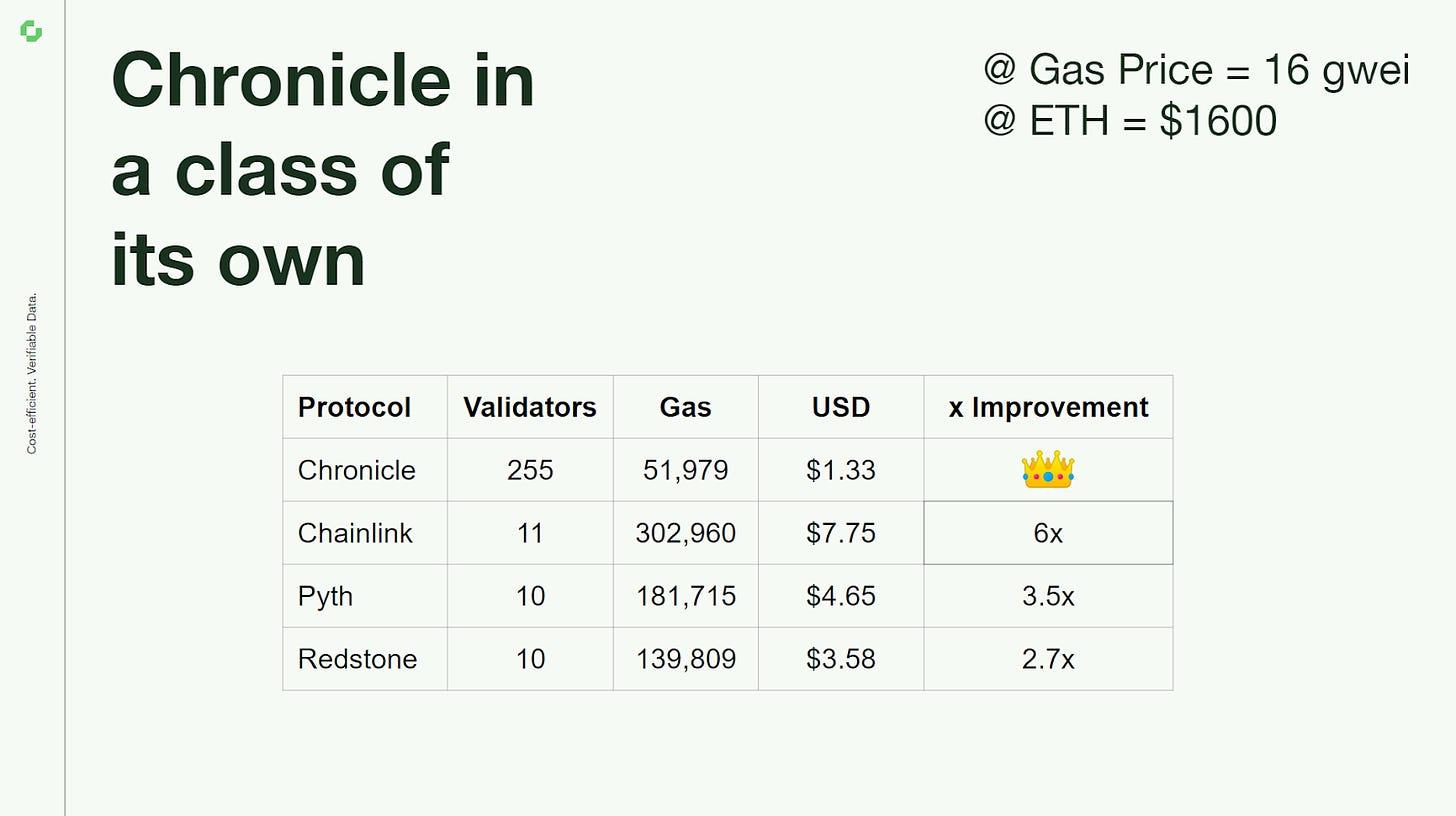
In addition, Scribe also achieves significant gas savings, greatly reducing the oracle update costs on L1 and L2. Compared to other providers, this is equivalent to a 6x improvement over Chainlink, a 3.5x improvement over Pyth, and a 2.7x improvement over Redstone.
Schnorr signature encryption technology has been used in Bitcoin for many years. The Chronicle Labs team is the first to use Schnorr to create this novel oracle.
Furthermore, as Scribe is designed as a single implementation on the EVM, new oracles can be quickly and efficiently deployed on any EVM chain, allowing Chronicle to charge lower deployment costs than leading providers.
Unlocking Future Business Models
Solving the long-standing technical issues plaguing blockchain oracles opens up a much-needed new business model for oracle providers, without compromising security or decentralization. This is a fully serviced, supported, and premium oracle service, implemented in a similar way to SaaS. That is, subscribe to the oracles you need and only pay when needed. It is permissioned but cost-predictable.
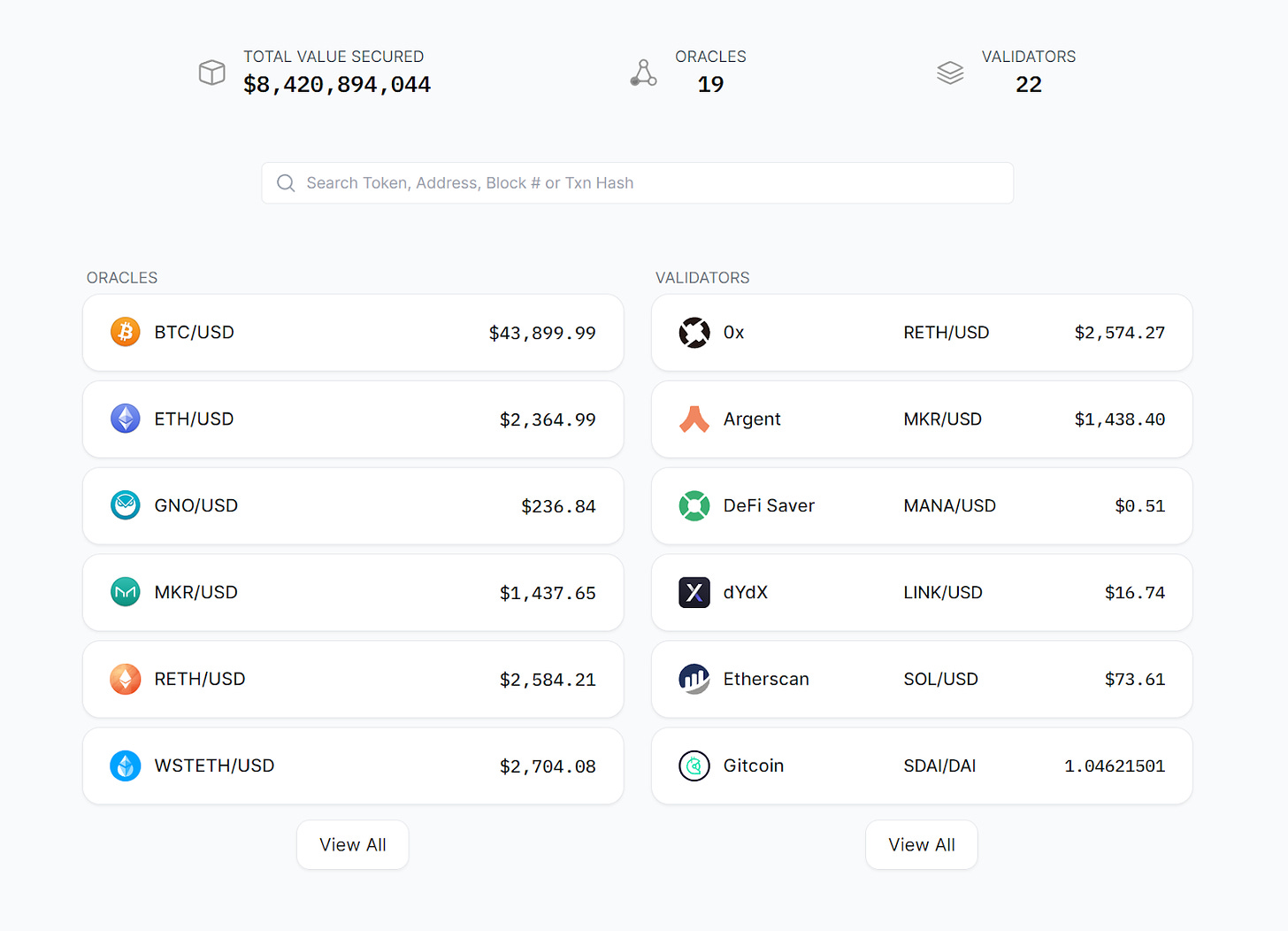
This approach has garnered unique attention for Chronicle, by building an on-chain dashboard that allows any user to track oracle data end-to-end and cryptographically verify the signature of each oracle update report.
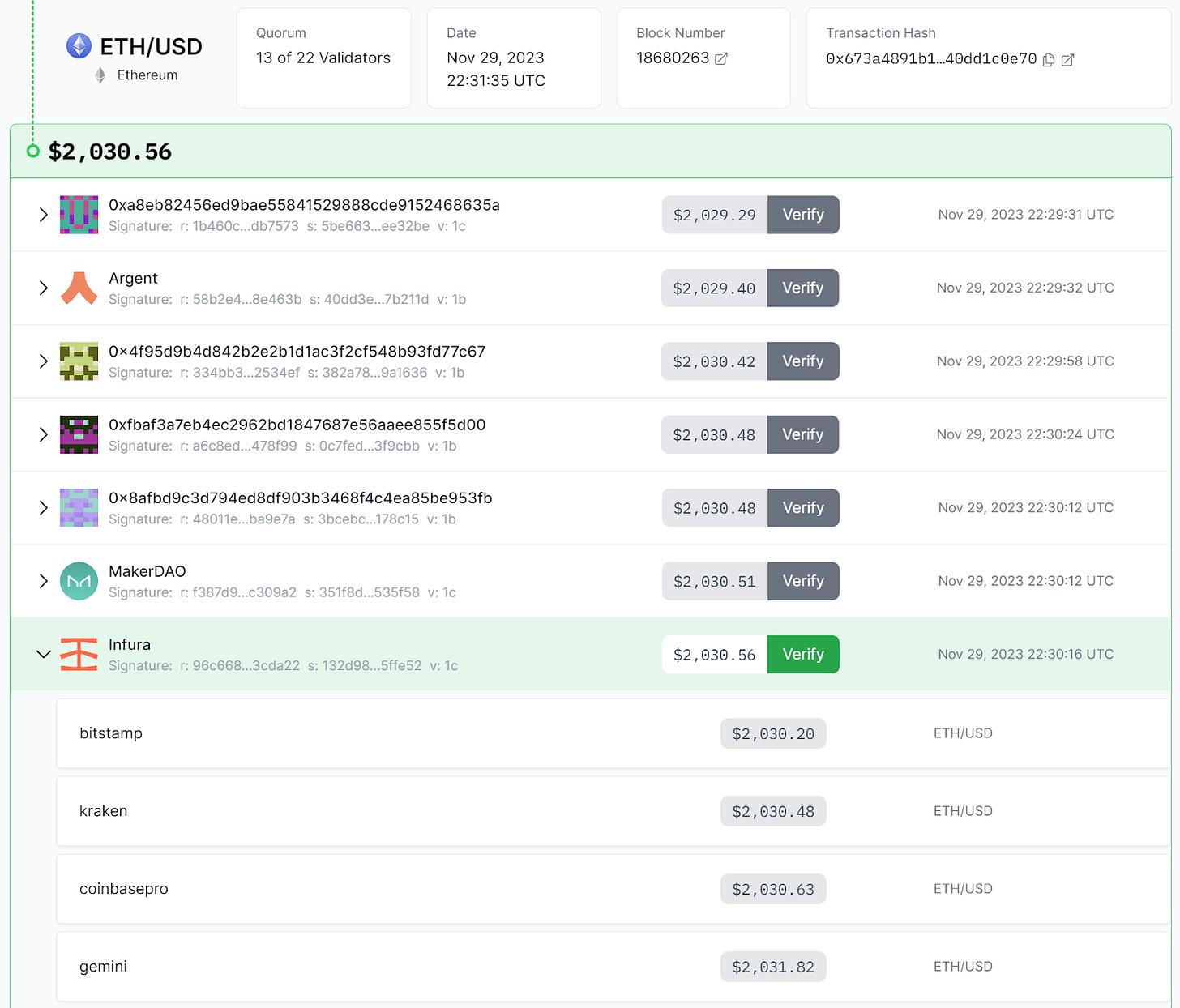
The overall result of this approach is a professional and predictable service designed to protect billions of dollars in value in a verifiable manner. If "the future of finance" is to take place on-chain, financial providers will need a more transparent and supported data delivery option.
In short, Chronicle Protocol seems to be ahead of its competitors, as its solution is not only more cost-effective and transparent in technology, but also focuses on business feasibility and sustainability. Whether Chronicle is ahead or other projects turn to this new and improved technology stack, it is clear that there will be a revolution in on-chain data.
免责声明:本文章仅代表作者个人观点,不代表本平台的立场和观点。本文章仅供信息分享,不构成对任何人的任何投资建议。用户与作者之间的任何争议,与本平台无关。如网页中刊载的文章或图片涉及侵权,请提供相关的权利证明和身份证明发送邮件到support@aicoin.com,本平台相关工作人员将会进行核查。


