
Original Author: Liu Honglin
A few days ago, I exchanged views with friends from mainland government departments on China's regulatory issues regarding cross-border investment. The other party raised a very straightforward question: After the restrictions on cross-border brokers like Futu, Tiger, and ChangQiao, will on-chain US stocks in crypto exchanges become a new avenue for capital outflow from mainland China?
Regulatory departments have a keen sense of smell.
In the past few years, many mainland users who bought Hong Kong and US stocks relied on cross-border brokers like Futu, Tiger, and ChangQiao, but the good times did not last long. On May 22, 2026, the China Securities Regulatory Commission (CSRC) disclosed that it had initiated an investigation into related entities of Tiger Securities, Futu Securities, and ChangQiao Securities for illegally conducting cross-border business and issued administrative penalties. On the same day, eight departments including the CSRC announced a rectification plan that brought the actions of foreign institutions regarding marketing, account opening, handling trading instructions, capital transfers, customer service, software operation, and self-media traffic into the regulatory spotlight.
The effectiveness of this administrative penalty is significant. As of June 12, the penalized foreign brokerage firms had basically begun to comply with regulatory requirements and stopped providing "securities investment services for existing customers in mainland." Please pay close attention to the order of expression in my sentence; if you are a mainland user of the aforementioned three brokers, you should be able to understand the real meaning of this sentence.
The theory of Dayu's water control tells us that sometimes guidance may work better than blockage. Tightening the old routes does not mean that the demand for buying US stocks will disappear. For some mainland investors, Nvidia, Tesla, Apple, and Nasdaq ETFs are not just distant stock codes, but a way for them to understand global asset allocation, exchange rate risk, and a sense of wealth security. Now that the old channels are gone, they will naturally look for new entry points.
For crypto exchanges, this is undoubtedly a tremendous fortune and business opportunity.
Futu Securities has successors
According to data disclosed by the world's largest virtual currency exchange, some An, since its stock trading products launched on June 1, 2026, the total trading volume has exceeded 3 billion USD, the asset management scale has surpassed 1 billion USD, and the average daily net inflow is approximately 42 million USD; among page visitors, about 1 in 7 registered an account, and nearly 90% of these newly registered users ultimately made trades.
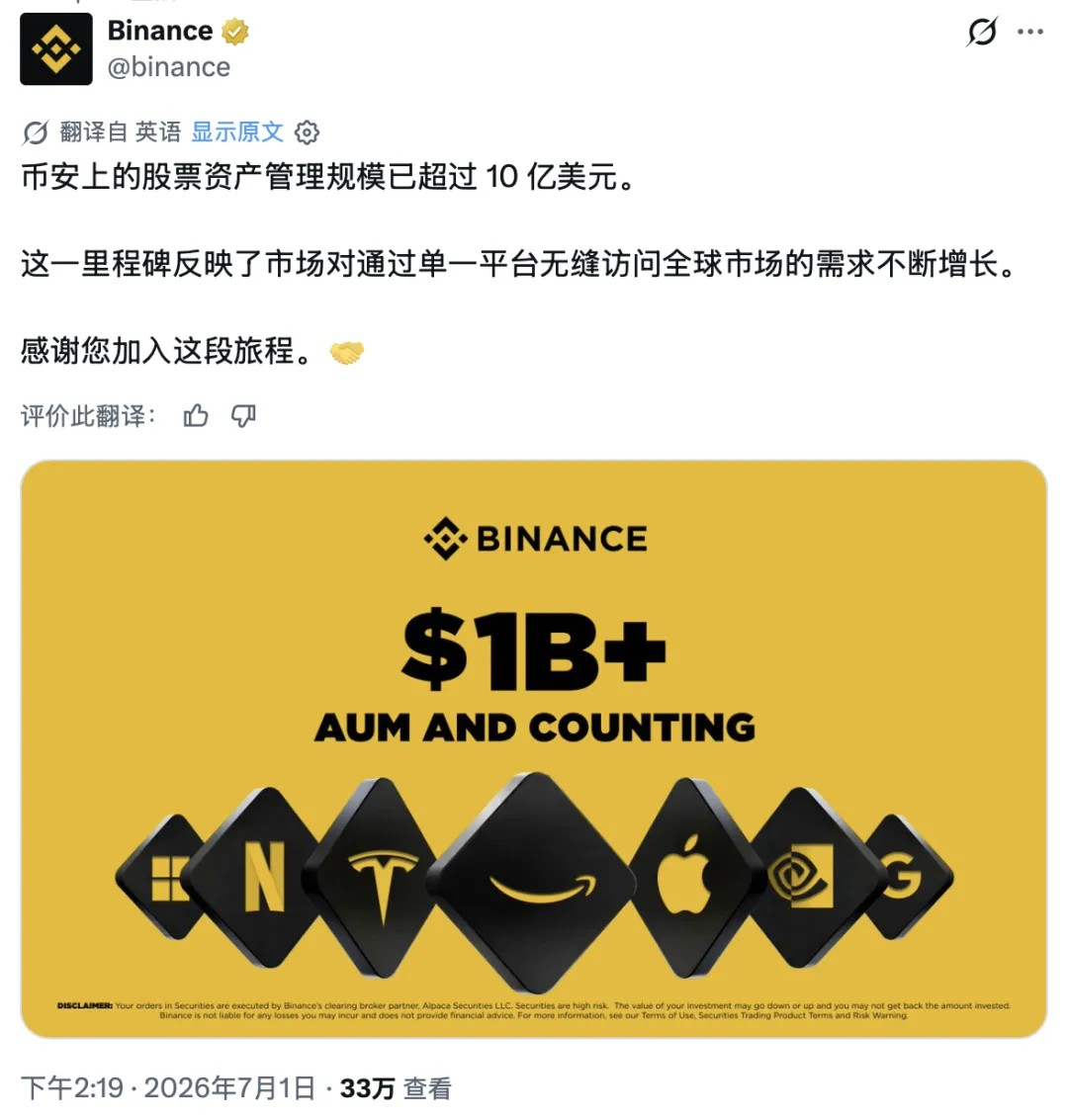
Some An publicly stated that its stock asset management scale has exceeded 1 billion USD
The reason why on-chain US stocks can thrive rapidly in a short period is not because the concept is new, but because it has optimized the previously cumbersome routing for cross-border securities asset investments to be extraordinarily smooth.
According to relevant data disclosed by some An, only about 11% of adults globally hold brokerage accounts. Although US stocks account for about half of the global stock market value, overseas investors hold only about 18% of them. About 73% of stock trading users on some An come from emerging markets. This means that the target of on-chain US stocks may not be those mature investors who are accustomed to using IB and Futu, but rather a large number of users who were previously excluded from traditional broker services.
A user who already holds USDT or USDC, and has completed exchange KYC (Know Your Customer), now does not need to open an offshore brokerage account, does not need to wait for banking deposits and withdrawals, and does not have to care too much about US stock trading hours. They just need to switch to the "stocks" page in the exchange or connect to a specific on-chain stock protocol in their wallet to see the trading interface for US stocks and ETFs.
Some exchanges have even begun to support securities transfer, meaning that users who no longer wish to use traditional brokerage products can transfer their previous stock positions into the crypto exchange system and then, through authorization and minting mechanisms, convert their holdings into stock tokens for 24-hour trading, collateral borrowing, or entering DeFi (decentralized finance) scenes.
Crypto exchanges in the past competed for coin trading, contracts, wealth management, and new projects, now they are competing for users' global asset accounts. Stablecoins, US stocks, ETFs, gold, government bonds, Bitcoin, Ethereum can all be integrated into the same interface.
What users see is an entry point for asset management, but what regulators see is an increasingly difficult cross-border investment path to identify according to traditional securities account logic.
Several Ways to Play on-chain US Stocks
It should be noted that while on-chain US stocks on the market are described this way, the solutions among different platforms are not consistent.
The first type is broker entry type. For example, the US stock and ETF trading entries mentioned in some An's announcement essentially connect the exchange front-end to traditional securities infrastructure behind it. Users see stock entries in their crypto accounts, but order execution, clearing, settlement, and custody still depend on brokerage dealers, clearing brokers, and custody systems.
The key to this model is not whether stocks are on-chain, but whether the crypto exchange has embedded traditional broker capabilities into its user interface.
The second type is on-chain token type. Products like bStocks and xStocks usually emphasize 1:1 support for underlying stocks, reserve proof, on-chain transfer, and wallet self-custody. They are more like making US stock exposure into tradable on-chain certificates. What users see on the interface are stock codes, but what investors actually hold is often not the stock itself of public companies but a certificate or token issued by some offshore entity.
The third type is distribution network type. Platforms like OKX and MEXC integrate on-chain asset issuers like Ondo, and exchanges take on more of the entry, liquidity, and user experience packaging. The actual determinants of investor rights are still the issuance documents, redemption arrangements, eligibility user restrictions, and platform terms.
What users see is a trading pair, while what is behind could be tokenized securities, tracking certificates, or just some form of price exposure.
The fourth type is contract exposure type. Coinbase offers perpetual stock contracts for qualified users outside the US and settles in USDC, where users trade synthetic exposure to US stock prices. This is much further from "holding stocks," it is more like turning US stock prices into a new product that can be long or short, leveraged, and can incur financing fees on the exchange.
Looking at these routes together provides a clearer picture:
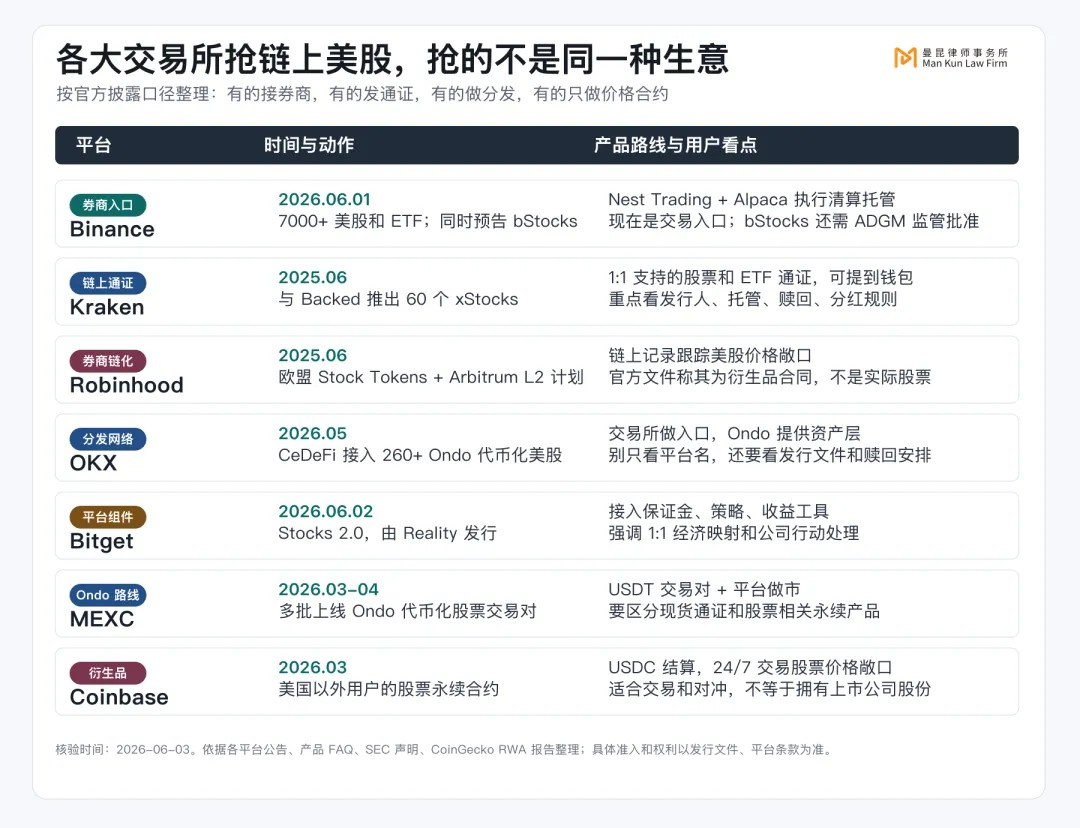
Paths of several types of on-chain US stock products
Although the routes differ, the effects converge: they all are moving the demand for US stocks from the traditional securities market to the habits of using crypto exchanges, stablecoin accounts, and on-chain wallets. To clearly explain this, the following lawyer Honglin will use the on-chain US stock products of some An as an example to clarify the real situation of the industry at this stage.
Some An as a Sample
First, let’s look at some An's stock trading entry.
According to some An's disclosures, its stock trading product launched on June 1, 2026, allows users to directly access over 7,000 US stocks and ETFs within the some An App and settle using stablecoins.
This is not the traditional experience of "downloading a brokerage app again," but putting US stocks next to the crypto accounts that users are already using. Users' USDT, USDC, BNB, and crypto assets are in one system, and the stock trading entry is also in the same system.
From a legal structure perspective, this route is not some An directly conducting securities custody. Some An's relevant materials also clearly state: Nest Trading Limited as an introducing broker will route securities orders to clearing broker Alpaca Securities LLC, which will complete execution, clearing, settlement, and custody; some An does not handle or custody user securities.
This arrangement looks quite "decent," as it does not completely discard traditional securities infrastructure but puts the broker and clearing capabilities in the backend.
However, from a Chinese regulatory perspective, the problem lies precisely here. The user sees some An on the front end, uses stablecoins, and the entry comes from the exchange account, while product promotion and community discussions likely occur in a crypto context. As for who executes, clears, and holds in the backend, ordinary users may not really care. If regulators still identify according to "whether offshore brokerage apps are targeting the mainland market," they will miss services repackaged through the exchange interface.
Now let's look at bStocks.
According to an announcement released by some An on June 11, 2026, bStocks is issued by a related company of some An Group, BTECH Holdings Limited. The announcement positions bStocks as a certificate representing specific financial instruments, not the shares of the relevant listed company itself.
Each unit of bStocks is backed by US stocks held by a regulated custodial agency on a 1:1 basis. It can be traded 24 hours in the spot market, and stocks and bStocks can be exchanged on a 1:1 basis. It supports publicly verifiable reserve proof and allows withdrawal to compatible BNB Smart Chain wallets for self-custody.
The legal boundaries of bStocks should not be ignored. Some An stated that bStocks is one of the first to be officially listed as tokenized securities on the FSRA list of the Abu Dhabi Global Market (ADGM), issued according to the prospectus approved by the FSRA, and traded on recognized investment trading platforms. Here, ADGM refers to the Abu Dhabi International Financial Centre.
The announcement also emphasizes that bStocks are not stocks or shares, and holders do not directly own the shares of the relevant listed companies; the product is only offered in a secondary market manner to qualified users in approved jurisdictions, not offered in the US or to US persons, nor publicly offered outside of ADGM.
This is the interesting part of tokenized securities. They have a compliance package and will diligently write out the issuing entity, prospectus, qualified user, jurisdiction restrictions, risk alerts, and product terms.
However, for mainland regulatory authorities in China, what truly matters is not whether the documents mention restrictions, but whether the product actually penetrates these restrictions. For example, a mainland user buys USDT through OTC, then enters the exchange, sees the bStocks US stock trading entry, follows the tutorial from a Chinese community to complete the purchase, and even transfers the tokens to an on-chain wallet to continue participating in DeFi. The boundaries in documents and the real-world usage paths may not always align.
Moreover, it is worth noting that bStocks has subsequently been integrated into some An's quick exchange's regular investment scenarios. According to product descriptions, qualified users can set up regular investments for bStocks, starting from a minimum equivalent of 0.01 USDC, to automatically buy supported bStocks at their set intervals.
This design pushes on-chain US stocks from "trading when wanting to buy" to "continuously investing like a fund regular investment." If 24-hour trading solves the trading time issue, fractional shares and low thresholds address the purchase threshold issue, then regular investments solve the continuous allocation issue. It makes on-chain US stocks not just a new trading pair but more like an entry point that can accommodate users' savings and asset allocation habits over the long term.
As for the market outlook for on-chain US stocks, some An is confident. Some An's research department predicts that by 2031, platforms like crypto exchanges may bring in 2 trillion USD in incremental funds to the global stock market and bring in 300 million new investors; at the current growth rate, some An's own stock trading asset management scale may exceed 10 billion USD by the end of 2026.
What are the difficulties of mainland regulation?
Why do on-chain US stocks make mainland regulatory authorities feel troublesome?
From the perspective of Chinese regulators, what truly needs attention is whether non-compliant funds are flowing into overseas capital markets through new product entries. Although this route has been gray in the past, regulatory authorities at least knew where to look: banks, cross-border brokers, tax information exchanges, and the promotional and service chains facing users in the mainland.
In simple terms, there were three relatively clear gates in the past.
The first gate was the bank. For users who need to purchase foreign currency, wire transfers, or deposit and withdraw funds, there will be transaction records left in the bank account, making the purpose of funds, counterparty, and unusual frequency identifiable. When it comes to regulation and enforcement, banks in mainland typically cooperate with inquiries, freezes, stoppages, and retrieve transaction records. This is the most important infrastructure for traditional fund regulation.
The second gate was the broker. For users wanting to buy Hong Kong and US stocks, they usually have to open a securities account, fill out identity information and tax information, and have trading instructions, asset balances, and customer service records. Even for offshore brokers, if they conduct account opening, marketing, Chinese customer service, trading instruction processing, and services for existing customers in mainland, regulators can follow these actions to determine whether there is illegal cross-border business.
The third gate is the CRS, or the automatic exchange mechanism for financial account tax information. Of course, it is not infallible, and not all offshore accounts will be viewed in real time by Chinese regulatory authorities. But within traditional banks, brokers, and some financial account systems, the identity, account balance, and some income information of Chinese tax residents may theoretically be exchanged back through the CRS mechanism. In other words, traditional cross-border securities investment, even if it detours, still provides regulators and tax authorities with a chance to see some traces at the account level.
The problem with on-chain US stocks is that it does not simply change from one route to another, but dismantles these three gates.
RMB first becomes USDT or USDC through OTC, C2C, or other off-market methods. What banks see may only be transfers among individuals within the mainland, or a set of funds that appear not to directly point to securities investments. Once stablecoins enter offshore exchanges or on-chain wallets, further actions no longer go through the traditional bank account system.
Next, what users buy on offshore exchanges could be stock trading entries, tokenized securities, tracking certificates, or stock contracts. For users, this is "one-click buy US stocks"; but for Chinese regulators, the chain that could have been pieced together through the bank's fund usage, broker accounts, trading instructions, and CRS information exchange suddenly breaks.
The chain of on-chain US stocks from the perspective of Chinese regulators can be understood in the following diagram:
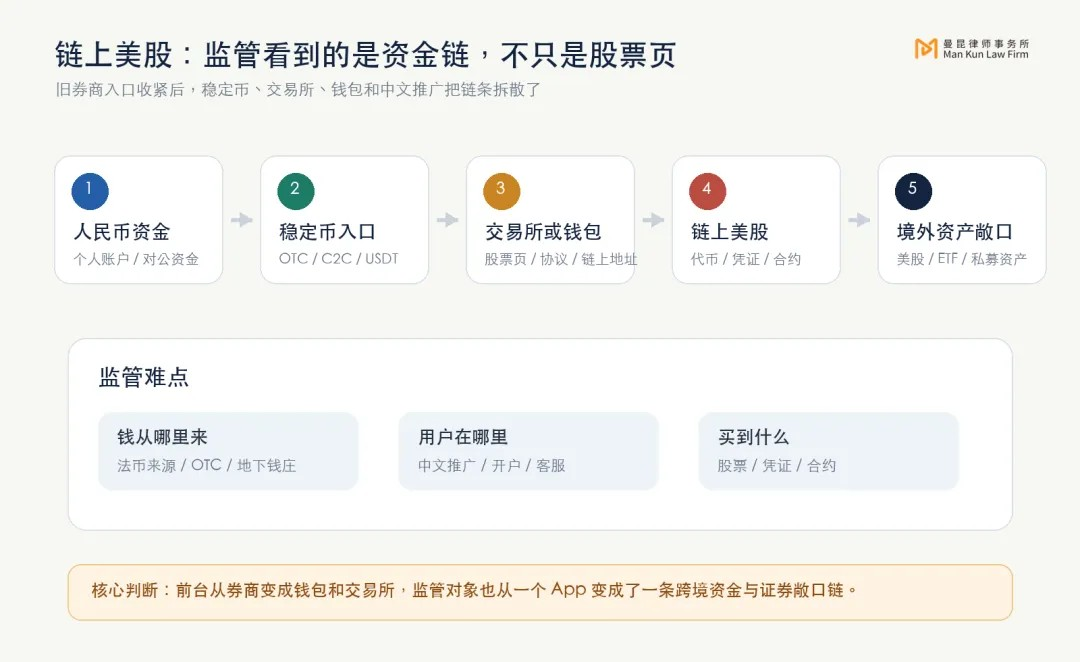
The fund and responsibility chain of on-chain US stocks from the perspective of Chinese regulation
The first difficulty is that the traceability of bank funds has been weakened.
In the past, to regulate cross-border securities investments, one could look along the paths of bank foreign exchange purchases, cross-border remittances, securities accounts, and broker channels. Now, funds may first turn into stablecoins within the mainland before entering offshore exchanges or wallets. Banks can see the former part but may not know that this money ultimately turned into exposures to Nvidia, Tesla, or Nasdaq ETFs.
Even more troubling, off-market stablecoin transactions are often mixed with funds related to fraud, underground banks, and points networks. Regulation now has to track not a single clear cross-border remittance but a series of relationships between "domestic transfers, stablecoin transfers, exchange accounts, on-chain addresses, and securities exposures." Each segment may have someone responsible, but there is no single institution that naturally grasps the whole chain.
The second difficulty is that the CRS set of tax information exchange tools is no longer adequate.
In traditional financial accounts, users' bank accounts, brokerage accounts, account balances, and investment earnings may fall within the scope of CRS information exchange. Even if it cannot be blocked in real time, there may later form traces of tax and asset information.
However, if on-chain US stocks occur within offshore crypto exchange accounts or on-chain wallets, the situation becomes much more complicated. Users hold exchange account balances, stablecoins, stock tokens, contract rights, or some kind of offshore certificate, which may not be automatically included in the CRS information exchange chain that China can effectively access as traditional bank and brokerage financial accounts would be.
This leads to a very real regulatory gap: in the traditional brokerage path, what users buy, where their accounts are, what their balances are, and how much profit they make theoretically can still be seen through financial account information exchange and tax reporting systems; but in the offshore exchange path, users may already hold exposure to offshore stocks, while mainland regulators may not be able to see them in a timely manner through existing mechanisms like CRS.
The third difficulty is that cooperation in investigations and law enforcement is no longer as controllable as in the banking system.
Within the domestic banking system, when regulatory departments, public security agencies, and tax authorities need to check transaction records, query accounts, or freeze funds, there is at least a relatively mature cooperation mechanism. Banks know who they are dealing with and also understand the consequences of non-cooperation.
But offshore exchanges are different. They may be registered in some offshore jurisdiction, their product documents state they do not target restricted regions, and the front end may not directly acknowledge service to mainland users. If mainland regulatory authorities want to check a certain user's stock exposure, stablecoin flow, on-chain withdrawal addresses, regular investment records, and redemption records at an exchange, whether they can obtain it, how long it takes, and how much they can obtain all depend on the jurisdiction where the platform is located, the platform's compliance attitude, and the efficiency of cross-border law enforcement collaboration.
This poses a significant shock to Chinese regulation. In the past, regulation faced a combination of "domestic banks + offshore brokers + CRS"; now it may face a combination of "domestic OTC + stablecoins + offshore exchanges + on-chain wallets + stock tokens." The former at least had relatively clear accounts and cooperation objects, while the latter disassembled funds, assets, and information flows into multiple different systems.
This is the real headache for mainland regulation regarding on-chain US stocks. It is not simply adding an investment tool but replacing the chains of banks, brokers, and CRS information that were traditionally amenable to enforcement with a new chain formed by stablecoins, offshore exchanges, and on-chain addresses.
Regulation is not completely blind, but the costs of seeing, the difficulty of identification, and the radius of cooperation have all been significantly extended.
Friendly Reminder from Lawyer Mankun
For investors, don't rush to consider on-chain US stocks as a substitute for Futu. What you pay with stablecoins is real money, but what you receive back may not be real stocks.
The first thing to check is the exchange itself. When offshore exchanges claim compliance, they usually mean they have licenses, registrations, disclosures, or compliance arrangements in some overseas jurisdiction, which does not imply they can provide securities investment services to mainland residents.
Especially for smaller exchanges, lacking mature asset custody, clear issuing documents, and sufficient liquidity, once they encounter delisting, suspension of redemption, or market making interruptions, users may find it difficult to identify who is responsible. For ordinary investors, the smaller the platform, the higher the yield claims, and the more it emphasizes "can buy domestically," the more you should stay away.
The second thing to check is your fund entry and exit path. In the past, buying stocks through cross-border brokers was troublesome, but users usually did not need to repeatedly buy and sell cryptocurrency in the C2C market. On-chain US stocks are different; many users need to first convert RMB into USDT, and then transfer the stablecoins into the exchange or wallet.
During this process, if you encounter funds related to fraud, points laundering, or underground banking, you may face mild risks such as account freezes, or severe risks like being involved in money laundering, aiding and abetting crimes, etc. Many people think they are just buying US stocks, but they may unintentionally be participating in cross-border gray or black money laundering networks.
The third thing to check is what exactly you are buying. As mentioned earlier, the stock token solutions of different exchanges are not consistent; some connect to clearing brokers, some are tracking certificates issued by offshore entities, some are synthetic exposures, and some may just be internal accounting of the exchange. Just because NVIDIA or Tesla is written on the interface does not mean you actually own shares in these companies. You need to know who holds the underlying assets, who does the custody, who can redeem, and when regional restrictions change, which document will you refer to in asserting rights.
For entrepreneurs in the field of US stocks or asset tokenization, what is really worth doing is not helping users bypass brokers.
If a team's business model is to do account opening links, rebate agents, community tutorials, deposit guidance in the Chinese market, or even to pitch "Cannot use Futu, come here," "New method to buy US stocks domestically," "One-click buy NVIDIA with USDT" as conversion language, then it is not far from the sensitive regulatory red line.
Whether you call it RWA (Real World Asset Tokenization), stock tokenization, or putting global assets on-chain, as long as you are selling securities assets, assisting in deposits and withdrawals, opening accounts, and guiding trades to mainland users, the risks are quite high. The truly viable path lies in doing products within an overseas compliance framework, with clear licenses, investor suitability, asset custody, information disclosure, and anti-money laundering requirements.
On-chain US stocks will not disappear simply due to regulatory concerns. The experience of account opening, trading time, fractional share trading, cross-border settlement, and stablecoin payments are all real problems that hold commercial value. But for Chinese regulators, it is not just a few exchanges adding a stock page; it could potentially become a new problem relating to demands for cross-border securities investment and illicit cross-border capital flows.
The bigger the storm, the more valuable the fish may be. But for mainland investors and service providers in the Chinese market, the real questions may be whose fish it is, where the fishing hook is attached, and ultimately who will bear the risk.
免责声明:本文章仅代表作者个人观点,不代表本平台的立场和观点。本文章仅供信息分享,不构成对任何人的任何投资建议。用户与作者之间的任何争议,与本平台无关。如网页中刊载的文章或图片涉及侵权,请提供相关的权利证明和身份证明发送邮件到support@aicoin.com,本平台相关工作人员将会进行核查。


