"The lucky big spender" hunts for quantitative robots.

CN
链捕手
Follow
2 hours ago

In today's stock market, where quantitative trading is all the rage, most people believe that these cold algorithmic robots are the ruthless harvesters of Wall Street, continuously extracting the hard-earned money of retail investors who fall victim to emotional misjudgments or information asymmetry at lightning speed.

However, in an emerging market over the past 48 hours, several top quantitative robots experienced a near-perfect yield curve collapse, while a mysterious account named a4385 raked in $280,000 from it.

This market is called the prediction market, and a trader named a4385 showcased a meticulously planned hunt targeting quantitative robots to the world.

Financial Version of "Guess the Size": An Arbitrage Paradise for Quantitative Models

Everyone understands the concept of guessing sizes, and there are similar games in the prediction market.

For example, if you bet on "Will the gold price go up or down tomorrow?" and you bet on "up," and the price indeed rises the next day, then regardless of how much it rises, your "up" position will be settled for profit based on the odds at the time of betting, which correspond to the probability of the event occurring. Conversely, if the price falls, no matter how much it drops, your position will go to zero.

"Will XRP go up or down in 15 minutes?" is a typical example of many markets in the prediction market. Each 15-minute market opens with a starting price; after 15 minutes, if the price of XRP is higher than the starting price, the traders who bet on "up" profit, while those who bet on "down" profit if the price is lower.

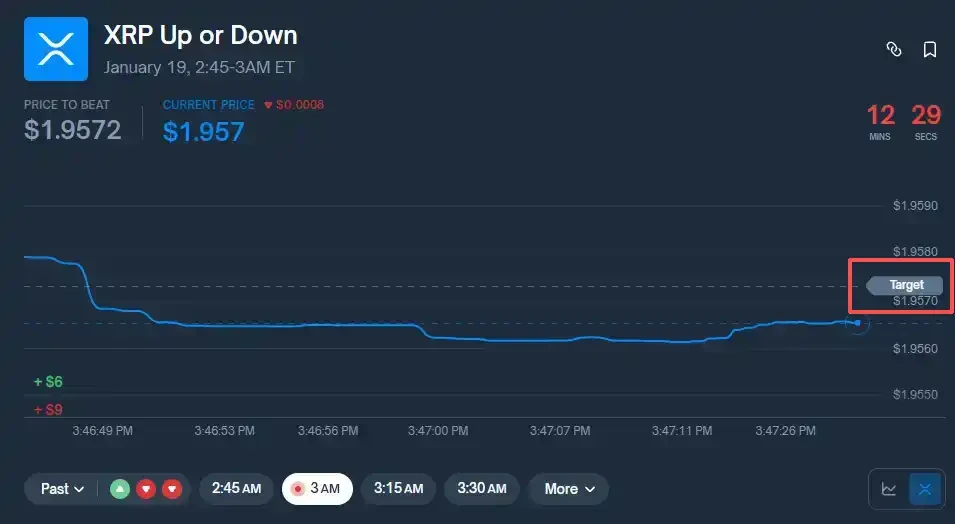
As shown in the image, Price To Beat corresponds to the starting price, and Current Price corresponds to the real-time price. The red "12:29" in the upper right corner indicates the remaining time until settlement. If the price line is above the "target" in the image at settlement, those who bet on "up" profit, and vice versa for those who bet on "down."

This real-time mechanism makes this market a paradise for quantitative robots: algorithms capture pricing deviations caused by retail investors due to emotions, information delays, remaining time, and other factors through sophisticated statistical models, and perfectly devour stable profits through automated trading.

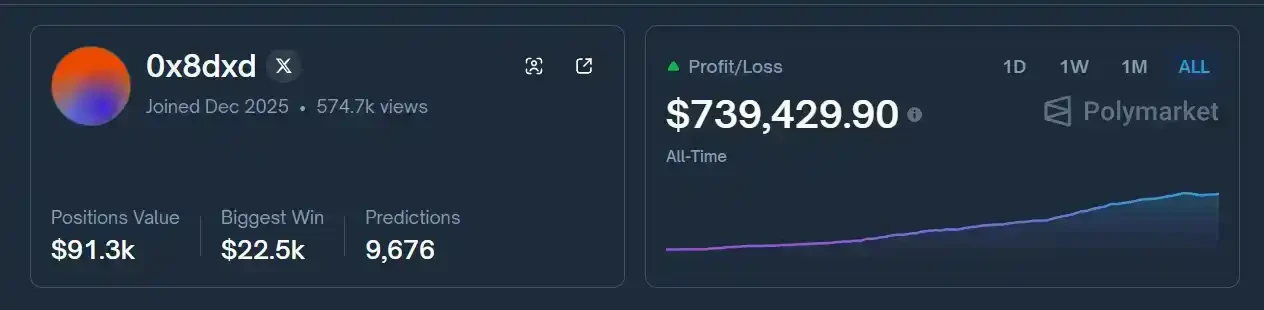
0x8dxd is a perfect example among many quantitative robots: since its launch on December 5, 2025, it has accumulated a profit of $740,000 over the past 44 days, participating in an average of 219 different markets daily, with a very smooth yield curve.

XRP Soars Right at Settlement, "Lucky Big Player" Doubles Funds

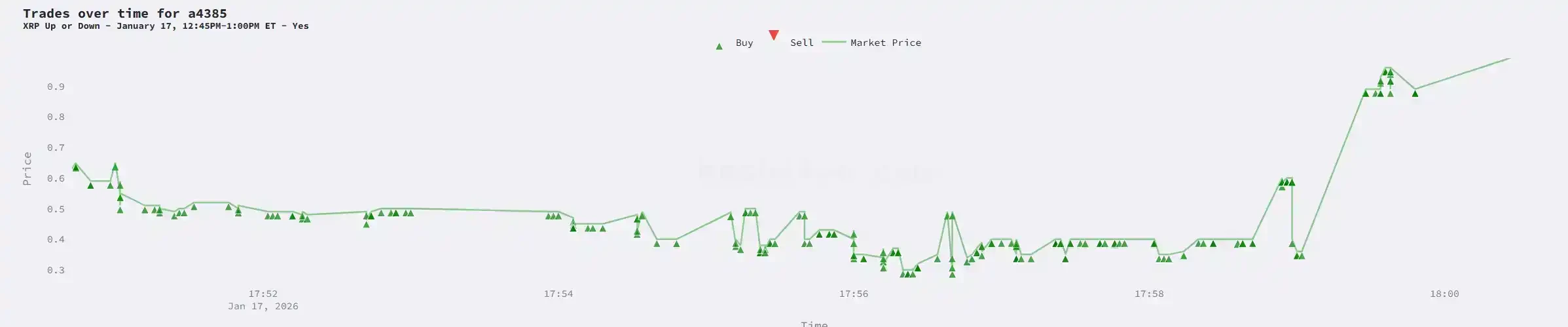
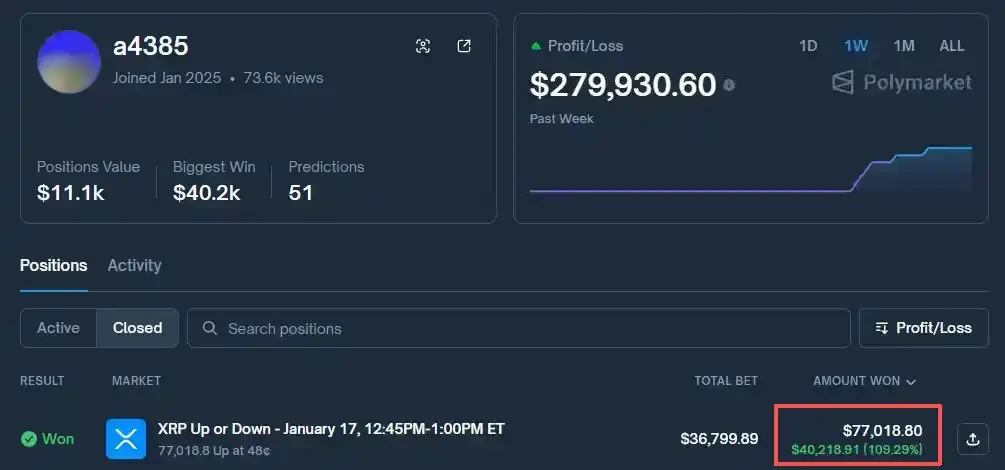
On the afternoon of January 17, 2026, a4385 bet on "Will XRP go up or down in 15 minutes?" with a bet on "up."

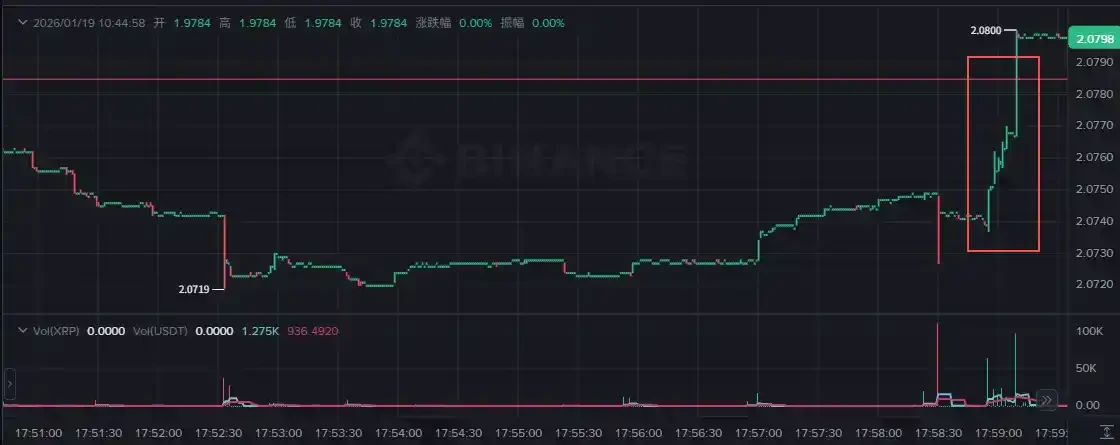
The starting price for XRP in this market was $2.0784, and until 17:58:54 (66 seconds remaining until settlement), XRP's price was still hovering at $2.0737, with a corresponding probability of an increase of only 36%—the market consensus believed that XRP would struggle to rise above the starting price in the remaining minute.

However, within the next minute, XRP suddenly began to rise continuously, and at the time of market settlement, the quoted price was fixed at $2.0817—just above the starting price.

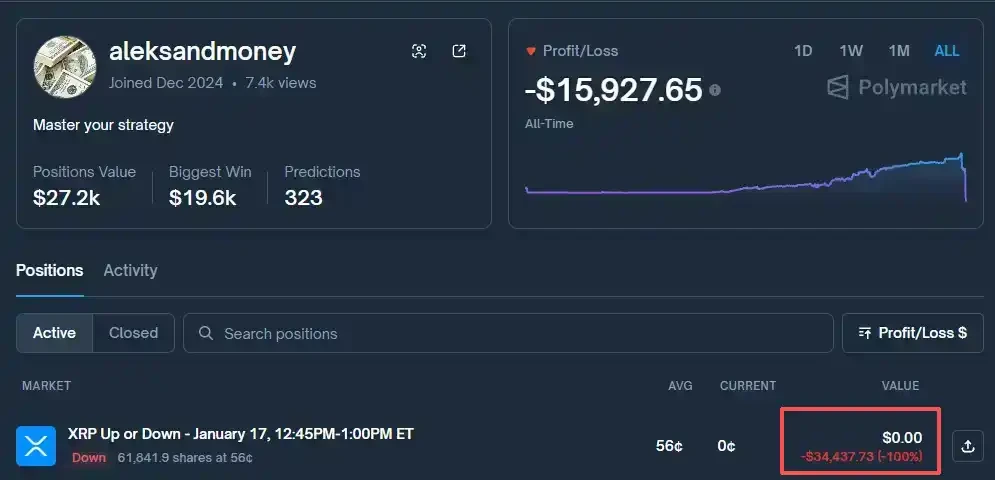
This meant that a4385 achieved substantial profits from entry to settlement, while those quantitative robots, like the one in the image below, lost all historical profits due to this single market and even faced additional losses.

This quantitative robot had made over $40,000 in profit over the past seven months, but incurred a loss of $34,000 in this market.

The Careful Manipulation Behind Repeated Luck

After the market settled, people discovered that a4385 had replicated several similar "lucky" operations: just one minute before the settlement in multiple markets, the price of XRP suddenly surged, only to quickly fall back the next second after settlement.

This led people to suspect that his "luck" might not be a coincidence but rather a precise strike against quantitative robots.

Theoretically, a4385 could first bet on "up" when the real-time price of XRP was below the starting price, and then one minute before settlement, buy XRP with a market order, artificially pushing up the price to ensure that the settlement price was above the starting price, thus locking in profits.

At this point, all previously seemingly inconsequential details began to matter: January 17 was a weekend, meaning that the order book depth provided by market makers for XRP was insufficient to buffer large trades in a short time.

Choosing XRP, a less popular asset compared to Bitcoin, further ensured a shallower order book depth, allowing the operator to move the price with less cost in a short time.

This provided a4385 with a perfect brief manipulation window:

First, in the prediction market, he made multiple large bets on "up" within 10 minutes before the market settlement. Since the real-time prices during this period were all below the starting price, the odds for betting were relatively high.

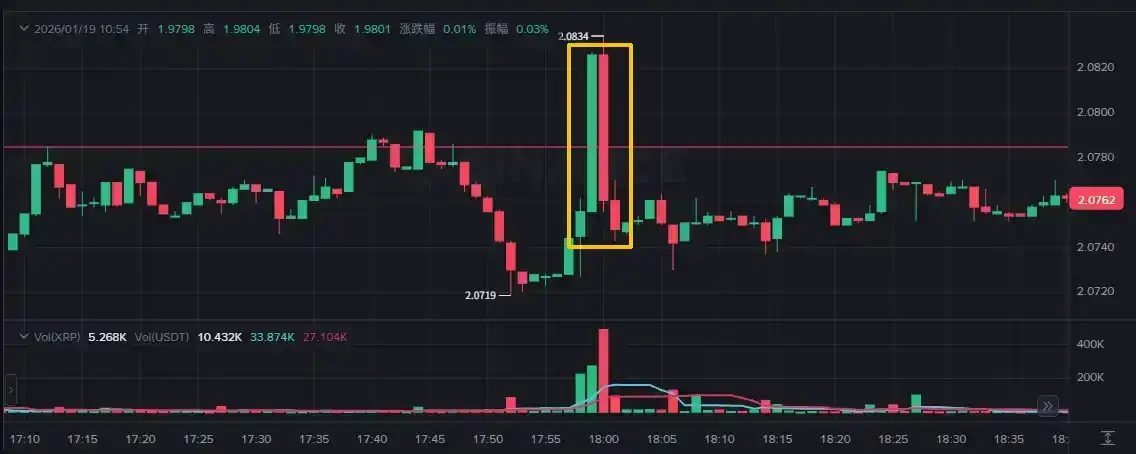
On the corresponding XRP price chart, the price hovered around 2.074 until just before 17:59. In the last minute, a surge of unusually large trading volumes entered, causing the price to suddenly break above the starting price (red horizontal line).

Once the market successfully settled, he immediately sold the XRP he had just bought, causing the price to drop back instantly.

If we assume that all market buy orders at 17:59 came from a4385, then based on the trading volume of $569,000 for that minute, and with an exchange fee of 0.32%, his total cost for buying and selling would be approximately $6,200.

His profit from betting "up" in this market was $40,218. By continuously replicating this strategy, he had already earned nearly $300,000 within 48 hours.

While we marvel at a4385's seemingly money-printing operations, we also need to consider the costs behind this seemingly "retail investor counterattack" story.

Buying to push up the price not only incurs thousands of dollars in transaction fees but also risks significant losses due to price drops when selling after settlement.

Therefore, while pushing up the price, he also needed to hold an equivalent short position. Only in this way, regardless of how violently the price of the XRP he held fluctuated, could the total value of his assets remain unchanged.

In other words, in addition to bearing transaction fee losses, he also needed over a million dollars in liquidity to ensure the feasibility of this strategy.

Thus, this is not a game of luck for a gambler, nor a carnival for ordinary retail investors.

Behind each legendary story of casino profits, perhaps the ones who truly laugh last are not luck itself, but the inevitable result of capital, structure, and rules being precisely calculated.

免责声明:本文章仅代表作者个人观点,不代表本平台的立场和观点。本文章仅供信息分享,不构成对任何人的任何投资建议。用户与作者之间的任何争议,与本平台无关。如网页中刊载的文章或图片涉及侵权,请提供相关的权利证明和身份证明发送邮件到support@aicoin.com,本平台相关工作人员将会进行核查。

Share To
APP

X

Telegram

Facebook

Reddit

CopyLink