Author: zhou, ChainCatcher
The year 2025 is destined to be a year that crypto investors and practitioners will repeatedly ponder.
In this year, the market accelerated the concentrated liquidation of financing illusions and narrative bubbles, beginning to shift from a speculation-driven false prosperity to a stock clearing based on effectiveness.
As the illusion of liquidity dissipates, once-prominent pioneers fall one after another, and the industry, in the painful process of dying and being reborn, forces every practitioner to re-examine the survival rules here.
2025 Project "Death" Portrait: From Narrative Clearing to Logical Judgment
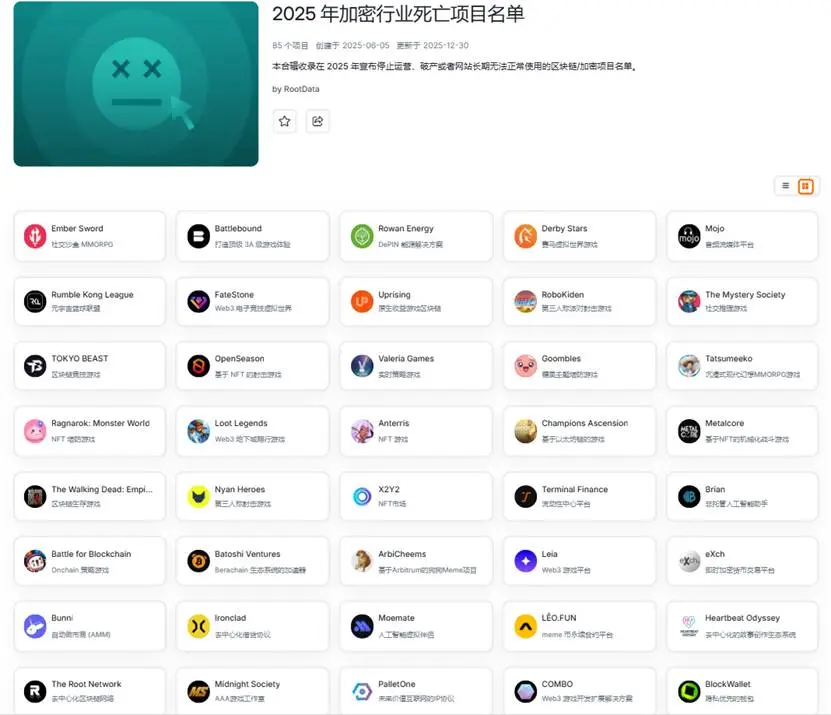
On December 30, the RootData data platform updated a list of dead projects in the crypto industry for 2025. These projects have either announced the cessation of operations or bankruptcy, or have been deemed "dead" due to long-term website inaccessibility. The list is still being updated.
Source: RootData
Looking back at past data, in 2021, the market was still in the early stages of a bull market, with hidden risks, recording 67 failure cases; then in 2022 and 2023, due to the chain reactions triggered by black swan events like the collapse of FTX and Luna, the number of bankrupt projects soared to 250 and 230 respectively; in 2024, as the market gradually stabilized, the elimination rate fell back to 171.
Unlike the passive deaths caused by explosions in the past, the current bankruptcies are more indicative of the collapse of business logic under extreme pressure, highly concentrated in popular tracks that were heavily invested in by capital.
Specifically, the GameFi sector is a hard-hit area, with a large number of projects, including COMBO, Nyan Heroes, and Ember Sword, shutting down one after another. The NFT sector is similarly devastated, with platforms once highly focused, such as Royal, RECUR, and X2Y2, all on the list.
In addition, competition at the infrastructure level has become increasingly brutal, with projects like CLV and Vega Protocol exiting due to weak ecosystems, while automated market maker Bunni, which suffered a fatal blow from hackers, reflects the devastating impact of missing security boundaries on protocol survival.
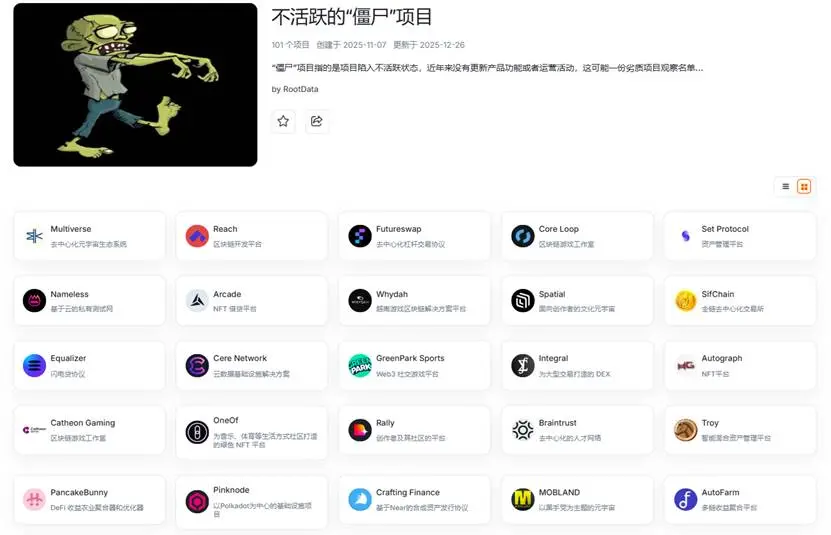
In addition to the explicit death list, RootData's compilation of "zombie projects" has exposed hundreds of projects on the brink of death. Most of them were born at the turning point of the 2022-2023 cycle. Although they have not declared bankruptcy, the projects have fallen into an inactive state, with no updates to product features or operational activities in recent years.
Among them are not a few remnants of the metaverse and gaming narratives (such as Spatial and GameSwift), once-promising DeFi protocols (such as finance.vote, Set Protocol, AutoFarm), and infrastructure and developer platforms (such as Reach, Pinknode, Unlock Protocol).
Source: RootData
Evolution of Industry Underlying Logic: From Narrative Illusion to Value Reconstruction
The root cause of the project bankruptcy wave in 2025 lies in the fundamental reversal of the underlying business logic in the industry.
Taking the GameFi sector as an example, Delphi Digital pointed out that the industry is performing extremely poorly in 2025, with financing amounts plummeting by more than 55% year-on-year. Some once highly anticipated star products performed mediocrely after launch, leading to a rapid freeze in market enthusiasm. Data shows that the GameFi market size shrank from $23.75 billion at the beginning of the year to $9.03 billion by the end of the year, a decline of over 60%.
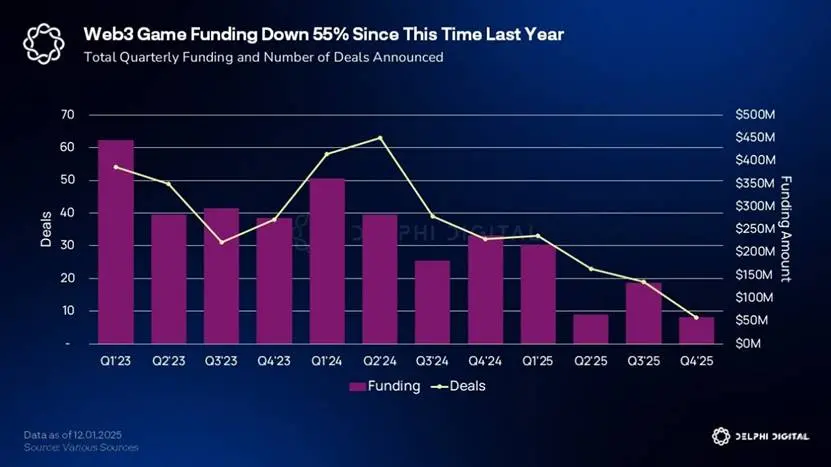
This grim situation reveals the inherent fragility of the previously popular "Play-to-earn" model: without sustained external incremental funding, a high-inflation token economic model not only cannot be maintained but accelerates user attrition. Although many projects attempted to seek a glimmer of hope by turning to Telegram mini-programs, the ecological break caused by stagnation in main chain business led to most user migrations ending in failure, with the entire sector's trading volume plummeting over 70%.
The collapse of the NFT market is even more alarming. Data shows that the NFT market fell to its annual low in December, with total valuation plummeting from $9.2 billion in January to $2.5 billion, a drop of 72%. Meanwhile, market activity showed a cliff-like shrinkage, with the number of sellers falling below 100,000 for the first time since April 2021, according to CryptoSlam data.
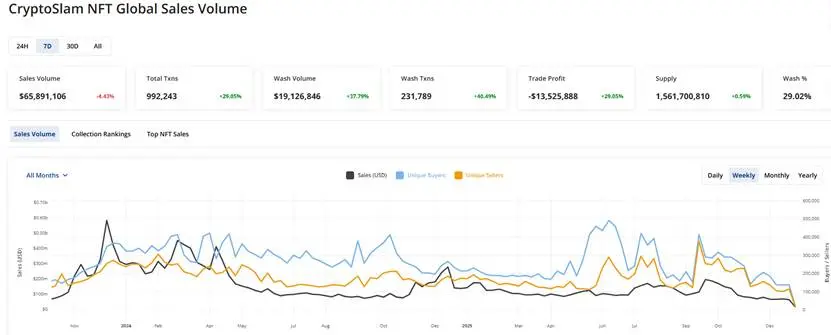
The reason lies in the lack of practicality, which has become the fatal flaw of NFTs. According to Bloomberg, the elite group in the crypto circle has begun to restructure their asset allocation, choosing to shift their attention from digital art to more certain physical scarce assets.
In fact, the collapse of GameFi and NFTs did not happen overnight. Many GameFi projects showed signs of trouble in 2022, with user attrition and inflation issues accelerating, while NFTs continued to languish after liquidity in the secondary market dried up, now entering a phase of final clearance.
Moreover, the DeFi sector has also not been spared, with the total value locked (TVL) dropping by over 20% throughout the year. On one hand, frequent and high-profile hacker attacks have shaken users' trust in protocol security boundaries; on the other hand, the exhaustion of yields under stock game dynamics has accelerated the outflow of a large amount of "floating capital" chasing high interest.
Overall, the pain of 2025 proves that projects characterized by "low effort, high leverage" have lost their survival soil. The crypto market is undergoing a paradigm shift from speculation-driven to value-driven, and only entities with sustainable business models can stand firm in the new order.
Ineffectiveness of Capital Endorsement: Collective Fall of Star Projects
In the liquidation wave of 2025, high financing scales and top institutional endorsements failed to serve as a "safe haven" for projects.
Data indicates that even targets once favored by top VCs like a16z, Pantera, and Polychain, when lacking real traction and self-sustaining capabilities, still cannot escape failure.
1. Vision and Reality Misalignment: Liquidation of High Financing
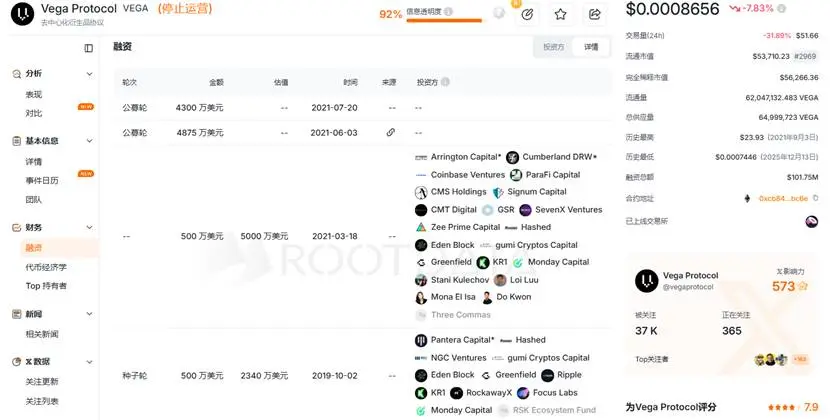
Among the publicly listed dead projects, Vega Protocol, which ranks high in financing amounts, once garnered over $100 million in bets from 29 top capital firms, including Coinbase Ventures and Ripple, based on its vision for decentralized derivatives. However, its mainnet TVL has long remained at the level of hundreds of thousands of dollars, far below competitors like Hyperliquid. Ultimately, under the dual pressure of weak user growth and resource depletion, the project was closed through community voting, shifting to software development.
2. NFT Bubble Burst: Chain Reaction Triggered by Liquidity Drought
The collective collapse of the NFT sector exhibits clear characteristics of "narrative collapse." The music NFT platform Royal (which raised $71 million), despite having support from a16z and star endorsements, still faced a funding chain break due to a 66% drop in secondary market trading volume and an inability to break through mainstream bottlenecks in practicality. Similarly, RECUR (which raised $55 million) with a brand IP valuation exceeding $300 million, and the established platform MakersPlace (which raised $30 million), gradually exited the stage due to market saturation, revenue collapse, and a cliff-like drop in user engagement.
3. Sector Squeeze and Ecological Decline: The End of Technical Narratives
In the infrastructure sector, the rise and fall of ecosystems directly determine the life and death of projects. CLV (Clover Finance), after receiving a $47.1 million investment from OKX Ventures and Polychain, ultimately closed due to the decline of the Polkadot ecosystem, delisting from multiple exchanges, and liquidity exhaustion. Fractal Network was forced to shut down under the pressure of monopolization in the ZK sector, due to a long technical landing cycle and low market adoption.
4. Structural Defects: From Metaverse Retreat to Protocol Security
Futureverse (which raised $54 million) entered liquidation under the dual blows of the metaverse retreat and insufficient revenue; COMBO (which raised $40 million) exhausted its funds due to the failure of the GameFi model and unsuccessful user migration. Additionally, the DeFi protocol DELV, once valued at over $300 million, ultimately chose to cease operations due to the high costs of fixing core vulnerabilities and a lack of market fit for its products.
These cases convey a clear signal: in the current environment of conservative investment attitudes, financing scale and institutional halo are no longer talismans.
Projects lacking real user retention and sustainable business models, regardless of how high their entry barriers are, will quickly fall into the endgame of funding chain breakage once they lose external capital infusion.
Conclusion
Pain is an inevitable path to maturity. In the crypto world, high financing, star VCs, and popular sectors cannot guarantee survival.
In this painful process of dying and being reborn, the industry will ultimately understand: all revelries that deviate from business common sense must eventually end in liquidation.
After all, there is no eternal winter or summer in crypto; surviving is the only narrative.
Click to learn about job openings at ChainCatcher
免责声明:本文章仅代表作者个人观点,不代表本平台的立场和观点。本文章仅供信息分享,不构成对任何人的任何投资建议。用户与作者之间的任何争议,与本平台无关。如网页中刊载的文章或图片涉及侵权,请提供相关的权利证明和身份证明发送邮件到support@aicoin.com,本平台相关工作人员将会进行核查。


