
Oracle referred to the $20 billion financing completed in early November as "one-time completion." JPMorgan believes this statement responds to market skepticism regarding Oracle's construction funding.
On November 23, 2026, JPMorgan analyst Samik Chatterjee's team released a report. The bank maintained an "overweight" rating on Oracle (ORCL.US). The bank bets that starting from fiscal year 2029, Oracle can expand through its own cash flow.
Funding for OpenAI contract is fully in place
On Friday, November 20, 2026, after the U.S. stock market closed, Oracle issued a statement. The statement stated that the funds required to fulfill the OpenAI contract are fully in place.
This contract carries significant weight. According to a Reuters report on November 20, 2026, the two companies plan to develop an additional 4.5 gigawatts of data center capacity in the U.S. This does not include the first Stargate park in Abilene.
JPMorgan estimates that the OpenAI contract accounts for approximately half of Oracle's existing remaining performance obligations (RPO). Remaining performance obligations are contracted but unrecognized revenue, which can be understood as Oracle's order book.
The statement mentioned that supplier financing disclosed on Investor Day has been finalized. Oracle is still privately negotiating with other suppliers, but these negotiations are considered additional options.
In the statement, Oracle claimed that it is the first hyper-scale cloud vendor to have all funding in place during this investment cycle.
The statement also disclosed engineering progress. The Abilene park is nearing completion. The gigawatt-level Shackelford park has received all necessary permits. The delivery of NVIDIA's Vera Rubin cabinets, according to the statement, will occur in the coming weeks.
Cash flow guidance has not changed. Oracle reiterated that free cash flow (FCF) will turn positive in the second half of fiscal year 2028. In fiscal year 2029, free cash flow will exceed $30 billion. Starting from fiscal year 2029, the company will handle the funding needed for growth on its own.
JPMorgan places greater importance on the signal behind the statement. The report states that the willingness of suppliers and customers to finance this round of heavy asset construction indicates that the industry chain has more confidence in the contract's economics.
The report contrasts this confidence with investor sentiment. In the bank's view, there is a strong dichotomy, with investor sentiment being noticeably more pessimistic.
About half of remaining construction costs will be covered by others
The focal point of the financing debate is where the money comes from. The report provides a summary. To complete the remaining gigawatt-level construction by fiscal year 2028, Oracle needs approximately $220 billion in capital expenditure.
This expenditure is covered about half by customer prepayments, supplier financing, and other leverage. This portion of funding does not require Oracle to initially pull from its own accounts.
The remaining gap will be filled by operational cash flow and the $20 billion in new financing. The report specifically states that the $90 billion in implied cash generation is not all used for construction. This also includes cash buffers and dividend payments waiting for disbursement.
According to the numbers provided in the report, the three funding sources can roughly be broken down as follows:
| Funding Source | Amount (approx.) | Explanation |
|---|---|---|
| Customer prepayments, supplier financing, etc. | $110 billion | Report states it covers about 50% of capital expenditure |
| New financing | $20 billion | Oracle states "one-time completion" |
| Implied cash generation | $90 billion | Includes cash buffers and dividend payments waiting for disbursement |
| Total | $220 billion | Remaining gigawatt-level construction by fiscal year 2028 |
The $110 billion in the table is estimated based on 50% of the $220 billion; the original report only specified the ratio. The total of the three items is consistent with the $220 billion total expenditure.
The composition of the $20 billion can be found in Oracle's announcement on November 2, 2026. The equity portion was issued at $116 per share, raising approximately $9.9 billion.
The debt portion consists of five tranches of senior notes, raising approximately $10 billion. The coupon rate ranges from 7.000% to 8.650%.
According to Investing.com on November 20, 2026, Oracle had made a commitment on Investor Day. For fiscal years 2027 to 2030, new capital market financing will be capped at $20 billion. Each will occupy $10 billion, excluding debt refinancing.
The $20 billion financing completed in early November corresponds exactly to this limit. Oracle management indicated to JPMorgan that this financing round is "one-time completion." The vast majority of supplier financing was finalized before Investor Day.
The supplier financing takes the form of accounts receivable, spread across numerous suppliers. The report emphasizes that Oracle does not overly rely on any single supplier, including NVIDIA.
Cost-plus contracts lock in margins first
The money is raised, the next question is whether these investments can be recouped. The report's answer lies in the contract structure.
Large AI contracts with delivery periods of more than a year are priced using a cost-plus method. Simply put, this means adding an agreed profit margin on top of the construction and operational costs.
This is somewhat akin to how a renovation company quotes based on "material costs plus management fees." If material prices rise, the quote goes up accordingly, while the company's profit remains unaffected. The report believes this structure can protect Oracle's profit margins.
The report provides a preliminary estimation of the margin for a 1 GW contract. When fully operational, the gross margin for this contract is about 35%, with an operating margin of about 30%.
In the same estimation, the return on investment (ROI) is approximately 28%. These figures correspond to the full-load status; the report does not provide profit margins during the ramp-up period.
$16 billion revenue per GW cannot be extrapolated
On Investor Day, Oracle provided an annualized revenue figure of about $16 billion per gigawatt (GW). The report reminds that this figure only corresponds to mega-site transactions.
This cannot be applied to the entire 10 GW roadmap; the report offers two reasons.
Firstly, a significant portion of the existing approximately 3 GW capacity is primarily CPU-based.
Secondly, the targeted 10 GW capacity will not all fall within mega-sites.
The report's meaning is clear: estimating revenue by multiplying $16 billion per GW by total capacity is not valid.
The report believes that expansion after 10 GW will be closely tied to already established capacity. At that point, the entire capacity base will begin to generate cash, allowing Oracle to raise funds for growth more comfortably.
International expansion is another avenue. The report refers to this as leverage available to Oracle to further expand capacity.
Stock price is still nearly half of target price
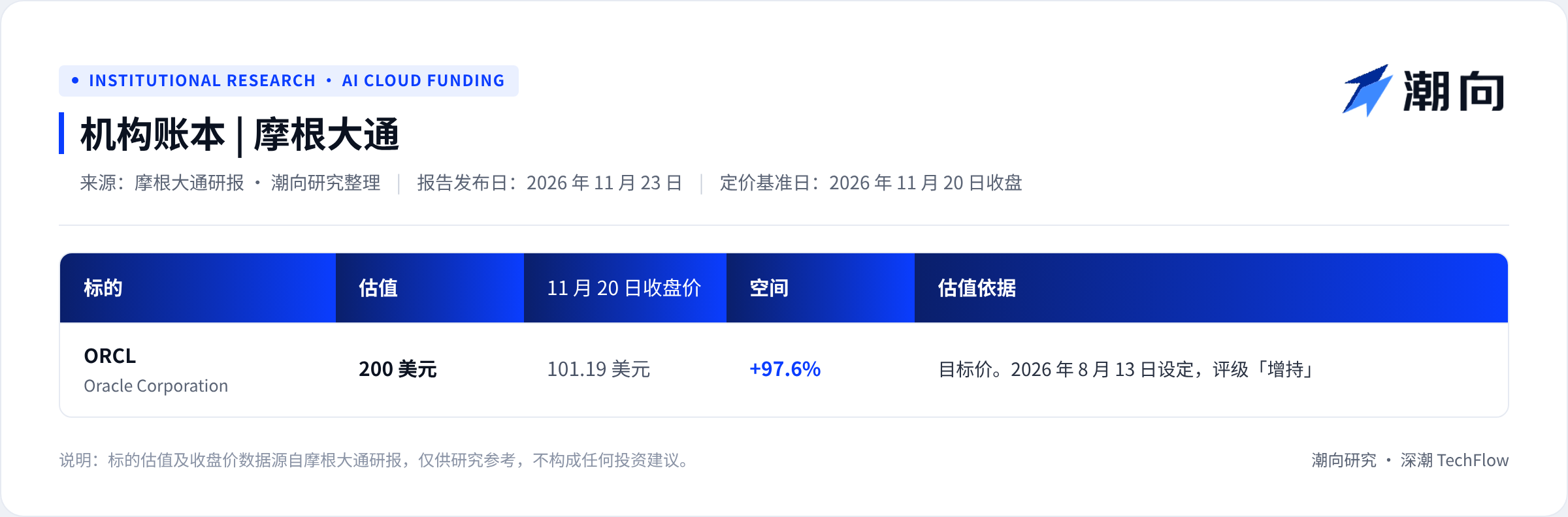
The report's cover shows Oracle's closing price on November 20, 2026, at $101.19.
The report includes a history of ratings. On March 11, 2026, JPMorgan upgraded Oracle from "neutral" to "overweight." At that time, the stock price was $149.40, with a target price of $210.
On August 13, 2026, the bank adjusted the target price to $200, when the stock price was $153.28. This was the most recent adjustment in the rating history; the current report does not mention a new target price.
Calculating based on the $200 target price, there is approximately 97.6% upside potential from the closing price on November 20. From August 13 to November 20, Oracle's stock price fell about 34.0%.
The rating history also records a point of contrast. On September 10, 2025, Oracle's stock price was $241.51. At that time, JPMorgan's rating was "neutral," with a target price of $270.
After the statement was released, the stock price reacted. According to a Reuters report on November 20, 2026, Oracle's stock price rose by 3.3% in after-hours trading.
The report concludes that this statement represents a positive development. It helps address financing disputes and should reassure investors regarding the gigawatt-level construction path.
JPMorgan's judgment has two time points for comparison. The more recent one is the delivery of Vera Rubin cabinets, which the statement said would be completed in the coming weeks.
The more distant one is the second half of fiscal year 2028. Oracle's guidance is that free cash flow will turn positive during this period.
Institutional Ledger
Fixed statement regarding the research report's content (broker's view, not潮向 research's view)
This article is a summary and interpretation of third-party broker research reports by潮向 research. The ratings, target prices, earnings forecasts, and related judgments quoted in this article are solely the opinions of the broker's analysts and represent the position of their respective institutions, not潮向 research's view, nor do they constitute any investment advice.
Markets are risky, decisions should be independent. This article should not be taken as the basis for buying or selling any securities.
免责声明:本文章仅代表作者个人观点,不代表本平台的立场和观点。本文章仅供信息分享,不构成对任何人的任何投资建议。用户与作者之间的任何争议,与本平台无关。如网页中刊载的文章或图片涉及侵权,请提供相关的权利证明和身份证明发送邮件到[email protected],本平台相关工作人员将会进行核查。