Author: Kelly Ye, Coin Metrics
Translator: Shenchao TechFlow
Senchao Introduction: After SpaceX listed and tested the waters for five months, the Pre-IPO perpetual contract market has undergone a qualitative transformation. Faced with the heavyweight listing of Anthropic, the crypto-native derivatives market not only crushes the former in trading scale and open interest depth, but also showcases astonishing price discovery accuracy. From the announcement of the S-1 amendment to the bell-ringing for listing, on-chain perpetual contracts have gradually become a keen outpost for understanding the true fair value of unlisted unicorns.
Data proves that on-chain perpetual contracts predict actual listing trends far more accurately than traditional IPO pricing. On the eve of the opening, the deviation between the perpetual contracts and the spot opening price shrank rapidly from 12% to just 0.45%, even providing uninterrupted liquidity and hedging tools during after-hours and weekend traditional stock market closures. This leap from marginal side bets to an all-weather derivatives infrastructure is reconstructing the global paradigm of new stock pricing.
Key Points
The Pre-IPO perpetual contract market has matured since SpaceX: The trading duration of Anthropic perpetual contracts lasted for months rather than weeks, achieving a record transaction volume of $4.97 billion on its first listing day, more than double that of SpaceX, and the open interest did not show any signs of withdrawal after listing, maintaining a high overall open interest of $550 million.
Early quote practices varied, gradually converging and unifying: In the early stages, various trading venues adopted different quoting standards such as price per share, valuation, and placeholder shares. Until the S-1 amendment officially disclosed the capital structure, major exchanges quickly switched and converged to a per-share pricing standard, narrowing the price spreads across platforms to within 4% before listing.
Perpetual contracts provide more guiding significance than official IPO pricing: On the day before listing, the closing price of the perpetual contracts was $98.33, an 18% premium over the official issue price of $83, with a discrepancy of only about 1% compared to the first-day closing price of $97.17.
Pricing accuracy sharply increased close to opening: On the night before listing, there was a deviation of about 12% between the perpetual contract price and the spot opening price; however, with liquidity injection, the price spread rapidly narrowed to 0.45 in the final minute before the opening.
Seamless connection between the bell-ringing and overnight periods: On the first listing day, the closing price of the perpetual contracts maintained a deviation of within 0.2% from the Nasdaq closing price; during the overnight and traditional weekend stock market closures, perpetual contracts continued to hedge and digest market information, with only a 0.4% deviation from the first trade price on Monday morning.
Anthropic underperformed amidst overall AI sector rebound: From last Friday's close to this Monday's trading period, Anthropic fell a cumulative 1.0%, while Nvidia and Nasdaq 100 index perpetual contracts rebounded sharply. The substantial spending promises on computing power and profit-taking using perpetual contracts for locking in gains are the primary reasons.
Introduction
Earlier this month, we systematically explored the implied expectations of crypto-native perpetual contracts for Anthropic's listing in the special report "Countdown to ANT." At that time, the quoting system for Anthropic across trading venues was still fragmented, and a unified conversion consensus on price per share had not formed.
In this report, we compare the pricing signals implied by the perpetual contract market with the actual performance after the stock listing, reviewing how this emerging asset class has withstood the most challenging real-world test to date.
A larger and earlier established derivatives market
In every metric, the volume and maturity of Anthropic's perpetual contracts significantly surpass those of SpaceX.
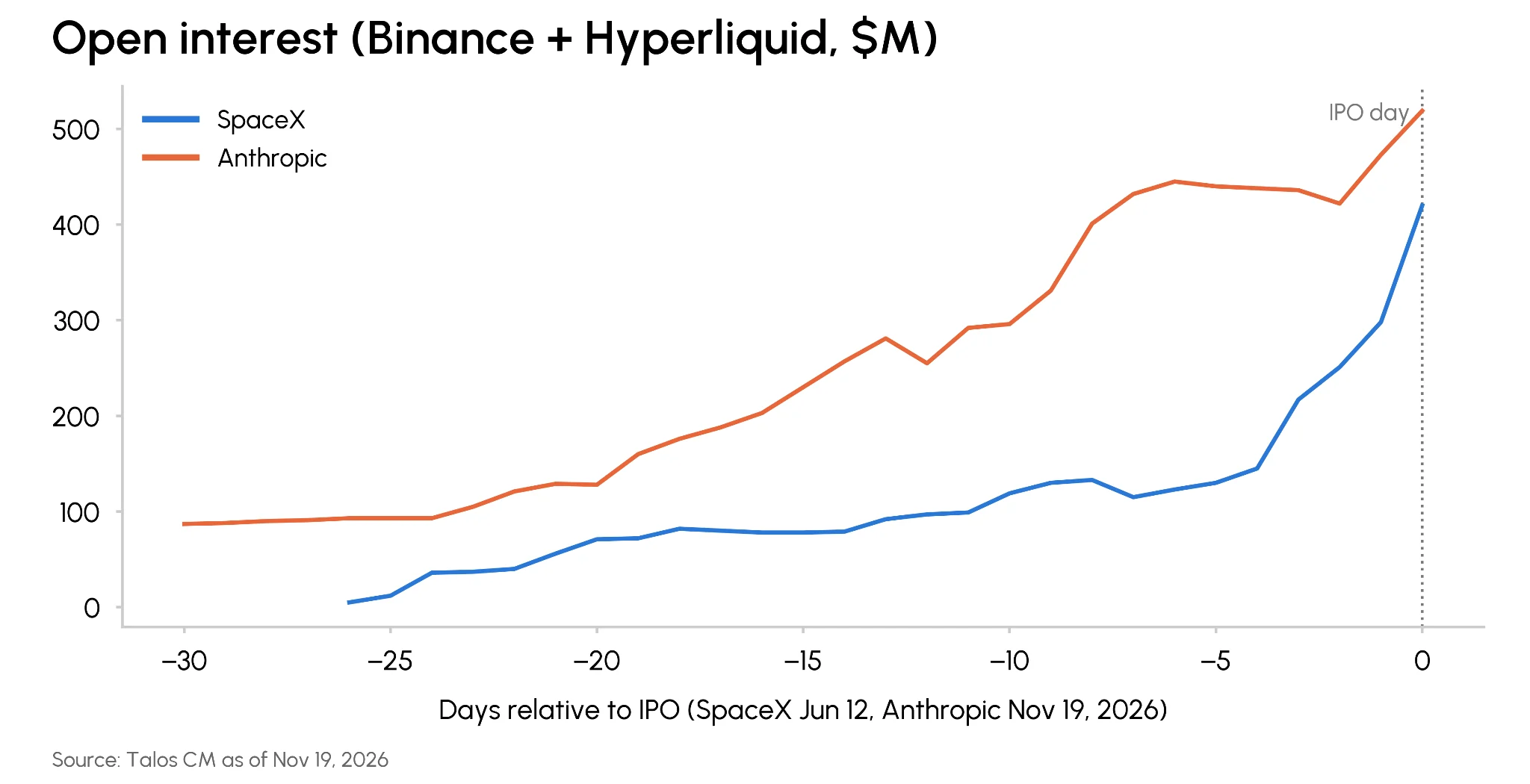
Figure: Source: Talos CM market data and Talos analysis. Open interest is based on daily snapshots at UTC time 00:00, aggregated from Binance and Hyperliquid Builder markets.
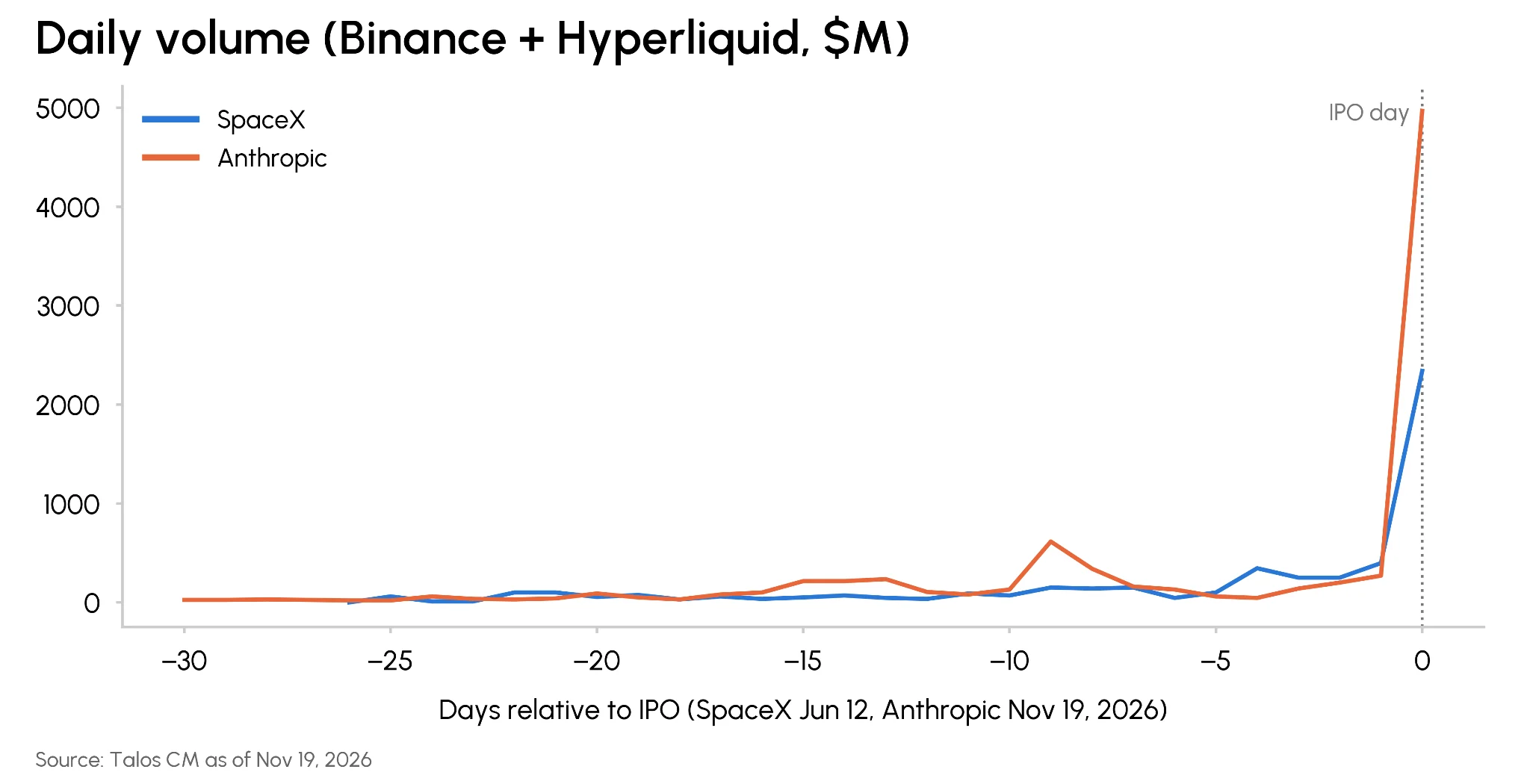
Figure: Source: Talos CM market data and Talos analysis. Daily trading volume statistics are based on UTC time daily, covering the Binance and Hyperliquid Builder markets.
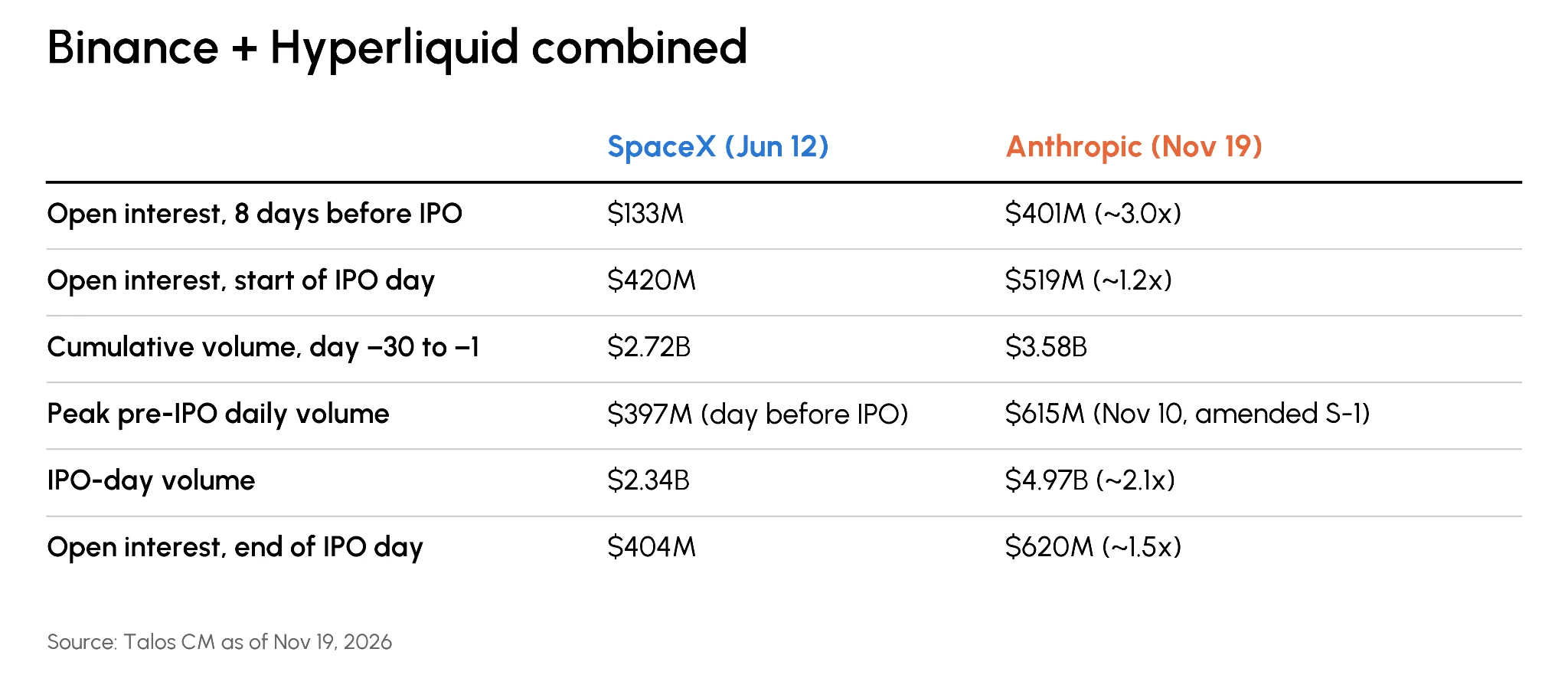
Figure: Source: Talos CM market data and Talos analysis. Day 0 is the first day of the IPO, with open interest taken from daily snapshots at UTC time 00:00.
Two core differences stand out:
Double the trading activity on the first day: Anthropic's perpetual contracts recorded a total transaction volume of $4.97 billion on their first listing day. Binance’s transaction volume surged from $269 million the previous day to $3.4 billion; trading volumes across various Builder markets under Hyperliquid also skyrocketed from $141 million to $1.57 billion. In contrast, SpaceX had a transaction amount of $2.15 billion on its first listing day.
Stable open interest retention post-listing: The open interest of Anthropic's perpetual contracts not only did not collapse after listing but rather rose steadily from $519 million the day before listing to $553 million on the listing day, and maintained at $549 million on Monday. This sharply contrasts with SpaceX's open interest, which halved rapidly after listing.
In just five months, Pre-IPO perpetual contracts have evolved from initial concept verification to a mature trading track with volumes in the billions of dollars.
While the number of trading venues for Anthropic's perpetual contracts is roughly comparable to SpaceX, most markets have traded continuously for months, rather than just a few weeks.
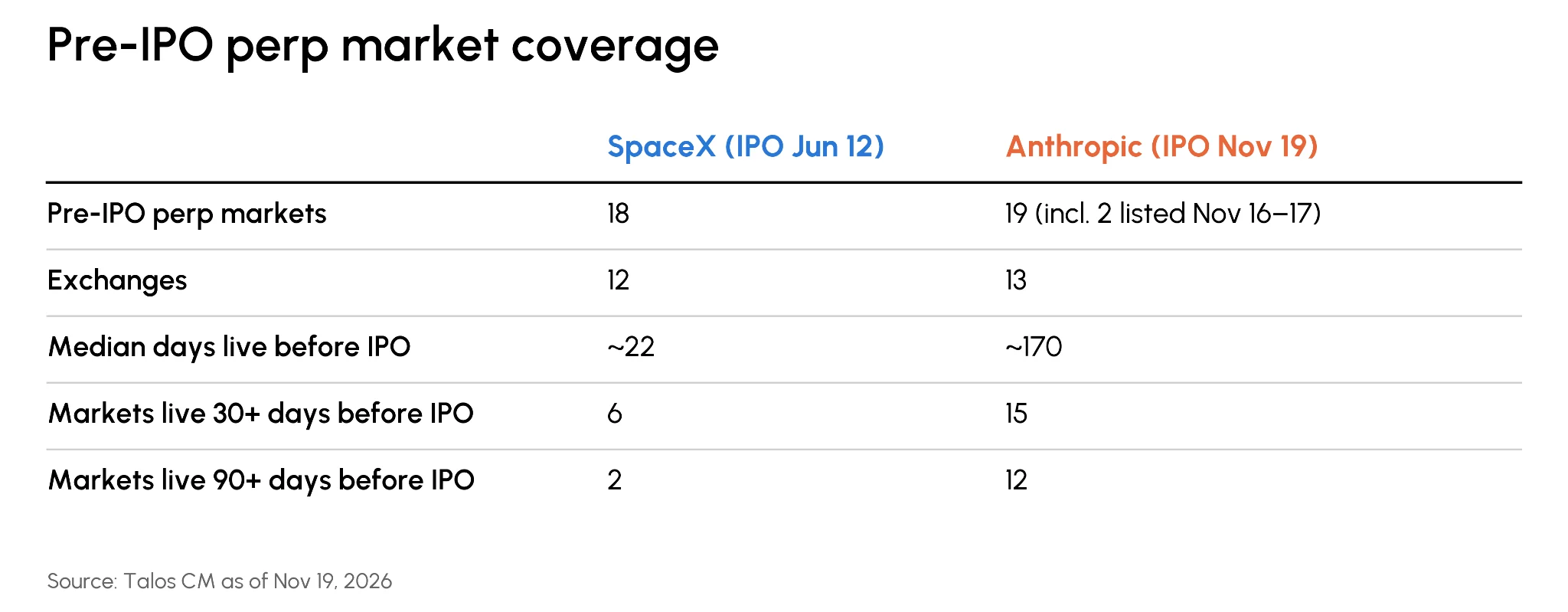
Figure: Source: Talos CM reference data and Talos analysis. The statistics cover all Pre-IPO perpetual contract markets of Anthropic and SpaceX tracked by Talos CM across all exchanges.
The prices across trading venues also rapidly converged before listing: As major mainstream platforms switched to per-share quoting, in the days leading up to the official listing, the price spreads between different trading venues had significantly narrowed to within 4% (approximately $95 to $99).
The same company, various quoting practices
During the preparation for listing, the same company adopted various distinctly different quoting standards across different platforms:
TradeXYZ under Hyperliquid quoted prices based on per-share prices of Class A common stock; while the Entropy market on the same chain quoted the fully diluted valuation (FDV) directly in billions of dollars; Binance initially priced ANTHROPICUSDT using a placeholder of 1 billion shares, later smoothly migrating to ANTUSDT on November 17; OKX started with a placeholder of 1 billion shares and adjusted its benchmark twice during restructurings (to 10 billion shares on June 30, and further to 13 billion shares on October 23).
It wasn't until November 10, when Anthropic submitted the S-1 amendment officially disclosing the overall share structure, that major trading venues finally transitioned to a standard contract based on price per share.
This early fragmentation led to three major market pain points: the lack of a single fair reference price; share resets causing open interest to superficially appear to plummet; and friction making direct arbitrage between the same asset across platforms difficult.
As more technology unicorns approach the capital market, establishing a standardized reference pricing benchmark across trading venues has become an urgent infrastructure demand for the entire industry.
Pre-IPO prices: The outpost for real listing pricing
Throughout the countdown phase to the listing, on-chain data released two highly penetrating pricing signals:
The S-1 amendment triggers the highest transaction volume: Prior to the official listing, the most active trading day was on November 10 (with daily transaction volume reaching $615 million), a key moment when the amendment clearly set the price range for shares issued.
Premium relative to the official issue price holds greater predictive value: On the eve of listing, the perpetual contracts closed at $98.33, 18% higher than the officially set issue price of $83, but the gap with the actual first-day closing price of $97.17 was only about 1%. A similar pattern was seen during SpaceX's listing: its perpetual contract price was 28% higher than the official issue price, while the final first-day closing price exceeded the issue price by 19%, with a discrepancy of only about 7% between the perpetual contract and the actual first-day price.
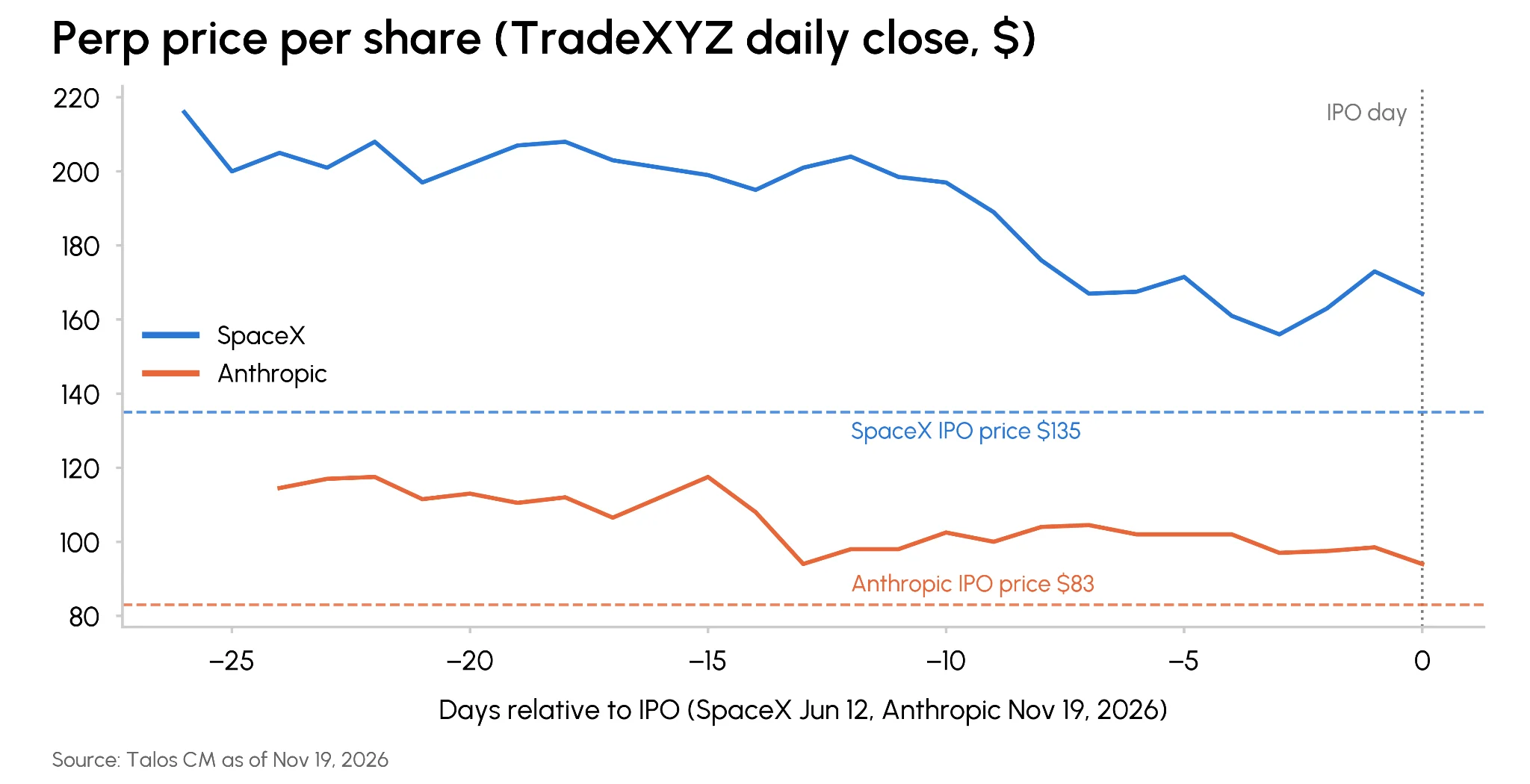
Figure: Source: Talos CM market data and Talos analysis. TradeXYZ daily closing prices (UTC time 00:00), with each contract corresponding to one share of Class A stock.
If we benchmark against the first trade price in the spot market's opening, the process of price dimensional convergence is even more exquisite:
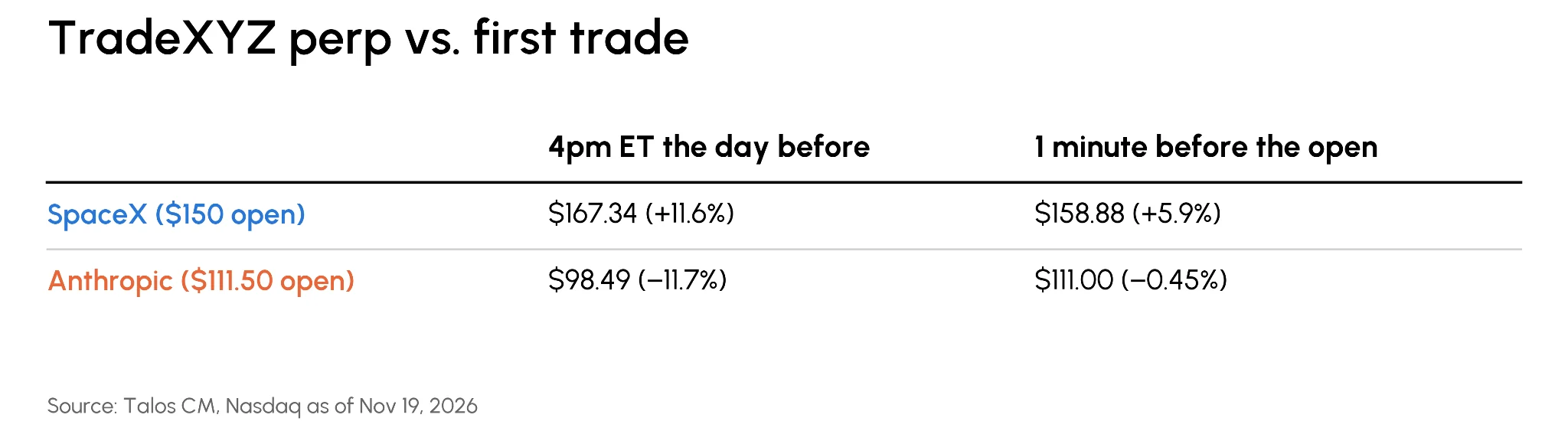
Figure: Source: Talos CM market data and Talos analysis. The pre-opening comparison uses TradeXYZ 1-minute candlestick data; the percentage represents the premium ratio of perpetual contracts relative to the spot opening price.
The night before the official bell-ringing, there was approximately a 12% deviation between the perpetual contract prices of SpaceX and Anthropic and the final spot opening price (SpaceX was above, Anthropic was below). However, as the bell-ringing moment approached, in the final minute before the opening, the difference for Anthropic’s perpetual contract sharply converged to just 0.45%. Previous research on Cerebras and ChangXin Memory (CXMT) showed a completely consistent pattern: deviations of 12% to 14% the night before narrowed to a very tight range of 1% to 3% just before opening.
Seamless transition at the bell-ringing moment: All-weather steady transition
For Pre-IPO perpetual contracts, the spot bell-ringing opening is the most testing vulnerable moment. Mismatched quoting practices, delivery and settlement delays, or liquidity gaps can easily trigger severe slippage and decoupling. However, Anthropic’s transition process demonstrated remarkable stability:
Continuous upward movement before opening: On the morning of November 19, the perpetual contracts rose steadily, reaching $110.10 five minutes before the Nasdaq bell-ringing, up 12% from the previous day's close.
Liquidity surge at the moment of opening: In the first minute after opening, perpetual contracts temporarily surged to $114.73, then fell under pressure as profit-taking occurred in the spot market, retreating to approximately $105 by noon. The trading volume during the hour of most active trading reached $483 million.
Close tracking of the spot closing throughout the day: The perpetual contracts closely tracked the downward trend of the stock throughout the day, ultimately ending the first day of trading near the Nasdaq official closing price of $97.17, with a deviation of only about 0.2%.
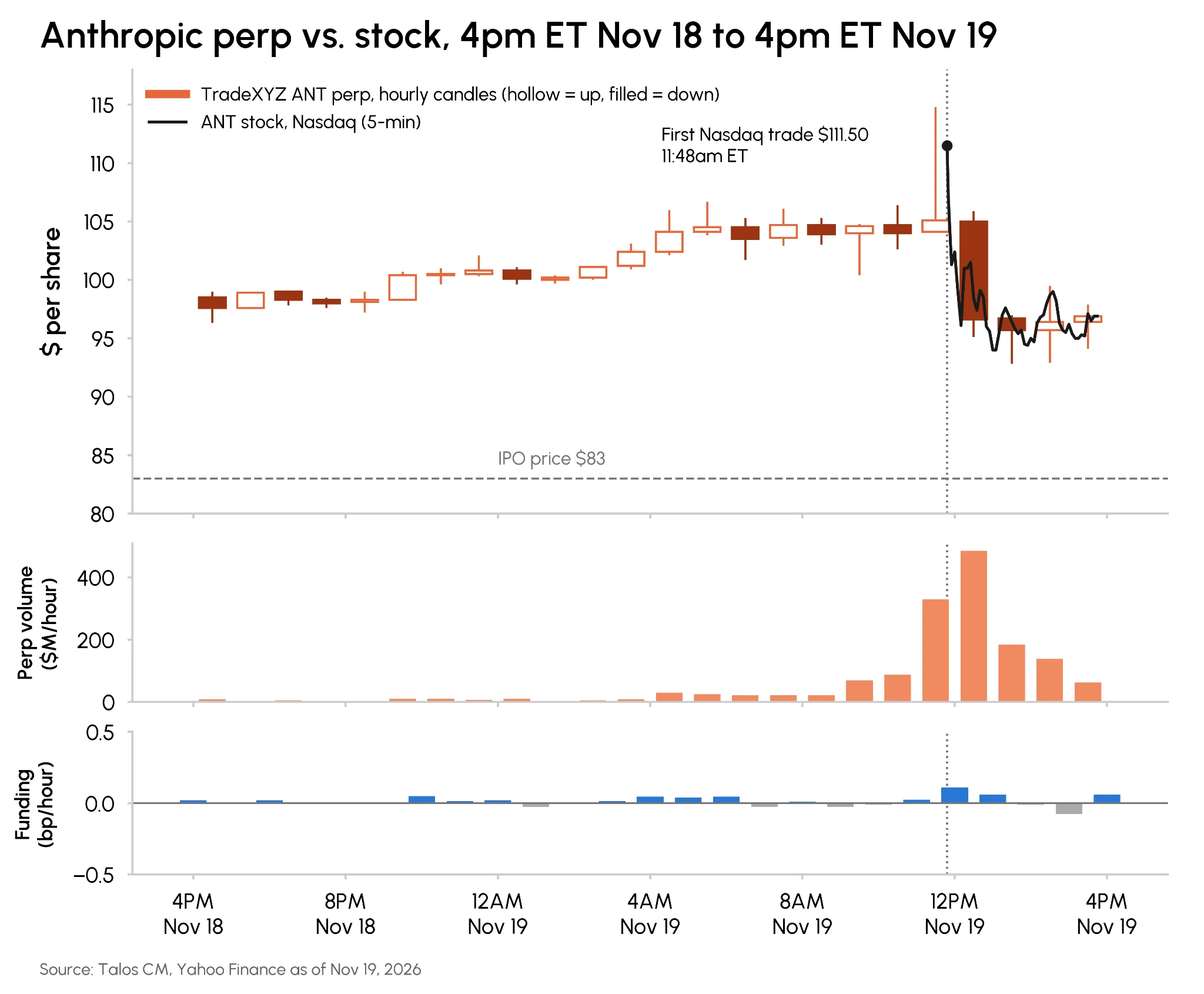
Figure: Source: Talos CM market data (TradeXYZ hourly candlestick, trading volume, and funding rates), Yahoo Finance (ANT 5-minute price), and Talos analysis.
From the second day of listing to Monday: closely tracking the trend, with relatively lagging rebounds: Anthropic coincided with major market turbulence: the Nasdaq index reversed from a 2% intra-day rise to a 2.25% decline on the first listing day, and the panic index VIX soared to around 28. During the overnight traditional U.S. stock trading closure, perpetual contracts continued their all-weather pricing, with their price deviating only 0.4% from the spot's first pre-market trading price at 4 AM and just 0.2% from the Friday opening price.
When the AI sector experienced a strong rebound over the weekend and Monday, Anthropic's performance lagged relatively: it closed down 1.0% from last Friday, being the only one among the AI targets tracked to close down, while Nvidia rebounded sharply by 31%, and Nasdaq 100 perpetual contracts rose by 6.6%. Two reasons explain this differentiation: first, Anthropic serves as the most direct public testing ground for verifying whether substantial AI capital expenditures can translate into commercial returns (as its public documents revealed commitments to billions of dollars in computing power procurement, with computing power costs consuming 55% of total revenue in the first half of 2026); secondly, the stock price remains above the issue price of $83, with some institutional investors using the 24/7 uninterrupted perpetual contracts as an all-weather hedging tool to lock in listing profits. Overall open interest remained stable at a high level of $550 million, with funding rates maintaining a neutral balance.
Conclusion: From marginal side bets to all-weather outposts
In "Countdown to ANT," we questioned what Pre-IPO perpetual contracts truly meant for Anthropic. Now the facts provide a conclusive answer: they not only accurately priced the market performance on the first day of listing but also assumed a crucial risk rebalancing function during traditional market closures.
Pre-IPO perpetual contracts are no longer just marginal side bets before listing but are gradually transforming into an all-weather operational, deeply liquid independent outpost trading market. This market is pushing the traditional financial closed pre-listing price discovery process out into the transparent on-chain space.
免责声明:本文章仅代表作者个人观点,不代表本平台的立场和观点。本文章仅供信息分享,不构成对任何人的任何投资建议。用户与作者之间的任何争议,与本平台无关。如网页中刊载的文章或图片涉及侵权,请提供相关的权利证明和身份证明发送邮件到[email protected],本平台相关工作人员将会进行核查。