Author: Heart of Computing Power
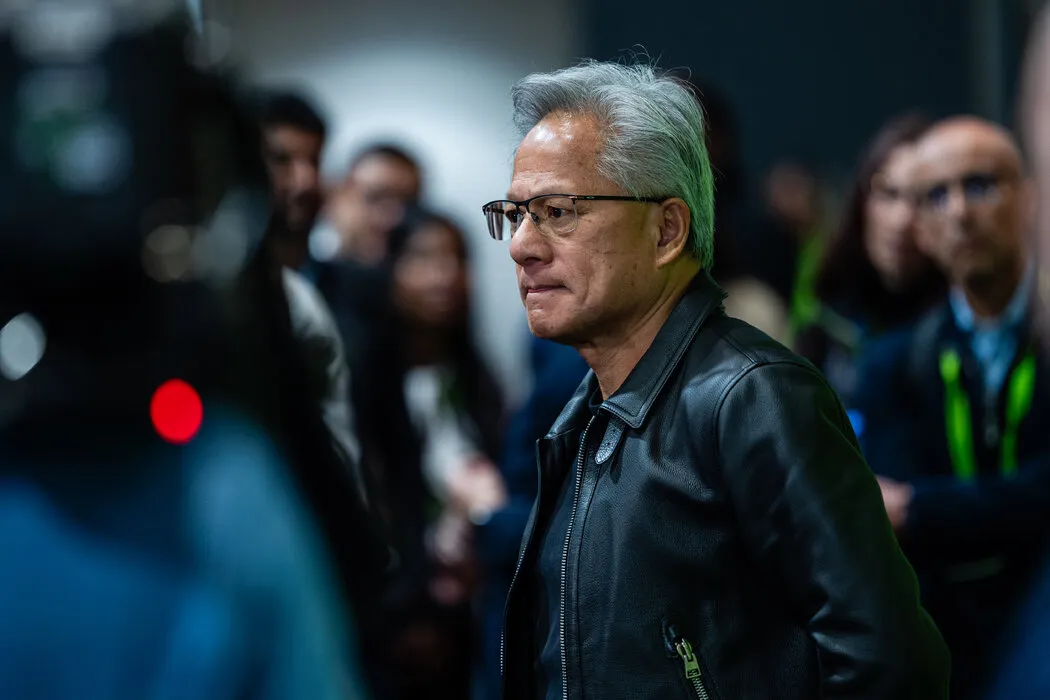
On November 12, 2026, Jensen Huang suddenly resigned.
Just 11 days later, on November 23, Nvidia announced his return as CEO. When
the news broke, Nvidia's stock price skyrocketed 31.48% that day, rebounding nearly a trillion dollars in market value.
Although Huang returned to his original position, during the 11 days he was away, on November 19, a new chip export control rule took effect in the United States, directly tightening the neck of Chinese enterprises renting high-end computing power overseas.
While Huang is back, the business model of global computing power has completely changed.
1. Who's Borrowing Money to Buy Nvidia Cards
During the 11 days Huang was away, Wall Street's biggest concern was not how much Nvidia was earning now, but who would still be able to borrow money to buy its chips in the future.
On November 17, Nvidia released a very attractive financial report, reporting quarterly revenue of $115.8 billion, more than doubling compared to the same period last year, a growth of 103%.
But on the same day during the earnings call, the company revealed another number:
Nvidia signed procurement agreements with some new cloud service companies, guaranteeing up to $32 billion in computing power purchases.
If the guarantees for client projects are also counted, the maximum exposure surges to a hefty $118 billion.
The company clearly stated that every new investment and guarantee would be rigorously reassessed going forward.
At that time, the chairman also declared during the meeting that they did not plan to invite Huang back.
This made investors uneasy: while the previous chips sold well, if Nvidia no longer took on the risk for clients, who would be willing to lend the money for the next batch of chip purchases?
To understand why investors were worried, one must first look at how these clients typically borrowed money to buy cards.
Take CoreWeave, a company that specializes in graphics card leasing as an example, they borrowed money from financial giants to buy chips.
They used the Nvidia chips they purchased as collateral to secure a loan of $2.3 billion from investment firms like Blackstone and Magnetar.
These institutions lent them so much money because Nvidia had signed an initial procurement agreement worth $6.3 billion as a backup.
The agreement clearly states that as long as CoreWeave delivers on time, Nvidia will cover all costs for the surplus computing power that cannot be rented out of their data center.
Put simply, the lender is calculating two guarantees:
If the company cannot repay the loan, how much can they sell the Nvidia graphics cards used as collateral for;
If the data center does not get fully rented out, with Nvidia as a big boss covering the rent, the lender will definitely not incur any losses.
Anther company, IREN, which previously mined Bitcoin and has now transitioned to computing power, is having an even tougher time.
They are helping Microsoft build data centers, and Microsoft pays in installments, with only 20% of the contract amount prepaid for each batch.
However, when IREN goes to buy Dell server equipment, Dell has a strict rule that the full payment must be settled within 30 days of shipment.
This creates a huge funding gap: the data center hasn’t been built or started generating rental income, yet equipment vendors are already knocking on the door for payment.
Companies like this seeking bank loans depend entirely on how many new graphics cards Nvidia is willing to allocate and how much risk they are willing to share for new projects.
If Nvidia stops caring, banks will immediately hesitate to lend.
This concern quickly reflected in the stock market.
On November 20, with uncertainty about interest rate trends, doubts about whether AI could actually break even, and panic triggered by Nvidia's leadership change, the Taiwanese stock market fell about 6% in one day, the South Korean composite index dropped over 5%, and the S&P 500 index in the U.S. also fell by 3.7%.
But something miraculous happened three days later.
On Monday, November 23, as soon as Jensen Huang announced his return, without any new data centers powered on yet, IREN's stock price surged by 23.86%, and CoreWeave also rose by 22.32%, far surpassing the Nasdaq composite index's increase of 6.51%.
This was the market's most genuine reaction: as long as Huang was back in that position, Wall Street believed that the game of “Nvidia covering for clients borrowing money to buy cards” could continue.
2. The Supply Chain Only Recognizes Huang's Face
In addition to Wall Street's financiers, chip foundries and component suppliers far away in East Asia also value Huang's personal brand.
During Huang's departure, the Industrial and Commercial Times published a report stating that TSMC was assessing credit limits based on customer financial conditions, and orders exceeding the limit must be backed by cash; some customers even had to pay upfront in full to get on the production line.

This quickly spread online, interpreted as “Huang just left, and TSMC immediately asked Nvidia for cash.”
However, if you review the original report, it mentions companies like MediaTek, Creatives, and Decap that produce custom chips, and there is absolutely no news that TSMC changed Nvidia's payment rules.
Although the rumors were unverified, why did people believe them?
Because within the entire East Asian supply chain, Huang's ability to leverage personal connections is truly irreplaceable.
Choi Tae-won, chairman of South Korea's SK Group, has publicly recounted a true story.
To create new chips, Huang personally approached him with just one request: to hope that SK Hynix could move the delivery time for the next generation of high-bandwidth memory, HBM4, six months earlier.
It’s often tough to urge a delay in delivery for normal purchases, let alone in the chip industry.
For Huang, it might just be one line, but for SK Hynix, moving up the delivery date by six months could mean readjusting the entire R&D timeline, testing verification, capacity distribution, and even the delivery schedule for other major customers.
Suppliers are willing to disrupt the entire production line schedule for you, partly based on the volume of your orders, and partly based on who is making the request, and whether they have been reliable over the past few decades.
Musk also mentioned this issue on X. He believes Huang's management of Nvidia's supply chain is extraordinarily effective, with many collaborations built on a “handshake agreement” with Huang himself. Once Huang leaves, these relationships based on personal trust could also be affected.
The so-called “handshake agreements” are underpinned by years of accumulated business credit. Amid the global tightness of advanced chip capacity, such trust is sometimes more valuable than a written contract.
Nvidia’s technologies, patents, teams, and assets belong to the company, but the personal credit, industry resources, and business trust that Huang has built up over the past 30 years cannot just be transferred through a board decision to appoint a new CEO.
Huang left, and new executives might go to negotiate with the same procurement orders and budgets, but suppliers may not be willing to take the same risks for them.
However, as soon as Huang returned, everyone knew that the reliable person was back.
3. Renting Computing Power in Southeast Asia Got Stuck
Having secured clients borrowing money to buy cards and stabilizing chip production factories, the biggest challenge Huang faces upon his return is to whom the manufactured chips can still be sold or rented.
In the few days he was away, on November 16, the U.S. Department of Commerce's Bureau of Industry and Security (BIS) announced a new regulation, which officially took effect on November 19.
This has been referred to as the “Southeast Asia Ban” by the market, but if we break it down, it precisely blocks two businesses.
The first is the direct buying and selling of chips.
According to the new rules, no matter who wants to sell specific high-end chips to Malaysia, Singapore, Indonesia, Thailand, or Brazil, or transfer them in these locations, they must first seek a permit from the U.S. government.
However, there is a loophole: if the company buying chips is headquartered in the U.S. or its parent company is American, as long as they file a report according to regulations, they can bypass the need to apply for a permit each time.
The second business is the renting of computing power overseas; this is the real knockout punch.
Previously, when Chinese companies could not buy high-end chips domestically, many would take a detour and rent graphics cards from data centers in Singapore and Malaysia.
Now, the new regulations have directly blocked this route: as long as overseas data centers rent out high-end computing power that exceeds the specified scale to enterprises headquartered in China or other restricted regions, they must seek a permit from the U.S. government.
There is only a very small exception: computing power used specifically for commercial recommendation systems may be allowed.
This means that the U.S. now monitors who is using graphics cards, where they are located on Earth, what they are used for, and how much quantity is utilized.
Moreover, the scope of these regulations extends far beyond the five countries mentioned earlier.
Once this order was issued, data center owners in Southeast Asia were thrown into a panic.
On November 18, the Malaysian Minister of Investment, Trade, and Industry, Zohari, publicly stated that the Malaysian government is asking the U.S. for clarification on how the permit applies when local data centers sell computing power to third parties.
The urgency from local data center owners relates directly to their ability to secure loans from banks.
Imagine, the owners have bought the land, received power approvals, and signed long-term leases with Chinese customers for five years.
Now when they go to the bank to apply for a loan to build the data center, the bank asks: what will you do if the U.S. government does not issue a permit by the time your center is built and delivered, preventing you from renting the computing power to this client?
Once this issue is blocked, previously secure long-term leases are suddenly impossible to use to secure bank loans.
Stricter actions are still to come.
On November 23, the same day that Huang resumed his position, the U.S. Department of Commerce directly placed several companies, including the Singapore computing power company Megaspeed International, on the export control blacklist.
For the past several years, Huang has been making trips to Washington, trying to find ways for Nvidia to sell chips to China.
But now, the wind has completely changed; lawmakers from both the Democratic and Republican parties are closely monitoring where high-end chips flow, and congressional hearings are set to continue.
Nvidia's board itself has established a special committee focused on national security and export controls, and independent investigations within the company have not ceased.
It can be said that while Huang has regained control of Nvidia, the territory available to him for doing business in China has been greatly compressed.
4. Domestic Companies Start Testing Domestic Cards
As the route for renting computing power overseas tightens, domestic enterprises immediately start looking for alternatives.
The IT Times interviewed chip distributors and found a noticeable increase in customers inquiring about domestic computing products in recent days.
For domestic chip manufacturers like Huawei's Ascend and Cambrian's Suyuan, this is undoubtedly good news.
However, industry insiders know very well that when customers inquire about pricing for the first batch of cards, it is likely just to prepare for overseas supply disruptions, to buy some as backup.
Whether domestic chips can truly seize this substantial business opportunity hinges on whether customers will place a “second purchase order.”
Because after customers buy the first batch of domestic cards, they need to migrate their currently operating AI models to run on domestic cards.
Once they do this, all the real capabilities will be revealed: under the same accuracy and response time, how much electricity and cost will it take to process a million tokens on domestic cards?
When business peaks and millions of users simultaneously surge in, can domestic cards handle it, or will they crash?
Only by obtaining these concrete data and accurately calculating the economics will domestic customers be able to decide whether to massively increase orders moving forward.
▌▌▌▌▌▌▌▌▌▌
Looking back at this farce over the 11 days, many things have already become clear.
There are about 60 executives within Nvidia who report directly to Huang. If a professional manager were to take over as CEO, they could assume this management board from day one, but being able to take over the list does not mean they can manage this system. Coordinating nearly 60 executives, understanding the technical logic of various business lines, and making quick strategic decisions in a complex market environment is not only a test of management ability but also a profound understanding of the industry, personal prestige, and long-term accumulated organizational trust.
The management structure of Nvidia can be inherited, but Huang's management ability and personal influence are very difficult to replicate.
In fact, on November 17, the day Huang was absent, Nvidia not only released its financial report as usual, but also smoothly signed new contracts for chip substrates and advanced packaging with major firms like Jingshuo, Samsung Electro-Mechanics, and Siliconware.
The normal operation of the company can continue without any one individual.
However, whether it's persuading the Koreans to unilaterally push forward the delivery of the next generation of memory by six months, or convincing a company that hasn't even collected rent to continue borrowing huge sums to buy a batch of graphics cards, it is not as simple as stamping a contract.
The willingness of the other party to stake hundreds of billions in real cash hinges entirely on Huang himself.
The most remarkable ability of Huang is his knack for getting Wall Street creditors, clients building data centers, and East Asian foundries, all thinking individually of their own interests, to believe in the same delivery date.
This personal credit, accumulated over more than thirty years, cannot be transferred by any successor, not even with an appointment letter.
As for where these top-notch graphics cards, painstakingly put together by him, can be shipped to or rented out in the future.
When he returned to his office on November 23, the rules outside had already changed.
For over thirty years, Huang excelled at tying the global industrial chain together, but now, he faces a rapidly fracturing global AI market, and this might be the toughest test he’s encountered since leading Nvidia.
免责声明:本文章仅代表作者个人观点,不代表本平台的立场和观点。本文章仅供信息分享,不构成对任何人的任何投资建议。用户与作者之间的任何争议,与本平台无关。如网页中刊载的文章或图片涉及侵权,请提供相关的权利证明和身份证明发送邮件到[email protected],本平台相关工作人员将会进行核查。